A little more than five years ago, what’s now Delmore Orchard was one of nine vacant lots on Delmore Road in Cleveland Heights’ Noble neighborhood. It boasted a buried asphalt driveway, remnants of a house foundation and hard clay soil.
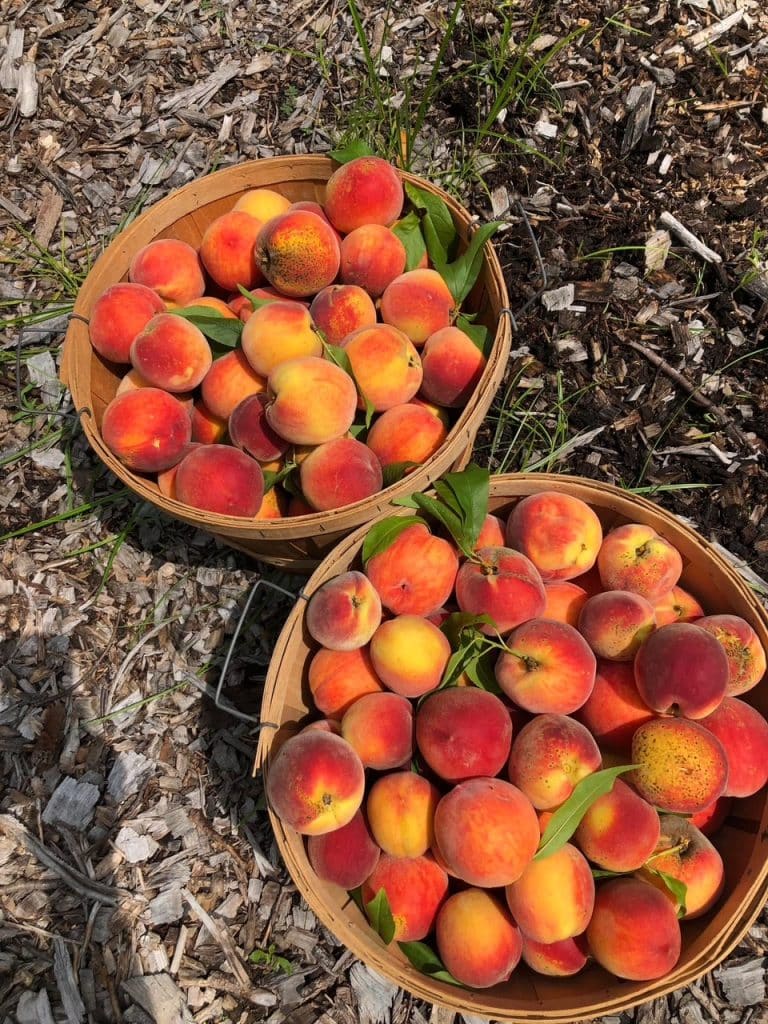
Thanks to one resident’s bold vision, grants and in-kind donations, and a massive amount of physical work by a core group of community members, that once-vacant lot is thriving. In fall 2025 the orchard marked its fifth anniversary season by donating 150 pounds of fresh peaches, pears and plums to the Heights Emergency Food Center.
The foreclosure crisis that began in 2007 left communities across Cuyahoga County with thousands of vacant homes, many of which were, and continue to be, demolished. The First Ring Property Inventory issued in 2024 by the cities of Cleveland Heights, Euclid and South Euclid, along with the Western Reserve Land Conservancy, tallied 551 vacant lots in Cleveland Heights, or 3.5% of all land parcels in the city. While building new housing on these lots is the priority of area planning entities, the Delmore Community Orchard story shows how residents themselves can help create projects that improve community engagement, life and visual appeal starting at basic street level.

For Danialle Benham, head “steward” of the small but mighty group that created it, the orchard was “the best thing to come out of COVID” and “I do think that every neighborhood, every community, should have a spot where people can grow and see food.”
An orchard’s beginning: pipe dream or opportunity?
A community garden that sprouted earlier on the lot had an out-of-code wooden fence and was a target of theft and vandalism, distressing both the city and nearby residents. Benham, a master-gardener certified by Michigan State University who lives directly behind the lot, tried to buy it from the Cuyahoga Land Bank. Unfortunately, that option was only available to adjacent side neighbors. So she got involved with the community gardeners, and then the city acquired the lot and she was given an opportunity to take over the space.
She asked two friends, Margaret Lann and Michelle Moehler: “I have this pipe dream of making this into an orchard, should I do it?And will you help me? Or have I completely lost my mind? And both of them were like, ‘You haven’t lost your mind, and we’ll help you.’”
Starting a community orchard from scratch: what does it take?
After the city of Cleveland Heights assumed ownership of the lot, the group of community members stewarding the orchard were given the “privilege,” per Benham, of managing it. The city’s department of planning and development helped the group comply with ordinances, some overlooked by the previous gardeners. For instance, metal fences on either side protruded beyond the boundary of neighboring porches, and had to be moved back. A new shed (donated by Home Depot) on the property, and some of the the trees needed to be a certain distance from neighbors’ homes.
“They helped guide us to make sure that we’re being good neighbors to our neighbors … because we have active homes on either side of us,” Benham said.
The city also donated, and continues to provide, wood chips, which cover the ground all around the trees to make the orchard easier to maintain.
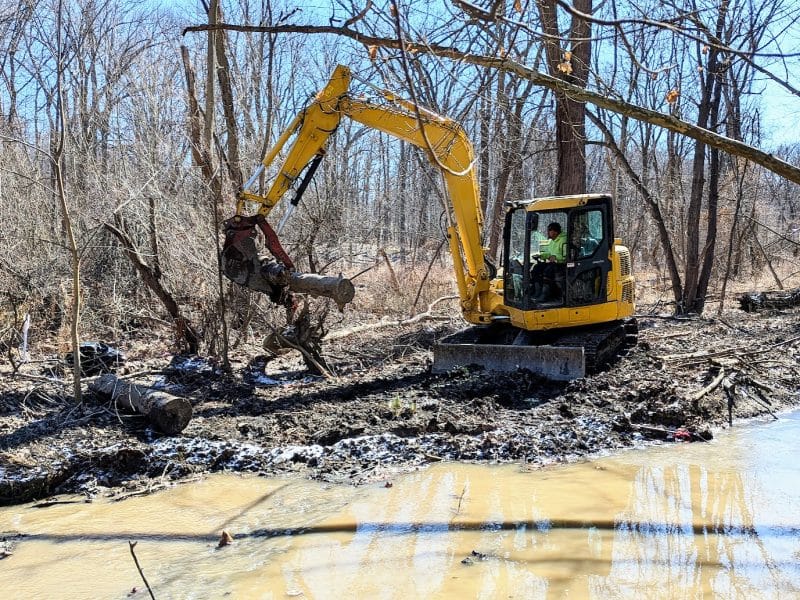
A tremendous amount of physical work was required at the start. When the stewards first dug into the soil, Benham recalled that they almost needed pick axes.
“I cannot tell you how much asphalt we pulled out of there, like the driveway and the crumbling foundation of the house,” she said. “Even with the most recent tree planted this fall, Bill (Gann), one of our other stewards, dug for an hour and a half around what we think must have been a footer of the original house.”
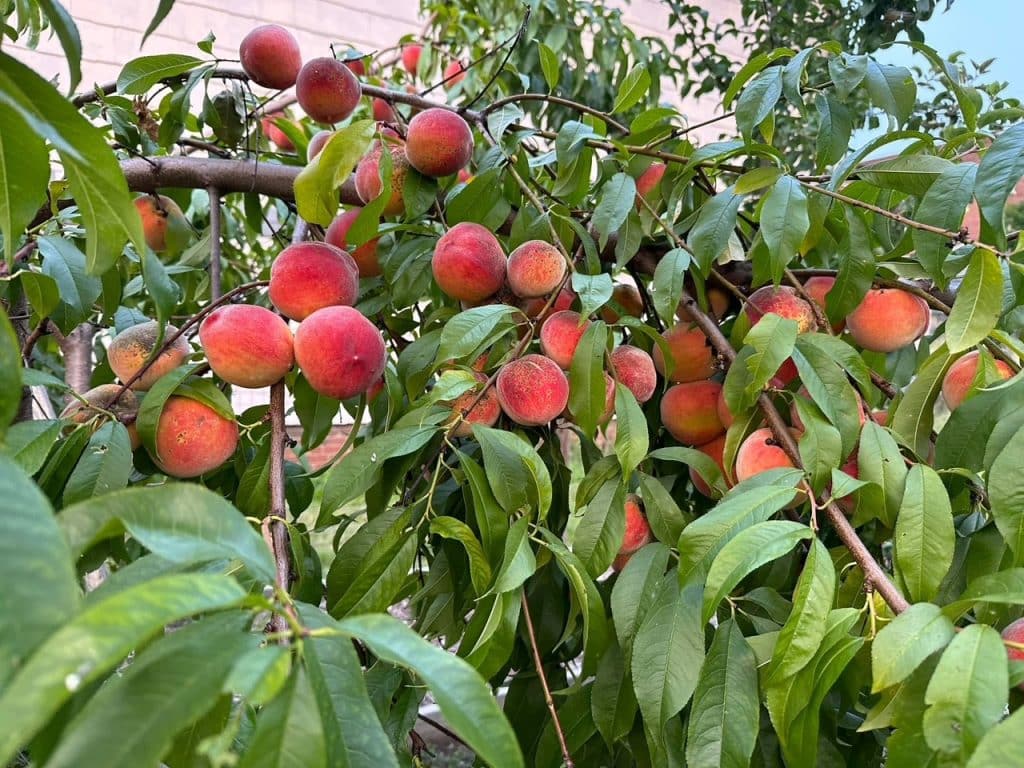
The orchard launched in September 2020 with six apple trees of different varieties, two pawpaws, six blueberry bushes, two raspberry bushes, four grapevines, two peach trees, native pollinator plants and 300 daffodil bulbs. The trees were 2- to 3-year old saplings; given that it takes 3 to 5 years for trees to begin producing fruit, that first season the fruit was sparse. A few were left on the trees to herald the start of the orchard, but most of the fruit was removed early to encourage the trees to develop. While the blueberries did not survive, and the raspberries have been struggling, the orchard has grown with the addition of two more pawpaws, two plums, two pears, another peach and, this year, a nectarine.
With no running water on the lot, there needed to be a way to make the orchard sustainable. Benham had three rain barrels collecting 150 gallons of water that flowed off her garage roof; these were “sistered” together with a 300-gallon cistern (donated by a landscaping company) placed behind the shed, and the collected water used for watering via hoses fed by gravity. The cistern is hooked up as early in the spring as possible in order to collect ample water.
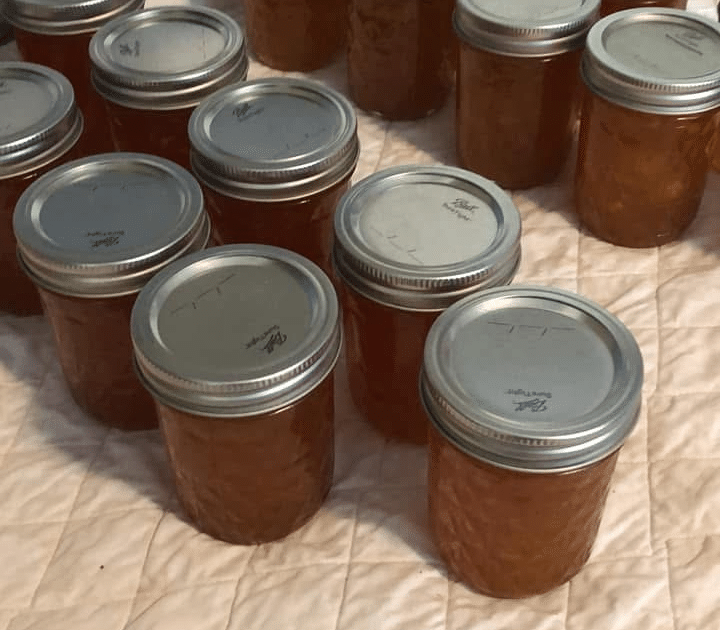
When peach trees give you small, ugly fruit you make bourbon peach jam!
“So typically in a commercial orchard, you’re going to have a rotation of your trees, because not every tree is going to produce,” Benham explained.
By the orchard’s third year there was an abundance of peaches, but last year “they were what you would consider seconds or almost thirds,” she added. “They didn’t look pretty. They were kind of small. We were selling the nicer fruit the year before, at the orchard, at the Noble Market, but … no one was going to want to buy those very small, very ugly peaches.”
So Benham, an active canner (both her mom and grandmother canned), taught another steward how to can, and “we canned those ugly peaches and made jam with the understanding that we would sell it and then just bank that money to buy more trees or stakes or anything we needed. We made traditional peach jam, and then we made a bourbon peach jam … people were very sad that there was no Delmar bourbon peach jam this year!”
Powered by people, small grants and donations
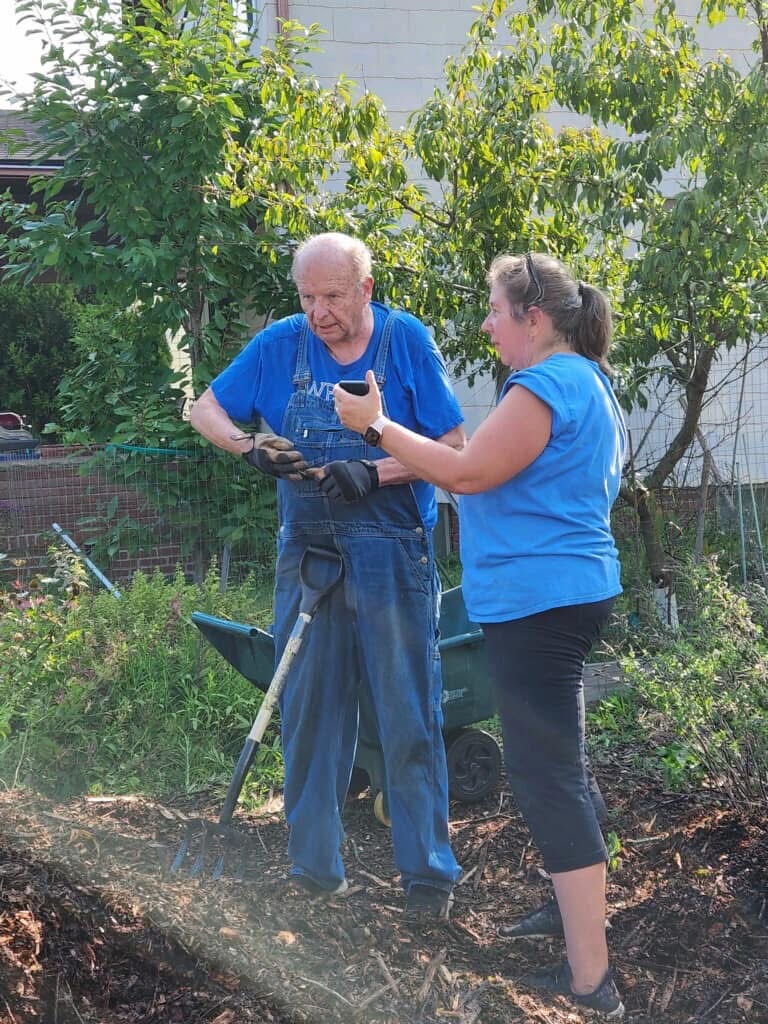
“Everyone who volunteers and works at the Delmore Orchard actively are called stewards, because we’re stewarding this land for the next wave so no one’s really in charge of it,” Benham said.
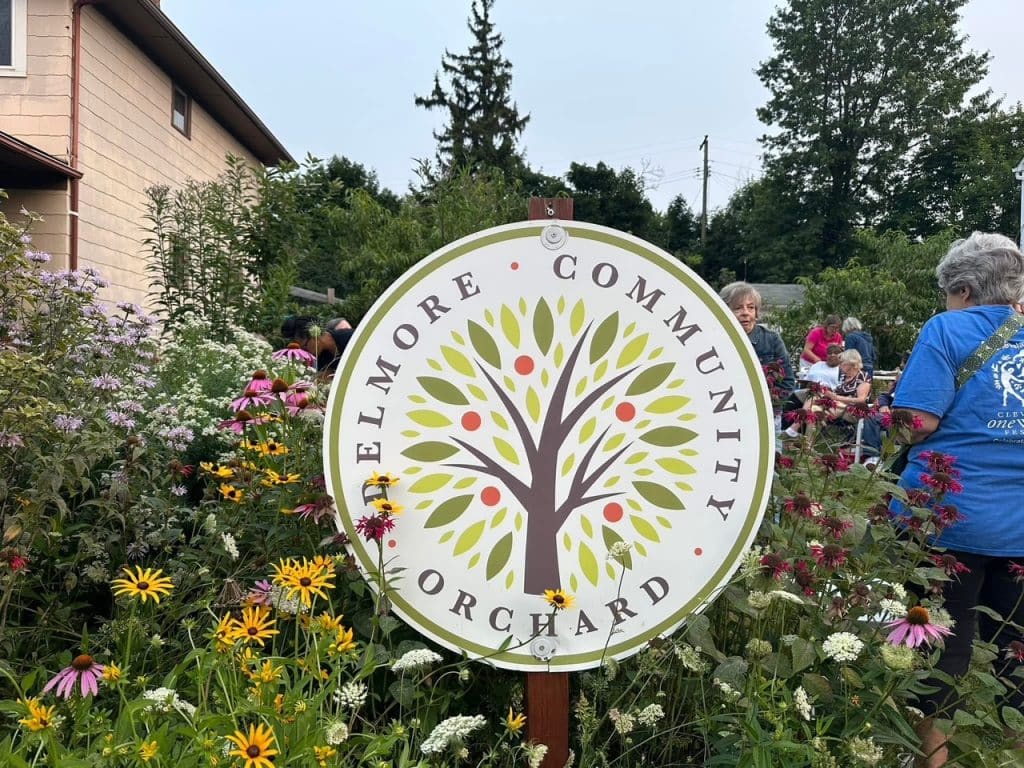
A dedicated group of 10 stewards have been active from the beginning; additional neighbors help here and there, and contribute what they can. Steward Michelle Moehler of Michelle Moehler Design created the orchard’s logo and sign. A neighbor across the street who has a landscaping business mows the small plot of grass. Sometimes someone will notice weeds when walking by and pull them; or offer to buy a needed item like organic fertilizer spray, or contribute extra shovels and rakes from their garage. A group of Boy Scouts planted the pawpaw trees to fulfill community hours. “Anyone is welcome to come to any work day and be involved as much as they want to be or as little as they want,” Benham said.
Along the way, small grants came from FutureHeights and others. Tom Gibson and Elsa Johnson of Green Paradigm Partners were instrumental in garden design, sourcing grants and pollinating.
Changing the environment
At first, the stewards noted no organic matter – no worms, grubs, nothing living. Now, Benham said, after five years of “putting down wood chips, which are breaking down,” and “roots that are breaking up” the clay and slate, “making soil and letting it breathe” the efforts are paying off.
“If you dig a little deeper, you’re going to find some gems,” Benham said. Pollinating plants in the orchard’s welcoming bed have attracted multiple varieties of bees, and helped to increase the local goldfinch population, which loves thistle seed.
Oh, deer
Deer are an ongoing problem. Benham asserts that the animals probably get more produce than people do. In fact, she’s given up on the dream of grapes along the fence: “I might as well just hand out lollipops to the deer!”
They’ve destroyed young trees by nibbling at the bark (which the stewards try to protect with metal), and they devour low-hanging fruit on the more mature trees, she said. Hormones released by female deer attract bucks that then damage young trees by rubbing them with their antlers to remove the felt, or to mark their territory. The deer like the warmth of the wood chips, and the orchard’s privacy and protection, so they often sleep there at night. Benham went before Cleveland Heights City Council in 2022 to report on the deer damage, and made some suggestions for the city’s deer management program (The Health and Public Safety Committee of City Council has been exploring approaches to managing Cleveland Heights’ increasing deer population, and is currently running an online survey to solicit feedback from residents.)
Benham would like to see a program similar to the one that South Euclid conducted with the Ohio Department of Natural Resources. In one half of that city they caught and sterilized does; in the other half deer were euthanized. Benham said that some of those sterilized does, recognized by their tags, sleep in the orchard and for a while, at least, won’t attract the destructive bucks nor help multiply the population, while the meat processed from the euthanized deer can help local food pantries.
Community Impact
Brenda May is the leader of Noble Neighbors, a volunteer group that promotes growth and connection in the neighborhood. May is also a Delmore Orchard steward; there is much overlap between the two groups.
May lauded Benham for creating “a fabulous asset in the neighborhood,” which has “given a sense of hope, of identity.” She said it has altered the prevailing narrative of lament that “they’re tearing down our street one house at a time” as the city, funded by the county, tears down vacant, blighted homes.
May noted, “At least one person moved onto the street because of the orchard, and wanted to get involved,” and that the orchard has been a catalyst, with “neighbors making changes themselves. I’m seeing them mow their lawns more often. I’m seeing them take greater care and detail about the flower garden that sits in front of their places. In places where people aren’t oriented toward the community outside their home, they don’t plant, they don’t invest, even in labor to rake their leaves or mow their lawn.”
May also noted that the wider community is responding: “People from Holden Arboretum have helped with advice or labor such as with pruning issues, and they’re paying attention to what’s going on there.” Several Cleveland-area garden clubs have held meetings in the orchard and shared their expertise. May sees more people identifying with the neighborhood now, such as when running for city council – which is helping to counter the negative reputation of the area.
The local Heights library branch and preschool groups have used the orchard for children’s reading, art and Earth Day events, with a side benefit being that the children can see firsthand how fruit grows. While the orchard hasn’t yet hosted a concert, Benham welcomes non-amplified musicians to perform there. “A violinist who walks her dog past the orchard keeps saying, ‘Oh, I would love to do this!’” Replied Benham, “Anytime, just let us know!”
Sharing the abundance
The orchard is unfenced in the front so that stewards and other neighbors are welcome to take what they want.
But in 2025, with trees established and the peaches and pears producing for consecutive years, the stewards decided to donate to the Heights Emergency Food Center (HEFC).
“I mean, how more hyperlocal could you get than to go to a food pantry on Yellowstone and Mayfield and the orchard’s on Delmore right by Monticello? I mean, you’re a mile away from one another. So for me, it was just a blessing to know that I could help our neighbors,” Benham said.
Debby Shewitz, volunteer director of HEFC, said, “HEFC has been receiving produce from a number of local community gardens for many years. As far as I know, Delmore is the only orchard bringing us produce, and pretty much the only ones bringing us any fruit. Adding fruit to the mix we receive is definitely a plus.” (Shewitz cautioned that at peak harvest season, due to storage limits, HEFC doesn’t need more of “the ‘standard cukes, zucchini, and especially tomatoes that every garden grows in abundance,” but welcomes any interested gardeners to reach out in offseason to coordinate donation plans in advance with HEFC.)
A model for other vacant lots?
Given the earlier mentioned 551 vacant lots in Cleveland Heights, and 33,000 vacant parcels in Cleveland (18,000 of which the city owns through the Cleveland Land Bank), could this and other resident-driven initiatives inspire the transformation of more lots into green community assets?
The first priority for many, including Benham and May, is new housing, such as the 45 infill green built modular homes that Rebuild Cleveland and FutureHeights are partnering on for vacant lots, mostly in the Cain Park and Cedar-Lee areas of Cleveland Heights. FutureHeights serves as the community development corporation (CDC) for Cleveland Heights. (Start Right is a second CDC that partners with the city, focusing on programs that will help low-moderate income families.)
Lee Chilcote, executive director of FutureHeights and founder of The Land, sees this as “an opportunity to return these lots to productive use … to meet the demand for new housing and attract new residents to Cleveland Heights, and help revitalize neighborhoods.” FutureHeights, which sees its role as supporting, community efforts, rather than leading, provided early grant support to Delmore Orchard (funneled through Noble Neighbors as fiscal agent).
“I don’t think every vacant lot should be used to make a green space, because I think if we can use the footprint where we’ve already built instead of to keep going farther out. Me being someone who cares for our Earth, that whole urban sprawl, we keep just gobbling up land, but then it just becomes bare … in my perfect dream little world, there would be an orchard or a walking forest in every community, where people can have that fresh fruit, that fresh vegetable, and kids can see where things grow,” Benham said.
“A friend of mine who’s an occasional steward, an adult my age, middle age, she had never picked a fruit off of a fruit tree until this year, while we were picking…shouldn’t we all have that experience?”
What’s next, what’s needed?
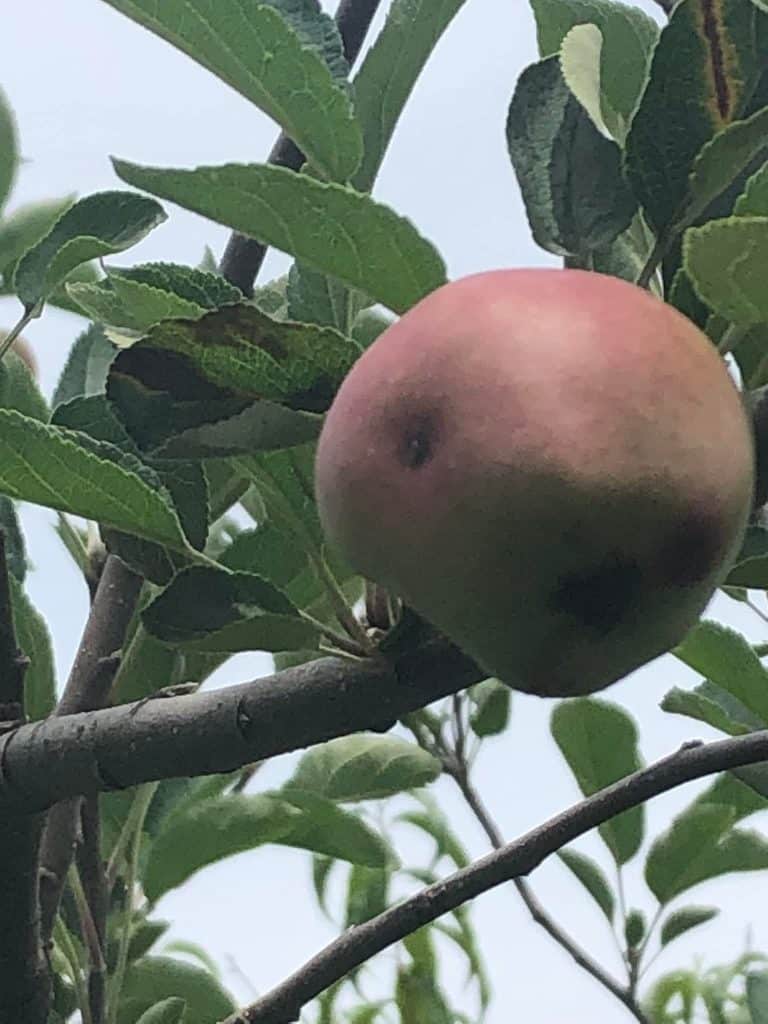
In mid-February, the trees will be pruned in time for them to heal before any spring growth begins. Other plans for the season ahead include introducing ladybugs as a natural way to control the spring aphid problem, and bringing in more pollinators. Perhaps there will even be a 5th birthday celebration. One abiding dream of Benton’s is to have a monthly “pop-up meet-and-greet and just swap out fruits and vegetables” during growing season.
Though the orchard is becoming self-sufficient, and Benham isn’t ready to give up her role as head steward, the core group is keeping their eyes out for the next wave of volunteer stewards to manage Delmore Orchard so it can remain a community asset. The orchard’s specific material needs include an 8-foot ladder and a fruit picker for the coming season.
To learn more or offer volunteer help or supplies, follow the orchard on Facebook or contact the stewards through NobleNeighbors@gmail.com.
We're celebrating four years of amplifying resident voices from Cleveland's neighborhoods. Will you make a donation to keep our local journalism going?