
A life characterized by verse: How one Cleveland poet found himself through writing
When Cleveland poet Philip Metres was a senior in AP English at Wilmette, Illinois’ Loyola Academy in 1987, he was assigned a poem that would change the course of his life.
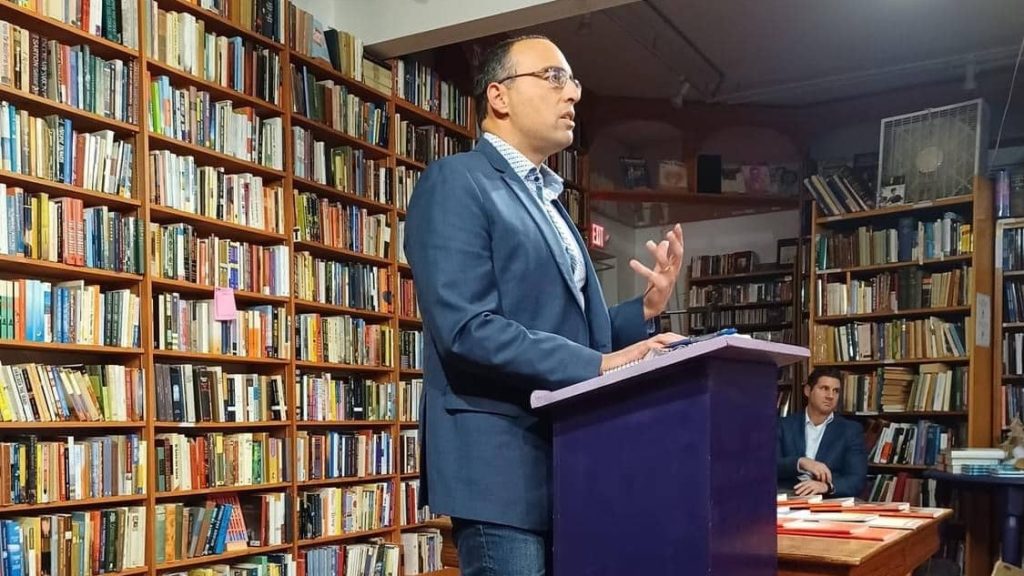
When Cleveland poet Philip Metres was a senior in AP English at Wilmette, Illinois’ Loyola Academy in 1987, he was assigned a poem that would change the course of his life.
“Let us go then, you and I,
When the evening is spread out against the sky,” he read.
These opening lines, belonging to “The Love Song of J. Alfred Prufrock” by T.S. Eliot seemed to be speaking directly to Metres.
“How can he read my mind? How does he know what it’s like to be me?” Metres thought as he read along.
What struck him most was how the internal monologue of the poem’s subject seemed so close to his own — someone hyper self-conscious who couldn’t get out of his own head.
“There will be time, there will be time
Time for you and time for me,
And time yet for a hundred indecisions,
And for a hundred visions and revisions,
Before the taking of a toast and tea,” the poem goes.
This piece unlocked something Metres called a “treasury of the interior life.” From that moment on, he had caught the “poetry virus.”
Every day for months, he began keeping a journal of daily thoughts, feelings, images, anecdotes and stories. Little did he know, years later, pieces that started in these notebooks would end up getting published in the same literary journal Eliot’s poem originally appeared in — “Poetry” — and Metres would become “one of the essential poets of our time,” as quoted in his biography on Poetry Foundation.
Even with the multiple awards and accolades he would go on to receive — including the Guggenheim Fellowship, Lannan Literary Fellowship, three Arab American Book Awards and the Cleveland Arts Prize — Metres doesn’t believe any of it matters as much as the process and journey — the greatest one for him being the discovery of his identity.
Learning about his ancestry
Before Metres could figure out who he was, he had to get to know the people who came before him.
During the depths of the COVID-19 pandemic, he decided to do research into both sides of his family. He’s always been interested in genealogy, and he wanted to make sense of his ancestors, “not just geographically, but the emotional and spiritual and psychic stories that formed the people that came before me,” he said.
While looking into his mom’s side of the family, he talked to all of his oldest relatives, and one of them sent him photos from their family archive. Two of them were poems.
“One of the poems was about the place that they came from, this place in West Cork called Bantry, and it was an elegy to a lost place because they had moved, and the other was a poem of faith,” he said. “I was just really touched and moved.”
The poems, written by his great-grandmother and great-great-grandmother on his mom’s side, are some of the oldest artifacts in his family.
“Discovering those poems made me feel like I was part of something larger than myself … just feeling like there are other people who felt like they needed to set words down in a certain musical way to help them understand their lives and to share something of the truth of their lives was just beautiful,” he said.
What he learned about his ancestors would go on to inspire his book “Fugitive/Refuge,” published in 2024, which follows the journey of his refugee ancestors on his dad’s side from Lebanon to Mexico to the United States. His poem “Raise Your Glass” calls back to the people who came before him:
“A toast to the migrants
the authors of movement
who write with their feet,” he wrote.
Metres said reading his ancestors’ poems and writing his own poetry based on what he learned helped him understand something fundamental about himself — that he is part of a much larger story than just his own.
Life experiences informing Metres’ poetry
Metres goes through three or four journals per year — a record of his life, as he calls them — but he keeps the total number of complete notebooks a secret.
They’re full of scribbles, well-thought-out ideas, the beginnings of published poems and anything that inspires him. But, most importantly, they’re a window into his mind and each version of himself he has been throughout his life.
The journals detail his college days, majoring in English at the College of the Holy Cross from 1988 to 1992, his adventures studying abroad in Russia for a year, his graduate school years at Indiana University and his current life as an English professor at John Carroll University, a husband to Amy Breau and a father to two daughters.
Before he started recording his life, though, he had a full childhood characterized by endless talking, people in each other’s business all the time and the idea that his family was not just his immediate pedigree, but all of his relatives and everybody they knew, too.
Growing up outside of Chicago with a mother of Irish and German descent and a Lebanese-American father, he said the cultures were so dynamically different that it caused a lot of comedy in the family.
“My dad’s family is very demonstrative … My mom’s family was much more introverted,” Metres said. “It was two different worlds, but they were brought together by their shared faith, actually. I think that mattered a lot to each of them, so I really cherish this sense of connection to family, to place and to food traditions. Those all were part of our life.”
The lessons he learned growing up are evidently explored in his poetry. His piece, “You Have Come Upon People Who Are like Family and This Open Space,” which reads from right to left, is just one example.
“people upon come have you
family like are who
space open this
space this open
you welcome I that
away turn to
stay to wish you unless
shoes your remove and rest
speak your into lean we
slake to drink tender
eat to fullness and
end the are you
beginning my of
of beginning the
end my.”
Poetry as a means of preaching nonviolence
The characteristics that shaped Metres’ childhood are still strong in his life today. His 19-year-old daughter, Leila Metres, said her dad has always been very involved in the lives of her and her sister, Adele Metres.
She described him as sentimental, intelligent and aware of other people’s experiences — something she said more people should strive to be.
“When I was a kid, I would probably say that my dad’s main interests were poetry, basketball and peace,” she said. “I used to make cards for him or little gifts for him that had peace signs on them because he always just preached the idea of a nonviolent form of activism where you’re just advocating for peace between people.”
Phil Metres’ passion for nonviolence shows through in his writing, and it’s a part of him that began to develop at a young age.
His dad is a Vietnam War veteran, but he was also heavily impacted by the first Gulf War when he was a junior in college, as well as 9/11 later in life.
“War involves death and killing and destruction,” he said. “I mean, we have totally censored war, and so that really haunted me — what does it mean to live in a society that is so unable to come to terms with the truth of war? … What the alternatives are to war has been an ongoing passion of mine, so looking at the heart of the darkness of war is something that happens a lot.”
He has written multiple poems about conflict. His books “Shrapnel Maps” and “Sand Opera,” which won the 2013 Beatrice Hawley Award and 2012 Arab American Book Award for poetry, explore the Israeli-Palestinian conflict and the Iraq War.
In each piece, he has tried to make sense of war from the perspective that the people being killed are like him in some respects because he has a Middle Eastern background.
“What does it mean to live in a society that deems those lives not worthy of existence?” he asked. “In writing them, it makes me feel that I’ve contributed something about the truth of the brutality of war and the necessity to find an alternative to it. It’s become something that I’ve had to carry, even though one wouldn’t want to. That’s just been part of my writing life.”
Charles Malone, assistant director of the Wick Poetry Center, said Phil Metres’ poetry takes on huge topics in a human way.
“He’s looking for the humanity of everyone involved,” Malone said. “Often, the speaker in his poems has some self-assessment or self-reflection that moves things forward and gives them a deprecating sense of self-esteem, so the ego doesn’t get in the way of these conflicts, or how he’s thinking about resolving conflicts. And I think it takes a lot of courage to write towards resolution like that.”
In his poetry, he takes on almost a radical approach to being open to others’ perspectives, which adds to the humanity of the work.
One of the poems in “Shrapnel Maps,” called “One Tree,” explores a conflict between two neighbors about a tree on the property line that only one wants to tear down.
Malone said the poem is a great example of how Phil Metres writes, as the piece is intimate and holds a lot of metaphors that stem from the image he creates and how he holds tension in the piece.
When Phil Metres reads it, he does so calmly, but with a sorrowful tone, taking his time with each word.
“Always the same story: two people, one tree, not enough land or light or love.
Like the baby brought to Solomon, someone must give. Dear neighbor, it’s not
me. Bloom-shadowed, light-deprived, they lower the chainsaw again,” it reads.
“[In Phil Metres’ work,] I think he might be asking questions first,” Malone said. “Often, when there’s tension or when we’re struggling with another point of view, we don’t have the empathy necessary to hear other points of view. And it always feels like there’s a curiosity and an empathy in his writing.”
At the Wick Poetry Center, Malone said they are often focused on using poetry to create conversation — that’s what is most impactful to the writers. He feels poetry can do the same for society on a larger scale.
“Poetry that’s relevant to the world and helps us understand it, it feels incredibly vital and valuable, and it becomes something that you can find your way in,” he said.
Phil Metres’ identity today
Phil Metres has published over 10 books, each exploring family, legacy, genealogy and conflict — all of which have helped him form his sense of identity, bit by bit.
Isaiah Hunt, a John Carroll University Hopkins Fellow, has been mentored by Phil Metres for almost four years. He said he often inspires him to be bolder with his work.
“His poetry is extremely brave … It’s always talking about a lot of different things — about religion, about humanity, about a lot of politics as well … Being about the idea of not shying away from these topics, not holding back, like, if he can do that, if he’s able to talk about that, then I can too,” he said.
Metres’ poem that stands out the most to Hunt is “Raise Your Glass.” He said that while he reads it, he invites his audience to lift their invisible drink and say a toast with him. This experimentation with his performing and writing inspires Hunt.
“When you’re reading a poem, specifically his poems, you are listening to him,” Hunt said. “You are wandering into his own narrative to explore that.”
This narrative, which Phil Metres has added to for so many years, has inspired his daughter, Leila Metres, a sophomore English major at the University of Massachusetts, to become a poet as well.
“Even before I could write and read, I would take a book and I would just run my eyes over the words because I wanted to read like my sister and like my parents,” she said.
She admires the way her father carries himself in writing and activism spaces, and it has inspired her to form an idea of the kind of person she wants to be. She said she would write poetry all day for her job if she could.
“[Poetry] has been a way for me to make sense of my life and find respite during hard times in my life, and it’s also a way to communicate my love for other people and also just to notice more about the world around me,” she said. “I don’t really think that I can imagine a life without poetry and writing in it.”
Keep our local journalism accessible to all
Reader support is crucial as we continue to shed light on underreported neighborhoods in Cleveland. Will you become a monthly member to help us continue to produce news by, for, and with the community?
P.S. Did you like this story? Take our reader survey!
Author
Related Articles
Walking Cleveland’s past, one story at a time
“How much of Cleveland do I pass by without knowing the story?”
More than a card: Why Cleveland Public Library still matters in the digital age
September is National Library Card Signup Month. The Land talked with Cleveland Public Library Executive Director Felton Thomas, Jr. at the Main Library downtown.
The Movie Nerd Report: It’s “Primetime” for Northeast Ohio cinema
There’s a lot of fun screenings happening at independent theaters around Greater Cleveland this week.


