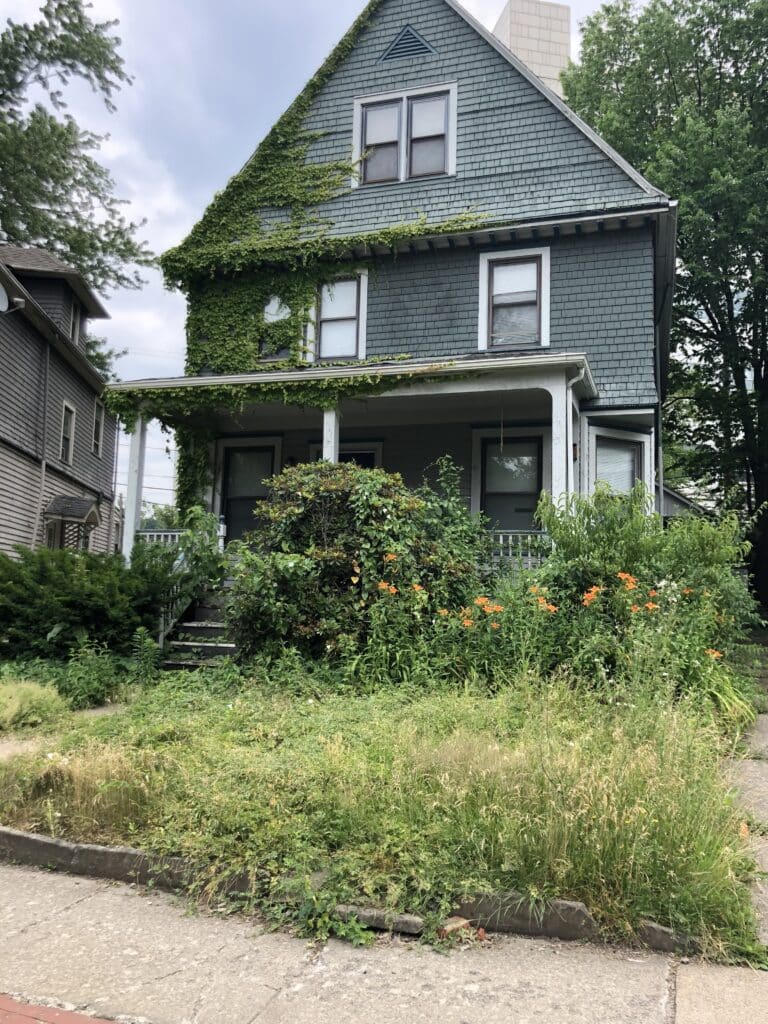

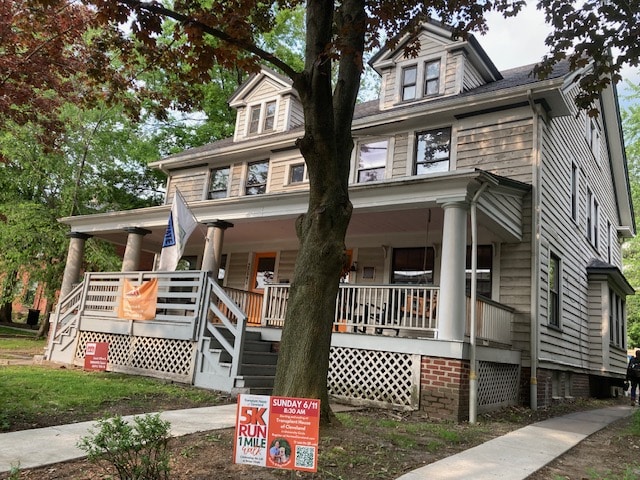
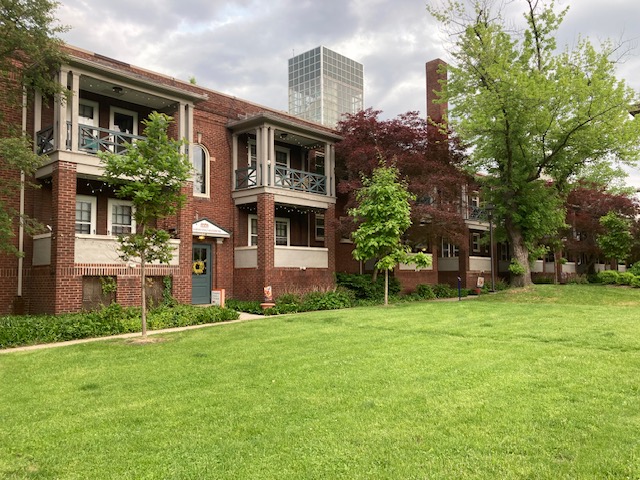
For what may be a limited time, E. 115th Street, one of the last examples of a beautiful old University Circle residential street, will serve as a deteriorating heritage park – a museum, if you will – populated with 12 homes left empty by their owner, University Hospitals.
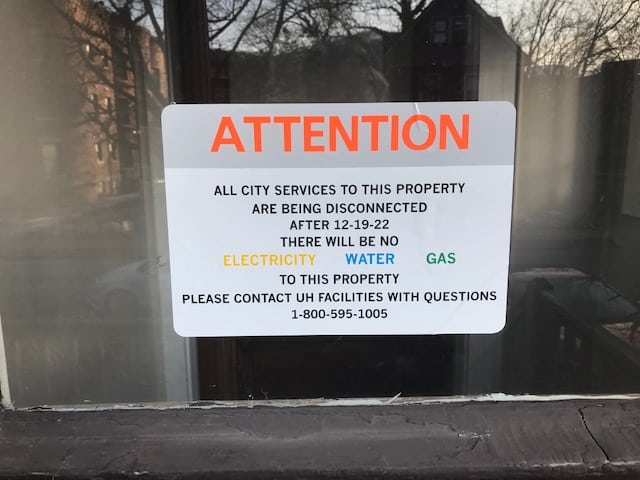
Utility shut-off notices on the front doors are dated “12-19-22.” A UH statement provided to The Land said, “We have not finalized any plans for East 115th Street at this time.”
One wonders how long it will be until plans are finalized – and if it isn’t already a fait accompli that UH will ultimately seek to tear down these historic houses, which it acquired from University Circle Inc. (UCI) several decades ago, to better suit the institution’s needs.

“We will continue to analyze and incorporate the changing nature of how health care is delivered, the health care needs in Greater Cleveland, and the needs of our patients to map a path forward for the area along East 115 Street,” the statement continued. “UH is deliberate and thoughtful in its planning and the potential impact on the surrounding community. Any work done on East 115th Street will embrace the same philosophy.”
In an email, UCI also denied any knowledge of the area’s future, referring this writer to University Hospitals for answers about the future of E. 115th St.
Elaine Turley, executive director of the Transplant House of Cleveland, which occupies two UH-owned buildings on East 115th and offers temporary house to organ transplant patients and their families, says the organization is on tenterhooks awaiting UH’s decision. “We don’t know yet what the future of the Cleveland Transplant House is on E. 115th Street,” said Turley. “UH had talked about demolishing these two buildings in the past, and they’ve told me they are no longer going to do that.” George Stamatis, communications manager for UH, referred The Land to its original statement when asked about the Cleveland Transplant House – the statement which says no plans have been finalized.
Meanwhile, the area continues to deteriorate before our very eyes. Nearby, Hessler Road residents had to remind UH to send in a groundskeeper to maintain overgrown lots last year, and now that summer is finally here in Northeast Ohio, a quick inspection of the properties suggests another reminder is in order.
E. 115th Street preservation has been a battle for decades
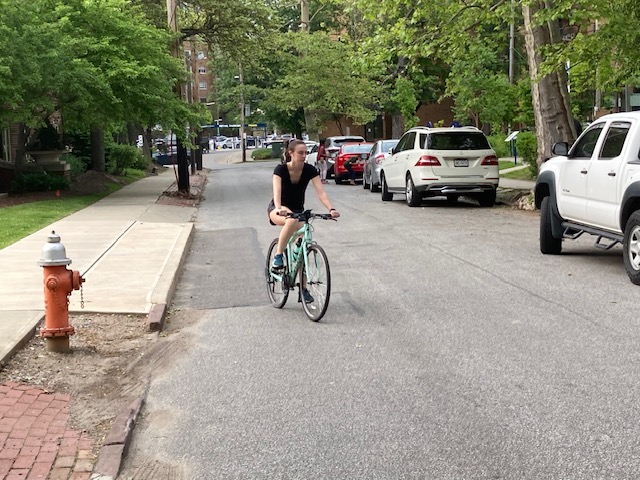
Debate started in the 1970s about the fate of this dog-legged 800-foot-long street of homes on wooded lots connecting Cornell and Mayfield Roads. UCI owned much of the rental property then and members of the old University Circle Tenants Union (UCTU), which consisted of tenants living on E. 115th Street, Hessler Road, and Ford Drive, had many public brawls with UCI over land use issues for many years. I know, because I was helping advocate for tenants at the time.
In 2005, Chris Ronayne moved from being Mayor Jane Campbell’s chief of staff to become the president of UCI, which is the University Circle neighborhood’s “community service corporation,” a large institution-dominated version of the community development corporations elsewhere in Cleveland. Ronayne quickly proclaimed a truce with neighborhood residents, stating that he was committed to working with residents, homeowners, and renters.
Ronayne, who is now Cuyahoga County’s newly elected chief executive, was an activist in the old Northeast Ohio Sierra Club suburban sprawl committee during the 1990s while he was a graduate student at Cleveland State University’s College of Urban Affairs. He was the only college student who became an activist on the committee. While at UCI, he built on the outreach developed by the previous president of UCI, David Abbott. (Before Abbott, UCI-resident relations were abysmal. Abbott went on to lead the Gund Foundation and is now retired.)
“University Circle residents have been ignored for too long,” Ronayne proclaimed to Hessler residents at a 2005 meeting. I remember because I was at the meeting when it happened. In recent years, Ronayne and representatives of the Hessler Neighborhood Association have had a public falling-out over a development proposal in the backyard of a Ford Road house that UCI sold to developer Russell Berusch. Hessler residents say their fragile, historic street can’t take more development and that previous renovations by Berusch have already damaged their street.
Even so, Ronayne stuck by his pledge to keep the E. 115th St. century homes in existence for as long as possible. He had UCI lease the homes from UH, rent them out, and maintain them.
Over a decade ago, I encountered him when he made a presentation in Cleveland Heights, and I asked him about the fate of E. 115th Street. He responded, “It’s a game of whack-a-mole. Every time they (UH) come up with a proposal to take down the houses, it’s whacked down.”
Hope for E. 115th St.
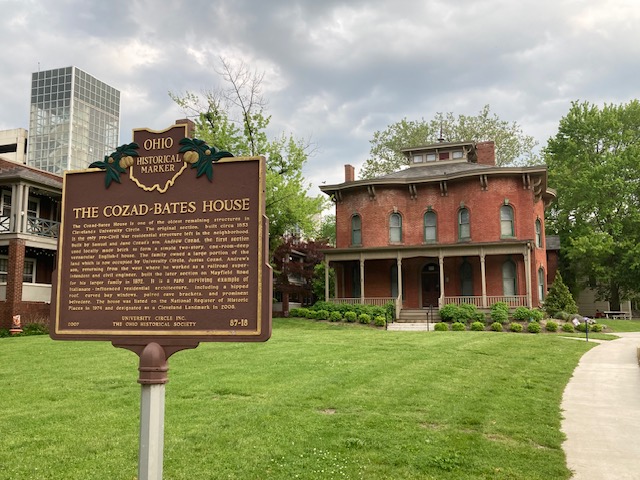
A long-waged preservation battle in the area has resulted in some properties being preserved and kept up. The nearby Cozad-Bates House at 11508 Mayfield Ave. has been renovated as a center celebrating Northeast Ohio’s role in the abolitionist movement. On the northwest corner of Mayfield and E. 115th St. is the American Cancer Society Hope Lodge, and near the Cozad Bates House on E. 115th are the three buildings of UH’s Transplant House of Cleveland. Additionally, on the south end of E. 115th St. there are still two large, occupied houses and the 44-unit Fayne Apartment Building at 2085 Cornell Road. The Fayne building currently has no vacancies, according to the building’s property manager, The Coral Company.
Jeanne Van Alta lived on Hessler and then E. 115th in the 1970s and ‘80s. Like many who lived on E. 115th and Hessler in those days, she was a professional activist, helping start the Rape Crisis Center. She was also co-owner of The Food Project, a Coventry Village organic grocer in the 1970s and ‘80s. “I think the employees and patients of UH that walk along E. 115th really enjoy it, they should keep it much like it is,” she told me.
Yes, many observers have had the idea that UH just might consider how this speck of a beautiful neighborhood might continue to be preserved somehow, bringing a park-like environment to UH patients, UH staff, UH itself, while keeping loveliness for all in University Circle. The hope is that in one fell swoop, that doesn’t involve tearing down paradise and putting up a parking lot.
A hotbed of activism back in the day
Like many who lived on Hessler and E. 115th in the 1970s and ‘80s, Van Alta was a member of the old UCTU. This group got the Cozad-Bates House declared a historic landmark, the first step of several to the now fully preserved and protected Cozad-Bates Underground Railroad Interpretive Center of Restore Cleveland Hope. (Van Alta is on the board of Restore Cleveland Hope.)
In the late 1970s, members of the UCTU took over a vacant lot on Cornell Road. They made it a “People’s Park,” and installed a park bench, park pathway, and other simple amenities – then maintained “a place for residents and where UH employees can have lunch in summertime.” This “park” lasted for some months until UH declared it was taking back the land. A construction crew arrived one morning only to find a sit-in – protesters protecting the park. The Cleveland Police Department arrested about 20, some who wouldn’t stand up, lugging them to a paddy wagon headed to the downtown city jail. (The late Judge Sara Harper, then a Cleveland Municipal Court judge, threw the charges out.)
“It was a solid neighborhood when I moved there in 1973,” said John Lawson, now a Cleveland-based attorney living in Shaker Heights. “The street was actually part of Little Italy in the old days and two Italian families still lived there.” He’d gotten the job as custodian of the then UCI-owned “Six-Pack” apartment building (now the home of the Cleveland Transplant House) and became active in the UCTU.
“The street was full of professional organizers in the 1970s and I was as forthright as the rest until I ran for Cleveland City Council and won,” Lawson said. Murray Davidson, an executive at UCI asked him, “Are you really going to listen to these people, (meaning Lawson’s organizing constituency)?” Lawson eventually realized that compromise was necessary to get things done, and his agreement to a zoning change on Circle Drive frustrated his activist neighbors.
University Hospitals controls the fate of paradise
Today, neighbors are still willing to speak up. Many of the vacant homes on E. 115th are obviously not maintained and actively deteriorating. With each storm, parts of houses blow off. These properties must have slipped UH’s mind. Nature was on its way to reclaim the houses in 2022 when two members of the nearby Hessler Neighborhood Association took action about deteriorating conditions: Janice Coggar took photos of the poorly tended grounds of these UH-owned properties, and Laura Cyrocki posted these photos on Facebook. UH responded, bringing in groundskeepers.
UCI has found a replacement for outgoing UCI president Ronayne, who left in October 2021. This month, Kate Borders will become president of UCI, leaving her position as president of a downtown Tempe, Ariz. organization. Borders is also the board chair of the International Downtown Association in Washington, D.C. One can wonder what Borders and the other powerful institutional leaders in the area will recommend for our tender little wooded E. 115th Street, loomed over by a research institute and two large parking garages. Time will tell.
Keep our local journalism accessible to all
Reader support is crucial as we continue to shed light on underreported neighborhoods in Cleveland. Will you become a monthly member to help us continue to produce news by, for, and with the community?
P.S. Did you like this story? Take our reader survey!