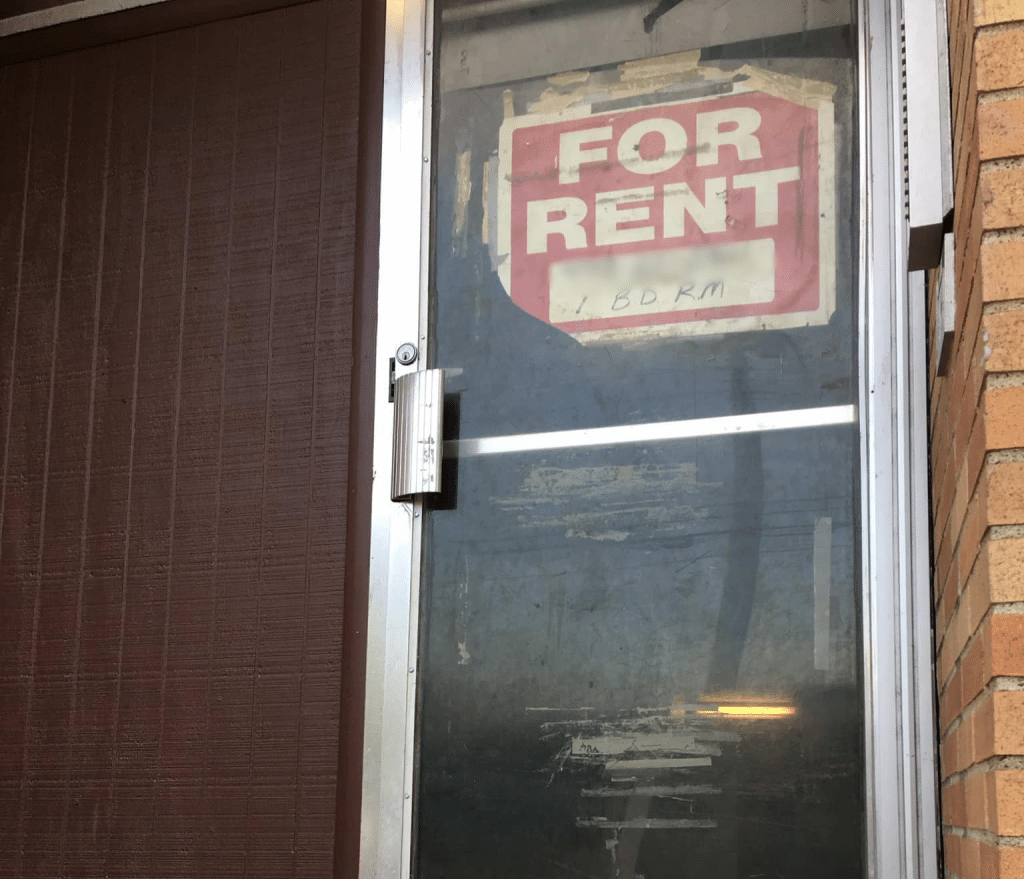
Cleveland has experienced one of the highest annual rent increases in the country over the past year. As rents continue to rise, Clevelanders face a growing challenge when searching for affordable housing.
A recent report from tech real estate company Zillow shows that Cleveland rents continue to climb, with July seeing a 7.3 percent increase from July 2023. Rising rents reveal that for Clevelanders, affordable housing is about more than just the cost; affordability is interlinked to housing quality, safety, justice and stability.
The Cost of Affordable Housing in Cleveland
For housing to be affordable, the U.S Department of Housing and Urban Development recommends that individuals and families should spend no more than 30 percent of their income on housing expenses. Residents who spend more than 30 percent of their income on housing are considered rent-burdened. According to 2020 census data, the median gross rent in Cleveland is $909 per month, which narrowly falls within the affordable range, comprising 29.2 percent of the median household income of $37,351.

For renters like Leah Thompson, a Ward 4 resident in Cleveland, navigating rising rents has been challenging, even with a good relationship with her landlord. “These are people that care about the neighborhood and the city but ultimately, they’re still landlords and unfortunately at this point I think it’s clear that they are interested in making a profit,” said Thompson, whose name has been changed to ensure privacy. “It’s just infuriating to pay more money for things that I can’t even see reflected in the house.”
“Lack of supply, when supply is limited, prices go up,” explained Sally Martin O’Toole, director of Building and Housing for the City of Cleveland, when discussing factors behind rising rents. “It’s also a reflection of cost of materials, costs of renovating, so even if you are a good landlord, your costs have grown considerably and so you pass that along to your tenants.”
Cost of materials isn’t the only factor causing a trickle-down effect of rising rents in Cleveland. July brought with it the 2024 six-year reappraisal of properties in Cuyahoga County. On average, property values increased by 32 percent county-wide. Properties in Cleveland are seeing an average 49 percent increase in value, which could mean higher rents.
“Everybody’s going to get that valuation change by the end of July… with it driving up the taxes on these properties, they [property owners] are going to pass that along,” O’Toole said.
Local property owners aren’t the only ones receiving news of reappraisals, so will the increasing number of business buyers and out-of-state investors operating through limited liability companies [LLCs] who have been cashing in on Cleveland’s properties.
“What we’ve seen is an influx of business buyers,” explained O’Toole. “On the east side of Cleveland, the preponderance of business buyers is close to half, so half of the transfers are going to LLC owners. This means that this is keeping inventory away from people who might want to be homeowners. It also means that we have LLCs, pretty much dictating rents.”
Finding affordable housing becomes more complicated for Cleveland renters when properties owned by out-of-state owners are often in worse condition than those of in-state owners.
Balancing Affordability and Quality
The City of Cleveland Property Inventory – 2023, a survey detailing the condition of 163,000 parcels in the city, revealed that while locally owned structures often received excellent or good grades, the majority of structures owned by out-of-state owners, only 7.6 percent of parcels in Cleveland, were graded as being in fair to hazardous condition.
“We see a lot of out-of-state and out-of-country owners of these units, and as we do, we see a decline in the condition of the units, so it’s harder to find an affordable apartment, and even harder still to find a well-maintained, affordable apartment,” O’Toole explained.
The condition of housing is more than just an aesthetic problem; it’s a health and safety issue.
According to the Fair Housing Center for Rights and Research’s 2024 State of Fair Housing Report, renters in Northeast Ohio are more likely to live in areas designated as High and Very High Environmental Hazard Exposure Areas (EHEAs). This suggests that renters are disproportionately exposed to greater environmental hazards and toxins.
Additionally, many Cleveland homes are older, with 75 percent of the housing stock built before the federal ban on lead-based paint in 1978, increasing the likelihood that lead paint can still be present in homes.
“What’s that connection between affordable housing? It’s not affordable for someone to be exposed to lead,” emphasized Austin Cummings, senior research associate at the Fair Housing Center for Rights and Research, an agency that promotes equal housing opportunities in Northeast Ohio.
Living near or among environmental hazards and toxins can lead to a range of severe health issues like asthma, heart disease and cancer.
Relocating to a safer environment may seem like the solution but is not a simple option explained Cummings, “That’s not always the case for a lot of renters, especially if you are lower income, you don’t always have the ability to just choose freely.”
Choice and availability of affordable and safe housing plays a crucial role in ensuring housing stability for individuals. “Because of a hierarchy of needs, the very first thing that you are focusing on is your basic needs which would include housing, so unless that is stable and on a good solid foundation, its really difficult to thrive in other ways,” explained Ashley King, director of Housing Stability at the United Way of Greater Cleveland.
While Thompson’s current housing is safe, stable and within her budget, rising rents present a real threat of being priced out. “I feel like I would not be able to pay for another two-bedroom at the price I’m paying now,” Thompson explained. “If I moved into another place, I wouldn’t be able to afford it, I think that would set me back.”
Who is Cleveland affordable for?
Housing affordability in Cleveland differs across factors such as age, household type and race.
“Older adults generally have a fixed monthly income and that income isn’t fluid,” King explained. “ If their housing costs increase… it makes them vulnerable and susceptible to a large rent burden.”
The United Way of Greater Cleveland’s 2023 Cuyahoga County Community Needs Assessment revealed that older adult households that rent are much more likely to be burdened by housing costs, with 56 percent of older renters spending more than 30 percent of their income on housing.
Demographic disparities in housing affordability extended beyond age. The assessment also revealed that female renters are experiencing high rates of unaffordable housing. In Cuyahoga County, female householders with children have the least affordable housing, with only 35 percent living in housing that is affordable for them.
Despite programs like Housing Choice Vouchers, which are designed to help eligible families access decent housing, many still face barriers due to source of income (SOI) discrimination. This occurs when housing providers refuse to rent to tenants based on the source of income used to pay rent, such as housing vouchers.
A 2017 report by the Fair Housing Center for Rights and Research found that in Cuyahoga County, housing providers with properties in areas with low density of housing choice vouchers denied voucher participants more than 90 percent of the time.
“Choice voucher participants through CMHA [Cuyahoga Metropolitan Housing Authority] are predominantly Black, predominantly Black women, predominantly Black women with children, so they [property owners] are perpetuating segregation,” Cummings emphasized.
While it is legal for property owners to refuse to rent to prospective tenants based on their source of income, illegal discrimination against protected classes remains a significant issue. The 2024 State of Fair Housing Report revealed that between 2014 and 2023, 78.3 percent of housing discrimination complaints filed in Northeast Ohio originate from Cuyahoga County, highlighting the persistent challenges in ensuring fair housing practices.
The Future of Affordable Housing in Cleveland
“I think that people have been screaming that housing is unaffordable and inaccessible for years now,” Thompson said. “It doesn’t have to be an issue, it just has to be a priority and it has to be a conscious choice and an intentional choice to make the change.”
Cleveland is making progress to improve the landscape of affordable housing, with several housing developments already up and running and more in the works. For example, Aura at Innovation, an 82-unit apartment complex in Cleveland’s Fairfax neighborhood, will have 30 percent of its units affordable to Clevelanders earning 70 percent, 80 percent, or 95 percent of the area median income.
Cleveland is also embracing new technology when it comes to solutions for affordable housing. Earlier this year, Cleveland City Council approved $500,000 in funding for Lutheran Metropolitan Ministry’s housing pilot project which plans to provide 3D-printed housing options to address homelessness and support households with low to moderate incomes.
The City of Cleveland is also implementing policies to hold landlords to higher standards and protect residents. Policies like Residents First require out-of-town investors to have an in-town agent legally responsible for the condition of the property. Civil tickets can be issued to property owners who refuse to repair and remedy violations, including health code violations.
For residents who need help now, there are community services that are still dedicated to supporting Clevelanders, like United Way’s 211 hotline which connects callers to community resources like housing, food and utility assistance.
“Housing is hard but then on the other hand, housing is actually really simple,” King emphasized. “What people should really know is that everyone wants safe and stable housing and everyone deserves it as a basic right.”
We're celebrating four years of amplifying resident voices from Cleveland's neighborhoods. Will you make a donation to keep our local journalism going?