Washing machines whisk away those glaring stains. But they also pluck inconspicuous bits of plastic that flow out and pollute our environment and our bodies.
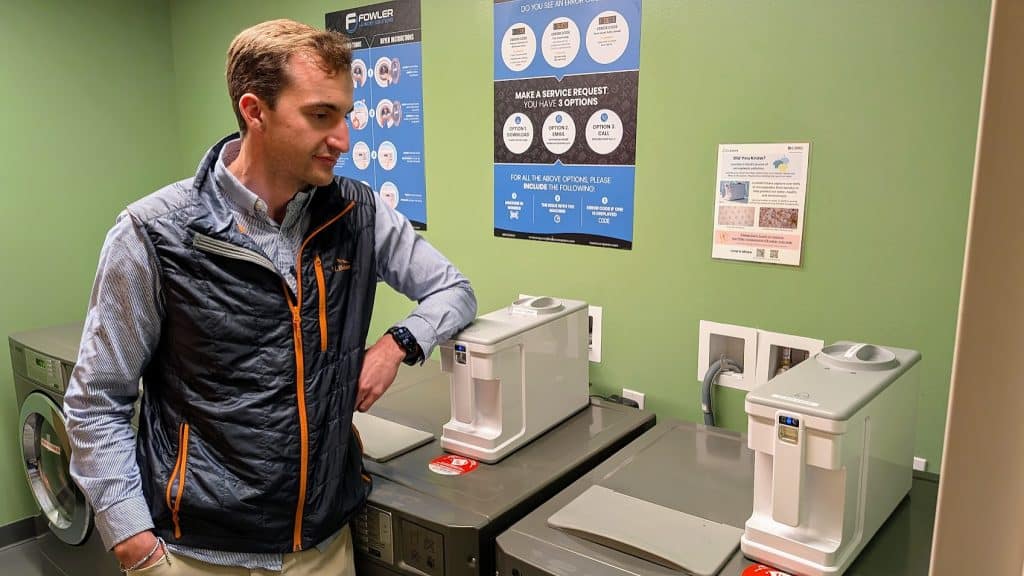
Three young alumni of Case Western Reserve University have started a business on campus to make and market filters for those microplastics. In April, Cleanr-brand filters were piloted on five washers in the school’s Stephanie Tubbs Jones Hall dormitory. In October, filters were installed on all remaining 95 dorm washers around campus with room for them. They’re also being piloted on five washers apiece at the University of Akron and the University of South Alabama.
“Microplastics pollution is one of the most critical environmental and human health crises of our time,” says Max Pennington, Cleanr’s chief executive officer. “And their concentrations are set to double by 2040 if we do not act now.”

By different estimates, people dump anywhere from 11 million to 44 million tons of microplastic fibers or particles in the environment per year. Then they breathe, eat and drink the stuff. A Cornell University study showed microplastics growing more than sixfold from 1990 to 2018 in diets in 109 countries. A 2019 article in Environmental Science and Technology showed Americans taking in 78,000 to 125,000 microplastics per year, plus another 86,000 for those who use only plastic bottles to drink the recommended amount of water.
Microplastics have been found in people’s blood, breast milk, lungs, livers, placentas, testicles, kidneys, urine, stool, saliva, bone marrow and individual cells. In New Mexico, brain levels of microplastics grew 50 percent from 2016 to 2024.
Not surprisingly, early research suggests that microplastics greatly harm our health. They seem to damage our genes, sperm and ovaries, while raising our risk of dementia, cancer and other ailments.
Wash is the worst
Many products are plastic in part or whole, from tires to gum, and tend to shed microplastics over time. But washers are the biggest source, responsible for 35 percent of the microplastics in oceans. Most synthetic cloth is plastic, and much natural cloth has plastic additives, such as dyes and flame retardants.
You won’t notice the missing bits. They’re no bigger than 5 millimeters, or one fifth of an inch. But they add up. Pennington says that an average wash makes 1.7 million microplastics. At five loads per week, that’s roughly 430 million per year, amounting to about 2.8 ounces or 15.6 credit cards.
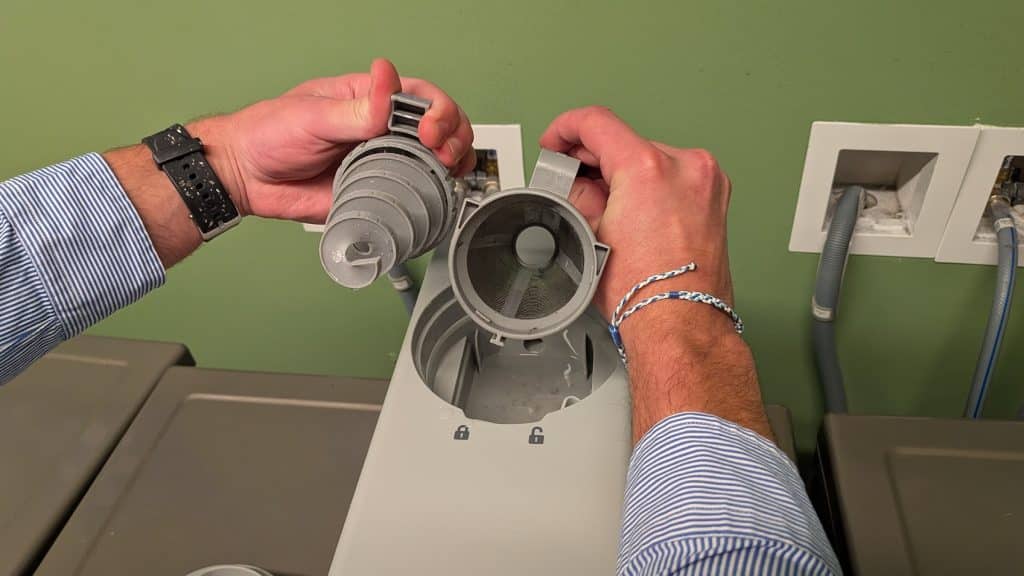
Washers have internal filters that catch coins, buttons and other sizable things. But Pennington says that they miss most microplastics. Cleanr filters have been certified as catching 90 percent of microplastics down to 50 microns, or two thousandths of an inch, in a disposable pod.
The filters are plastic and recyclable. Cleanr plans soon to start a program to recycle the pods. For now, Pennington says that microplastics are much stabler trapped in pods in the trash than loose in pipes and waterways, where they keep becoming smaller and harder to filter.
The Cleveland Water Department website says that the agency’s treatments remove particles that size from the water pumped to our homes, but no count has been taken specifically of microplastics. Northeast Ohio Regional Sewer District Jenn Elting says the district removes microplastics from the bottoms of its tanks but probably misses ones that stay afloat. Still, she says the total suspended solids are low and well within state limits.
Clothes on campus
Case Western has bought 100 filters at $299 each. The only unfiltered washers left in its dorms are those in big stacks with no convenient place for filters.
Each filter is maintained by student cleaning crews. It tends to need cleaning after about 20 loads, and its pod to need replacing after about every five. A light and an app prompt the crews. Some of the used pods go to professors researching microplastics.
Case Western students interviewed welcome the filters. “I wasn’t aware that the washing machine was such a ginormous producer of microplastics,” Vivian Chuang said recently. “Microplastics are unhealthy for the environment and us.”
Jack Honomichl, co-president of the school’s Precious Plastics recycling club, says he just hopes that the filters prove sustainable commercially. “I worry that, like many environmental things, it is a net benefit to humanity but not profitable.”
Cleanr sure hopes for profits. It has raised about $9 million in capital so far. It has competitors, including Bosch and Samsung, but Pennington says Cleanr’s filters are handier and their unique technology more effective.
Pennington comes from Madeira, Oh., near Cincinnati, and learned about microplastics while interning there for Procter & Gamble, which makes Tide laundry detergent. Back at Case Western in 2021, he teamed with two of his fellow engineering majors to create a filter inspired by the gills of manta rays and basking sharks, which filter plankton.
The corporation has eight employees, five of them Case Western grads. It leases office and lab space on the top floor of the school’s seven-story Sears think[box], billed as the nation’s biggest public makerspace and innovation center.
Cleanr has eight U.S. patents granted or pending. It won a 2025 Best of Tech Award from the Greater Cleveland Partnership. In October, Forbes Magazine called Cleanr filters “an easy and practical way to significantly reduce microplastic emissions.”
Help at home
Cleanr is selling filters not just to colleges but homes. Pennington says some customers want to reduce microplastics in storm pipes and septic tanks, which might leak, and they all want to help the environment. “They’re worried about their kids and grandkids and the future.”
A homeowner can buy a filter and 10 pods for $299. Or they can pay $199 plus $35 per quarter for a subscription that extends the warranty and provides 20 more pods.
The company says the filter can be installed in under 15 minutes to any washer with room on top or nearby. The owner attaches an accompanying hose to a water outlet and the washer’s hose to the filter.
Future filters
By 2029, France will require the internal filters of all washers to catch microplastics. Similar legislation is pending in Congress, six states, Canada, Australia and the European Union. Cleanr is working on providing those filters.
The business also aims to supply filters for water used in products, from beverages to printer ink, and for water discharged by industries. Says Pennington, “We hope to continue to make jobs and expand and scale the technology and bring additional products to market.”
Ohio hosts several washer factories, including the world’s biggest, Whirlpool’s in Clyde. And Cleveland abuts a very polluted Lake Erie. So Cleanr’s website says, “We believe our city can be ground zero for solving the microplastics crisis.”
More ways to help
Filters are just one of many ways that consumers can reduce microplastics. Environmentalists recommend washing clothes with cold water and liquid detergent, preferably in front-loaders, and of course buying less plastic.
Keep our local journalism accessible to all
Reader support is crucial as we continue to shed light on underreported neighborhoods in Cleveland. Will you become a monthly member to help us continue to produce news by, for, and with the community?
P.S. Did you like this story? Take our reader survey!