Local community leaders urge fellow queer organizers to prioritize a need for sober spaces.
This article was published in partnership with The Buckeye Flame, a nonprofit news organization amplifying the voices of LGBTQ+ Ohioans. Follow the Buckeye Flame on Facebook, Instagram, LinkedIn, Twitter, TikTok and more.
For almost a century, gay bars and nightclubs have served as an essential refuge for the LGBTQ+ community, providing spaces where individuals can be their authentic selves without fear.
In Cleveland, Ohio, queer people looking to connect with one another are limited to a small handful of LGBTQ+ nightlife establishments: Twist Social Club, The Hawk, Cocktails, Vibe Bar + Patio, The Leather Stallion and Studio West 117.
The conundrum? To access these spaces, patrons must also be around alcohol. For a community in which 30% struggle with addiction, this means that LGBTQ+ individuals must often choose between health and community. LGBTQ+ recovery advocates say this creates a double-edged sword for those trying to maintain sobriety.
“When I ask for a RedBull or water, I’m either giggled at or there’s no water and the RedBull is just for drinks and I can’t purchase it to just be social with everyone else,” says Tony Correa, founder and executive director of B. Riley House, an LGBTQ+ drug and alcohol treatment facility in Cleveland, Ohio.
Correa created B. Riley House in 2016 to provide a sober space with tailored services like partial hospitalization programming, intensive outpatient treatment, mental health assessment, psychotherapy courses and other services for members of the LGBTQ+ community seeking substance abuse recovery support. B. Riley House stands as one of only two LGBTQ+-specific sober houses in the country, doing what it can to provide social support while clients are engaged with services, but not always able to provide support after that.
“B Riley can be a hub, but at some point, it’s also like getting out of the doctor’s office and still hanging out at the hospital,” says Tyler Stimpert, board president of B. Riley House. “It doesn’t allow folks to really expand or open their wings after addiction has been managed.”
Data from Recovery Research Institute shows that gay, lesbian, and bisexual individuals face an increased risk of substance use disorders, with approximately 18%higher rates of alcohol addiction, 20 percent higher rates of drug use disorder, and 5.9% higher rates of prescription medication misuse compared to the general population.
Sexual minorities continue to be underrepresented and encounter significant stigma and discrimination, adding complexity to their journey in recovery without spaces outside of facilities like B. Riley House.
“As a culture, we are focused on addiction recovery and completely ignoring addiction prevention,” Stimpert says. “We don’t have spaces for queer people already in place, so the people asking for these spaces are those recovering from addiction.”
Alternatives to traditional recovery meetings
Gay bars and queer spaces have long been associated with the use of numbing agents like alcohol to manage shame and internalized homophobia, often without much thought.
“I think that more safe spaces need to crop up for us to frequent because for the longest time all we’ve had are bars, some of us bathhouses, and those are not conducive to our new way of life,” Correa says.
Sober individuals seeking community often turn to traditional recovery meetings, which provide consistent support. However, these meetings may not always be affirming due to their roots in religious practices and teachings. That is where the LGBT Community Center of Greater Cleveland’s Smart Recovery group meeting comes in.
“For someone that was raised in the Bible belt with my own religious trauma, it was really hard for me to be in traditional recovery spaces,” says Ryan Thomason, a social worker and counselor at Behavioral Health Services of Greater Cleveland who started Ohio’s first LGBTQIA+ Smart Recovery meeting in 2020. “So I wanted to create a space for those to be themselves and feel their true self while accessing that unconditional support.”
SMART Recovery’s 4-Point Program is the organization’s flagship secular program serving those with addictive behavior, including both substance and activity/process addictions. The meetings are held weekly on Wednesdays and Fridays evenings at the LGBT Community Center.
Growing quickly
The group initially met once a week with two to four participants at each meeting, but over a three-month period, it quickly grew to two meetings per week with up to 50 participants. This growth is attributed to the program’s effectiveness and the increasing demand for sober spaces in Cleveland. Recently, the program received a grant that will facilitate its expansion to the East Side, addressing a geographical disparity where LGBTQ+ resources in the city are disproportionately housed on the west side.
“We were dabbling in creating community events, like ax throwing, candle-making and picnics in the park,” Thomason says. “These activities were not only aimed at creating supportive spaces for discussing recovery but also at building a strong sober community.”
The importance of third spaces
When individuals achieve sobriety, they often find themselves with newfound freedom and spare time that was previously consumed by substance use or other maladaptive behaviors. This transition can lead to a significant change in social circles, as previous friendships may have revolved around shared experiences of addiction.
“I think it comes back to the idea of third spaces. Just having places to go that isn’t a gay bar,” Thomason says. “There’s a reason that the LGBTQ+ community are five times more likely to turn to a substance and develop a dependency for it at some point in their lives. It’s because the only place for the last couple of decades that you could truly be yourself and feel safe is at a gay bar. “
By fostering friendships and a sense of community in these third spaces, individuals in recovery have people to turn to for company, support, and encouragement outside of formal recovery settings, creating a more holistic approach to sobriety.
Comedy, Poetry and Art in Columbus
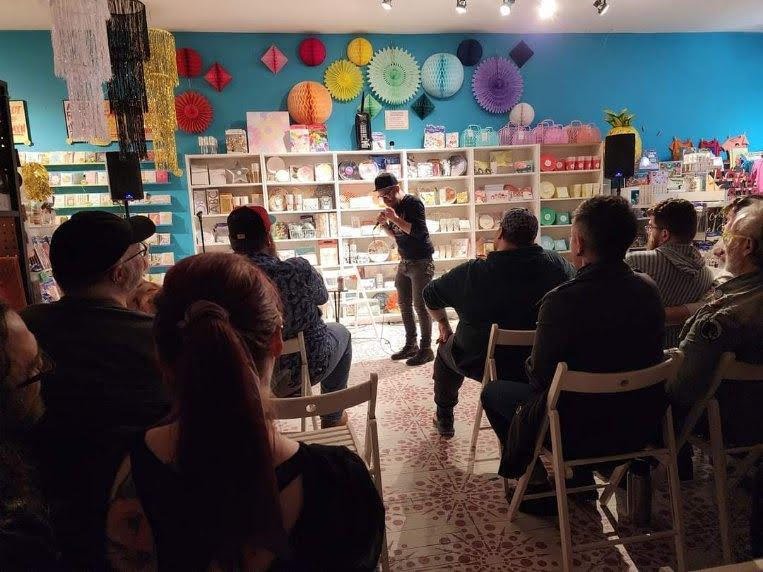
Out comic Wonder Doug took matters into his own hands, creating LGBTQ+ sober events for individuals to gather outside of bars. Doug, who is almost nine years sober, started the monthly show “Celebrate” in Columbus as an alcohol-free entertainment space.
“Celebrate” showcases comedians, poets, and artists at Wild Cat Gift and Party in Clintonville, offering the LGBTQ+ community a space to enjoy entertainment without alcohol. The show is a monthly success, combining comedy, poetry, and art, and providing a unique, sober gathering space.
“A lot of the performers and audience members fall into the LGBTQ+ spectrum,” Doug says. “I think they’ve appreciated a show where there isn’t a drunk host screaming at everyone to buy them shots or ask ‘Who here is drinking?’ I think the performers also appreciated being paid with money and not a bar tab.”
More spaces needed
The work done by community leaders like Ryan Thomason and Wonder Doug lay the groundwork for continued support, but they say it is up to the community to build the path toward creating sober spaces for queer communities to gather in an affirming, safe and conducive way.
“People are hungry for this sober community where they can just be around other people like themselves where they don’t feel like they have to leave part of themselves at home in order to authentically connect,” Thomason says. “It took me eight months to get more than five people in a room. So, a lot of people may be discouraged by the time it takes to put in the work.”
Identifying need
Experts highlight that another barrier to this work is the significant gap in data regarding the specific needs of those in recovery in the LGBTQ+ community. This dearth of information makes it challenging to address their unique health and wellbeing concerns effectively and to allocate resources where they’re needed most or properly sell a business plan to create these spaces. The Greater Cleveland LGBTQ+ Community Needs Assessment (CNA) was created to address these gaps.
Organizers say the tool is crucial for identifying the specific challenges and needs of our community, which have been largely overlooked ”By collaborating with over 200 local stakeholders, we’re able to gather comprehensive data that will help shape better policies and improve the well-being of LGBTQ+ individuals on a local level.” says Stimpert, who is also a Research Assistant on the Greater Cleveland LGBTQ+ Community Needs Assessment.
With the CNA, Stimpert and the team have actively addressed the intersection of substance use/abuse within the LGBTQ+ community of Northeast Ohio. Specific questions about substance use were included in the survey. A dedicated focus group, termed “Intersectionality Listening Sessions,” addressed this topic, allowing participants to voice their unique challenges related to substance use and recovery, ensuring their perspectives were integral to the assessment.
During the Listening Sessions, participants emphasized the need for more sober spaces and support systems, emphasizing a clear call for more LGBTQ+ friendly cafes, restaurants, residential treatment facilities, and trans-specific rehab centers to provide supportive spaces. Additionally, the lack of visibility and public education about LGBTQ+ sobriety has been highlighted, advocating for campaigns to normalize and promote sobriety within the community.
With results from the assessment expected to be released October 19, there is hope on the horizon for queer people in Ohio seeking these spaces.
As the Greater Cleveland LGBTQ+ Community Needs Assessment aims to shed light on these pressing issues, there is confidence that future initiatives can pave the way for healthier, more supportive environments. Advocates and community leaders continue to push for the creation of more inclusive sober spaces, offering a sanctuary where LGBTQ+ people can thrive without compromising their recovery.
By prioritizing these efforts, LGBTQ+ Ohioans can ensure that everyone has a safe space to connect, heal, and grow together.
Keep our local journalism accessible to all
Reader support is crucial as we continue to shed light on underreported neighborhoods in Cleveland. Will you become a monthly member to help us continue to produce news by, for, and with the community?
P.S. Did you like this story? Take our reader survey!