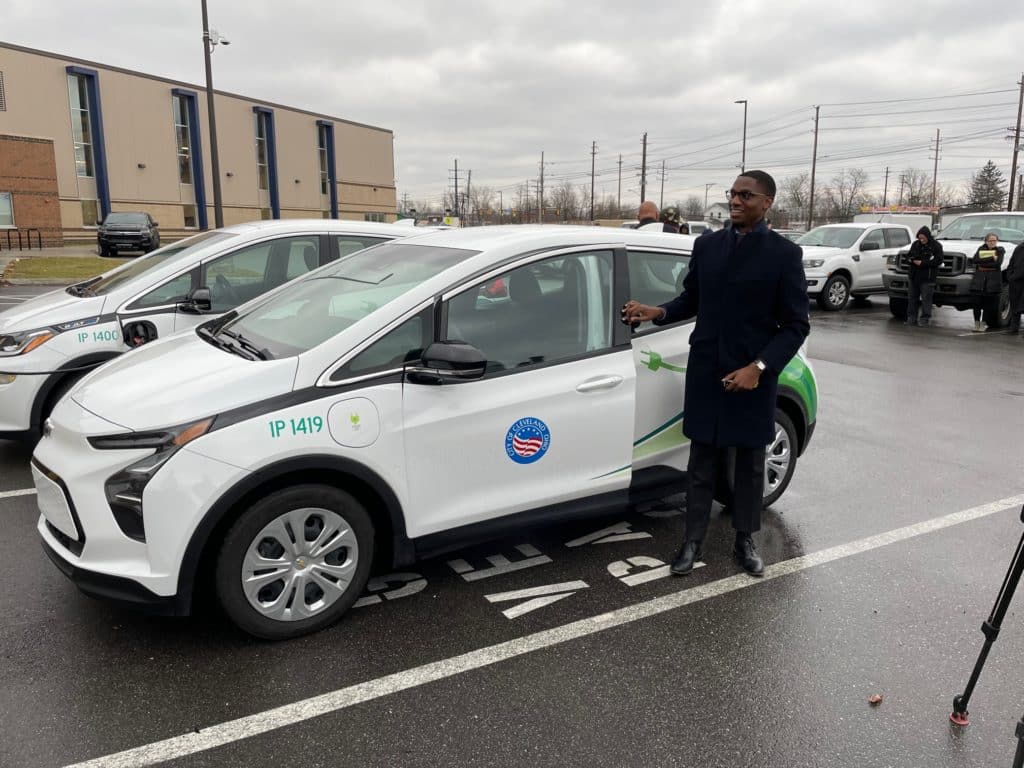
“It’s so quiet!” Cleveland Mayor Justin Bibb said as he climbed into an electric vehicle outside of Frederick Douglass recreation center on Miles Avenue on the city’s east side on a blustery, cold November morning. “You can’t even hear the engine.”
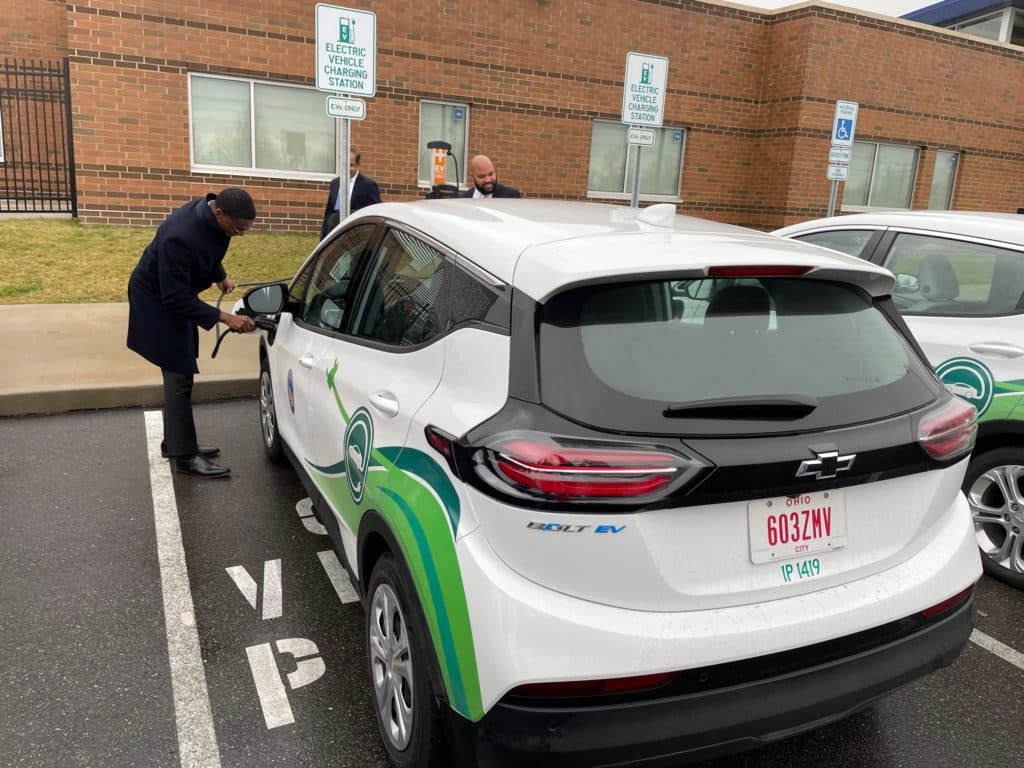
Bibb was in the Lee-Harvard community Wednesday morning to promote the city’s new EV charging station at the rec center, where electric vehicle owners can currently charge their cars for free. It’s one of four new charging stations the city intends to roll out in the coming months. Three more are expected to be installed early next year – one each at Hopkins Airport, the West Side Market, and Cleveland City Hall.
On Wednesday, Bibb took a test drive to show off the technology. After getting the keys from one of his staffers – “I’m the mayor, so it’s my car, right? So can I have the keys?” he quipped – Bibb and Ward 1 council member Joe Jones circled the parking lot while the TV cameras rolled and a gaggle of reporters watched.

At the press conference, Bibb touted the new charging station, which opened two months ago, as part of a push to make EV ownership more affordable and accessible to city residents. “We’re seeing the largest federal investment we’ve ever seen in tax credits for electric vehicles,” Bibb said of incentives of up to $7,500 available next year for people who purchase EVs under the Inflation Reduction Act passed by Congress in August. “This charging station means that if you’re a resident of Lee-Harvard or Mount Pleasant, you can charge your vehicle right in your neighborhood.”
The new rec center charging station was funded through an Ohio EPA grant program aimed at bringing electric vehicle charging stations into communities that have been historically left out of such investments, according to a city news release.
An EV charging station is a piece of equipment that connects your electric vehicle to a power supply. Charging stations provide the “fuel” for the vehicle, just like gas stations do for conventional vehicles. They typically also allow vehicle owners to power up their vehicles more quickly than they can do at home with standard outlets.
Publicly accessible EV charging stations are an important part of making electric vehicles more accessible, said Anand Natarajan, the energy manager in the city’s office of sustainability. A lot of people don’t have the confidence yet to buy electric vehicles because they’re not sure where to charge them or fear they’ll run out of charge mid-trip (a phenomenon known as “range anxiety”). This is especially true for less expensive vehicles that cannot travel as far on a single charge.
To increase EV ownership, the city needs to create a network of publicly accessible charging stations, Natarajan said. EVs are typically more expensive than gas-powered vehicles, but they are generally cheaper to maintain and operate and cause less pollution to the environment.
“The availability of used vehicles is increasing, so we have to make sure the infrastructure is there so that everyone can be able to charge their vehicles,” said Sarah O’Keeffe, the city’s director of sustainability.
Not only are new electric vehicles becoming more affordable – the 2023 Nissan Leaf is priced from $28,040, not including the $7,500 tax credit – but there is also a burgeoning used car market, including many under $10,000, Natarajan said. The station at Frederick Douglass is the first publicly accessible charging station in Cleveland. There are other electric charging stations in Cleveland, Natarajan said, but they’re privately operated.
Frederick Douglass was chosen because it was accessible to the community and improvements were already being done to the recreation center, he said. It was funded through a $15,000 Ohio EPA grant. Although it’s free for now, the city will look at implementing a fee-based model, as other cities like Shaker Heights and Lakewood have done with their charging stations, said Natarajan.
The Northeast Ohio Areawide Coordinating Agency (NOACA) has a regional EV charging station plan and the city is in the process of developing one, Natarajan said. The city is also planning to issue a request for proposals to develop EV charging stations through public-private partnerships.
Cleveland has committed through its climate action plan to having an all electric fleet by 2035, except for police vehicles, according to Natarajan. Currently, the city has four electric vehicles and the airport has two, but that will change as the city buys more, he said.
When the Frederick Douglass EV charger was first installed two months ago, usage was fairly low because it wasn’t advertised. Then the charging station began appearing on EV charging station locator apps and since then, usage has steadily increased. “Not only does it serve the community, but it’s also fairly close to the highways,” he said. “It’s accessible to folks who are passing by in the neighborhood.”
Elizabeth Lehman, the city’s sustainability manager, said that it’s important for the city to install EV charging stations, because it will encourage residents to take the leap and embrace this new technology, making Cleveland a healthier, less polluted city. “We can’t wait for electric vehicle adoption before putting the stations in,” she said. “People need to see these EV stations as motivation, so they see it makes sense to purchase electric vehicles. That way, people know the stations are close by and it supports their purchases.”
Keep our local journalism accessible to all
Reader support is crucial as we continue to shed light on underreported neighborhoods in Cleveland. Will you become a monthly member to help us continue to produce news by, for, and with the community?
P.S. Did you like this story? Take our reader survey!