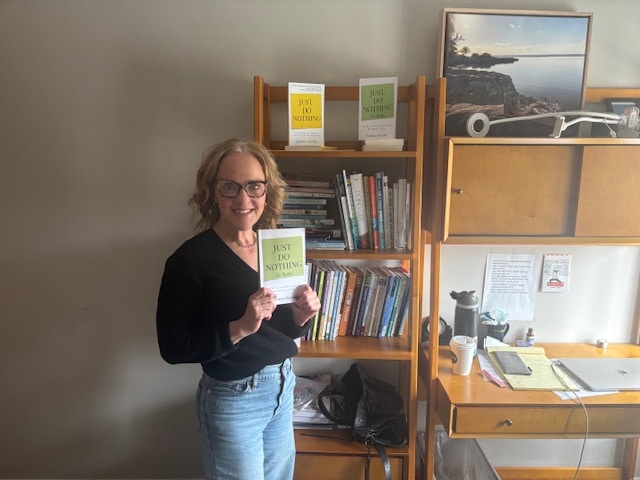
Native Clevelander, Joanna Hardis, is an author and cognitive behavioral therapist committed to using evidence-based practices to help people get “unstuck.” She’s especially focused on helping parents.
Hardis draws upon her professional training and experience raising three children. Educated at both Cornell University and Case Western Reserve University, Hardis is the author of the bestselling book, “Just Do Nothing: A Paradoxical Guide To Getting Out of Your Way.” The Land recently caught up with Hardis at her Cleveland Heights office to discuss her latest book, “Just Do Nothing (For Parents): How To Parent Better By Doing Less.”
What does the book title, “Just Do Nothing (For Parents)” really mean?

The title doesn’t mean we shouldn’t do anything. It’s really about learning how not to get hijacked by our internal experiences, emotions and thoughts. When we get hijacked by our fears about our kids or by our kids’ emotions, we don’t parent the way we want to parent. We have to be able to recognize our thoughts, fears, urges, etc. and pause before we react.
Distress tolerance is the ability to tolerate emotional discomfort without letting it derail your actions or emotions. This is the premise of “Just Do Nothing (For Parents).” Could you explain?
Distress tolerance is what we call a psychological construct. It’s a perception that we can handle emotional discomfort. So, our actions follow a challenging emotion. If someone is distress tolerant they believe they can handle uncomfortable emotions, like fear, uncertainty, shame, etc. They don’t avoid any situation, person, action, etc., that will evoke those feelings. Conversely, distress intolerant means an individual will do anything to avoid uncomfortable emotions and feelings; and when they do feel them, they’ll do whatever they can to make them stop as fast as possible.
You stress the importance of understanding how one’s own parental practices influence how we parent. Can you give examples?
We come into parenting with our lived experiences as kids and what our parents did. Much of what was modeled for us and how we adapted to that modeling influences us today. Present-day parenting topics weren’t even talked about until the 70s and 80s. Parents did their best to adapt to given situations. Genetic, learned and environmental factors also affect parenting, which makes for the perfect storm.
How important is it for parents to practice self-awareness?
Self-awareness for parents is beyond important. I see a lot of parents coming in, wanting to drop off their child and having the therapist fix him. If not the therapist, then the school or teacher. They don’t realize they are the model and emotional mirror for their child. A parent can’t tell their child “You can do this,” or, “You can tolerate being uncomfortable,” if they aren’t modeling the behavior themselves. They have to take accountability for their own relationship to distress and discomfort. If they’re distress intolerant, how will they be able to effectively model it for their kids? It all starts with the parent.
You state in the book that reactions are impulsive and responses are intentional. Could you elaborate?
This is one of the main reasons I wrote the book, because I’m a parent and the concepts are relatable. I think today, parents are given too much advice, especially through social media. They’re told, “You do too much,” or “You do too little.” It’s confusing. My book’s subtitle is “Parent Better By Doing Less.” I wanted to help parents have a framework and skillset to determine the answer to those questions. A useful question they can ask is, “Am I reacting to my feelings (which never goes well), or responding to the situation?” When we’re reacting, we’re basically trying to make a feeling go away, which only makes it stronger. When we’re responding to a situation, we’re most likely not highly emotionally charged and better equipped to handle challenging events.
You metaphorically talk about riding an “emotional wave.” Can you highlight the three components of an emotion and how they relate to parenting?
Emotions have three components: physical sensations, urges and thoughts. An emotion is a piece of information. For example, imagine you’re sitting in a meeting at work and you realize you’re hungry. What do you do? Leave the meeting to go eat? No, you take note of your state and address it at an appropriate time. Often, when parents start to get a feeling about their child, or their child starts to get distressed, they immediately act on it. Parents need to recognize their feelings as information that does not always require immediate action. When you’re feeling an emotion, try to notice the sensations in your body and the urge to do something. Notice the thoughts in your head but slow down your reaction. Oftentimes it’s not that deep. It’s not an emergency.
We all armor up in some way, you say. “It’s how we’ve adapted to protecting ourselves from feeling uncomfortable.” “JDN (For Parents)” highlights parenting types, including The Perfectionist, The Minimalist/The Underreactor and The Chicken Little Parent. What are the disadvantages of being a well-armored parent?
Everyone armours up functionally to protect ourselves when we’re feeling vulnerable or defensive. It may not always be the most skillful approach, but we’re trying to protect that vulnerability. The disadvantage is that it often gets in the way of effective parenting. As a third wave Cognitive Behavior Therapist, I’m trained to think of behaviors functionally, instead of good or bad (or binary). All parents, because of their lived experiences, have places they protect. It’s how they’ve adapted. Those protective behaviors may not always be effective when parenting. It’s important for parents to do a self-awareness inventory and notice their patterns and decide whether or not they are working for them.
Just Do Nothing (For Parents) presents in two sections. The first portion details present-day parenting and Part 2 highlights the skills needed to build distress tolerance and emotion regulation, including “JDN” and “Say No, JDN” and “Accept Their Mood (Even When It’s Bad)” and “JDN and Set (and Hold Boundaries).” At the end of each JDN, you have a blank page called “WINS.” What is the purpose?
People are so hard on themselves and they approach this work with so much self-blame, guilt and perfectionism. They say things like “Well, I should be able to do this,” or “This is silly that I can’t just master this.” Behavior change is incredibly hard, and when we’re talking about change happening in our head, it’s ridiculously hard. People need to start noticing the micro changes in their behavior and write them down. People often want that big win – that big sexy thing, like winning a marathon or having their kid get accepted to Harvard. They want that big outcome but that’s not the way it happens. If it does happen, it’s through a thousand micro shifts changing their behavior. We have to train ourselves to notice the positive because our brain has a negativity bias.
What is your advice for parents of neurodivergent children, including those with attention deficit hyperactivity disorder (ADHD) or on the autism spectrum?
I think parenting a neurodiverse child is difficult. Parenting in general is the hardest job anyone ever does and it only gets harder as the child gets older. The more challenges you add on, whether it’s neurodivergence, mental or physical, it requires the ability to move through challenging emotions, uncomfortable situations and develop distress tolerance.
“JDN (For Parents)” includes several exercises to complete for self-reflection. One asks parents to imagine their child delivering their eulogy. What is the benefit to doing this?
This is a common practice in acceptance and commitment therapy. It’s not something I invented. Here, parents reflect on how they want to be remembered. They ask, “What is really important?” “What are my values as a parent and am I living by those values?” For example, if I value connection, community and honesty, am I living those values if I’m being overprotective and blowing up my child’s phone and constantly texting him? It’s important to approach these situations with compassion and curiosity, not judgment. The exercise gets you thinking about how you want to show up as a parent. What is really important and how is it going to build connection?
When confronting tense parenting situations (or any scenario) you highlight the power of using the acronym PAUSE. What are the five steps in the process and why is it important to not only practice these skills in the heat of the moment?
First, if we only practice these skills in the heat of the moment, we won’t remember them. These skills can be practiced all together, separately or with a mixture. The P is to pause and literally slow down your roll. A is to assess. Ask yourself, “Am I really in danger or just feeling uncomfortable?” When we react quickly, the adrenaline in our body sends a message to our brain that we’re in danger, which reinforces the nervous system’s sensitization. We need to stop and assess if we’re in literal danger. We need to remind ourselves that, “I’m feeling uncomfortable but feelings are safe.” U is to unclench. In stressful situations, we’re braced and it sends a message to the brain: “Danger.” S is soften. We need to soften our body as much as we can and soften toward the discomfort of the situation. We need to accept reality, otherwise we increase the intensity of our emotions and situation. E is to engage in the activity we were doing before we became emotionally escalated or some other distractor.
What are your main ideas you hope readers take away from Reading Just Do Nothing (For Parents)?
First, instead of trying to make an uncomfortable moment comfortable, start getting comfortable with discomfort. Second, stop paying so much attention to your thoughts. Lastly, don’t fixate on your feelings, pay attention to your behavior. We need to learn how to separate feelings from what we need to be doing or how we want to be acting, especially as parents.
We're celebrating four years of amplifying resident voices from Cleveland's neighborhoods. Will you make a donation to keep our local journalism going?