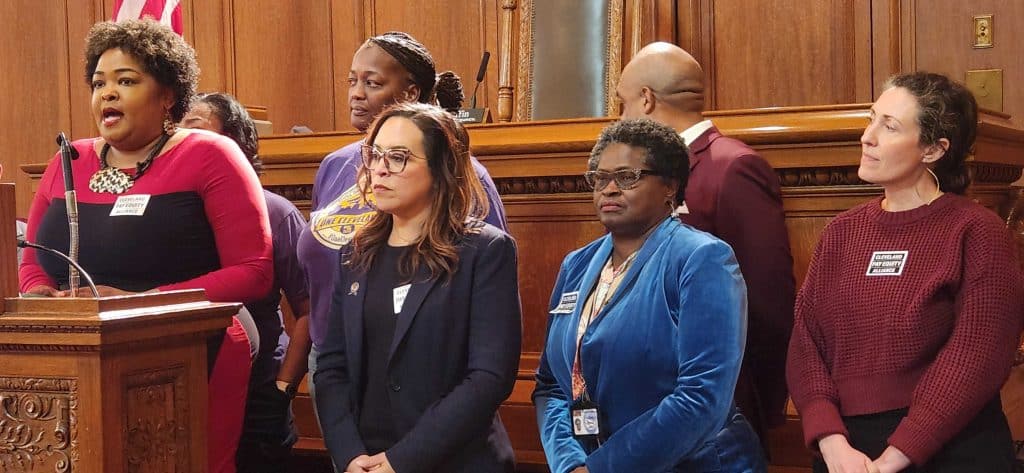
A sense of excitement and pride filled the air in Cleveland City Hall Council Chambers on January 27 as media and pay equity advocates gathered for the introduction of a new pay transparency legislation focused on giving job seekers a fair chance at receiving the wage they deserve — something long overdue for Ohio’s second largest city.
That afternoon, representatives from the Cleveland Pay Equity Alliance, a joint project of Collaborate Cleveland and Northeast Ohio Worker Center, as well as representatives from Service Employees International Union (SEIU) Local 1 and Plexus LGBT & Allied Chamber of Commerce stood side-by-side with City Council members as the legislation was introduced.
Here’s a quick rundown of how Ordinance No. 104-2025 changes the scope of pay transparency in Cleveland:

- Employers must include salary ranges in job postings
- Employers cannot ask about salary history during hiring
- Employers must provide salary range for a current position upon employee request
- Violations can result in civil penalties up to $1,000 per occurrence
If passed, the ordinance would take effect 180 days after its enactment, giving employers time to adjust their practices. Once it’s in effect, any person may allege that a violation of the ordinance has occurred by filing a written complaint with the Fair Employment Wage Board (FEWB) within 180 days of the alleged violation.
Cleveland Ward 17 Councilman Charles Slife, who introduced the mechanics of the ordinance, said the legislation would prevent businesses from using salary history as a way to set the salary, though those conversations will typically still have to happen to some degree.
“While some data has shown that people who are asked to report previous salary, especially people who are lower-income women from disadvantaged communities, it winds up creating this cycle of continuously being underpaid relative to industry averages,” Slife said. “More people will be able to know what jobs they’re applying for and be paid the salary or the hourly rate that is commensurate with their skills.”
Why now?
Slife said Cleveland was a bit late to the game as a major city adopting this kind of legislation.
“I want to share that this is not a new concept. In fact, arguably, Ohio is late to the game on this one. This [type of ordinance] is in over 20 states,” Slife said. “What we’re doing today is already reality in states across the country, blue, purple, red, but there’s no statewide law in Ohio that could cause this to happen. Cities in Ohio would have taken the lead to advocate for their residents and their workers, and that’s what we’re doing here today.”
The Pay Equity Alliance shared in a release that cities across the country and Ohio, including Columbus, Cincinnati, and Toledo, have been passing similar legislation since 2019. States with similar pay transparency laws are closing the gender wage gap, with data showing a 6-percent wage increase for women, on average, after the legislation is enforced, and no wage decrease for men.
Grace Heffernan, executive director for the Northeast Ohio Worker Center, said the introduction and passing of pay transparency legislation in Cleveland has been in the works for years.
“This is building on three years of working on pro worker policy with City Council,” Heffernan said. “The Worker Center and Collaborate Cleveland have both led initiatives independently, and when this opportunity around pay equity was rising to the surface, it really felt like an opportunity to bring some shared and common cause to what feels like an important city-wide issue. This is really building on the shoulders of a lot of foundational work that’s been happening.”
Executive Director Abby Westbrook of Collaborate Cleveland, a local nonprofit advocating for women and gender justice, echoed Heffernan’s sentiments about both organizations working separately and together to move the legislation forward. Westbrook believes the two organizations’ strong track record in worker-related issues with the City of Cleveland made an impact in getting the pay transparency ordinance to the table.
“The Worker Center had been working with City Council on wage theft and on reinstating the Fair Employment Wage Board. Collaborate Cleveland had been working with City Council on Municipal Paid Leave Policy. There was a lot of interest in it, and a lot of compelling research about why this is important,” Westbrook said.
She said it was about a year ago when the two organizations came together to start what they believed to be truly vital work for the city.
“[We] came together to form the Cleveland Pay Equity Alliance to really look at this issue, look at the best practices, and work with City Council and the Mayor’s Office to research and understand what a good policy is, and how we could work to pass a strong policy,” Westbrook said. “We’ve been working together to really develop and get the policy to this point, and are really committed to seeing it through to passage and through to implementation.
Support from City Officials
Councilwoman Stephanie Howse-Jones said the pay transparency ordinance will put workers in a better position throughout their careers.
“For workers to be empowered to know where they should be going at the negotiation table, and then also having a level of cover of when you feel like something is a misstep, where can you actually go to do some further investigation,” Howse-Jones said. “I’m really looking forward to us going through the legislative process to see that pay equity and transparency is a reality in Cleveland, and so Clevelanders know they have public servants who are doing all that we can to increase the vitality of families here in the City of Cleveland.”
Councilman Slife spoke personally to his experience with pay transparency throughout his career, noting that he went to job interviews only to discover what was being offered was not going to be commensurate with what he was looking for, nor did it reflect his qualifications.
“That transparency will allow workers to know at the forefront if this is a prospect for them or not,” Slife said.
City of Cleveland Senior Policy Advisor Austin Davis said much more gets accomplished in the city when different branches of government work in tandem.
“Together, we’ve created a really ambitious pro-worker agenda here in the City of Cleveland,” Davis said. “This includes things like re-establishing the Fair Employment Wage Board, which lay dormant for 20 years, things like preventing the city from contracting with firms that have engaged in wage theft…things like increasing the city’s living wage or fair employment wage.”
More Common Than Not
Davis noted that this legislation is “designed to address stories that are all too common.” He mentioned he was contacted by a professional colleague of his after she heard about the press conference to introduce the legislation. He didn’t know she had her own lived experience tied to fair wages.
“Her reaction was…this happened to me. Thank you for acknowledging that this is happening in our community, and thank you for doing something about it. And it surprised me. She’s a professional. She’s at the pinnacle of her career, but that first job held her back for a long time in the jobs that she had afterwards,” Davis said. “We knew it happens statistically. Abby [has] done a great job of pulling those stats about how much the wage gap is for women and women of color, but, boy, it’s our neighbors and it’s our friends and our colleagues.”
Bethany Studenic, an employment litigation attorney for Sobel, Wade, and Mapley and co-founder of systemic injustice non-profit Enlightened Solutions, said she hears claims of pay history discrimination pretty often.
“Maybe it’s a woman coming into a company and they’re hiring men at $10,000 or $15,000 more, and she doesn’t find that out until maybe a year into her employment. Now, if you’re seeing what the salary band is up front, you at least have the opportunity to negotiate that up front so you’re starting from the same starting point,” Studenic said.
Setting Up Future Generations for Success
Dr. Jennifer Bosco of Plexus, Inclusion Hub Director for the LGBTQ Chamber of Commerce for Northeast Ohio, said this legislation will help businesses save time developing and aligning their jobs with the market that’s out there. She said this also leads to building strong trust lines between businesses, employees, potential candidates, and even consumers.
“Our young workforce is looking for ethical and inclusive-minded businesses and businesses who show up first to move pay equity forward,” Bosco said. “Those are the ones they will be attracted to and apply to.”
Sandra Ellington, a member of the Executive Board for SEIU Local 1, said the introduction of the pay transparency legislation makes her proud of her city.
“This groundbreaking legislation is going to help everyone no matter where you’re from: east side, west side, Black, white, LGBT+, it doesn’t make a difference. Every human being deserves a chance,” she said.
Ellington said the introduction of the legislation is a win for the working people.
“Every dollar counts when you’re a working person,” she said.
When asked how Clevelanders who don’t follow local politics would be made aware of the pay transparency legislation’s introduction, Davis said it will be a joint effort between City Council, Mayor Just Bibb’s administration, and the FEWB.
“We’re biting off right now the ordinance itself, and they’re gonna figure out how to make sure everyone knows about it, because the point is really well heard. If people don’t know about it, then it won’t have any power. And that’s not the point. The point is to see work and change being done in our community,” Austin said.
Next Steps for the FEWB
Kate Warren, special assistant to the Chief of Integrated Development in Mayor Bibb’s Office, was appointed to the FEWB during its recent reseating process. With her position in Mayor Bibb’s office, and her previous work with the Center for Community Solutions researching poverty, Warren said her appointment was a good fit. And, Warren’s previous involvement as an inaugural advisory committee member for Collaborate Cleveland made her privy to the pay transparency ordinance’s existence. Even her own lived experience of starting her first full-time job at less than $30,000 and receiving only incremental raises for her next two positions added to her desire to show support for an issue she cares about personally.
When asked about the Board’s dormancy over the last 20 years mentioned by Davis, Warren said the FEWB was reinstated shortly after ordinances around anti-wage theft and living wages made their way to the table. The Board will be responsible for investigating complaints and enforcing the ordinance. The legislation includes provisions for appeals and establishes procedures for handling violations.
Warren said the Board is still getting its bearings since it is newly seated, and has only had two meetings since late 2024.
“What we’ve talked about is a focus more so on education and outreach, and also having a mechanism for receiving reports or complaints, and then deciding as a board how we will handle those complaints when they come to us,” she said.
The Board has not yet met to discuss the pay transparency ordinance, and has yet to discuss how they would handle issuing citations to violators of the ordinance. The Board is scheduled to meet for the first time in 2025 on Wednesday, February 26 at 10:30 a.m.
Keep our local journalism accessible to all
Reader support is crucial as we continue to shed light on underreported neighborhoods in Cleveland. Will you become a monthly member to help us continue to produce news by, for, and with the community?
P.S. Did you like this story? Take our reader survey!