
Born and raised in the city of Cleveland, Quartez Harris remembers the difficulty of growing up in the public school system. Labeled in elementary school as a student with a reading disability, it was impossible to imagine that writing would become the center of his adult life. But Harris had something to say about education and its intersection with poverty and racism, and poetry was the medium he would use to share his voice.
In 2020, Teaching Cleveland lauded Harris’ poetry collection, “We Made It to School Alive,” as a book that “Every teacher in Cleveland should read.” For the span of the next few years, he was everywhere – from articles on Cleveland.com to discussions on stage at The City Club of Cleveland to doing workshops at schools and libraries in and around the city. He was even awarded the prestigious title of Ohio Poetry Association’s 2021 Poet of the Year.
But when the publisher, Twelve Arts Press, went out of business and the book went out of print, this important poetic narrative documenting the experiences of Cleveland students and the people who care for them all but vanished. Until now.

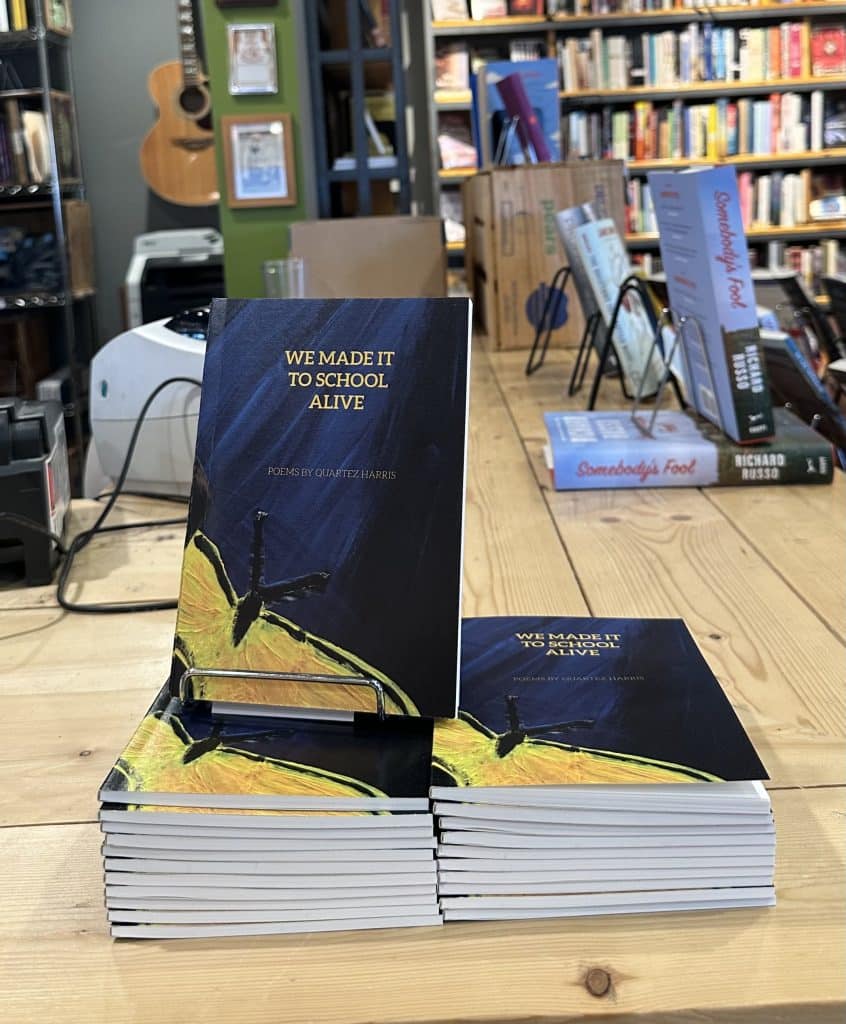
Harris has re-released his popular poetry collection with additional new material. The updated book not only marks the launch of his career as a vital voice in the literary world, but also represents the voices of students, parents, caregivers, teachers, administrators and others struggling within the education system.
The Land sat down with Harris to discuss the re-release of “We Made It to School Alive,” and his journey to becoming a writer despite the odds stacked against him, plus what his fans can expect next.
Q: What do you remember about being a student in the public schools?
A: My time as a student was complicated because it was filled with stigma. I had a learning disability. I felt like I was ostracized. I was removed from the general ed classroom and I didn’t want to be. I didn’t want to be pulled out, considered different, or challenged with learning. It started in second grade, for reading comprehension. And by high school, I was mainstreamed but I still didn’t feel like I belonged because I had to report to an intervention room and I avoided the windows because I didn’t want anyone seeing me in that space. No one talked to me about how this was a classroom for my uniqueness. No one was trying to offset the stigma of being a kid in a special ed environment.
Q: Had things changed when you returned as a teacher? What seemed different and what felt the same?
A: When I became a teacher, I was curious about the infrastructure of special ed. There were kids like myself who avoided special ed because they avoided their classrooms and their teachers. Other students took advantage of what was offered to them. As a teacher, I was having conversations with students I wished teachers had with me. I was mesmerized by my position. Someone who was struggling with learning, I was now helping with empathy.
For anyone who struggled with learning, I was able to make them feel seen. I was not a special ed teacher but kids had Individualized Education Programs (IEPs) and I made sure that in my general ed classroom, their needs were being met. In classrooms at Cleveland Metropolitan School District (CMSD), teachers can be challenged with overpopulated classrooms, and all teachers are required to overextend themselves, even if it’s not healthy, to make sure student needs are equally met. That is not mandated. That is my lived experience as an educator.
If you are at an under-resourced school, you have to deprive yourself of giving to your kids. Some schools have the infrastructure, and other schools are toiling, and there is not much support in these school systems.
Q: Who encouraged you to become a poet?
A: I took a William Shakespeare poetry course in high school and it was the first “A” I ever received. I realized that poetry could be nonsensical. My life never made sense. Writing doesn’t have to be a straight line, it could be a landscape. It ushered me into the idea that I could make my own language.
I couldn’t identify with Shakespeare, because he was a white man, but I could identify with playing with words. At Ohio State, I was introduced to African American poets, Ed Mabrey and William Evans, who were both spoken word poets who were also writers. I want to emphasize “writers” because they could both write well and perform well. We shared the same identity as Black men. It became my intrinsic motivation to write and perform.
Will [Evans] had an open mic night that he hosted in Columbus near campus and that very space became an incubator for my poetry. I shared my grief with learning. His space was where I processed it all with others.

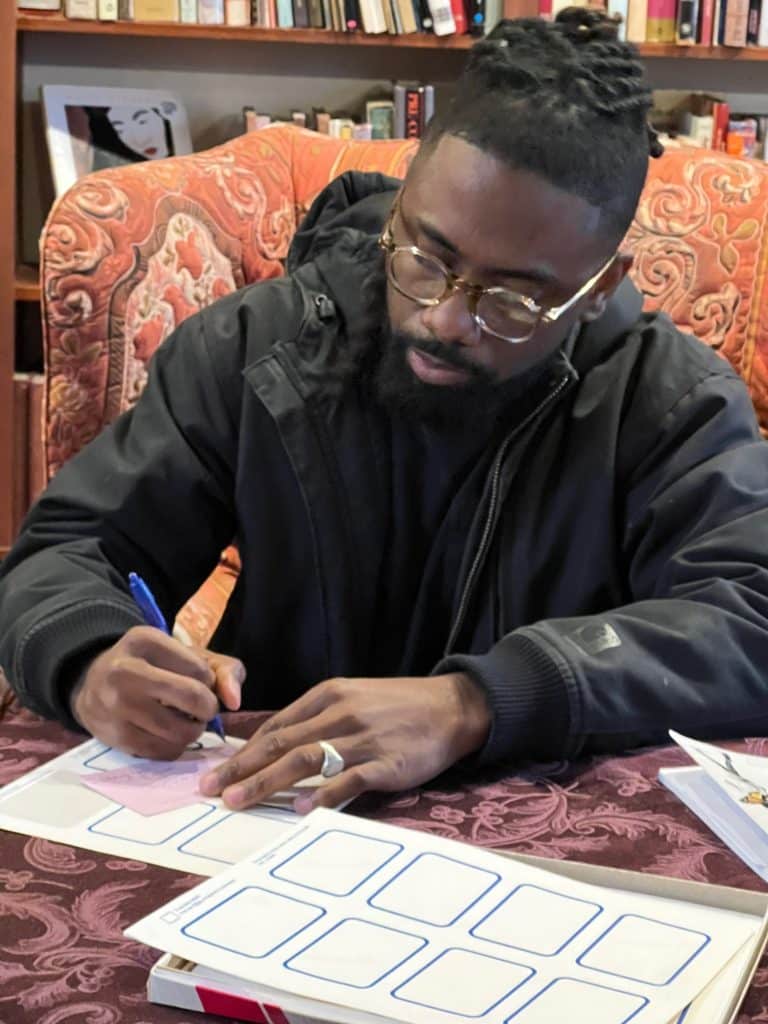
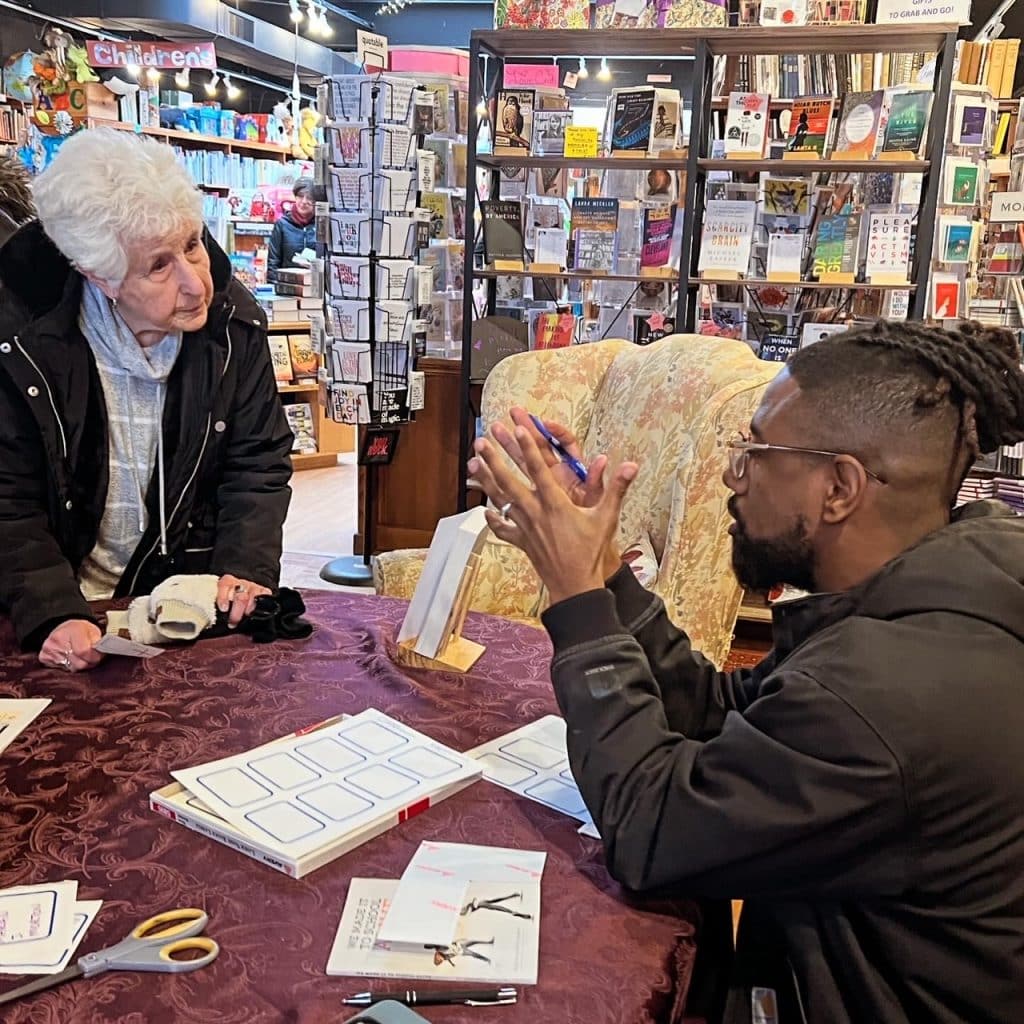
Harris meets with readers and fans during an event at Loganberry Books in February. [Photo from Dahlia Fisher]
Q: Did you always know you wanted to be a writer? Or when did you know?
A: My whole life, everyone told me my reading and writing was a deficiency. I never thought I could use my deficiency until I was introduced to poetry. I could break things apart, break words apart, and perform with words. That’s when I was like, “alright, I am in.”
Q: What was the experience like to become a published author?
A: It started with a small independent press that is no longer in business. They had a contest called the Writing Knights Gland Slam. You submitted a manuscript and based on the status, you advanced to recite or perform. I had the luxury of bridging my loves – writing and performing. And I got to the point where I could potentially have a publishing deal.
When I reflect, people can believe in you, on your behalf, and I took on their offering. I was able to publish my first full-length collection, “Nothing But Skin.” It’s no longer in print, but it was like my launch into the publishing world.
Q: What was it like after the first book was published? Did your life change at all?
A: My sense of self-worth was reinforced. I was in a space I never thought I could enter. I was elated. I came from a background in which I thought this was something I was far removed from and someone believed in me. I had this book. I was reaching out to people, hustling, and going to venues where I could read and sell my book. It opened up possibilities to share my work. What changed? I changed. I look back on Nothing But Skin and I see so many grammatical flaws, but it was what I needed to write something else.
Q: How did you go about writing something else?
A: There was a huge gap before the next one. I became a teacher. That became my identity. I forgot I was a poet. But then I was having these vulnerable conversations with these kids, my kids, and I wanted to document and process what I was listening to. And this one kid, who I saw as a kid who I didn’t think was afraid of anything, told me that he was afraid to walk home because all he heard was gunshots. It got me thinking about how our school was meshed in this, in gun violence.
When Twelve Literary Arts, which was a literary arts organization for Black kids that is unfortunately no longer in business, offered me a stipend of $5,000, I was the first Barabara Smith Writing Fellow, and I got to stop Ubering to make extra money on the side and focus on my writing. That’s how “We Made It to School Alive” was able to come about.
I got to meet a lot of local writers and creators in Cleveland. Ari Washington, Michelle Smith and others who I consider literary and arts giants in the community. They sat around a table and gave me real-time feedback. I felt like this was a collective quest to make sure I got the language right. By the time I completed the fellowship, Twelve Literary Arts created an extension called Twelve Arts Press and published my collection.
That’s when my life began to buzz. When the book came out, I got a lot of local recognition. Nikki Grimes quoted my book. NPR Ideastream and The Plain Dealer shared my work. Shaker Schools invited me out. There was a pull of people who were vested in the narrative, the poetic narrative of my Black and brown students.
Q: How did the buzz around the poetry collection help you advance your writing career?
A: Someone happened to share the poetry book with two different agents and I got a call. She wanted to represent me. And then another agent called and also wanted to represent me. They grappled over me, and both had to put their sales hats on. I ended up signing with Tanya McKinny. Some writers on her agency’s list were at the forefront of literature. And the person who had referred me, I looked up to.
I signed a three-book deal. I had been working on a novel, I had twenty loose pages. There was an expectation that I would write for the market. When you get a commercial book deal, they want a book to sell. You write from the heart and present it to them, then make changes with their feedback. I hit the deadline due date, and I got an official thumbs-up. I’m grateful because this is the novel I was called to write. Otherwise, if they didn’t give the novel a positive response … I would have fallen into despair, if they said this novel doesn’t have a chance.
Q: What do you mean when you say that you were called to write the novel?
A: It’s fiction, but it echoes a difficult time in life, when I was a teenager, with a learning disability.
I am writing a book that I wish someone would have said to me. I am proving to myself that I can tell a story that matters to me, which in turn will matter to others. I feel like this is what the book represents. Before I can go on to do anything else, I have to write this, because I was labeled disabled as a writer.
My life and the landscape of my life and what is happening – I am in disbelief – I can’t believe I wrote a book that named me Ohio Poet of the Year, but maybe after I write this next book, then I can believe.
Q: What’s different about writing a novel versus a collection of poetry?
A: There’s a structure involved with long form. Poetry is short form. I read fiction, and prose, before poetry. Even in my poetry, there is an arc. I call myself a narrative verse poet. I am always telling a story. Part of taking it on means writing it with my editor and being supported, and now it makes sense why an acknowledgment page is always spewing with people. No one writes alone.
Q: How did you feel when you heard the publisher of your popular poetry collection would be closing shop and the book would go out of print?
A: I felt supported across the margins of society. How did an organization that was such an important ecosystem for young people not be able to support itself? I thought less about my work and more about the young people who would not have access to literary arts in this unique way. My book exceeded my expectations and I was at peace with it. But then I started seeing that the book was still having an active presence in the literary landscape and deserved to be in print.
Q: What went into getting it published again? How did you choose the new poems?
A: For me, “We Made It to School Alive” is very much my backstory. I had the opportunity to submit to my agent and the larger market but I wanted it to be grounded in Cleveland and printed in Cleveland. Why not just reach out to the press that had been printing my books? Outlandish said they were comfortable if I gave them creative license to reimagine the cover art. And, once I had their go-ahead, to know it was happening, I said I would write additional poems. I always thought there was more to say. I had been thinking about it.
Q: What was it like doing a pre-launch with Rebel Readers at Loganberry Books in February for Black History Month?
A: It was actually breathtaking. I was invited in such a warm way. I didn’t think anybody would have an interest in the book being re-released because it had a launch (in 2020), but Rebel Readers believed in it, felt that it deserved an audience, and highlighted the story and concerns I agonized over in my collection. There was press built around it, a bridge to going live on Ideastream. There was a new momentum. Loganberry Books was flooded, and my fiancé couldn’t find a seat. They are champions of my work. I am grateful.
Q: When and where can people buy the new edition of “We Made It to School Alive”?
A: The official launch was on March 24 and there was an event at Visible Voices Bookstore with poetry readings by different local literary artists, and there was a book signing. The book is out now. It’s available at Loganberry, Mac’s Backs, Visible Voices, and directly from the publisher, Outlandish Press.
For more information on Harris’ work, click here.
We're celebrating four years of amplifying resident voices from Cleveland's neighborhoods. Will you make a donation to keep our local journalism going?