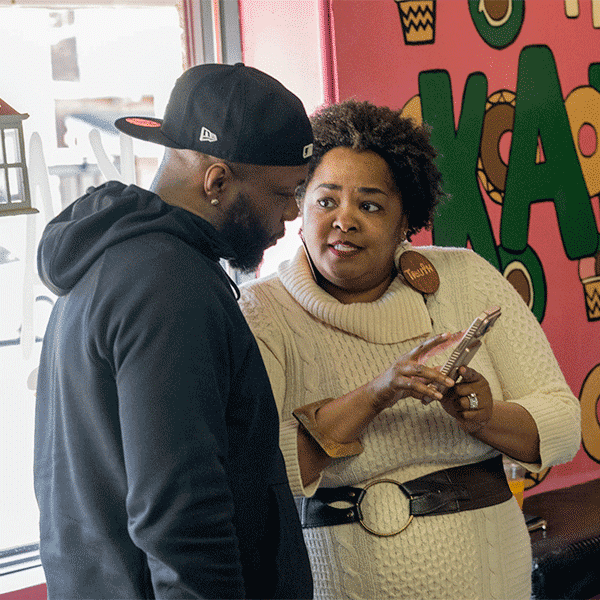
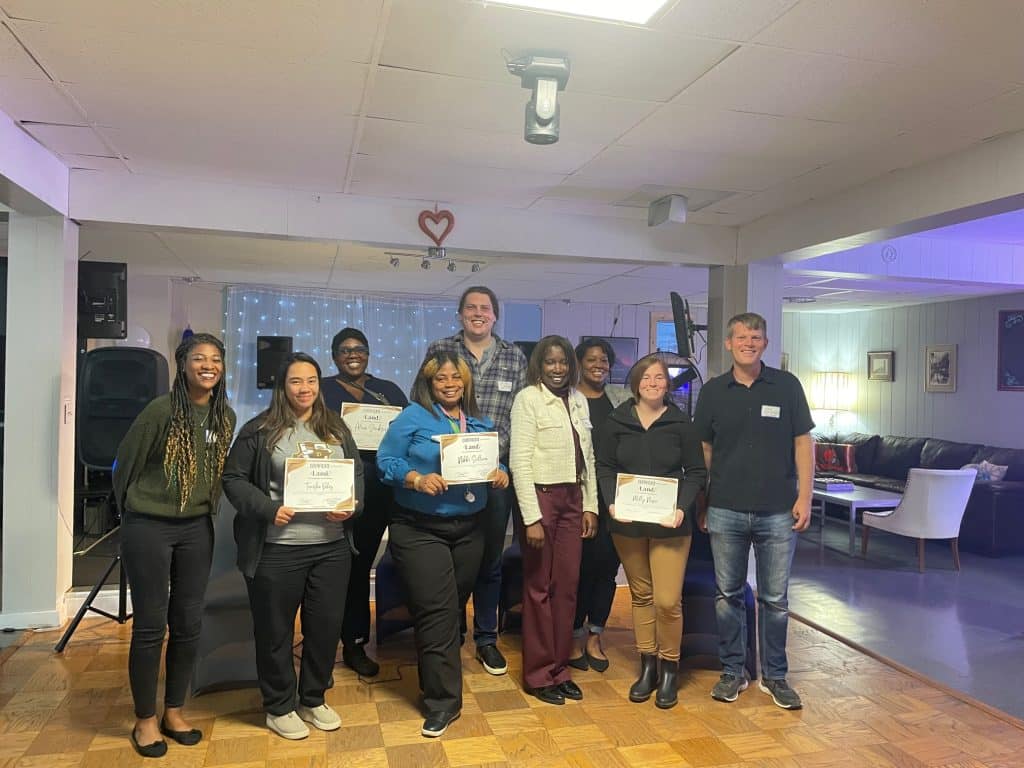
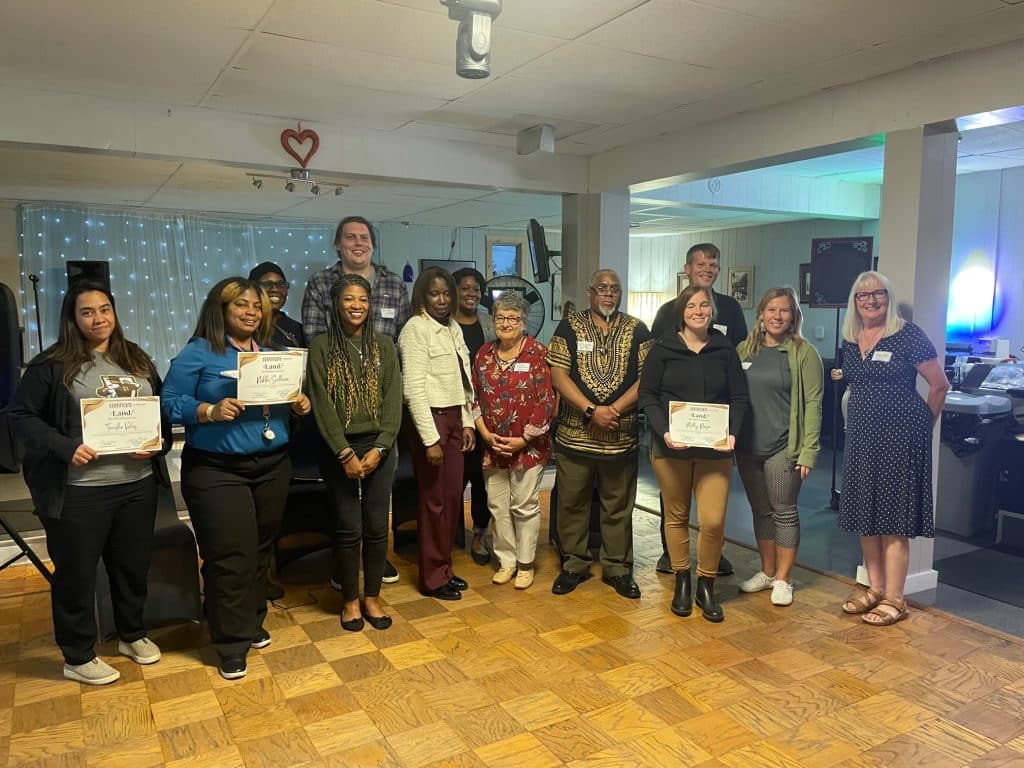
On Wednesday evening, The Land gathered at Gatewood Home/Share in Collinwood with community journalism program graduates, staff, and friends to celebrate and connect with one other. Since 2022, more than 50 residents have graduated from the program, and The Land recently announced that its sixth cohort of community journalist trainees will begin classes on Monday, Oct. 2.
Community journalism program mentor Faith Boone interviewed three of our participants about their experiences.
Faith Boone: What drew you to the community journalism program in the first place?

Tanisha Velez: I’ve always been interested in writing. I thought that as a community member, versus somebody that’s looking from the outside, I had something to contribute. I’m actually in the works, meeting the people on the ground, and I’m able to write about them.
Cindy Hill: I always wanted to connect to more kinds of audiences. I was always in grant writing or copy editing and not something that was as broad as journalism, where you can reach a lot of people at many different reading levels. I wanted to learn how to write true journalism. And I learned in such a quick amount of time – six weeks is such a good program. I was able to learn about structure, especially starting with the who-what-where-when-why-how and going into the nut graph (a paragraph explaining the main thesis of the article). I was able to adapt my story and put it into that shape, and everybody was able to read it, follow it beautifully, and it was like magic. Usually I slave and wrestle with everything and you don’t have to, you can actually follow the format. That was my happiest moment, learning that I could be a journalist too.
Sandra Golden: There were a couple of reasons why I was interested in the workshop. Number one, I love The Land as a publication. Number two, I love Cleveland. I was born and raised in Cleveland and was happy to see and learn about information that’s happening in the city that’s positive. Not always the bad news that goes on in the city of Cleveland, but really showcasing what the city of Cleveland offers to the community. And number three, in my real job I’m an academic. I’m a professor at Notre Dame College. I wanted to learn how to write beyond academics, which can be boring. There’s a certain audience that reads academic journals and gets excited about it like me. I wanted to learn how to write like a journalist, and I’m always looking for that experience and opportunities to learn. Those are the three main reasons.
Faith: What community or issue were you focused on in your piece? What did you decide to write about?
Tanisha: I decided to write about a group of women called “A Little Bit of Love.” What they focus on is really fundraising to support different things that are going on in the community. It could be anything from an event that needs funding to a woman that needs a wheelchair. Whatever the community needs, they’re looking for ways to fundraise and really support that effort. (Editor’s note: Tanisha’s story will be published soon.)
Cindy: My story came out of a personal experience. I was in a Latin club learning to dance Latin, and a young woman in a wheelchair came up and stole the night because she was just spinning and doing all her moves in a wheelchair. I went up to her and asked, can I do a story on you? How did you even get in here? I ended up doing my first profile. I’d never done a profile before, and my mentor [Raquel Santiago] helped me figure out how to tell her story. But I always, always tried to let her keep her identity whatever that was. If she wanted to say she was disabled or not, it was really her identity. It was a really powerful moment for me to learn why we’re telling stories. It was about Kim Ocampo, yet the title ended up being “I’m just me.” She didn’t say either way if she was disabled or not, she was just like, “I don’t really see it.”
Sandra: I graduated from Collinwood High School and grew up in the Collinwood community. My mother still lives in the Collinwood community. She’s a 53-year resident who lives two blocks away from the Cleveland Food Bank, and that was my story. I wanted to write about how the Cleveland Food Bank could bring hope to the Collinwood area. I noticed throughout the city of Cleveland there’s lots of things happening to revitalize communities, but I always felt like Collinwood was left out. I’m learning more about what’s happening in the Collinwood area, but I wanted to tell the story of the Cleveland Food Bank in terms of how they’re expanding their footprint in the Collinwood area to combat food insecurity. (Editor’s note: Sandra’s story will be published soon.)
Faith: What have you learned about community so far and what it stands for?
Tanisha: There’s many different types of community, right? There’s community at work, community at home. But within the community that I’m focused on, it’s knowing that the culture of community never died, it’s just that it’s not taught to the next generation the way we were raised. That skill sharing, that “I’m-a be there if you need sugar,” or “Hey, I got extra food, here’s a plate.” That kind of community isn’t being taught. But through these spaces and what I do with my own children we’re trying to reintroduce that sense of community. As long as we focus on community in the community, we can come a long way. A little cheesy, but you know what I meant.
Cindy: I have an unusual outlook on community because I was raised in foster care. I had to go find community. I found it in choir. I was instantly a soprano, and I belonged. So I learned from that that all these communities we write about, really they have a sense of belonging, that’s the top thing. With belonging comes trust and ease. So when I approach someone to write about their story I do say, “I’ve had your experience.” I’m interested in mental health issues because my family has had some of those. I may live in this city and they live in that, but we still find community as a reporter and a subject. I just love that wider community and how communities overlap.
Sandra: I’ve always been involved in community in some way. I look at community from the micro perspective as well as the macro perspective. As an educator, I always try to create a sense of community in my classroom. It’s so important in terms of how we learn. We learn from one another. Then I look at the broader sense of community – it’s that feeling of belonging, of being a part of something. When I came back to Cleveland, I took a position with the Sisters of Charity Foundation in the Cleveland Central Promise neighborhood. It’s one of the highest poverty communities in the city of Cleveland. It has the highest number of low-income households, primarily women. Ninety percent of households are headed by women. It has the most failing schools in the city. Our goal was to build this community – nonprofits and profits working together to uplift a community, so that they can become sustainable in taking care of their children, family, and just one another. So community just means so much from my perspective in terms of how we take care of one another and build relationships. Community is important, and it’s important for me to give back to the community that gave so much to me.
Faith: What’s something that surprised you when you were drafting your piece or putting it together?
Tanisha: So, to be honest, I’m still working on my draft. Things that are surprising to me are that I can write a story. You know it’s usually that thing that you’re just writing words down for work or whatever. But then, when you get into it or get into a flow, it’s like, ‘OK, this is something I enjoy doing.’ I’ve always enjoyed writing, I just never really had the opportunity to really do it. So this was the opportunity for me to really do it. It really helped me get to that point.
Cindy: My surprise was that I saw so many stories within stories. I wanted to write about Kim, but I saw all these other angles the whole time. I was like, ‘Maybe I can write about that, oh this sounds better,’ so I was jumping around. I had the most wonderful mentor and she helped me through my big surprise of, where’s the story? I was really not sure where to find my true story for this young woman. She said this is a common thing all journalists are struggling to find the actual story you’ve been given. She said the way she does it is each of these interviews are pixels in a picture. And you just put them all down like a little puzzle and they start to assemble into a story. The thing I learned at three in the morning while still trying to figure out the story is if I just do what-what-where-when-why-how, the story is in that sentence. I literally found my story, my real core kernel of a story by just using that little structure. That’s because I was still new. But now I really see how that structure can help us find that story that we’re trying to seek.
Sandra: I didn’t find the story, Lee [community journalism instructor Lee Chilcote] found the story for me. He said this is the heart of your story, the community resource center. That works for me. I was surprised by the pace of the community journalism program; it went really fast. And I met every deadline. Whether I knew what the story was was another question, but I was meeting the deadlines. I tend to get stuck when writing. Now I know what the heart of the story is, so I can go back to it and focus on that piece.
Faith: What advice do you have for future community journalists?
Cindy: I learned how to interview people and stay out of the way so the story could be told. My advice would be to just be the vehicle for the story that’s already happening with this person and this situation. The more we’re out of the way, the better the story becomes.
Sandra: So my advice would be trust the process. Just let it happen. Trust your workshop facilitators leading you through the process and be open to the growth, whatever that growth may be.
Tanisha: My advice would be to really focus. I have a hard time doing that. The other thing would be to really write something that pulls on your heart that needs to be said, so I guess digging deep. Like me, I’m focusing on these women, and it’s a story you’re never gonna hear about unless it’s told, right? Because it’s five women that are just in their kitchen cooking meals for unsheltered individuals, driving around helping people, and you’re never gonna know about that, right? And it’s like, do we highlight these women, shine a light on them somehow. That’s my advice: Find the story that pulls on your heart and you really need to tell somebody about it.
Faith: I just want to say, I was really surprised by the three of you up here. This is my first year of being a mentor, but I was surprised by how much passion people had for what they were doing. And for the stories that they wrote. They really did want to find something that would pull at heartstrings and set something in motion to make a difference. I really did appreciate that from all the participants. Let it happen and trust the process – your story is there, it will unfold.
A piece of advice I’d give to the mentees is to not give up. No matter how much you want to give up, it’s definitely there. You just have to find the pieces and use the structure so it all flows.
Learn more about The Land’s community journalism program here, and sign up for the newsletter to receive ongoing updates.
We're celebrating four years of amplifying resident voices from Cleveland's neighborhoods. Will you make a donation to keep our local journalism going?