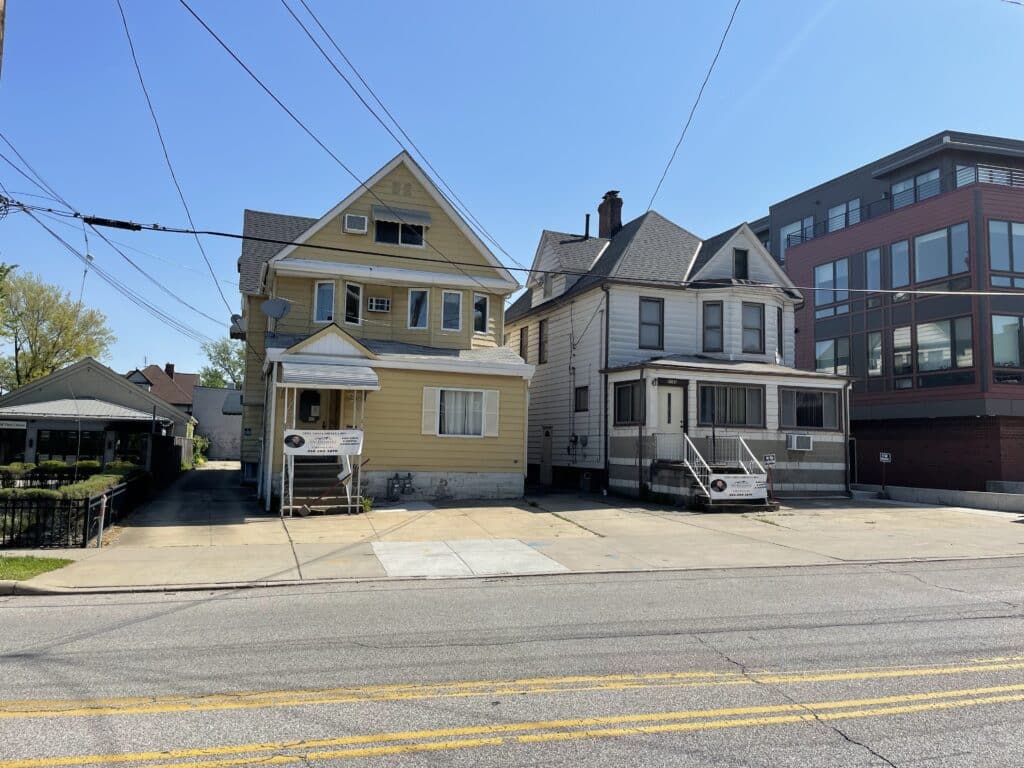
A developer is seeking to demolish two historic homes at Cornell and Random Roads in Little Italy and replace them with 14 new apartments. The proposal continues an accelerating trend of building rental housing in the neighborhood, and the community is pushing back on the scale and density of the project, even as the developer has revised the project to try to address neighborhood concerns.
The proposal, which was presented at the April 27 meeting of the Cleveland Landmarks Commission and updated at a May 4 Little Italy Block Club meeting, shows a mix of two- and three-bedroom units with parking located in the rear of the building. The building would be oriented towards Random Road but would also have a facade facing Cornell, Kevin Oliver of Oliver Architecture told the commission on behalf of developers Jeff Shoykhet and Carmen Ann Marino. (You can view the most recent version here.)
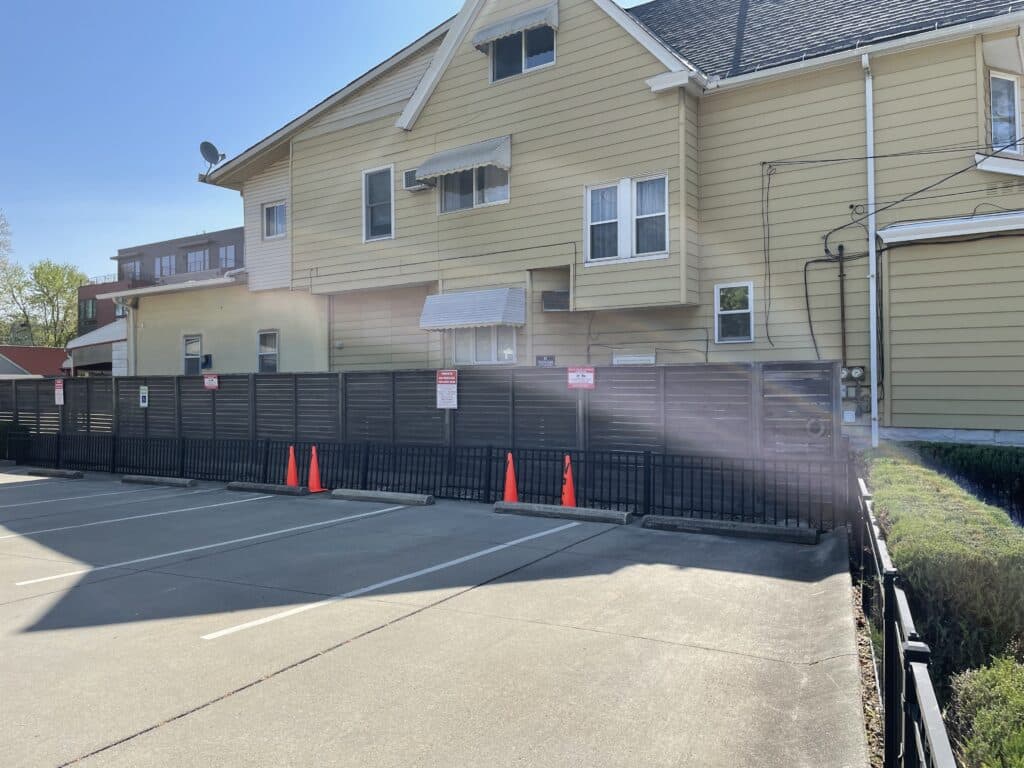
Oliver said the existing two-story homes on the property, which have been used as rental property for years, are currently “not in good shape” and much of the historic character of the homes has already been removed. As of May 9, the joint properties are listed for sale for $650,000 (sale pending) and are described as rental properties appropriate for “multiple tenants.” The current configuration of the property also includes a rear parking lot.

The design of the proposed building would include a brick facade, front porches, and balconies, and 15 parking spaces for 14 units, plans show. The driveway would be tucked behind the building facing Baricelli Apartments, a 44-unit apartment building that rankled some residents who thought it was too dense and modern when it was approved by the landmarks commission in 2019.
Karl Brunjes, a staff member with the landmarks commission, said that the local design review committee serving Little Italy “seems to be comfortable with the project, including the demolition, but it needs to be the right project.” The committee asked to know the cost of rehabilitating versus demolishing the buildings, wanted to see a salvage plan for the interior of the buildings, and would like the developers to consider adding two different colors of brick and presenting either one or two homes that front Cornell Road instead of Random Road.
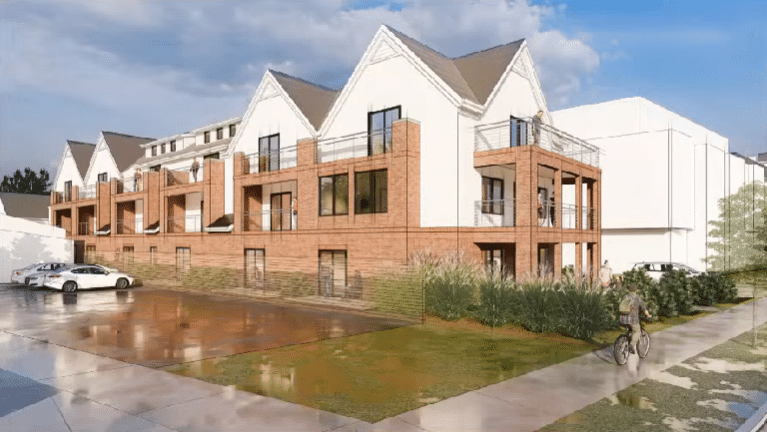
Little Italy Block Club members expressed further concerns, adding in public comments sent to the commission that they prefer to see owner-occupied housing over rental housing, that the design is out of context, that there’s insufficient parking and lack of green space, and that by demolishing the homes, the neighborhood is losing part of its history.
According to a 2015 study by the Levin College of Urban Affairs at Cleveland State University, at the time, 93% of the housing in University Circle and 82% of the housing in Little Italy is rental rather than owner-occupied. Since then, additional for-sale and rental projects have been developed in both neighborhoods. The CSU report argues that Little Italy should develop more owner-occupied housing to remain stable and position itself for the future.
“Planners and community developers need to strengthen and reposition Little Italy and control the future trajectory of the neighborhood,” the authors stated. “The demographic and property conditions assessments suggest that the area has the potential to attract more families and young people because of its assets and proximity to University Circle – specifically the Uptown district. However, there is very little vacant land available for development. The report recommends a number of programs and policies to guide neighborhood revitalization … They prioritize reinvesting in the housing stock, increasing the percentage of homeowners, and using the expansion of the Cleveland Montessori school and the new Greater Cleveland Regional Transit Authority (RTA) Red Line transit station to attract new residents – while preserving and enhancing the character that defines Little Italy as a special place to live and visit with historical and cultural significance.”
Brunjes expressed the opinion that restoration of the homes is unlikely here because “the costs of renovation are working against them,” but at least one landmarks commission member disagreed. “I’m really hesitant to demolish historic existing structures in an historic area,” commented Michele Anderson, who lives in Tremont. “I think we can set a precedent when we have these homes on these larger lots, that they’re worth more to remove and demolish than they are existing and contributing. I think if these homes were in a different area, on Franklin Boulevard or in the West Clinton historic district (in Ohio City and Detroit Shoreway), then they would probably be remodeled and re-sold as renovated single or two-family homes.”
She added, echoing residents’ concerns, “If we continue on this path we’re not going to have owner-occupied housing, we’re going to have student housing. I’m not supportive of the demolition.”
Arthur Hargate, a Little Italy resident who moved to the neighborhood from Cleveland Heights 10 years ago, said he had a similar reaction when he first reviewed plans at the Little Italy Block Club meeting in March. He cited the 2015 CSU study and said that too much of the new housing that is being developed is rental housing aimed at the student and young professional market, which doesn’t help stabilize Little Italy for the long-term as a diverse community.
“We’re adjacent to and a part of a college community, and I get the fact that rental is important for students and for University Circle,” he told The Land. “But in terms of neighborhood stability, we’d like to see wealth generated for the people who live here. We’d like to see more homeowners investing and homes being built that are reasonably affordable.”
The developers presented the Cornell Road Residences plans for conceptual feedback only and are now tasked with considering making changes in response to comments. According to Hargate, the revised plans the developer presented on May 4 respond to community concerns. “The developers have been responsive to community and Landmarks Commission input on the design in my opinion, and the look and feel of the structure now seem to be much more consistent with the overall context of the neighborhood,” he said in an email.
At this time, it is unclear when the project will return to the landmarks commission for final approval. The Land reached out to the architect and the Little Italy Redevelopment Corporation, which is the community development organization serving the neighborhood, to find out more about the designs and approval process, but we have not heard back yet.
View the most recent Cornell Rd. Residences proposal here. You can watch landmarks commission meetings on YouTube. To send questions, comments, and feedback to the Cleveland Landmarks Commission, email landmarks@clevelandohio.gov or call 216-664-2532.
Keep our local journalism accessible to all
Reader support is crucial as we continue to shed light on underreported neighborhoods in Cleveland. Will you become a monthly member to help us continue to produce news by, for, and with the community?
P.S. Did you like this story? Take our reader survey!