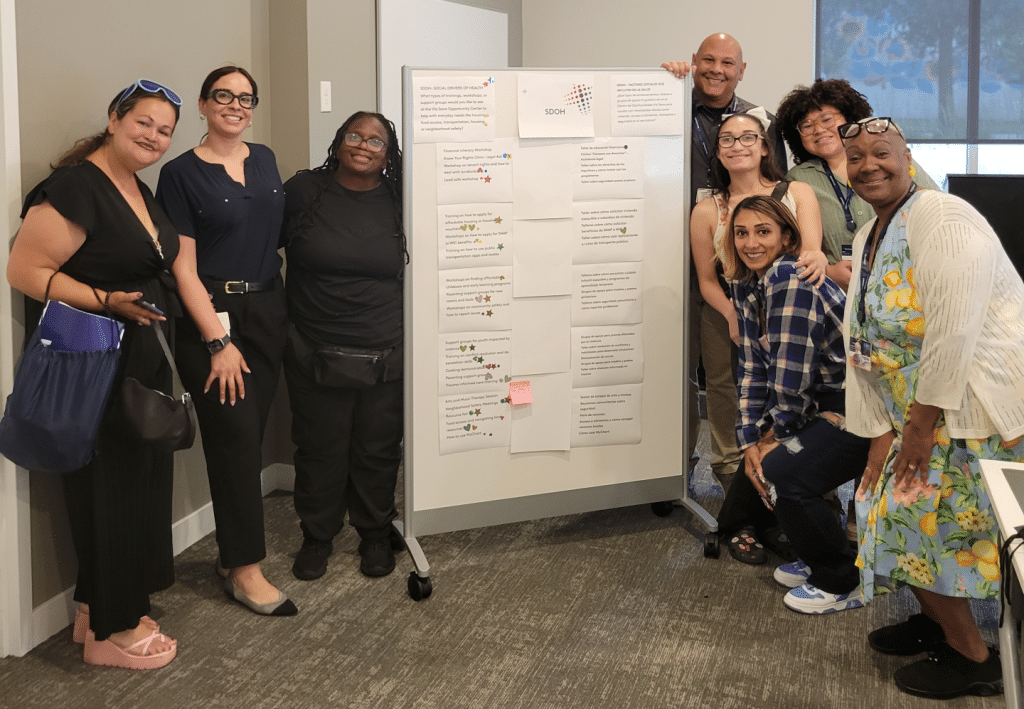
MetroHealth recently asked Clark-Fulton residents to help shape the future of community health and wellness — one workshop at a time. Through a series of Community Listening Sessions at its new Opportunity Center, the health system is using neighborhood data and resident feedback to guide programming that addresses the real-life needs of families in one of Cleveland’s near west neighborhoods — needs that include real-world issues like substance abuse, domestic violence, food insecurity and more.
On June 10th, the MetroHealth Institute for H.O.P.E. hosted its first Community Listening Session of the year, with two follow-up sessions on June 24th and June 28th. All sessions were held at the MetroHealth Via Sana Opportunity Center, located at 3335 W. 25th, the system’s new community hub that had its soft opening in the fall 2024.
Since its quiet launch at the end of last year, the Opportunity Center has become a vibrant community space, hosting more than 130 events and serving over 1,000 individuals. Events have ranged from a community baby shower organized by Planned Parenthood to Spanish dance classes for the community. The facility has also become a permanent fixture for one of the Cuyahoga Community College (Tri-C) Access Centers.

At the heart of these Listening Sessions was the goal of sharing key findings, specifically information collected between October 2022 and November 2023 — about Clark-Fulton residents’ health and social needs. More than 400 neighborhood surveys were collected. Attendees were asked to review and respond to findings around patient health factors, community vulnerabilities and MetroHealth’s social determinants of health data.
Community voices help shape programming
The first Listening Session was introduced by Marilee Santiago-Rodriguez, director of transformative knowledge and education at the MetroHealth Institute for H.O.P.E., who helped guide attendees through the data collection process and emphasized the Institute for H.O.P.E.’s goal of building community-driven programming.
“At MetroHealth, we identify ourselves as the guardians of health, guardians of hope, ” said Santiago-Rodriguez. “We take pride in being a public hospital that serves everyone, regardless of ability to pay. We are considered a safety net health system for the most at-risk members of our community. We are open and accessible to about 95% of Cuyahoga County. So, if you live in Cuyahoga County, we’re proud to say that you’ll find a MetroHealth facility within 10 minutes of where you live.”
Bridging the gap between care and daily life
At the heart of the Opportunity Center’s programming is the MetroHealth Institute for H.O.P.E., a department launched in July 2019 to bridge the gap between clinical care and real-world social factors affecting patients’ lives. Leveraging the expertise of professionals from across the MetroHealth system, the department’s mission is “to address the social determinants of health among our patients and communities to equitably improve health and quality of life,” according to Santiago-Rodriguez.
“Nearly 80% of a person’s health is shaped not by clinical care or genetics,” said Santiago-Rodriguez, “but by where you live, your socioeconomic status, education level, and habits.” The Institute of H.O.P.E was designed to deliver holistic and equitable care to help with these factors, she added. “We pushed doctors and clinical teams to think outside the box. We asked how can a doctor focus or pay more attention to the fact that he or she is prescribing a medication that requires to be taken with food and a patient may not have food at home. So we’re building that lens to think beyond just prescribing a medication.”
Programming at the Opportunity Center is set to expand as Institute for H.O.P.E. seeks to remain an institutional force behind the shift towards more community-based, preventive, and inclusive care.
Surveys ask “how can we help you?”
Starting in 2019, MetroHealth began screening all patients for social risk factors through a 22-question survey completed during routine medical visits. The survey asks patients about challenges they may be facing — such as food insecurity, housing instability or safety concerns. Then the survey ends with asking patients, “How can we help you?” according to Santiago-Rodriguez.
“We wanted to develop interventions or programs that are tailored to our patients based on what they’re presenting with,” said Santiago-Rodriguez.
The goal of collecting this data is not for the health care system to address every need alone, but to connect patients with trusted community partners who specialize in these areas, according to Santiago-Rodriguez.
“We are dependent on community-based organizations and partnerships,” she said. “We’re not the experts on how to solve for poverty. So it takes a village to address a lot of these issues.”
Patients’ needs that were identified through the survey included substance abuse, intimate partner violence, social isolation, food insecurity and housing challenges — demonstrating the wide range of non-medical factors that impact health every day.
Building community trust was the first step
In September 2022, MetroHealth was awarded a $350,000 grant through the Ohio Health Improvement Zone Initiative (OHIZ) initiative to identify the social needs of a single neighborhood. Clark-Fulton was selected due to the recent MetroHealth investment in its main campus and the coming Via Sana Opportunity Center. 1,200 people completed the survey – 404 of them residents of Clark-Fulton.
In addition to office visit surveys, MetroHealth had outside events to supplement its outreach within the community. It has partnered or hosted 24 unique events between October 2022 until November 2023. “We partnered with trusted community organizations,” said Santiago-Rodriguez. “This allowed us to build trust with both residents and community partners.”
Clark-Fulton data parallels citywide trends
The data presented by Metrohealth’s Institute offers a snapshot of Clark-Fulton community demographics and a portrayal of key local drivers of health. The data shows a comparison between the Clark-Fulton community and the broader city of Cleveland. Many of the health and socioeconomic vulnerabilities seen across Cleveland are closely mirrored in the Clark-Fulton neighborhood.
Coronary heart disease (9%) and diabetes (17%) rates matched citywide averages. Other indicators — such as SNAP benefit usage (42%), depression (27%), high blood pressure (38%), housing cost burden (57%), and overdose deaths (1.3 deaths/1,000 residents) — fell within five percentage points of city averages.
Clark-Fulton reported higher rates of violent crime, with 2,514 incidents per 10,000 residents — a figure well above the city average.
Demographically, Clark-Fulton’s population of 7,649, is evenly split by gender, with 50% male and 50% female residents. Thirty percent of residents are minors — 9% higher than the citywide average. The working-age population (18-64) makes up 60% of the neighborhood, compared to 64% citywide. Seniors represent 10% of the neighborhood, slightly below the city’s 14%.
Nearly half of survey respondents (46%) identified as Hispanic — well above Cleveland’s citywide average of 13%. This reinforces that Clark-Fulton continues to be one of the most densely populated neighborhoods with Hispanic families.
While the poverty rate is higher in Clark-Fulton, 87% of participants reported being employed. Despite this, many cited continued struggles with food access, utility costs, financial insecurity and housing stability.
Listening session feedback shapes the future
Residents provided direct input through sticker voting and post-it note suggestions across three themed boards during the sessions.
The Health Education Board revealed Listening Session Attendees’ strong interest in managing stress, anxiety and chronic illnesses. Attendees called for workshops on healthy cooking, diabetes management, understanding food labels, teen health and mental health support groups. There was also interest in grief and caregiver support, cancer detection and navigating the healthcare system.
The Workforce and Training board highlighted the need for GED tutoring, college prep and career-pathway programs in fields like nursing assistance, customer service, medical billing, IT support and food safety. Residents also requested specific partnerships, such as space for study groups for Cleveland State University commuter students or expos for independent healthcare providers.
The Social Determinants of Health (SDOH) Board drew attention to everyday needs. Suggested workshops included trauma-informed care, lead safety and youth support groups for those impacted by violence. Residents expressed support for moving MetroHealth programs like Daddy Bootcamp to the Opportunity Center and offering services like health screenings and preventive care workshops.
Health programs rooted in community needs
The Via Sana Opportunity Center features classroom and presentation spaces, as well as an industrial kitchen available for workshops and training sessions. The facility may become home to many nonprofit-led educational initiatives. It is also poised to expand health-focused programming through MetroHealth. During the Listening Session, residents voiced strong support for different offerings like support groups for youth impacted by violence, trauma-informed care workshops, and resources for those living with PTSD
Santiago-Rodriguez connected the feedback to existing resources: “We have a community trauma-informed educator at MetroHealth who can bring workshops to this space.”
There was also discussion about relocating MetroHealth’s existing “Daddy Bootcamp” program to Via Sana, alongside new offerings. “We want to promote wellness and preventative care through knowledge,” Santiago-Rodriguez added. “That includes workshops on nutrition, chronic disease management, diabetes care, cancer education,and mental health.”
In addition to education, the center could also host health screenings and outreach collaborations with various MetroHealth departments. “We want to break those cycles within our families,” Santiago-Rodriguez emphasized.
What’s Next for the Opportunity Center?
“If we can help improve the quality of life for an individual or an entire community, we’ll begin to see shifts in economic stability, educational attainment, lower poverty rates, and overall well-being,” said Santiago-Rodriguez.
Two additional Community Listening Sessions were held in June. Attendees were introduced to the staff that support the Via Sana Opportunity Center, including Kivin Bauzo, operations coordinator, and Rhonda Jones, administrative secretary. Both are key staff at the Opportunity Center who help lead operations at its sister site, the MetroHealth Buckeye Health Center located on Cleveland’s East Side. The Opportunity Center will host a community calendar of upcoming, onsite workshops and programs, according to Jones.
Community members or organizations interested in using the Opportunity Center space are encouraged to email mhopportunitycenter@metrohealth.org for more information.
We're celebrating four years of amplifying resident voices from Cleveland's neighborhoods. Will you make a donation to keep our local journalism going?