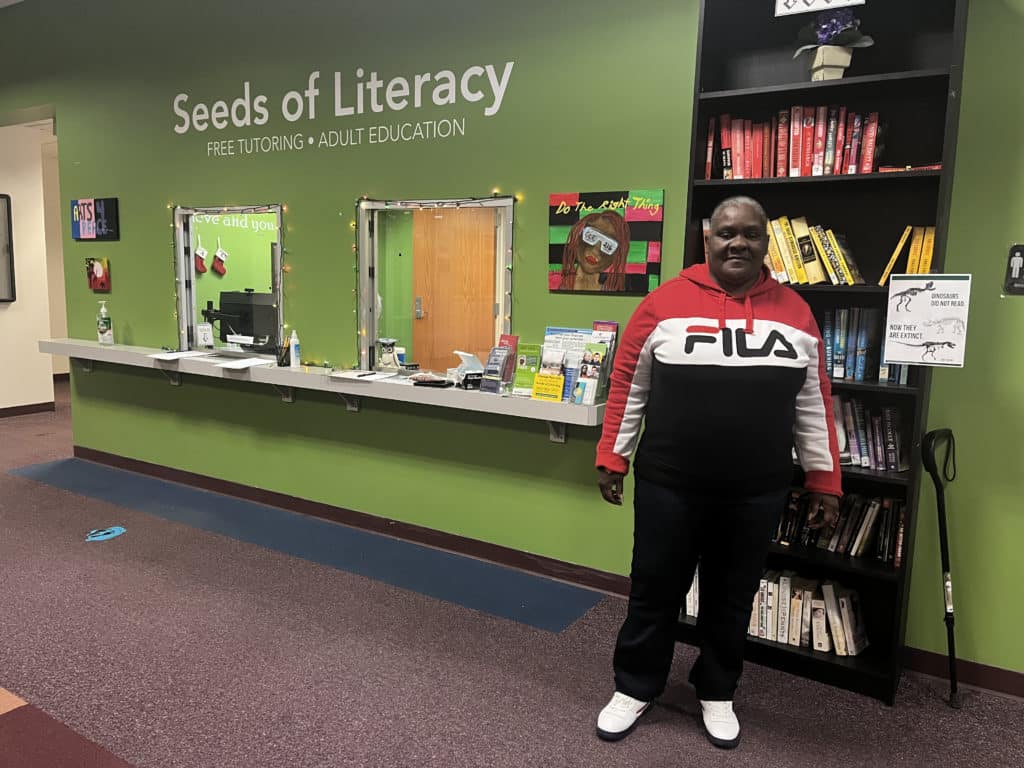
Rosie Walker gets up every Tuesday and Thursday knowing exactly where she’s going: class at Seeds of Literacy. She’s been attending GED tutoring there two days a week since January, and she says she has many favorite parts of Seeds, including her fellow students, tutors, and the weekly book club.
“This is the kind of place right here that will make you get up and want to come and be around people like this,” Walker said.
Seeds provides free one-on-one literacy and GED tutoring to adults at two locations: on the west side of Cleveland at 3104 W. 25th St. and on the east side at 13815 Kinsman Rd. The nonprofit, which is celebrating its 25th anniversary this year, has about 250 volunteer tutors and serves about 1,000 students each year.

Literacy and GED attainment is a necessary condition for many people to land jobs and advance their careers, and annual income increases with educational attainment, according to an August 2020 report from The Literacy Cooperative, a nonprofit that aims to address low literacy levels in Greater Cleveland. But for many people who rely on public transit as their primary form of transportation, getting to literacy and GED tutoring and job training programs is a barrier. Cleveland is one of the poorest big cities in the country, with a poverty rate of 29.3% in 2021, according to the U.S. Census; Seeds of Literacy students have a poverty rate of 88%.
When a student doesn’t make it to class at the Seeds east side branch, Kara Krawiec, the east side site coordinator, calls them to check in. From those calls, she realized that one of the most common reasons that students said that they couldn’t make it to class was transportation.
“I actually had a student tell me that unfortunately she’s had to make the decision, ‘Do I eat that day? Or do I buy a bus ticket to come to Seeds?’” Krawiec said. “It’s often a difficult barrier for students just to be able to physically get to our locations.”
Cars are expensive – but so is Cleveland’s public transportation
The many Seeds students who rely on RTA public transit as their primary form of transportation are not alone. About 23% of Cleveland households don’t have access to a car, according to 2020 estimates from the U.S. Census. A 2017 ValuePenguin analysis of the affordability of public transit in 73 cities ranked Cleveland as the fourth-least affordable city. In Cleveland, the median income of people who take public transit to work was $19,556, and riders who bought a $95-monthly pass spent about 5.80% of their income on public transit, the study found. In the most affordable public transit cities in the study, riders spent 1-2% of their income on transit.
Funding is also a major challenge for RTA, whose largest source of revenue is a 1% sales tax in Cuyahoga County, said Clevelanders for Public Transit (CPT) advocate Chris Martin. Ohio’s funding of public transit lags far behind most other states despite having the 14th highest ridership in the nation, according to a 2017 report from policy research institute Policy Matters Ohio. In 2018, the state ranked 42nd for per capita funding of public transit, investing $0.57 per person into public transit, compared to the national average of $58.69 per person.
In 2022, the U.S. Department of Transportation sent RTA $13 million more than its usual annual funding, but that money is earmarked by RTA for infrastructure – “it could go towards rail car replacement, bus replacement, improving railroad tracks, stations and maintenance facilities,” RTA spokesperson Robert Fleig told The Land in an email.
The pandemic also brought challenges, and RTA ridership and revenue from passenger fares are still down 40% from pre-Covid levels, said Rajan Gautam, RTA’s deputy general manager of finance and the board’s secretary-treasurer. Though RTA walked back fare increases scheduled for 2021 and 2022, fares have doubled over the past 15 years while service has been reduced over 25%.
Some literacy and workforce organizations, including Seeds, Towards Employment, and The Centers’ El Barrio workforce program, provide limited numbers of free RTA bus passes to those who need them, but these agencies say they lack the funding to do so consistently. Towards Employment has seen a high level of demand for bus tickets, including requests for bus tickets to get to job interviews, said Jill Rizika, the president and CEO of Towards Employment. Meanwhile, a partnership between The Centers and car-share service Sway Mobility that allows El Barrio workforce trainees to use an electric vehicle for free has shown some promise to improve transportation access to job training and workforce development.

How much do bus passes cost, and what discounts are available?
RTA partners with colleges and universities in the area, including Cleveland State University, Cuyahoga Community College (Tri-C), and Case Western Reserve University, to provide discounted bus passes to students through its Student U-Pass Program. Most of the participating colleges charge students a fee – typically around $45-60 per semester – to cover the cost of the U-Passes or include the pass as part of their student activity fees. At Tri-C, the college covers the entire cost of the passes, and students can ride RTA for free. U-Passes can be used for any travel by the student on RTA, not just transportation to and from class.
The U-Pass program is not currently available to students at Seeds of Literacy and participants in workforce training, though.
Outside of U-Pass, daily RTA passes cost $5 a day, with discounted rates of $2.50 for seniors, people with disabilities, and accompanied children ages 6-12; and $4.25 for K-12 students. A daily paratransit pass costs $7. Single trips are $2.50 ($2.75 for paratransit), with discounted rates of $1.25 for seniors and people with disabilities and $1.75 for K-12 students.
Monthly passes cost $95, $48 for seniors and people with disabilities, and $110 for paratransit. There are also seven-day passes available. You can find the full cost breakdown here.
The transit authority has historically provided a small number of discounted bus passes to a couple nonprofits, said RTA’s Gautam. The Business Volunteers Unlimited’s Homeless Stand Down event received 20 passes at a 50% discount, and the Summer on the Cuyahoga internship program received 95 all-day passes.
RTA is open to partnering with other organizations to provide free or discounted passes if the initiative aligns with the organization’s mission and values and complies with the board’s policies, Gautam said.
“It would have to be evaluated on a case-by-case basis, but I would love to be approached so that we can continue evaluating the need and how best we can meet it,” Gautam said.
As of now, “Seeds gratefully accepts donations of bus passes for our students,” said Krawiec, “and we continue to pursue a long-term solution with our friends at RTA.”
Providing free bus passes – with limited funding
Workforce programs like El Barrio, a Spanish-English job training program at The Centers, have also provided bus passes to help people get to jobs, training, and interviews. El Barrio led one of the eight Paradox Prize pilot projects, an initiative by the Fund for Our Economic Future that gave $1 million to efforts addressing transportation barriers to work.
In partnership with RTA, El Barrio used its $100,000 Paradox Prize grant to provide free monthly bus passes for people to use to get to work, job training, the grocery store, or anywhere else they wanted or needed to go. The monthly bus passes helped alleviate transportation costs and stressors for riders who may not otherwise have been able to pay the cost upfront, said Aysha Wilburn, who led the project.
The organization is no longer providing monthly bus passes through that effort, though. Like Seeds, it has a limited supply of bus passes to offer due to a lack of consistent funding for them, Wilburn said. The Centers’ Basic Needs Resource Center provides about 5-8 bus passes to clients a month. The resource center doesn’t keep track of what clients use the bus passes for, but Wilburn said she has two clients who are using bus passes for work-related activities.
The other part of The Centers’ Paradox Prize pilot project has continued, though. Clients can use a shared electric car from the car-sharing service Sway Mobility for free to get around. Only one person used the Sway car during the pilot project, but now about 10 people have used it, and The Centers has extended its agreement with Sway to use the car for another year.
The Centers’ car charges at the organization’s 4500 Euclid Ave. location when it’s not in use. Before using the car, clients take an online class going over the terms and conditions, and then they can download Sway’s app to schedule time to use it.
LaToya Edwards signed up to use the Sway car immediately after hearing about it from her career counselor at The Centers. She said she used the car about six or seven times a month last winter to get to her baby’s doctor appointments, job interviews and career events, and the grocery store.
“I had a car, and then it broke down on us. And it’s just me and my baby, so I didn’t have anyone to bring us food or things like that,” Edwards said. Without transportation, she was stuck. “For a couple months, we were just here toughing it out. And so I was made aware of that car, and it just really felt like such a blessing for me.”
Editor’s note: An earlier version stated that only colleges and universities are eligible to partner with RTA on its U-Pass program. Educational institutions can partner with RTA if they meet the transit authority’s criteria. The U-Pass discounts are premised around “underutilization of the riding privileges,” meaning RTA is able to provide the U-Pass discounted rates because not every person who is eligible for a discounted fare rate actually uses the service.
Keep our local journalism accessible to all
Reader support is crucial as we continue to shed light on underreported neighborhoods in Cleveland. Will you become a monthly member to help us continue to produce news by, for, and with the community?
P.S. Did you like this story? Take our reader survey!