
Does one vote matter in 2024? Cleveland activists say ‘Yes!’
In a state with some of the nation’s strictest rules, in an election year when democracy itself is widely seen as at stake, many Cleveland activists are boosting previous years’ efforts to register, turn out and educate voters.

Does one vote matter?
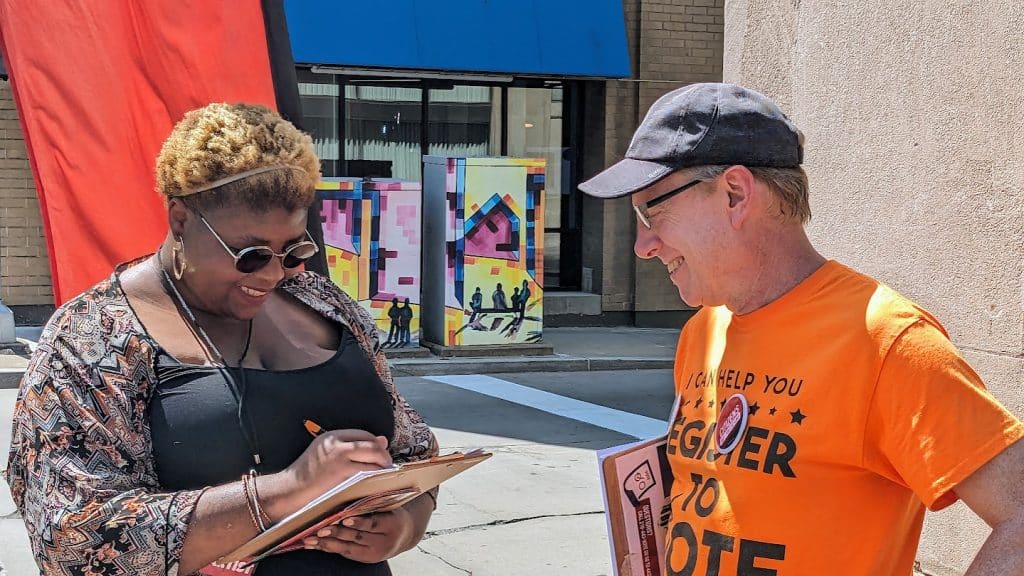
Updating her registered address during a festival at Zone Recreation Center, Marquesa Stephens says, “It makes a difference to at least show that we are paying attention. I can’t complain if you don’t see me.”
Updating her address during a festival at East Cleveland’s Pattison Park, Kathy Banks-Motley says, “You have no stake in the game if you’re not even trying.”
Applying for an absentee ballot during a festival at Playhouse Square, Jasmine Golphin says, “This is one step in a larger process to build the world I want to see.”
In a state with some of the nation’s strictest rules, in an election year when democracy itself is widely seen as being at stake, many Cleveland activists are boosting previous years’ efforts to register, turn out and educate voters. Volunteers and paid workers for partisan and nonpartisan groups are hosting voting parties, working doorbells, phones, the mail, concerts, naturalization ceremonies, schools, jails and homeless encampments, and finding other ways to give eligible people a say in our government.
They’re focusing on registration through Sept. 17, National Voter Registration Day, and continuing until 9 p.m. on Oct. 7, Ohio’s registration deadline. Then they’ll try to help registered voters cast ballots, driving them to vote, monitoring the polls, answering questions, and doing more through Election Day, Nov. 5, when the polls will be open from 6:30 a.m. to 7:30 p.m.
But these advocates urge you not to wait any longer. They want you to make a plan for voting right away, start to carry it out, and tell family and friends to do likewise.
Voting for democracy
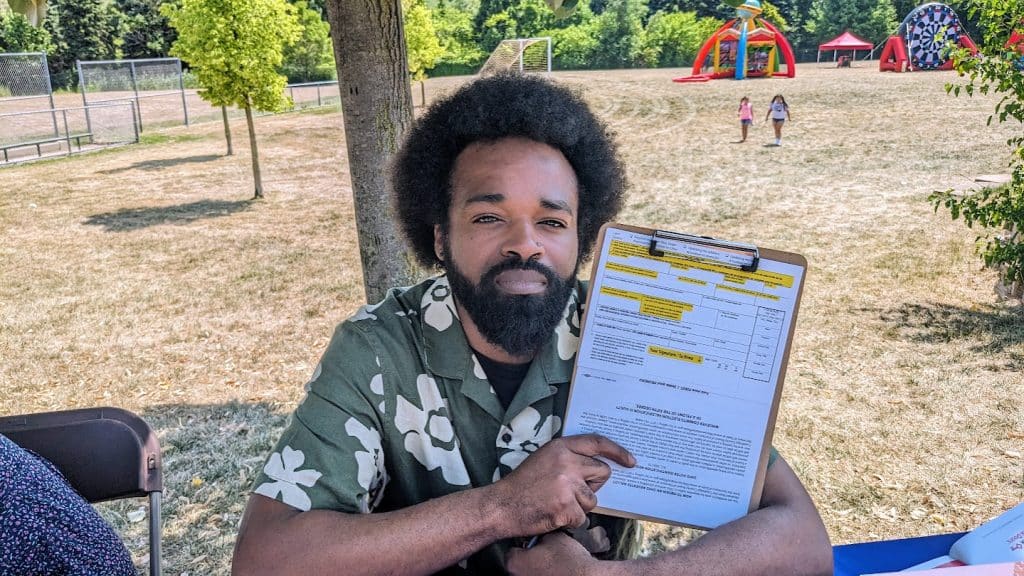
Advocates say voting is easy and essential. Bishop Chui, assistant director of Northeast Ohio Voter Advocates, says, “Voting is like the bottom line. It’s the very least a citizen can do to impact the things they care about.”
Alma Rodriguez, who signs up voters for the Young Latino Network, says officials “can’t be held accountable if you don’t do your own accountability.”
Chris Knestrick, executive director of Northeast Ohio Coalition for the Homeless, helps his clients exercise their right to vote. “It’s important that we practice this bedrock right of democracy,” he says, “especially at a time when it feels so fragile.”
It feels fragile because Republican leaders have tightened the rules for voting in Ohio and many other states, falsely disputed 2020’s results as confirmed by elections officials and judges from both parties, and failed to pledge to accept this year’s results. Former President Donald Trump and many supporters have been indicted on charges, and in some cases convicted, of staging or joining an attack on the Capitol to overturn incoming President Joe Biden’s victory, submitting false electors, or otherwise trying to thwart the voters’ choice. Many elections officials from either party who supported 2020’s outcome have been threatened, libeled, sent letters laced with fentanyl, or replaced by election deniers.
Prohibitions and purges
Last year’s Ohio House Bill 458 revised the list of acceptable voter identification documents, adding passports but eliminating mail, utility bills, government checks and anything else without a photo (except from religious objectors). Accepted documents must be unexpired, original and physical, not copied or virtual (except for a veteran ID card, which is always virtual). Your ID must have an Ohio address, though not necessarily a current one.
Among other changes, the bill sped up the deadlines to apply for absentee ballots, return those ballots and defend provisional votes. It cut ballot drop boxes to one per county. It eliminated early voting the day before the election. It also narrowed the list of people eligible to return someone else’s absentee ballot, but the U.S. District Court for Northern Ohio blocked that requirement in July.
In a statement praising HB 458, Ohio Secretary of State Frank LaRose said, “Ohioans are clearly supportive of strict photo ID for voting and we have found a common-sense way to make it happen that ensures voters are not disenfranchised.”
The bill was denounced by voter advocates. A joint statement by the Ohio Organizing Collaborative and others said, “HB 458 is a racially targeted piece of legislation that disproportionately attacks Black, brown, and naturalized Ohioans…. HB 458 is a deliberate and calculated attempt by Ohio Republicans to attack our freedom to vote and silence our voices at the ballot box.”
Soon Ohio might grow even stricter. A committee is weighing House Bill 472, whose new requirements include copies of absentee voters’ Ohio driver’s licenses or state ID cards.
Ohio has long purged the rolls of registered voters yearly. In July, LaRose’s office dropped 154,995 people, including ones who’d moved from their last registered addresses, been inactive for six years, or inactive for four years and unresponsive to notices.
The organizing collaborative calls Ohio’s purges the nation’s second biggest, behind only Georgia. Advocates say they’ve heard from many voters who believe they were wrongly purged. They urge anyone purged but eligible to register again.
LaRose said, “Diligent list maintenance helps prevent voter fraud.” But Republican, Democratic and nonpartisan elections officials, judges and analysts around the country have rejected claims of significant voter fraud. In 2021, the Associated Press found fewer than 475 potential cases of voter fraud nationwide in the previous presidential election, and few votes in those cases had been counted.
Mike West, community outreach manager for the Cuyahoga County Board of Elections, says that voter fraud is almost impossible to commit. Among its safeguards, the board compares signatures with records, compares ballots with stubs, compares the names of voters by mail with voters in person; keeps its computers offline and requires Democratic and Republican officials to use them together.
West says the Cuyahoga Board of Elections has never referred anyone for prosecution and would never do so for a simple mistake like wrongly claiming to be registered.
In August, LaRose’s office notified prosecutors in Cuyahoga and 19 other counties about possible cases of fraud. Spokesman Dan Lusheck said those cases mostly involved circulators of petitions.
The office also referred 597 alleged non-citizens to Attorney General Dave Yost for possible prosecution under election laws. But WVXU-FM Cincinnati reported in May that only one of LaRose’s 521 referrals of alleged non-citizens since taking office in 2019 had led to prosecution.
Advocates say that voter suppression motivates them and hopefully motivates voters. “The amount of effort that goes into trying to make it harder for everyday Ohio and American citizens to vote is evidence that our vote really matters,” says Elisabeth Warner, communications coordinator for the League of Women Voters of Ohio, which helps voters at www.vote411.org/ohio.
By the numbers
Cleveland registers voters at nearly the rate of the rest of Cuyahoga. In the last presidential year, 2020, 86.2 percent of adult citizens in Cleveland were registered versus 88.1 in Cuyahoga overall, according to researcher Mark Salling of Cleveland State University.
But Cleveland’s turnout tends to be much lower than the countywide one: 56.0 percent versus 71.0 per cent in 2020. Salling estimates that the city’s turnout ranged from 32.7 in Goodrich-Kirtland Park to 77.7 percent in Kamm’s Corners.
In a 2021 survey for Cleveland Votes and Policy Matters Ohio, Clevelanders said that they cared about election results but lacked information or comfort with the candidates. Advocates also blame Ohio’s growing Republican tilt, which reduces presidential campaigns in the state and turnout in heavily Democratic Cleveland.
Courtney Flynn, voter engagement manager for the Ohio Voter Rights Coalition, says that some registered voters fear going to the polls because many of those are guarded by police. Others fear jury duty. Jurors are summoned from the voter rolls by Cleveland Municipal Court and Cuyahoga County Court of Common Pleas.
Still, advocates think that turnout may benefit from a referendum on this fall’s ballot for an independent panel to create legislative districts that, among other things, would be more balanced politically. Aside from their contents, prominent referendums seem to boost turnout, as suggested by last year’s strong showing for referendums on abortion rights and adult-use cannabis.
Don’t assume you’re registered
Think your registration is current? Advocates say don’t think; verify. “It’s good voter hygiene to check your registration before you can’t do anything about it,” says Sue Dean Dyke, who leads Mobilize the Vote NEO.
You can register at the secretary of state’s office, 877-767-6446 (SOS-OHIO) extension 4. Or you can get a registration form at many other public facilities, such as the Cuyahoga elections board office, 2925 Euclid Ave., 216-443-8683(VOTE), city halls and libraries.
All U.S. citizens living in Ohio and turning 18 by Election Day can register now to vote unless they’re in prison for felonies. Most students in a dorm here can register at its address or their home addresses. Homeless people can register with the addresses they use for mail or other services.
The sooner you register, the sooner you can take a second step that advocates call essential: checking that your registration went through. If you registered online in Cuyahoga, you should be able to confirm it online the next day. If you registered on paper, the Cuyahoga elections board reports typically taking five workdays to post your registration online, a week to send you confirmation, and a couple weeks to notify you about any problems.
Among other reasons to check soon, not everyone who collects voter paperwork on the streets submits it to the elections board as promised. Erika Anthony, head of Cleveland Votes, says some people from out of town recently used her group’s name and asked voters for their full social security numbers, a clue to misuse. Ohio’s voter forms ask just for your social’s last four digits.
How to vote
You can vote by mail, vote early at your county elections board, or vote at your polling place on Election Day.
To get an absentee ballot, you must complete an application that reaches your elections board by 8:30 p.m. on Oct. 29. Starting soon, sometime in early September in Cuyahoga, absentee voters will be able to verify their applications and track their ballots.
Elections boards will start sending absentee ballots on Oct. 8 to voters who’ve already applied. A ballot must be completed and either postmarked by Nov. 4 or delivered to the board by 7:30 p.m. on Elections Day.
Military and civilian overseas voting begins on Sept. 20. See details at this link.
Early voting will take place at elections boards from 8 a.m. to 5 p.m. on Oct. 8-11, 8 a.m. to 5 p.m. Oct. 14-18, 8 a.m. to 6 p.m. Oct. 21-25, 8 a.m. to 4 p.m. Oct. 26, 1 p.m. to 5 p.m. Oct. 27, 7:30 a.m. to 7:30 p.m. Oct. 28, 7:30 a.m. to 8:30 p.m. Oct. 29, 7:30 a.m. to 7:30 p.m. Oct 30 through Nov. 1, 8 a.m. to 4 p.m. Nov. 2, and 1 p.m. to 5 p.m. Nov 3.
People with disabilities may vote early at curbside or with assistance. See https://www.ohiosos.gov/elections/voters/voters-with-disabilities/early-voting. Or they can vote on Election Day at curbside or with assistance. See https://www.ohiosos.gov/elections/voters/voters-with-disabilities/election-day-voting.
Registered Ohio voters who fail to update their addresses before the registration deadline may vote provisionally at their new homes’ polling places. So can anyone denied a normal vote for any other reason.
Want a ride to vote? Several groups will help, including RideShare2Vote.
Want to help work the polls? Contact your elections board.
Want to learn more about voting? Contact the secretary of state’s office, your county elections boards, the advocacy groups above or many other such groups.
Keep our local journalism accessible to all
Reader support is crucial as we continue to shed light on underreported neighborhoods in Cleveland. Will you become a monthly member to help us continue to produce news by, for, and with the community?
P.S. Did you like this story? Take our reader survey!
Related Articles

Watch Sherrod Brown, Jon Husted Northeast Ohio campaign stops [Video]
Get footage directly from the latest stops in Greater Cleveland.

Ohio voters rejected Sherrod Brown. Two years later, are they ready to give him a second chance?
The 73-year-old Democrat will need to win back voters in places that have increasingly turned Republican in recent years.
Cleveland to host public hearings on data centers, potential impacts
“We’ve worked with data center experts, compiled research, and visited data centers. Knowing what residents think about data centers is a critical part of what we need to understand.”


