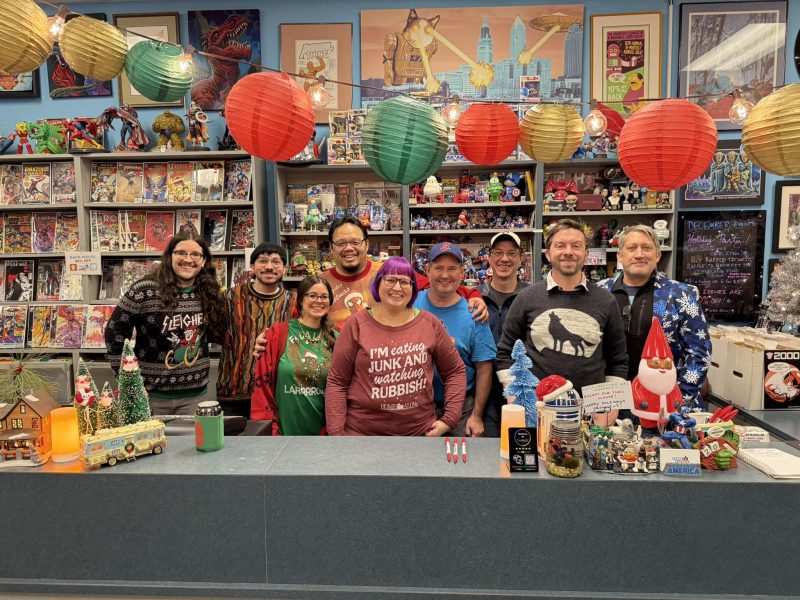
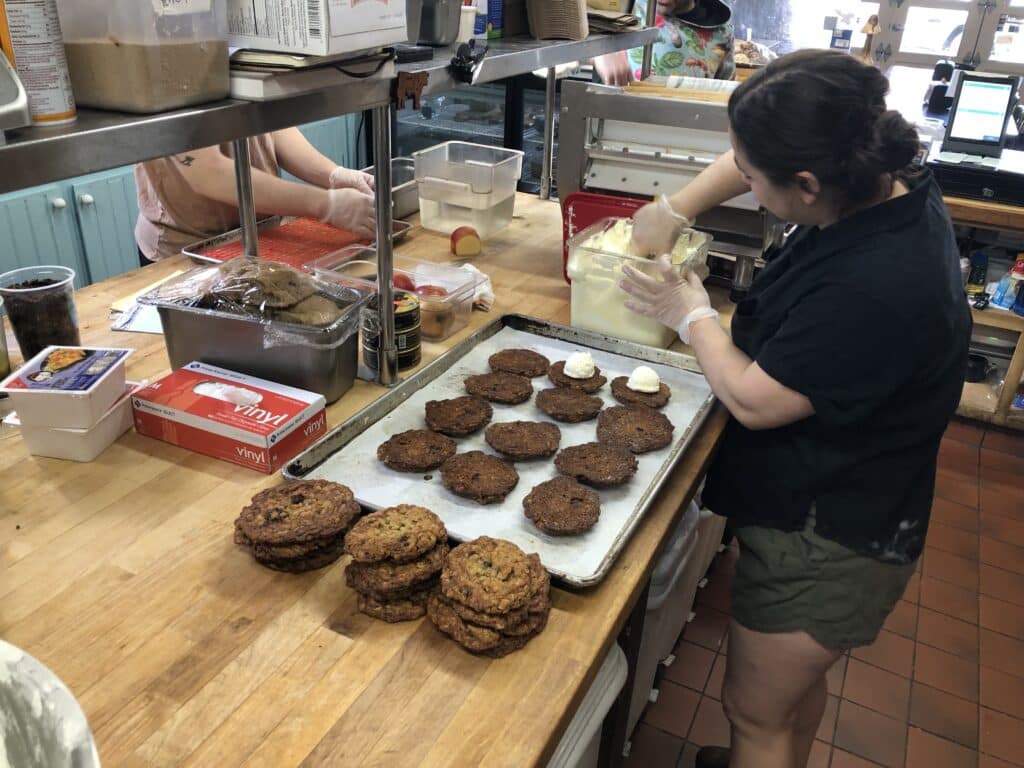
It’s easy to love a place like Larder. The Hingetown restaurant – opened in 2018 by chefs Jeremy Umansky and Allie La Valle-Umansky – welcomes guests with incredible smells of house pastrami, a counter full of enticing baked goods, and a friendly greeting from the staff.
The Jewish deli’s constantly rotating menu and innovative techniques have caught the attention of several national institutions and publications. This year, Larder was recognized by what is arguably the nation’s most prestigious food entity – the James Beard Foundation – with another James Beard Award nomination for Best Chef: Great Lakes. It marks the third nomination for the restaurant or its team in the five years since it opened.
We sat down with one of Larder’s founders, chef Jeremy Umansky, to talk about the philosophies and techniques that guide the restaurant, its Cleveland community, and how it feels to receive national recognition for the restaurant.

The following conversation has been edited for clarity and length.
How did you land in your location here on W. 29th St.?
It took us two years of searching. We wanted to recreate a delicatessen as you would’ve experienced it roughly 150 years ago in New York City or parts of Europe. We knew right away that we couldn’t put it in a new building. Originally we looked in the Heights, not even the city of Cleveland. A friend introduced me to Graham Veysey, who owns a lot of real estate around here. I was intrigued because they are developers living and working in the area they’re developing, which is so fantastic, I had never met anyone like that. Before we were here at Larder, it was Graham and his wife’s loft apartment.
When I came to check out the space I asked him if the floors are original: he said, “Mainly. The building is from the mid-1800s, the floors are from the 1890s.” I was like ok, sweet that works, close enough to 150 years. In Graham, we met someone who we want to do business with as opposed to a concept that we want to do business with.

So much of what you all offer at Larder is unique. When you order a dill pickle you might get a carrot instead of a (cucumber) pickle, for example. What inspires how you all approach food?
What we do is as traditionally rooted as anywhere you can find artisanal food – [traditional] producers rely highly on seasonality, they rely highly on the products they have close to them to be able to produce. The only reason we all associate cucumber with pickle is because at one point in time that was the vegetable we picked to start breeding for hothouse applications growing indoors in highly controlled environments. Cucumber was one of the first stabilized mass market produce items, going back 150 years to the industrial revolution. Across the world, people are making cucumbers (PICKLES) with carrots and all these different vegetables, because once the cucumber supply is gone you gotta make it with something else if you want a pickle.
What we do is extremely traditional, but done with modern sensibilities. For people who come in and think, “Wow, I’ve never had a kosher dill carrot,” it’s what they should have been having all along, but some big agricultural business entity, the market, or something in society conditioned you to think that a cucumber is what a pickle is. That’s not what a pickle is – that’s one type of pickled food.
People love when we make lamb ham or beef ham, especially people that don’t eat pork. They think it’s crazy, but Jews in Alsace [where it’s speculated the first large migration of Jewish people to Europe ended up] came up with these techniques 1,500 years ago. For 1,000-1,500 years, people have been making ham [cured leg meat] out of lamb and beef as others have made it out of pork. They had all these traditions of preserved, cured, and fermented foods. Traditional Jewish dishes, like tzimmes or cholent use these techniques. You can’t put culinary traditions in boxes. Today, I’m just a Jew making my version of Jewish food.
You all are constantly using your social media platform to lift up the people you work with or different things happening around Cleveland specifically. Can you talk about that?
That’s how we do business. We believe we’re only as strong as our weakest link. Any time you see us shout something out on social media – sometimes it’s people reaching out to us to share the platform, other times it’s just people whose work we love in the community we love. These are great things that we enjoy, so why wouldn’t we share it with everybody? We have a platform and a voice, and that’s how we want to use it. We don’t get paid for anything, it’s all organic.
We change our menu all the time, so we get to work with so many people in the community for things we put out in the restaurant. Whether it’s picking up ice cream from Mason’s or bagels from Cleveland Bagel, we want to point you to the great things happening around here. If you like something you try here that comes from a collaboration, you should go check them out, and if you like that, hey, here’s some other businesses you might like.

The restaurant also uses the physical restaurant as a platform for other businesses.
That’s part of it too. We met the people from A Bun Dance – they mentioned they had just moved here from China, though they’re originally from Cleveland and were looking to get things set up. We mentioned that we do pop-ups and asked if they’d be interested in the space. It worked out and was just what they needed.
This spring we’ll be taking a break to use our space for classes and some more events that we want to do. But this summer we’ll meet with some chefs and see who wants to use the space when we’re not there. We are open five days a week, but when we’re not there, the space should be used. The fee we charge people to use the space is tiny, just enough to cover the basic usage of the space.
Can you preview any of the special things you’ll be doing this spring?
The book I wrote about koji is being translated into Japanese, which has been a long time coming. We will celebrate five years of business at the end of April. I’m not sure what we’ll be doing yet. I would love to offer a special on our pastrami sandwich for our five-year anniversary, but I have to figure out the beef supply chain.
Your book is about koji, but a lot of people, myself included, don’t know what it is.
Koji is one of the oldest domesticated organisms on the planet – we domesticated koji in the same way we domesticated some animals or a plant like tomatoes, for example. Koji is a mold, very similar to mushrooms. It’s an important ingredient in the production of alcohol, miso, and soy sauce from almost anywhere in Asia. Anyone in the city of Cleveland with a soy sauce packet in their kitchen has koji around them on a daily basis, and they don’t even know it.
Most of the world’s population has been using koji – or whatever the word for it is in that culture – for a long time. For complicated reasons, after World War II we now use the Japanese word for it in the west, but literally India, Japan, Russia, the Philippines, even Australia have long relationships with koji molds. We’re a little late to the party.
To explain what koji does simply: koji is a mold that can turn foods that can’t be naturally fermented into foods that can be fermented. You also use it to brew alcohol … brewing alcohol is a powerful tool to create safe drinking liquid when as recently as about 175 years ago drinking water from a random source could make you sick or kill you.
So what does koji do? It eats rice in a way that breaks apart the complex carbs into simple sugars, so that yeast can eat rice to create alcohol. It changes the properties of starches, proteins, and fats into new compounds. If all of these things are locked up in a kernel of rice, corn, or a bean for example, our bodies can’t process them and we can’t get all of their nutrients out of them. Cooking helps us with it, but not all the way. We can’t get everything we need out of them … koji can help us with that.
Anyone who isn’t a cheesemaker or a charcuterie maker growing mold on foods will say it’s gross to use mold, but here at Larder we slather it on everything and make it really delicious for you.
What makes eating at Larder different?
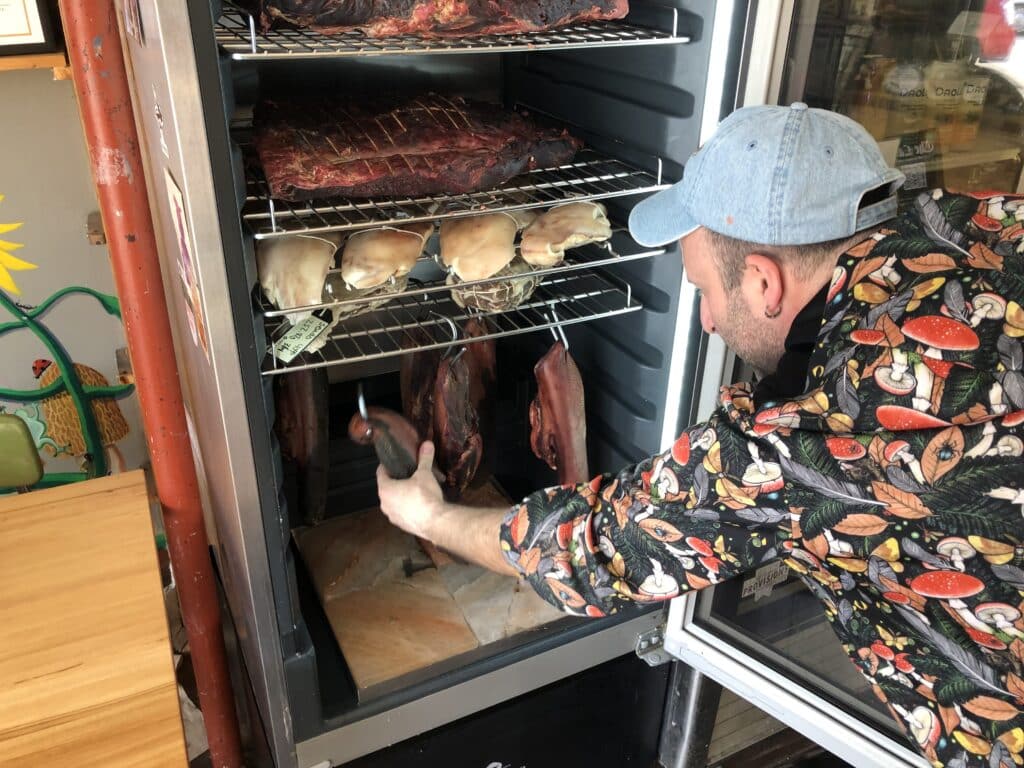
Someone coming into Larder needs to be a responsible eater. A responsible eater is someone that understands where their food comes from. Animals are filled with guts and have heads and eyeballs; plants have parts we’ve been told we’re not supposed to eat. When you walk into Larder right now I have pig necks, cow shoulders, cow tongues all sitting in a fridge in the middle of the dining room.You could be eating a sandwich, and they’re staring you in the face.
One time recently in the deli case we had our re-creation of a 16th century stuffed game bird. Using the recipe of a famous French chef, we processed parts of the chicken that people wouldn’t think are edible, made a meatball out of them, and used that to stuff the chicken, … Of course, some people love it, some people hate it.
My crew needs to understand the historical precedents for using ingredients, why we cook with them, and present a story. We take something out of antiquity and recreate it so there’s a holistic view of what we’re doing with our modern sensibilities and ingredients. You will see eyeballs and heads in our food – it’s not boneless, skinless chicken breast, sorry.
We have been mass-market indoctrinated to think there’s only one way to eat food. Why have we ended up eating things the way we do? If you look at old illustrations, Renaissance paintings, the way that we eat apples has changed. Why do they have to have perfectly shiny skins, why can’t we eat the stem? Why do you have to peel a potato for anything? Why do we have to peel an onion for anything? These are the things we examine at Larder.

What’s in the future for Larder?
We’re ahead of schedule on paying off the debt we took on when we opened Larder. Once we are debt-free as a business we will open other businesses. There might be a restaurant there, it might be other food-based businesses – they will definitely be things that Clevelanders can enjoy. We never wanted to open other businesses with existing debt because we’re small businesses entrepreneurs – we want to create sustainable long-term businesses that can take care of themselves. We have been getting a lot of questions about what might be next, and we’ve been looking at other spaces in other parts of town. Things are coming, and we are excited!
What does success for Larder mean for you?
Success for my wife and I is creating generational wealth, a goal for any entrepreneur and their family. We also want to provide long-term, good employment for our employees. Someone has to orchestrate and lead, but we’re all working together. It’s a distinctly small-business mindset, we employ people – people who become part of our friends and family, as opposed to being replaceable parts. We want them to be healthy and successful, and that means we have to pay them a good rate and take care of them. And you know what? They want to show up to work, they want to be here, they work hard, they don’t want to mess things up. I can step away and not worry about the quality of the food being served.
Can you tell us what it was like to be nominated for the James Beard nomination this year?
It’s awesome. You don’t get into business thinking you’ll conquer the world. You go into small business to provide a livelihood for you and your family. We are focused on making the most delicious food we can all the time. When something like a James Beard happens I get hit with disbelief, I deal with imposter syndrome. I feel like I’m just at my 26-person restaurant making sandwiches … I can’t find the words to express the awe and gratitude I feel.
I want people to know that the restaurant is not just me. I couldn’t do anything at Larder by myself. Larder is a team. My chefs cook way more than I do; I am frequently balancing books or even just greeting people. Everyone at Larder does everything, so that means some days I’ll get through the day without even making a pastrami sandwich, like today. People should know that Larder is more than the sum of its parts and is a united, team effort.
Larder is located in the Ohio City Firehouse at 1455 W. 29th Street, Cleveland, and can be reached at 216-912-8203. The restaurant is open Tuesday through Saturday 12 p.m. to 6 p.m.
Moses Ngong participated in The Land’s community journalism program.
We're celebrating four years of amplifying resident voices from Cleveland's neighborhoods. Will you make a donation to keep our local journalism going?