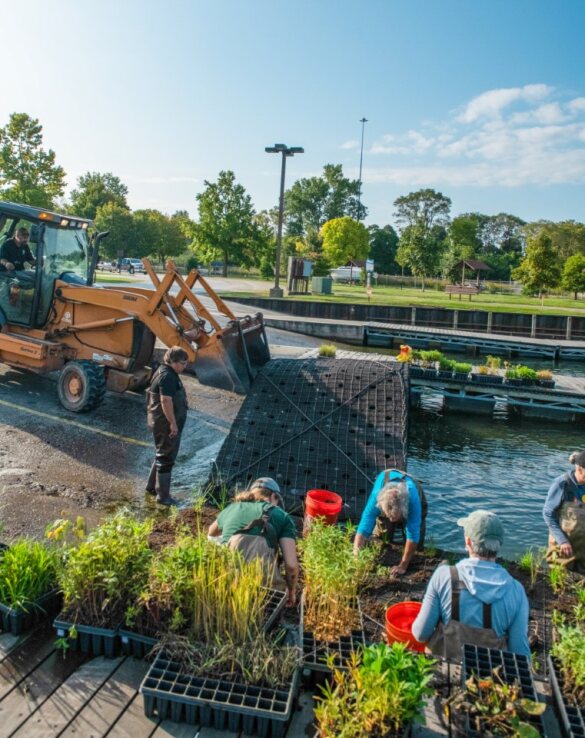
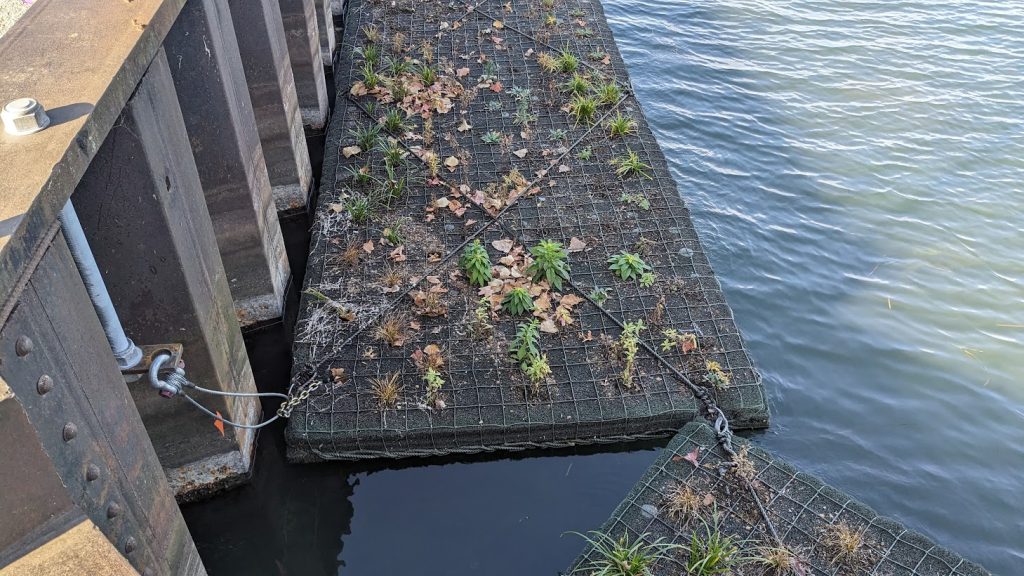
When Cleveland’s sporadic sunshine makes Lake Erie gleam, it’s easy for onlookers not to notice 10 little rubber mats floating in the shadow of Gordon Park’s concrete bulkhead.
But the fresh soil and baby plants on the new mats — in essence, floating wetlands — are a modest early step in an ambitious, decades-long CHEERS (Cleveland Harbor Eastern Embayment Resilience Strategy) project, which aims to make the lakefront more natural and more accessible to east side neighborhoods.
These mats are 19.5 feet long, 9.5 feet wide and about 8 feet deep. They’re miniscule compared to the 75 to 80 acres of shoreline officials plan to add from the East 55th Street Marina through Gordon Park in the project. But park experts say the mats will play a valuable supporting role in making the harbor greener and prettier.

Installed in September, the mats are expected to capture pollution while attracting microorganisms, insects, fish, birds, and mammals, such as deer and coyotes, performing the same role as wetlands, which are areas where water covers the soil that harbor biodiversity. Many such species have shown up at even smaller mats installed in 2017 and 2018 along the western bulkhead of the Cuyahoga River in the Flats. Mallards have nested there, turtles basked, and muskrats and weasels clambered on top.
Valerie Carter-Stone, Metroparks natural resources area manager, said of the new mats, “It’s not hard to imagine these becoming a fully functional base for the food web,” with a wide range of animals and organisms using it and feeding off each other.
Carter-Stone hopes these mats whet visitors’ appetites for CHEERS’ bigger improvements. “Our goal is to give the public an idea of what a softened shoreline looks like,” she said — that is, a more natural, gradual, curvy one than normal bulkheads and docks made of wood and concrete that block people from accessing the lake.
CHEERS should build on the success of the adjoining Cleveland Lakefront Nature Preserve, known as Dike 14, which opened to the public on a former landfill in 2012. The area draws many migrating birds, bats, and butterflies, but because it’s a nature preserve, it doesn’t accommodate swimmers, dogs, or strollers, as the CHEERS project will.

The mats were funded by $64,000 from the state’s H2Ohio water quality program, which aims to use a collaborative approach to clean up water systems across the state, and $5,000+ in staff time from the Metroparks. They were made by Martin Ecosystems of Baton Rouge, LA., which has created similar ones for shorelines elsewhere.
Martin’s website says, “Floating Treatment Wetlands are a green, innovative, and cost-competitive solution … restoring your water body’s health, beauty, and function.”
The mats were installed on two Saturdays in September by park workers and volunteers. They were trucked there, then towed by boat and tied to the bulkhead in a fairly sheltered part of the cove. They contain more than 130 plants from 24 species.
You can look at the mats. You can cast a fishing line over them. But you’re not supposed to touch or step on them, because that would disturb the plant and animal life that they’re supposed to protect.
Next summer, Gordon Park’s harbor will be used for the Pan-American Masters Games, which will draw older international competitors in many sports. The mats will be temporarily moved nearby.
The Cuyahoga River’s mats float on the shoreline side of the Scranton Road bulkhead just north of the Hope Memorial Bridge. Officials say they’re doing well on balance. At times, rising waters have washed some of them downstream, but a few have been recovered and returned with little damage.
The Fowler Family Foundation recently gave $25,000 to put floating mats by the Metroparks’ water taxi dock on the East Bank in the lower Flats. Jennifer Grieser, Metroparks director of natural resources, says those mats should help block garbage on that busy stretch of the river from drifting toward the dock.
The CHEERS project, currently in the design phase, is expected to cost about $300 million, much of it from grants. As currently conceived, it will add trails, play spaces, fishing sites, overlooks, a 36-acre island, and a footbridge to an area bordered by Burke Lakefront Airport to the west, Cleveland Lakefront Nature Preserve to the east, and extending north to the breakwall and south to Interstate 90.
According to the Metroparks website, CHEERS will “work to heal damage done by past unjust developmental practices and industrial use.” Brian Zimmerman, the Metroparks’ CEO, has said, “This project will create a resilient shoreline, improve quality of water and habitat, and eliminate barriers that have long separated Cleveland’s east side communities from the lakefront.” The project should also buffer nearby I-90 from the region’s increasingly harsh storms.
The Metroparks’ partners in CHEERS include the city of Cleveland, Port of Cleveland, Ohio Department of Transportation, Ohio Department of Natural Resources, and Black Environmental Leaders.
Nearby, the Metroparks have leased South Gordon Park from Cleveland and recently razed the old aquarium there. They are also building a Euclid Creek Greenway from the inland section of Euclid Creek Reservation to the lakefront. They opened the trail’s northern section this month. Overall, they hope to create a bigger network of parklands in the area, better connected to each other and to residents.
For more information about the CHEERS project, visit their website. To learn more and share your ideas for the future, attend the CHEERS Community Open House on Dec. 2. More information on the Open House and tour registration can be found here.
Keep our local journalism accessible to all
Reader support is crucial as we continue to shed light on underreported neighborhoods in Cleveland. Will you become a monthly member to help us continue to produce news by, for, and with the community?
P.S. Did you like this story? Take our reader survey!