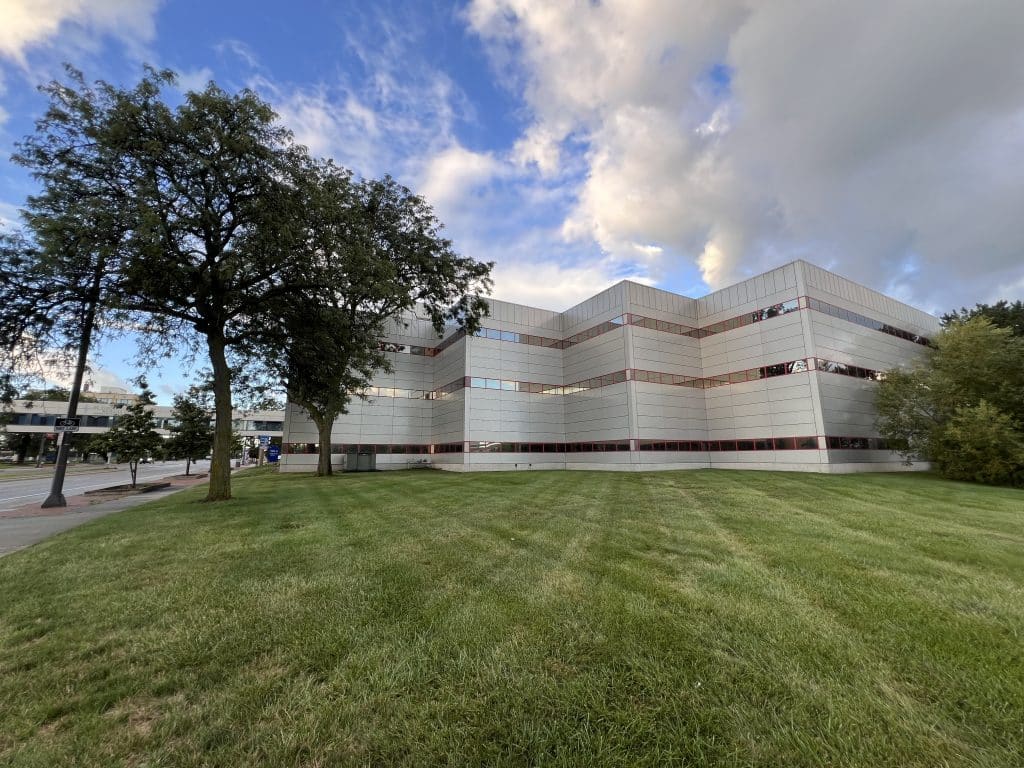
Cuyahoga County Council is withholding $7 million in funds for a mental health and addiction crisis center proposed for the former site of St. Vincent Charity Hospital on East 22nd Street.
The money would go toward project start-up costs and construction, which involves gutting and renovating a medical office, one of the few remaining buildings on the St. Vincent campus.
Council members have raised concerns about how the center would pay for annual operating expenses once the building renovation is completed.

Council President Dale Miller said that council is working with the project’s three partners to gather additional information about the center’s budget and finances, according to July 27 council meeting minutes.
The partners are the Alcohol, Drug Addiction & Mental Health Services (ADAMHS) Board of Cuyahoga County; The Centers, a provider of behavioral health services; and the county’s Department of Public Safety & Justice Services.
Council may vote on the proposed appropriation at its next meeting, which is scheduled for Sept. 9.
When asked if the mental health and addiction crisis center can move forward without the county funds, and whether they were making progress in talks with county council, the ADAMHS board, The Centers and the county administration issued a joint statement:
“(We) are working closely to address County Council’s questions about the new behavioral health crisis center. Ultimately, it is up to Council to determine when legislation supporting the $7 million investment moves forward.
“As with most development projects, delays can affect the timeline, especially if other funding sources must be explored,” the joint statement said. “However, we remain committed to advancing the project to ensure this vital resource meets our community’s mental health and addiction recovery needs.”
The center was scheduled to open in September 2026.
The estimated cost of the building renovation project is $30.9 million. So far, the project has secured $18.6 million in funding, including $6.8 million from the Ohio Department of Mental Health & Addiction Services and $2 million from the ADAMHS board.
If county council approves the $7 million, the project would still need an additional $5.3 million.
“We feel strongly that we can close that gap,” Brandy Carney, the county’s director of public safety and justice, told county council’s Safety & Justice Affair Committee July 15.
The as-yet unnamed crisis center would be open 24 hours a day, seven days a week for those dealing with urgent mental health and addiction problems. The center would include detox and crisis stabilization services and would help connect patients to long-term care.
The idea is to take pressure off emergency rooms and jails, which is where many people with mental health and addiction crises end up.
“We know that the ERs are currently getting hit with a lot of behavioral health issues,” Eric Morse, CEO of The Centers, told the county council committee July 15. “This will alleviate that push in the ERs and get them in the place where they can get the best care possible.”
Although the committee voted 3-0 to recommend approval of the $7 million in funding, members expressed misgivings, one of which was how the center would pay for year-to-year operations.
“We’re taking a leap of faith here,” committee chairman Michael J. Gallagher said.
Carney said the administration would return to council in the future and ask for $12 million in operating funds for the center’s first three years.
However, Carney added that operating money would come from other sources, including the ADAMHS Board and Medicaid reimbursements.
“We’ve been very clear from the beginning . . . this is one-time (operating) money, but it’s not just our (county) funding,” Carney told the committee. “There are multiple funding providers.”
The peer approach
The center, at 2322 East 22nd Street, would be the first of its kind in Northeast Ohio. Anyone experiencing a mental health or addiction emergency would be able to walk in any time for help. About 100 psychiatrists, nurses, social workers and other professionals would staff the three-story office.
“Peers” who have suffered from and overcome mental illness and addictions would also be part of the paid team.
“That is a movement within the behavioral health system,” said Scott Osiecki, CEO of the ADAMHS board until he retired Sept. 1. “It’s really important for people who have lived through it to talk to people who are undergoing a crisis, to say I have been there before and we can work through this and support you.”
Morse said employing peers in a center like this is new in Ohio, but according to the U.S. Substance Abuse and Mental Health Services Administration, it has become a best practice in other states, including Arizona, Delaware, Louisiana, North Carolina and Virginia.
“It really does change the dynamic on the floor,” Morse said. “You can keep people engaged and keep track of when they’re starting to ramp up. Peers can talk directly about what it was like and what to expect, which helps keep people calm and engaged.”
Carney said the center, because of its focus, would give help faster than a hospital emergency room for behavioral health patients and addicts.
“So often people who end up in emergency rooms with mental crises are told to wait because the medical facility understandably has to triage situations, and someone bleeding out has priority,” Carney said.
“Now they can walk in with a mental health or addiction crisis and there’s an urgent care specifically for them, and before they leave they can have a prescription if they need one,” Carney said.
Morse also stated that in communities where such crisis facilities were opened, about 83 percent of the patients who enter are discharged quickly and safely
Morse said that based on Cuyahoga County’s size, between 14,000 and 20,000 people need services that the proposed center would provide every year. The Centers has estimated that the city will treat about 17,000 county residents annually.
“One thing that came out of the pandemic is that people became more aware of behavioral health issues and the stigma is decreasing,” Osiecki said. “People are more willing to talk about it and seek help. That’s another reason why the crisis center serving as a front door to our system is so important.”
Floor by floor
The center has been designed by CPL, a national architectural firm with headquarters in Fairport, New York and a Berea office. Infinity Construction in Warrensville Heights would handle the construction.
The first floor would contain a walk-in urgent care wing. Patients would not need an appointment to talk to a counselor and/or peer supporter and receive treatment and medication as needed.
The urgent care section, unlike medical emergency rooms, wouldn’t have beds for patients but 40 reclining chairs. The layout is called the “living room model.”
“We hear from other centers like this across the country that up to 80 percent of clients can stabilize there,” Carney said. “There is a low amount of seclusion or restraint, a lot of that due to things like peer supporters engaging with people, and people feeling more comfortable.”
A 16-bed inpatient unit for those needing longer-term psychiatric care and a 13-bed detox unit for people with addictions would take up the second floor.
Finally, the third floor would have an outpatient-services department. Patients would receive counseling, case management and referrals to other agencies for ongoing care.
The center would also include two locked rooms for those sent from the courts for evaluation and a pharmacy, a key component.
“A lot of times, if the pharmacy isn’t onsite, patients won’t get the prescription filled,” Osiecki said.
Outside, Infinity Construction would add a car drive-up area. There would also be two additions, one for police and ambulances, the other for food and supply deliveries. Outdoor gathering space for patients in the longer-term care units would sit atop the ground-floor additions.
Central location
It’s appropriate that the behavioral health and addiction crisis center would be on the former St. Vincent campus. Before it closed in 2022, St. Vincent for years had the area’s only psychiatric emergency department.
“The first responders in Greater Cleveland always knew that location on East 22nd was the place to take people suffering from mental crises or issues,” Osiecki said.
“That’s why we were so excited when this location came up because the community already knew that a psychiatric emergency room had been there,” Osiecki said. “It’s a viable area. It was close to the highways and easy to reach.”
In March 2024, The Centers purchased the medical office building next to St. Vincent. The plan was to move its operations there from Euclid Avenue. Then Osiecki at the ADAMHS board contacted Morse about transforming that building into the crisis center, and Morse agreed.
The gutting of the medical building was completed in May. Construction was waiting for city of Cleveland building permits before county council balked on the $7 million in funding.
“This (center) is a great opportunity for the county,” Carney said.
Keep our local journalism accessible to all
Reader support is crucial as we continue to shed light on underreported neighborhoods in Cleveland. Will you become a monthly member to help us continue to produce news by, for, and with the community?
P.S. Did you like this story? Take our reader survey!