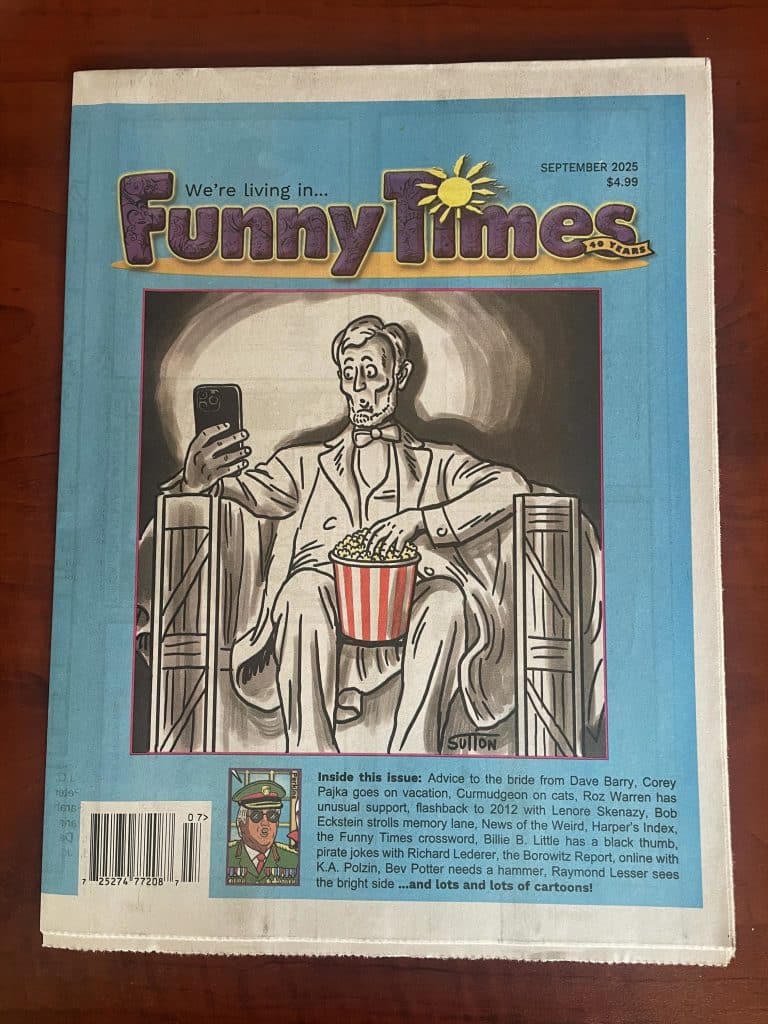
Forty years after Cleveland’s popular Funny Times debuted, its creators say that the times need mocking more than ever.
“Funny Times is newly relevant as the Trump presidency generates ever more shocking headlines to poke fun at,” says a press release honoring the anniversary and announcing the periodical’s first podcast, which debuts Oct. 3. “The left-leaning publication has always punched up.”
Ray Lesser, who founded and owns the Funny Times with his wife, Sue Wolpert, adds, “The right wing likes humor that punches down. We want to make fun of the rich and powerful who are trying to shut our democracy down.”

Lesser sees an example in the media moguls handling of liberal wits Stephen Colbert and Jimmy Kimmel. “You can see how important and valuable humor is by the fact that guys are so afraid of it that they’re trying to shut down the best humorists in the country.”
The Funny Times is one of the nation’s oldest surviving printed humor periodicals and, founders say, probably its most circulated, with about 45,000 subscribers. It has showcased many of the nation’s best-known humorists, some of whom have lived in Greater Cleveland, including Harvey Pekar, R. Crumb, Peter Kuper, Andy Borowitz and John “Derf” Backderf. The periodical has given early national exposure to popular creators such as writer Chuck Shepard of “News of the Weird.”
In the October issue, a cartoon by Jen Sorensen showed a Homeland Security agent telling a tourist from abroad, “In 2018, you liked an Instagram comment critical of the president’s necktie… Another terrorist!” In the September issue, Brian McFadden portrayed a “Fascism Career Fair” with opportunities like “Thought Police” and “Undercover Travel Agent” — in other words, a masked ICE agent, who says “Hope you like gulags!”
But the Funny Times mocks much more than politics. In October, Dave Coverly depicted a pumpkin saying about a pie, “It’s how he would have wanted to go.” Lynn Hsu showed a skeleton at an easel asking a nude model, “So, are you going to strip?”
The Washington Post has called The Funny Times “absolutely essential to understanding the human condition in this postmodern era.”
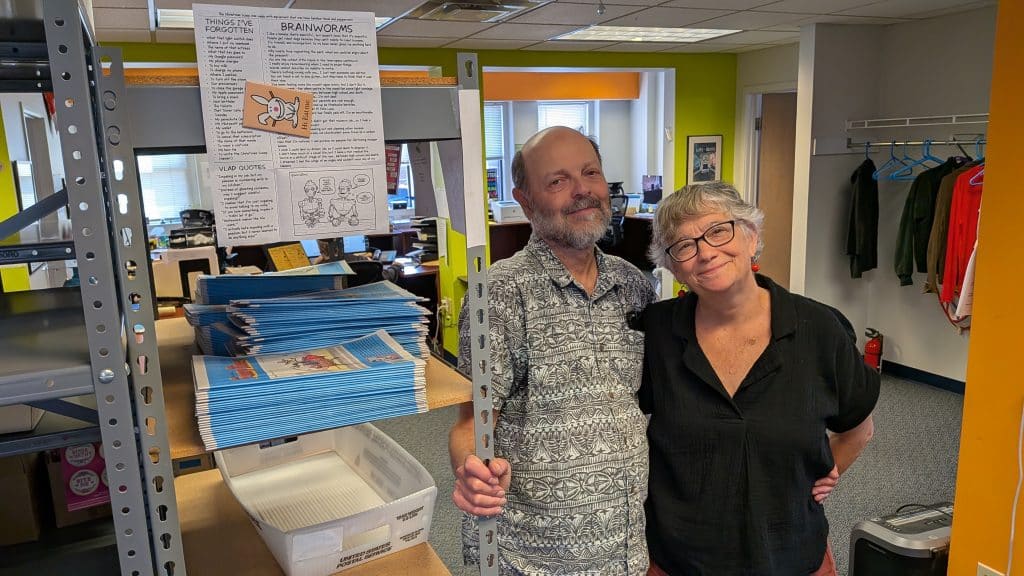
The publication is based at a small two-story office building that Wolpert and Lesser own at Cedar and Lee in Cleveland Heights. A full-timer and eight part-timers prepare the newsprint tabloid 10 times per year. Each issue has four color pages and 20 black and white ones. Each features more than 100 cartoons and at least 12 written pieces.
Some materials are unsolicited, and some solicited ones are original, but most are reprinted from other outlets. “We’re sort of the Reader’s Digest of American humor,” says Lesser. “We find the best stuff out there.”
Who are the Funny Times’ readers? In a preview of the first podcast, editor Mia Beach fondly calls them “a motley crew of hippies and housewives, geezers, goofballs and a handful of very precocious fifth graders.”
How it began
The periodical’s founders met at Heights High. They helped to start an alternative program there and graduated in its first class. Lesser also helped his father, who distributed comic books, candy and other goods. Wolpert’s father owned a company that wrote business reports and compiled a sort of Reader’s Digest of economic data and forecasts.
The couple spent a few years farming near Athens, Ohio. Meanwhile, Lesser took a comedy writing course at Ohio University and performed a routine there as a banjo player named “Abner Melody.” Wolpert studied occupational therapy and organized food co-ops. She also had a stillbirth. She feels that all those experiences helped prepare her for the Funny Times, which provides what she considers preventive mental health therapy for her and the readers.
The couple returned to Cleveland Heights to take care of Wolpert’s ailing father. They created the Funny Times in their living room while starting to raise three children.
For the periodical’s first four years, Wolpert and Lesser edited and laid out cartoons and writings by locals. They also designed and ran ads from local businesses. Wolpert says, “We traded ads for groceries, clothes, diaper services, meats…” They distributed the publication biweekly for free at local outlets.
In 1989, the couple test-marketed an issue with nationwide contributors for a nationwide audience. A remarkable 7.5 percent of recipients bought subscriptions. The couple dropped the local edition and made the national one ad-free, relying on fees from subscribers, who peaked at about 75,000 and included Steven Spielberg.
“We made piles of money,” says Wolpert. Today, each subscriber pays $28 for a digital subscription to the Funny Times or $38 to get it in print as well.
Stepping back
Over the decades, the couple gradually stopped managing the publication. It’s now published by their daughter, Renae Lesser, and her husband, Gabriel Piser.
Both the founders paint, and Lesser’s canvases have been shown at Negative Space gallery. But neither draws cartoons.
Wolpert administers a family charitable fund and the Funny Times Peace Fund. Lesser writes a column for the periodical. In a September installment headlined “Best Case Scenarios,” he writes, “It is revealed that Elon Musk is actually a Martian … After his family finds out his whereabouts, they come to take him home and donate all his companies to a trust fund to alleviate climate change and offer free one-way rocket rides to any other billionaire.”
The future
The first 10 Funny Times podcast episodes will run about an hour each, with no ads. They’ll feature interviews with the founders and contributors, who’ll also do readings. “If we have a great response,” says editor Beach, “we would love to continue for a second season.”
How long will the Funny Times continue? The founders worry not just about censorship’s rise and journalism’s decline, especially in print, but about artificial intelligence. Wolpert says, “They’re stealing the work of cartoonists, the style and the content. No credit. No payment.” Whatever the future holds, though, “We’ve had a great run.”
Keep our local journalism accessible to all
Reader support is crucial as we continue to shed light on underreported neighborhoods in Cleveland. Will you become a monthly member to help us continue to produce news by, for, and with the community?
P.S. Did you like this story? Take our reader survey!