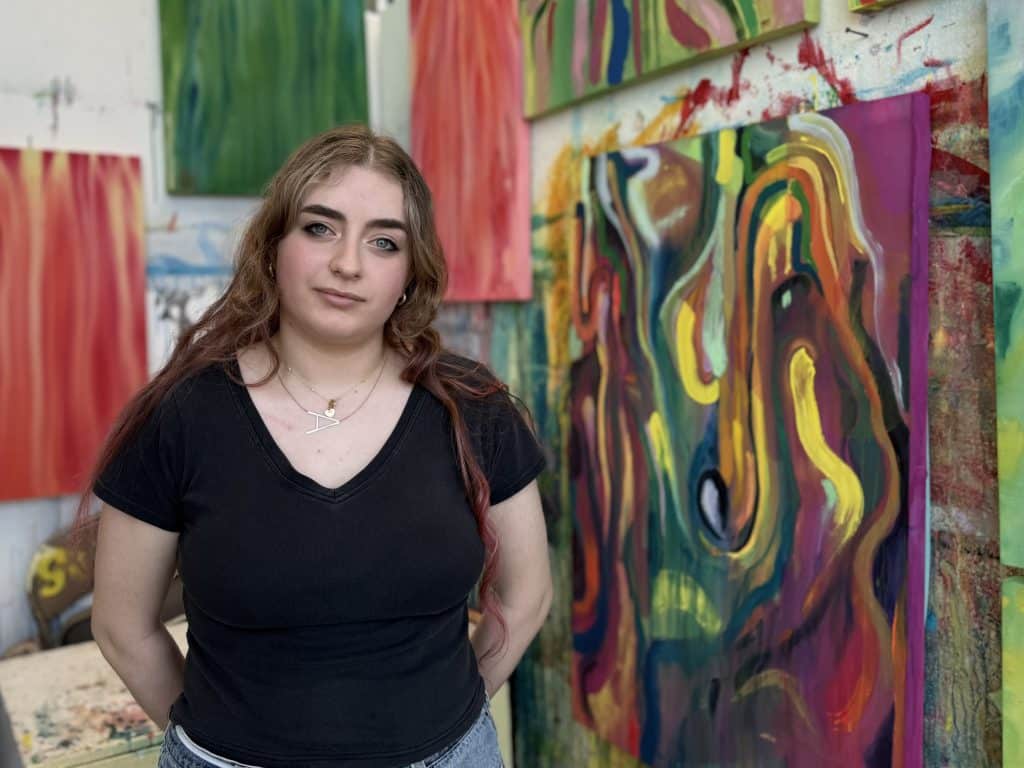
In January 2024, Audrey Magdics received the devastating news that her dad, Alex, 56, had suffered a stroke. She was in a tailspin. Luckily, Magdics, a junior who was majoring in painting and drawing at the Cleveland Institute of Art (CIA), was able to channel her sorrow through painting. That transformative experience led to her first art exhibition at the University Hospitals (UH) Cleveland Medical Center’s Trudy Wiesenberger Gallery, which is open now and runs through July 6.
According to Magdics, her dad had a hemorrhagic stroke, which caused a bleed and later an infection. That infection led to aphasia on the right side. Although her dad is bedridden, he’s doing well. She hasn’t told him about the exhibition, she said.
Magdics, 20, hopes her “Healing Horizons” exhibit will push people deeper into their process of emotional healing.

“Throughout my career in painting, I’ve always been painting from my own emotions,” she said. “So, this is just like a series of works that involved what happened to my dad, and how it affected my family.”
A graduate of Aurora High School, Magdics knew art would play a pivotal role in her life. That prediction probably came from being enrolled in a preschool art workshop before she could properly tie her shoes. Magdics continued to hone her skills through high school and went on to the CIA.
The Institute is known for its student-driven programs like “Creative Works,” which have allowed CIA attendees to express their feelings through art. This effort has been a professional boon for many; student pieces are in company galleries like Progressive Insurance Co. in Mayfield Heights, Cleveland Public Library (main branch), LGBT Center of Greater Cleveland and the Nature Center at Shaker Lakes, among others. Creative Works started in 2014, with some organizations having permanent student art installations, or temporary exhibitions in their spaces. According to Magdics, the process for teaming up with UH included developing a proposal, a budget and a resume to add to her application.
“The application was passed along for review by a panel of jurors, and they accepted me,” Magdics said. “I reached out to Tom Huck, art curator at UH after finding out, through a CIA professor, about a $1.25 million endowment from Dr. Fred C. and Jackie Rothstein, endowed director of curation at University Hospitals. Lane Cooper and Tony Ingrisano, are two art professors who were instrumental in bringing positive energy into my project and helping with the concept.”
The recently established endowed position is a collaboration between the Rothsteins and UH. It focuses on the healing power of art. Rothstein did his residency and fellowship at UH Rainbow Babies & Children’s. In 2003, he was named president of UH. A position he held until retirement in 2015.
How does art help with healing? Megan Holmes, professor and co-director of the Center on Trauma and Adversity at Case Western Reserve University in Cleveland, says art is a powerful tool for expressing and processing emotions, especially when words aren’t there.
“Creating art can offer a sense of control, safety and emotional release during difficult times like grief,” she said. “It activates parts of the brain connected to emotion and memory, helping individuals process experiences in a non-verbal, embodied way. Even just viewing art can be therapeutic. You don’t need to be an artist to benefit from the healing power of images. Illustrations that depict nature (like blooming flowers, flowing water or trees with deep roots) symbolize growth, renewal and grounding. These visuals remind us that even in pain, there is beauty, strength, and the possibility of restoration. And for those who feel drawn to picking up a pen or paintbrush, it’s important to know that the rhythmic, repetitive motion of painting, drawing or simple doodling can be incredibly calming for our nervous systems.”
Huck said it was a no-brainer to select Magdics’ work after examining the intense emotion and mastery of skill evident throughout her pieces.
“The works demonstrate a unique vision and thoughtful color choice that captivates the viewer, while effectively conveying the artist’s message,” he said. “Her work stood out for its originality and the way it reflects both personal expression and speaks to her healing journey while experiencing a family health matter.”
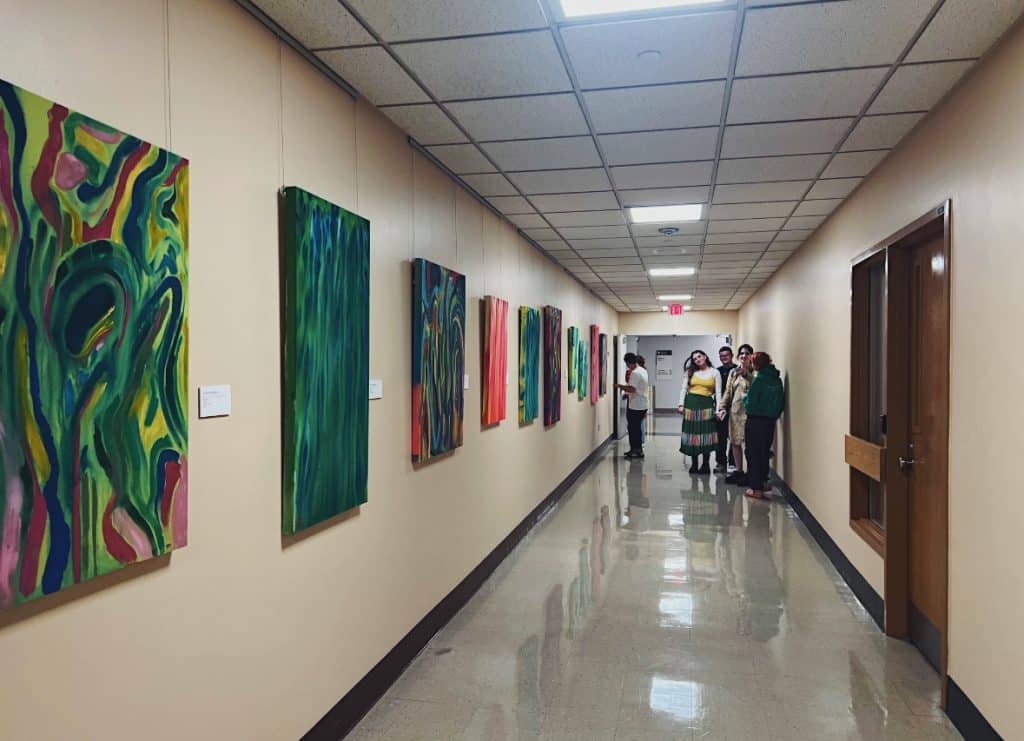
Seeing the Horizons
Magdics’ art studio space on the third floor of the CIA building on Euclid Ave. is what you would expect. Small splotches of splattered paint adorn an easel that appears so meticulously placed you wonder if it was on purpose? The walls tell the story of her journey, including her “Healing Horizons” work. The paintings display swaths of color representing the artist and her family’s emotional stages on this journey. Layers in the work depict tears, boldness and confidence.
There was some trepidation about going back to the same hospital where her dad spent four months recuperating following his stroke. Luckily, Magdic’s sense of community erased all doubt.
“When traveling back and forth to the hospital, I would stop and look at the artwork on display. It was cathartic for me, and it made me connected. I’m giving back to the same community that showed me love, only with a different body of work to view,” she said
Due to her dad, the exhibition opened on May 1. Magdics attended the ceremony without family members. However, many friends and faculty from the CIA were in attendance.
“The opening was nice,” she said. “My dad couldn’t be left alone, so my family could not attend. I realize abstract art can baffle some, but I hope that visitors will take the time to study the paintings as they pass through to visit sick loved ones. I did, and it brought peace.”
Keep our local journalism accessible to all
Reader support is crucial as we continue to shed light on underreported neighborhoods in Cleveland. Will you become a monthly member to help us continue to produce news by, for, and with the community?
P.S. Did you like this story? Take our reader survey!