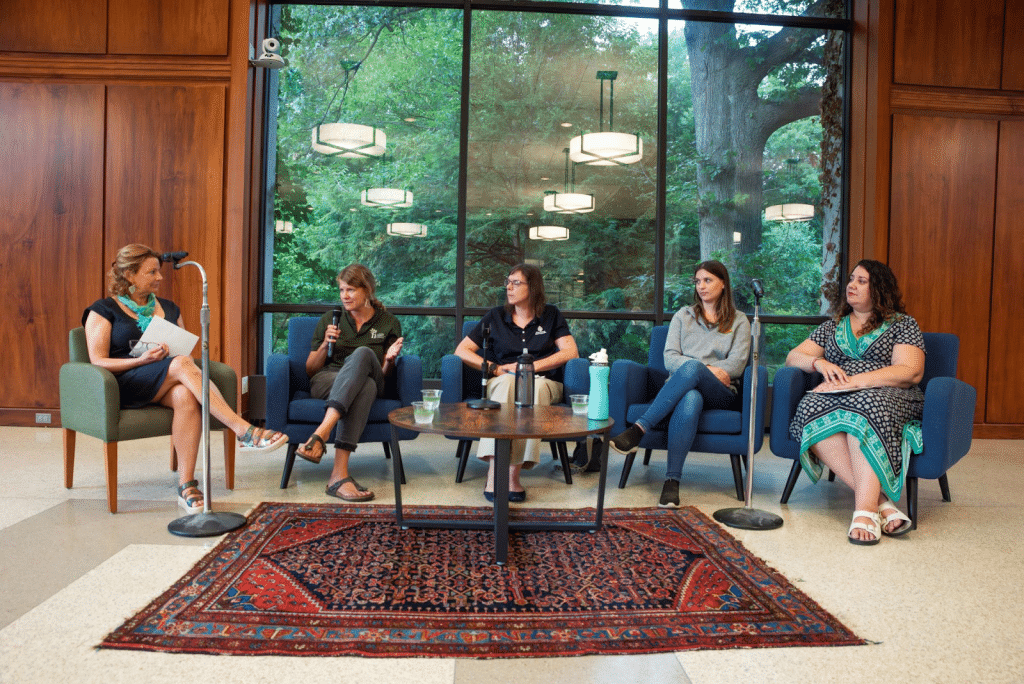
In August, at an event hosted at the Cleveland Botanical Garden, the Holden Seed Bank celebrated one year of collecting seeds for reforestation with a focus on the biodiversity of native species.
There were tables with local organizations like Meadow City Nursery and other groups that help homeowners identify pests or diseases in their trees and gardens, and how to move forward. There were other tables centered on education, with a mission to increase awareness and activity around native reforestation and mindful gardening practices that strengthen local ecosystems, including Nature in my Backyard, which is a program of the Audubon Society of Greater Cleveland, and the Shaker Lakes Garden Club. Master Gardeners of Cuyahoga County also had a table with information about deer and pest control, and how to spot specific bugs and how they may affect your garden.
The panel, moderated by Diane Bickett from the ECO Speaks CLE podcast, featured professionals from Cleveland Metroparks, Holden Seed Bank, Wild Ones Greater Cleveland and Pollinator Partnership. The speakers’ key points were focused on reforestation and biodiversity topics to consider as a community.

Kaleigh Obrock, conservation program assistant and project wingspan state coordinator from Pollinator Partnership, defined what “native” means when discussing native plant species.
“We consider something to be native if it was here before settlers came and brought it over. There is some debate over the specifics of that, but there is also some variety in invasive species as well. So there are pure native plants, which are specific to a region that they thrive in. There are also non native, where it’s not native to the region but it doesn’t cause any problems choking out or competing with native species,” Obrock said. “Then there are invasive species, which directly challenge native plants. There are also genetically modified native plants that you may find in greenhouses, which may have been modified to have more or less resources of a true native plant.”
Obrock also mentioned the free, self-paced training the Pollinator Partnership offers online. Once you complete training you are assigned to a local seed collection team. They are partnered with Holden Seed Bank, and have assigned many trainees to go out collecting as a volunteer with them.
Jessice Ausnehmer, president of Greater Cleveland Wild Ones, spoke about her organization and how they serve the community.
“We are a national non-profit, hosting free events and focusing on native seeds and biodiversity. We do seed collection activities, workshops, winter sowing in milk jugs of native seeds, and giving out native seed packets. We also recently installed a native seed library at the towpath in Akron,” Ausnehmer said.
Ausnehmer had an interesting response to a question from Bickett. When the panel was asked what trees to consider when replacing trees lost to the storm in early August, Ausnehmer said that leaving the fallen trees, if a safe option in larger yards and fields, would benefit local wildlife.
“Anything from owls to other small creatures can live in those dead trees and reproduce, increasing their strength and population,” Ausnehmer said.
Many panelists, including Ausnehmer, suggested oak trees as a native replacement to fallen trees, since they thrive in Northeast Ohio and have many varieties to aid in biodiversity.
A personal perspective
This event was particularly educational for a novice gardener like myself. I grow a container garden on my porch. The event fostered a sense of mindfulness when it comes to gardening and intention on adding to the existing ecosystem here in Northeast Ohio. There is so much beauty in the knowledge and awareness of what thrives in our region, and how much it can benefit the soil quality, insects and animals within their symbiotic relationship, and we need to make sure we fulfill our duty to engage with that flow, rather than disturb it.
Before the panel started, I spoke with Katie Stuble, director of the research department in science and conservation at Holden Forests and Gardens (HF&G), and Kim Lessman, the Holden Seed Bank manager. I had a few questions regarding the first year of the Seed Bank, and what that has taught them for the future of their work in our region.
AG: What sparked the creation of the seed bank?
KS: We were focused on the needs of the local area and restoration efforts, and within those efforts there are limitations when it comes to availability of seeds and seedling plants. We were approached by an organization called Terraformation, and they were looking to build capacity in the Midwest specifically and asked if we were interested in partnering. They provided us with a shipping container outfitted as a seed lab for collection, processing and organizing native seeds, so they could be sent back out for restoration efforts. That was the main spark for our own seed bank. It was a pretty happy marriage for us at Holden since we already have a pretty robust research department focused on plants and plant health, and the seed bank has turned into an asset for the research department. Rachel Kappler, coordinator for the great lakes basin forest health collaborative, is really thinking about reforestation and resilience, intentionally breeding areas to be resilient to tree and plant diseases that threaten reforestation efforts. Kim and Rachel have processed many seeds together focused on biodiversity and resilience.
AG: What is the seed collection process like?
KL: I often break this work into two parts, one is the site assessment before any seed collecting is done, which involves visiting a natural area with some tree identification guides, a GPS unit to mark locations of different tree species, and a bag in the event that something is ripe and ready. In that case I will do an opportunistic collection of those seeds. The first part is mainly looking for the species that you want, and assessing the population to make sure it will give you the genetic diversity you are looking for.
Right now, many site assessments are being done, as well as opportunistic collections. Starting in early September is when big seed collections take place. Holden’s main campus in Kirtland Hills has just over 3,000 acres of natural woodland areas.
So I have my seed collecting kit and a cohort of volunteers and we go out to these natural landscapes to assess and collect whichever targeted species is desired for that day.
Last October we were able to collect several five gallon buckets of seeds from this black walnut grove.
During seed assessments, I look at how many individuals there are, a minimum of 50 individuals is ideal in a seed collection. Individuals meaning different unique individual plants to gain that genetic diversity in a collection.
There is an ethics behind seed collecting, similar to foraging. We only collect about 20% of the population. We assess the health and viability of the individual plants and population as a whole, any pest or pathogen damage, fully assessing to promote biodiversity at large.
The seed bank recently built a poly house (a greenhouse-like structure using a translucent material to create a controlled environment for growing plants) so we can begin to grow seedlings in house. We’re also beginning to build partnerships and look for native plant nurseries, or other restoration organizations to collaborate with. We’re starting to have conversations to see who has capacity to grow these seedlings.
Anyone interested in volunteering can visit Holden’s website, which has a volunteer page for sign up, and folks can select which part of the process they’d like to participate in.
AG: Are there any specific tree or shrub species that are instrumental to reforestation in NEO?
K.L: Based on experiences and partnerships with those who manage natural areas and request these species from the seed bank, I would say most if not all hickories, oak species, black and white walnut, alders, elms, dogwoods, redwood, ash.
K.S: Yes, we process a lot of ash on the research side of things. Though we would never say let’s have a big ash forest, because ash is being killed right now by emerald ash borers, one of the big three in our emerging pests and diseases. It’s complicated to think about which species are instrumental to reforestation at this moment when we are still working on breeding resistance and resilience against pests and diseases. Breeding for resilience takes time, and it takes even longer for them to reproduce. With ash it’s tricky to test resilience as they won’t get attacked by emerald ash borers until about 12 years old. One of the beauties of being at the arboretum is that we have the luxury of time. I previously worked at a university and people in arbor studies had to rent space and secure funding, so the time it takes to research can be costly. The arboretum is there to really nurture the study of woody plants and trees.
What I want for our forests are incredibly diverse landscapes. So if another disease or pest comes up and wipes out one species that we didn’t expect, there are a lot of other species still present. One reason our conservation team is so keen on hickories and oaks is because they produce nuts, which is a food source and it’s very critical and dominant. If we lose that source from the system, we have to have diversity available to fill that niche and maintain the natural systems. We aim to have locally sourced native plant species available to put back into forests.
AG: Do you foresee any future partnerships with cities and urban spaces to trade out their decorative landscaping for more native landscaping and reforestation?
K.S: Yes, that is a big thing we focus on, greening the urban spaces. We have several community foresters, one who is dedicated to urban spaces is Amanda Wood.
K.L: Yes, I have had two small interactions with Amanda, and I cannot stop thinking about urban seed collection in support of urban canopy restoration, specifically sourcing seeds from this area so they are already acclimated to the ecosystem.
K.S: We’re right at the one-year mark for the Seed Bank, and most reforestation efforts consist of planting hundreds and sometimes thousands of very tiny seedlings into a larger area. When reforesting urban landscapes, the number of plants is much smaller, and the plants have to be much older and larger. We are several years out from being able to supply community foresters like Amanda, but it is a great goal for us.
AG: Any plans for seeds to become available for community members?
K.L: We gained a lot of interest really quickly from private land owners, residents, community members, master planters and all the folks who are native plant enthusiasts. We also had many people who wished to donate seeds to the seed bank, who understand our greater mission. It brought up a lot of things for us to consider, like how do we build some kind of a regional seed collection program, so we can have all these different avenues of people donating seeds. Also how can we have some sort of training program for people showing interest in learning about seed collection and processing, in a way that aids in the seed banks work.
K.S: Training to really empower those who wish to engage on a regular basis with seed collecting work
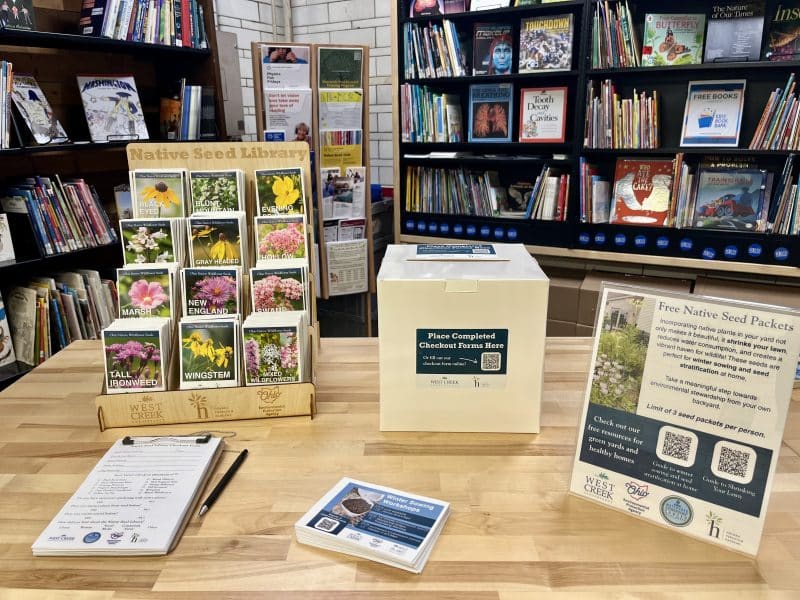
K.L: Also, what can we do to give space to those members who want to bring seed and those who want to receive seed. One of our staff members custom built this beautiful wooden shelf that will serve as our native seed exchange, it’s inside at our table! We wanted to create this physical avenue for seed exchange, and also if we have an over abundance or specifically collect with the intention of providing access, we’re hoping that this helps facilitate that intention. We have two, one will be at the botanical garden, and one will be at the Holden Arboretum. We’re also talking with the Cleveland Public Library system to try it out and see if a library partnership would be successful.
K.S: They were really excited about it, and we are discussing different ways this partnership could exist, like having pop-ups on specific days as a means of education and access.
Planting the seeds
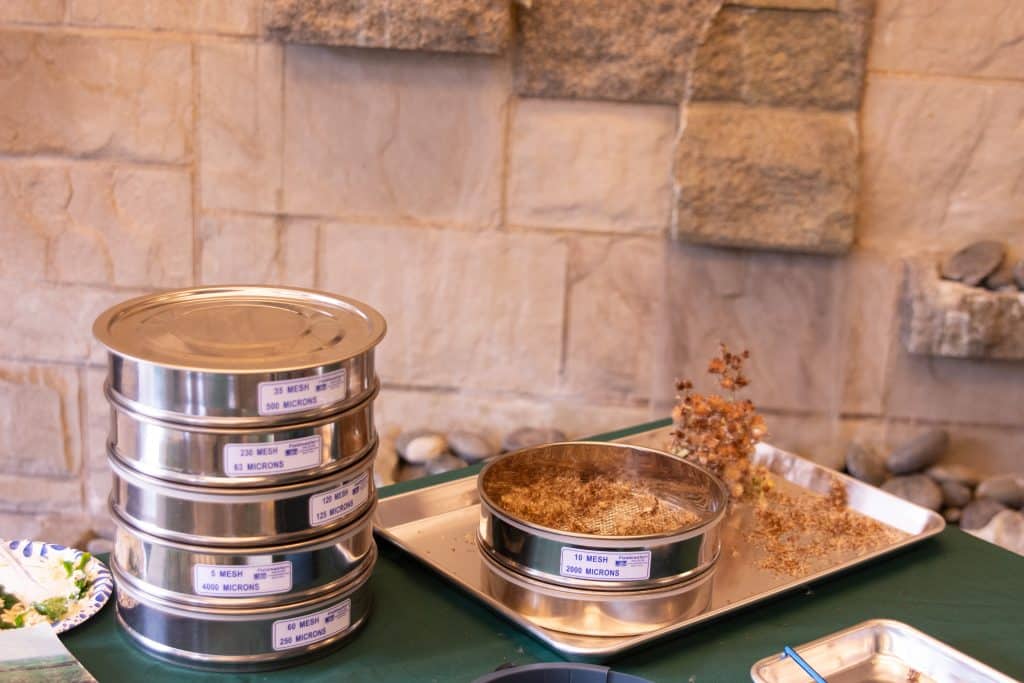
HF&G CEO Ed Moydell also gave some insight on the accomplishments of the Seed Bank over the past year, which includes growing the community and capacity by hiring two additional staff members. They also recruited and trained 20 volunteers on best practices for native seed collection and growing; and volunteers and staff have collected 150,000 seeds from 30 different species in the region.
“We joined the Midwest Native Seed Network, the National Association of Restoration Seed Banks, and facilitated the first stakeholder meeting on behalf of LEAP (Lake Erie Allegheny Partnership) members and we’re working to coordinate a regional native seed network in northeast Ohio,” Moydell said.
I also asked the CEO more about Holden’s urban community forestry work and their current partnerships.
“HF&G started our urban community forestry work in 2018. Since then, our team has been working in the Cleveland area to increase the tree canopy partnering with community groups such as community development corporations, neighborhood and other community groups.
Our focus is on the areas with the lowest tree canopy and highest need, like low-income areas of Cleveland that have been historically excluded from tree planting and care efforts. By creating a community around trees, we share our expertise and educate people about the importance of trees and how to care for them, empowering the community to care for and advocate for their trees,” Moydell said.
“As a member of the Cleveland Tree Coalition’s executive committee, HF&G is leading efforts to educate on tree care, pests, diseases and to strengthen the green industry workforce. Our Tree Corps program is a training program for adults interested in entering the tree care industry, providing hand-on training, typically centered on trees in urban spaces. We expect that the Seed Bank will ultimately be able to support urban tree planting efforts,” Moydell said.
We're celebrating four years of amplifying resident voices from Cleveland's neighborhoods. Will you make a donation to keep our local journalism going?