


As an adult living in Hough, I have always lamented the absence of a neighborhood playground where kids can have easy access to swings, slides, and other playground structures. One of my relaxing pastimes is sitting on my balcony, reading, writing, and watching kids play in the neighborhood. The flip side of this experience is that I take notice of what is missing for them.
When I was a child in the 1970s, I remember living two houses from the corner store, which was directly across the street from a local neighborhood park. This park had a full playground, complete with two sets of swings, one for toddlers and beginners and one for school-aged kids.
Monkey bars, a seesaw, a merry-go-round, stationary horse and duck rides, and other playtime amenities dotted the popular park. Bench tables, a water fountain, and a small grassy area suitable for all kinds of horseplay, wrestling each other, playing catch, or just relaxing added to the experience.

From ages 7-11, this park was a staple of my childhood. My two younger sisters started off on the toddler swings, where my three older siblings and I would take turns pushing them. Later, I graduated my younger sisters, one at a time, to the “big people” swings. The exhilaration they felt was apparent when they learned from me how to “pump” their hips and legs well enough to swing independently, and to swing almost as high as me, as was always their goal.
I remember when I no longer needed to push them on the stationary animal rides or stand under them to catch them if they fell from the monkey bars. They had learned how to push and develop themselves with coaching from their big brother. They were learning how to push themselves and grow, and they were having a whole lot of fun doing it.
Whenever we were not in our yard engaging in the more imaginary or more creative play, we always had the option – with parental permission, of course – to go to the playground and experience this type of play.
For a long time, neighborhood kids haven’t had this option. However, I am happy to report that the current lack of a community park in Hough is quickly on its way to being resolved.

A new park is on the way
By the end of 2024, the Hough community is slated to begin construction on a sprawling, 2.6-acre neighborhood park. This is approximately two times the size of the neighborhood park I grew up with in Hempstead, New York.
It all started back in 2021, when the city of Cleveland and the Cleveland Metropolitan School District released a request for proposals (RFP) for several school sites that were slated to be sold because they were no longer needed. The Western Reserve Land Conservancy (WRLC) pitched the idea of building a park in Hough on the former site of the John W. Raper Elementary School, and the proposal was accepted by the city. The now-empty school site is located on E. 85th St. between Wade Park Ave. and Hough Ave. next to Thurgood Marshall Recreation Center.
For now, the new park in Hough is simply being called the Hough Community Green Space to reflect its roots as both a community-centered space as well as a passive green space that’s about nature, health, and beauty in addition to recreation. At some point in the future, Ali said, the organizers will decide what to call it. Once it’s built, the park will be owned, operated, and maintained by the city of Cleveland, in conjunction with Thurgood Marshall Recreation Center, he said.
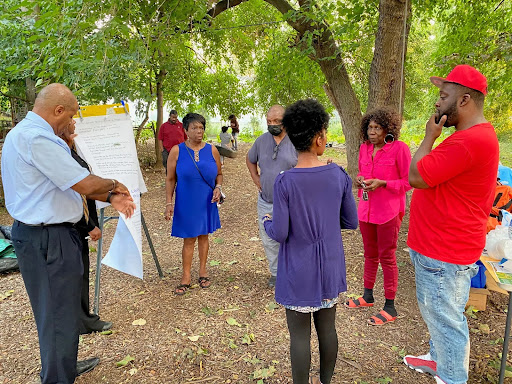
Gathering community input
A consortium of organizations, including the Western Reserve Land Conservancy, Famicos Foundation, Village Family Farms, Little Africa Food Coop, the city of Cleveland, and Cuyahoga County, along with Ward 7 council member Stephanie Howse, worked together to gather residents’ input into the decision-making process. “We literally went door-to-door and did a number of community engagement meetings,” said Khalid Ali, urban greenspace coordinator for Western Reserve Land Conservancy. “That’s how we fished out what people were thinking, what people needed.”
Ultimately, Ali said, there were seven meetings that took place between members of the community and the consortium of organizations, with design assistance from Environmental Design Group as well as a group of students from Cornell University’s departments of planning and landscape architecture. The group created a collective vision for the visual concepts and specific features of the park.
“In our outreach, we found that a lot of the programs at the recreation center don’t really speak to what they want to do,” said Ali, explaining how resident input shaped the plans. “A lot of the elements here aren’t necessarily for very small children or older individuals. A lot of it is teen-based or a little older. This park is going to have toddler play spaces, along with walking paths and outdoor workout equipment so older individuals can come out here every day if they want to and get their miles in.”

In addition, there will be a playground for elementary school-aged children, a pavilion where residents can gather and hold events, and a place where local partner Village Family Farms can sell produce on site. The space was designed with safety in mind. The park will be well lit and equipped with cameras. The pathways will be designed with obstacles and barriers to try to deter dirt bike riders from riding in the park.
Benches and grills will be provided at the park, so visitors don’t need to bring their own seating. Not all elements of the park are finalized, but the basic vision has been established. Ali said the park plans should be completed this fall after a final set of community meetings.
Ali said the park not only addresses the need for more green space on the east side of Cleveland, but also specifically in Ward 7, which does not have a community park. He cited the benefits of community green spaces with trees and play areas on people’s health, property values, and the environment. There is a lot of new development coming to Hough currently, Ali said, and people did not want to see the former school site developed as housing. They want to see a balance between development and green space, which is why they were excited about a community park.
The project has raised about $700,000 of its total goal of $1.6 million, Ali said. In addition to a grant from the Clean Ohio Fund, an impressive project by The Funder’s Network called Partners For Places recently awarded $180,000 to the project. The Western Reserve Land Conservancy also noted that the $180,000 grant from Partners for Places is being matched by local funders, including the First Energy Foundation, Bank of America, the Reinberger Foundation, and Dominion Energy Charitable Foundation, bringing the total raised from this grant to $360,000.
Expected to break ground this fall and complete the park next year, this partnership has hit the ground running.
“We are elated to see this transformative project bring high-quality green space, designed for all ages, to our service area,” said Ava Schmidt, neighborhood development planner at Famicos Foundation, a nonprofit community development corporation that serves the area. “Famicos Foundation will continue to collaborate with all partners to ensure the Hough Community Green Space reflects resident needs and desires and expands opportunities for neighborhood stabilization, equitable development, safe outdoor recreation, and social connection.”
Little Africa Food Co-op’s collaborative efforts led to residents learning more about the cooperative culture in food and land access, said Makanya “Ms. Mikki” Smith, executive team member for the Little Africa Food Cooperative. “While our goals are to ensure the space is created for generations to come, we take ownership in creating the cooperative models that will encourage the residents to use this space as an opportunity to demonstrate cooperative community. The community will become the stewards of these urban models that focus on education, wellness, and food nutrition.”
In my estimation, this worthy project speaks to the ability of talented individuals and focused organizations to forge successful collaborations between local organizations, community residents, philanthropy, government, and the academic community for the purpose of the common good.
It is impressive to me how the Hough Community Green Space project embodies the selfless will, determination, vision, organizational skills, and the brotherly love inherent to address the needs and breaches of communities.
It takes a village to raise our children, and here in Hough, the village has stepped up.
For more information about the Hough Community Green Space, visit Hough Community Green Space | Western Reserve Land Conservancy (wrlandconservancy.org) or contact Khalid Ali, urban green space coordinator, at kali@wrlandconservancy.org or 440/528-4150.
We're celebrating four years of amplifying resident voices from Cleveland's neighborhoods. Will you make a donation to keep our local journalism going?

![Lakewood High School students organize walkout to protest ICE [photos]](https://d41ow8dj78e0j.cloudfront.net/wp-content/uploads/2026/02/12155714/DSC_3775-800x600.jpg)


