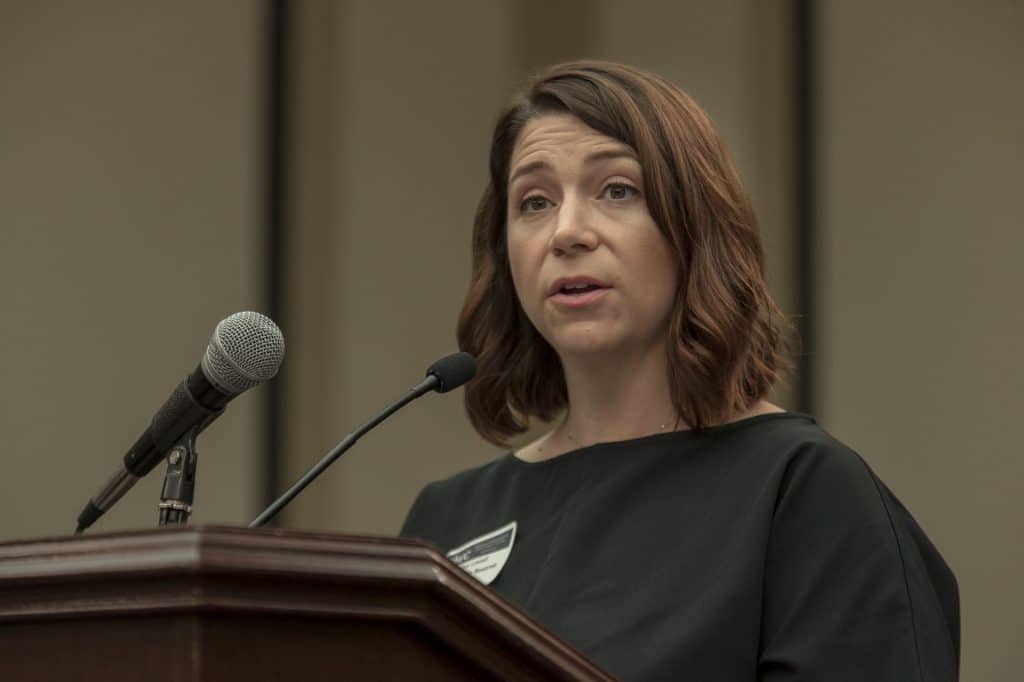
The Criminology Research Center (CRC), one of Cleveland’s most effective crime-fighting tools, is a bit of a secret weapon because most Clevelanders don’t know it exists.
However, the Cleveland Division of Police, Cuyahoga County Prosecutor’s Office, Collaborative to End Human Trafficking and Cleveland Rape Crisis Center know it well.
Located at Cleveland State University, the CRC was founded in 2008 and is led by Rachel Lovell, Ph.D., who was recently promoted to associate professor with tenure in the Department of Criminology and Sociology. Her nationally recognized team performs and publishes comprehensive, in-depth research pertaining to a range of crimes and public safety issues, including car jackings, gun violence, human trafficking, rape and sexual assault.
“We are able to speak about crime, violence and public safety because we are well-situated within the Levin College of Public Affairs and Education at CSU, an anchor institution in the community,” Lovell said. “Whether it’s policing or economic development or aspects of city planning, there are lots of conversations where public safety is a big component because many individuals are affected.”
In spring 2022, Lovell took over directing the CRC. The previous director, however, was an interim associate dean who focused primarily on administering the center. Lovell brought extensive research experience, existing grants from her decade of work at Case Western Reserve University and well-established relationships within the Cleveland community.
“My goal was to revive and develop the Criminology Research Center, and I’ve grown the center a lot in terms of the external funding I brought in,” Lovell said. “I’ve been collaborating with some of my colleagues, too, to get funding.”
Her team works closely with CSU’s College of Law, collaborating on law clinics for students through their Criminal Justice Center. Additionally, CRC researchers are currently completing several research reports for the Cleveland Division of Police regarding the effectiveness of ShotSpotter technology, which police are using to locate and monitor gunfire in neighborhoods. They are preparing for an upcoming study of carjacking incidents for the Cuyahoga County Sheriff’s Department.
At the heart of the CRC’s research role is performing evaluations, which, Lovell explains, means assessing the design, implementation and/or outcomes of a program, policy, or intervention to assess its impact or effectiveness in the community.
“Rachel has set up a great model where researchers can be integrated into the community and support what the community needs,” said Casey Albitz, research associate at the CRC. “Sometimes it’s difficult in academia to feel that your research is effecting on-the-ground practices and services, but her approach is grounded in partnerships with the community, so that we’re doing intentional research.”
Providing information that translates into action in the community
In 2014, while working as a Research Assistant Professor at Case Western Reserve University, Lovell began to consult with the Cuyahoga County Prosecutor’s Office. The partnership began when the Prosecutor’s Office funded a one-year research project focused on sexual assault kits. The following year, the federal Sexual Assault Kit Initiative was created, and the office received one of its first federal grants in October 2015 and has received funding through the program ever since.
Funded by the Bureau of Justice Assistance, the initiative launched nationwide efforts to test backlog sexual assault kits to arrest and prosecute sex offenders. Lovell’s groundbreaking findings burnished her reputation for conducting meticulous research that provides far-reaching insights into crimes related to rape and sexual assault.
“Being data driven allows us to better do our work,” said Mary Weston, Genetic Operations Linking DNA (G.O.L.D.) Unit supervisor in the county Prosecutor’s Office. “The research coming out of Rachel’s group has opened our eyes and educated us regarding the effect of sexual assault on the victim, and understanding what they have gone through by the time they are talking to us helps us be better prosecutors.”
Weston said that research wasn’t available to prosecutors when she started in 2013. Society still has a long way to go in addressing these crimes, she said, and more prosecutors need to become familiar with the findings of researchers such as Lovell and her CSU team. It’s also easier to get citizens – potential jurors – to understand.
“The research coming out of CSU affects everybody; her research demonstrates how it affects communities economically,” Weston said. “The people committing sexual assaults are also committing burglaries, robberies, domestic violence and other crimes. They are affecting the value of homes in your neighborhood, so that might be how we get people to care.”
Lovell and her CRC team’s work is known nationally and beyond, especially in the field of rape and sexual violence. Earlier this year, she was lead author on a paper published in “Violence Against Women” magazine: “There’s Gotta’ be a Better way … There was Nothing Empowering About any of it: Survivors’ and Stakeholders’ Narratives on the Barriers and Facilitators of Getting a Sexual Assault Kit.”
“One of the things we found was that none of the victims reported the crime or got a sexual assault kit because they thought their perpetrators would be punished or they would get justice,” Lovell said. “They did it for altruistic reasons: ‘I thought he might do it again’ or ‘I wanted to be listened to and believed.’ There is a different way of communicating that if you want to better support survivors and seek engagement with them.”
The CRC’s research demonstrates that there are major implications for how the media speaks about victims or how police and prosecutors work with victims. Publishing such papers also helps the CRC reach law enforcement, prosecutors, counselors, advocates and others beyond Cleveland.
Lovell and the CRC are now working with a research team in the U.K. They’re currently comparing and contrasting how sexual violence crimes manifest in the U.S and the U.K., For example, they’re examining how weapons and vehicles are used differently in committing these crimes. Last October, they gave a joint presentation with the F.B.I.’s Behavioral Analysis Unit regarding the important benefits from research and collaboration with partners.
Currently, Lovell is writing an op-ed with the Joyful Heart Foundation, founded in New York in 2004 by Mariska Hargitay of “Law & Order: Special Victims Unit” fame. The article aims to raise awareness and help survivors of sexual or domestic violence or child abuse.
“Rachel’s research has been a game changer for Joyful Heart Foundation’s work to end the rape kit backlog,” said Ilse Knecht, director, policy and advocacy. “Her deep exploration of the outcomes of testing rape kits – the identification of serial rapists and the cost savings experienced by communities – has helped us inform lawmakers and criminal justice system stakeholders, changing hearts and minds with powerful evidence, to successfully push reform initiatives.”
Efforts to understand human trafficking in Northeast Ohio
In 2024, the CRC initiated a research partnership with the Collaborative to End Human Trafficking. According to Kirsti Mouncey, president and CEO of the Collaborative, this initiative was a direct response to a key need identified by their coalition’s Greater Cleveland’s Coordinated Response to Human Trafficking: the lack of credible, localized data on the prevalence of trafficking in Cuyahoga County. Despite the scope of the issue, consistent data has remained elusive due to underreporting and fragmented systems.
“The partnership with CSU has been instrumental in grounding our work in evidence,” said Mouncey, who knew Lovell and her work from her years as Chief Program Officer for Cleveland Rape Crisis Center. “The research provides a stronger foundation for policy advocacy and funding requests and positions the region to respond more strategically and effectively to human trafficking.”
Mouncey added that Lovell’s proven track record — with more than $6 million in external funding and dozens of peer-reviewed publications — reflects not only her academic excellence but also her ability to translate complex research into real-world systems change. The same spirit defines her leadership of the current human trafficking study: one that acknowledges the complexity of the issue, centers ethical data use, and builds bridges between research, practice and policy.
“Rachel’s team understands that human trafficking is deeply interconnected with other systems, including housing, healthcare, and the justice system,” Mouncey said of the CRC. “They bring both analytical precision and a human-centered lens to the work, helping to shape a more coordinated and informed regional response to trafficking in Northeast Ohio.”
Conclusion
Why did Lovell choose to pursue uncovering complex details about criminals, their behaviors and their victims in her research career?
“There are so many survivors of crime out there, especially of sexual violence, who don’t talk about it, don’t disclose, don’t have the support that they need, and they just carry that with them,” Lovell said. “I am not a survivor of rape, but that may be why I have been able to stay in this work as long as I have because I don’t have to fight my own demons, although I don’t know a woman who doesn’t have at least one ‘Me, Too’ story of some sort, myself included.”
Keep our local journalism accessible to all
Reader support is crucial as we continue to shed light on underreported neighborhoods in Cleveland. Will you become a monthly member to help us continue to produce news by, for, and with the community?
P.S. Did you like this story? Take our reader survey!

![Cleveland activist organizations call for general strike at anti-ICE protest [photos]](https://d41ow8dj78e0j.cloudfront.net/wp-content/uploads/2026/01/28094754/IMG_8580-800x600.jpg)