The Collaborative to End Human Trafficking wants to end modern-day slavery in Northeast Ohio.
To that end, May was a big month for the Collaborative, Northeast Ohio’s anti-trafficking advocacy agency. On May 28, Kirsti Mouncey testified before the Ohio Senate Finance Committee. The president and CEO of the Collaborative joined other advocates and allies for survivors of human trafficking as they lobbied to preserve $4.5 million in state funding in Ohio’s 2025–2026 budget. This funding gained even greater significance due to cuts in federal Victims of Crime Act (VOCA) funds and will ensure that essential services for survivors remain uninterrupted.
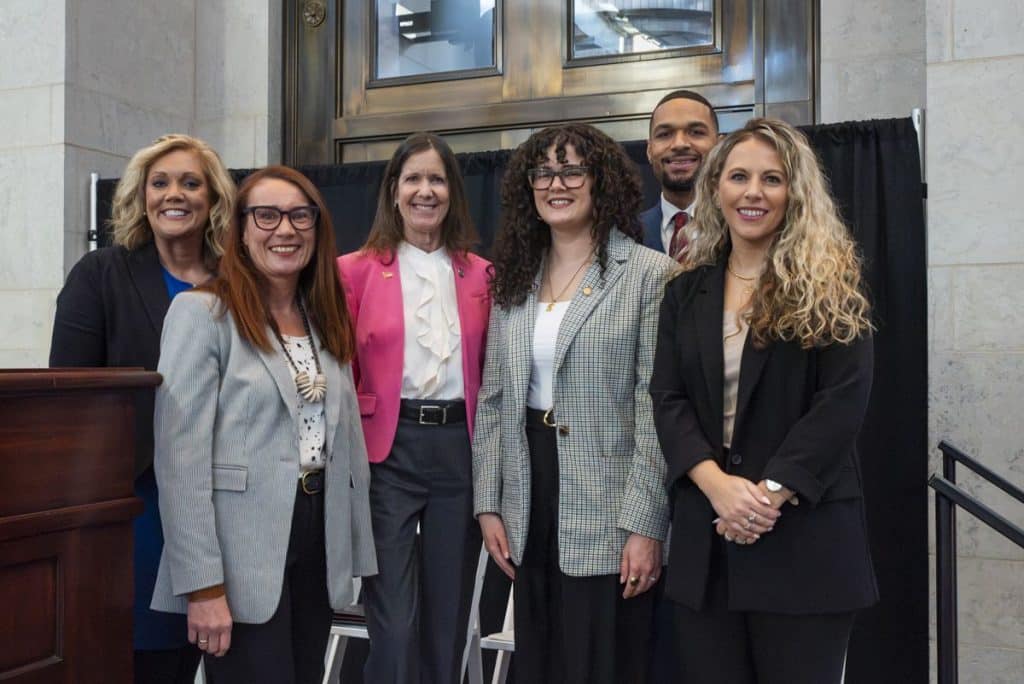
Also in May, the Collaborative held the first meetings of its new Leadership Council, launching a major initiative to increase its impact on raising awareness about the crime of modern slavery in Northeast Ohio.

The Leadership Council will advise the Collaborative’s working committees in a variety of fields such as data, legal and legislative, education, law enforcement, training, and prevention. The council will then make decisions for the coalition on what action steps the community needs to take. The new group includes CEOs from many of the Collaborative’s approximately 75 partner organizations, including Bellefaire Jewish Children’s Bureau, Canopy Child Advocacy Center, Cleveland Rape Crisis Center, The Centers, and the Cuyahoga County Sheriff’s Department.
“We feel this is the right direction to help our community continue to move forward and get involved in this issue,” Mouncey said. “These organizations are taking this effort so seriously that they believe their CEOs need to sit on this Council to change how we think about and react to human trafficking in Cuyahoga County.”
Jennifer Johnson, executive director of Canopy and member of the new advisory group, added: “The goal of the Leadership Council will be to take what the Collaborative does to the next level, to continue that work and ensure that we are taking accountability as leaders collectively to elevate it further from what it’s already doing.”
The Leadership Council falls under Mouncey’s mandate she received when she took over the Collaborative in 2020 – to clarify what the relationship was between the organization and its collection of committees, the Greater Cleveland Coordinated Response to Human Trafficking (GCCRHT). This anti-human trafficking coalition is made up of government agencies, nonprofit organizations and businesses.
“Kirsti’s able to take a group of varying disciplines and ideologies and use the strengths from each organization to push the Collaborative and that joint message forward,” said Capt. James Mackey, detective with the Cuyahoga County Sheriff’s Department. “She’s not afraid to say there are some things that are working, others that need retweaking, all to make each organization within the Collaborative more effective and serve the victims and get the education out there so that other people don’t become victims.”
The growth of the Collaborative’s impact
After the federal Victims of Trafficking and Violence Protection Act of 2000 passed and then Ohio’s state law against trafficking passed in 2010, the new legislation was primarily a law enforcement response. There were arrests and prosecutions occurring and in that process they recovered victims, but there were no services for survivors of human trafficking.
Although a group of organizations had gathered to discuss these issues shortly after the Collaborative was founded in 2007 and the groundwork had been laid for a community response, the GCCRHT was formalized in 2016. The group came together as a reaction to the potential uptick in human trafficking anticipated when the Republic National Convention was held in Cleveland. (Human trafficking activities often increase significantly around large public events such as the Super Bowl or World Series.)
“At that time, there were no hospitals or social service providers equipped to respond to victims, nor were court dockets responding to them,” Mouncey said. “We needed to create not only a service for survivors of human trafficking but a true community response, meaning that we needed to equip all of the different professionals [who interacted with survivors] with the tools and the knowledge to better address this issue in our community.”
In addition to supporting, equipping and facilitating members of the GCCRHT to act collectively, Mouncey and the Collaborative’s other two strategic priorities are to strengthen the organization’s “capacity, credibility, and influence so the community unites to effectively respond to human trafficking in Cuyahoga County” and ensure that survivors play an important role in the Collaborative’s operations and the organization’s impact on the community.
“I’m very proud of our board for including that last pillar about strengthening our survivors’ voices and leadership,” Mouncey said. “For so long, there were no survivor voices in decisions that were made or laws that were passed without survivor input, so we are balancing that out.”
One survivor, Andrea Mittman-Thomas, first got involved with the Collaborative in January 2023, after she met staff members at Ohio Attorney General Dave Yost’s annual Human Trafficking Summit. Since then, she has served on the Survivor’s Advisory Council, attended the GCCRHT Zoom or live meetings, and participated on the Legal & Legislative Committee.
“When survivors like me are included, it fosters a sense of purpose and belonging, which most survivors have never had before,” said Mittman-Thomas who is currently working on her Master’s degree in social work at Cleveland State University. “Healing can coexist with advocacy, and that’s one of the pleasures of being part of the Collaborative, because it’s been like therapy for me but has also helped my professional development in public speaking and interacting with different populations or organizations.”
Last July, the Legal & Legislative Committee that Mittman-Thomas serves on with other advocates, attorneys and legal experts was closely involved in the development and passage of SB 214 to expand access for survivors in Ohio to expunge certain criminal records, like solicitation and loitering to solicit, if the person was a victim of human trafficking.
“We’re strengthening our involvement so that instead of being reactive to those bills, we’re being proactive, meeting with lawmakers, building relationships with them, advising them on the right language and the right tone around human trafficking,”
Mouncey said. “That’s been a big step for us in the right direction.”
]
Leveraging education to raise awareness and a commitment to prevention
In January, the Collaborative rolled out its new public awareness campaign: “Humans Over Human Trafficking.” The organization partnered with the Brokaw advertising agency, which designed the campaign as a pro bono project.
“It’s our community-wide awareness campaign to educate people on human trafficking and speak to the idea that this is about dignity and humanity and that it is a community issue,” Mouncey explained. “Everyone has a role to play in combatting human trafficking, and it all starts with education: Know the issue, what it really means, how it shows up here in our community, and what we can do about it.”
Prior to Mouncey taking the helm, the Collaborative’s previous public awareness effort, “Human Trafficking Happens Here, Too,” which consisted of billboard ads, brochures, rack cards and posters on GCRTA buses and in the concourses at Cleveland Hopkins International Airport, had achieved success. Throughout 2019, for example, Northeast Ohioans and others registered 35 million views of the campaign, according to numbers from the Collaborative.
Today, the Collaborative also employs its Fundamentals of Human Trafficking training to equip individuals, professionals and community groups with “the knowledge to recognize red flags, understand root causes, and respond with empathy and action.” These sessions are offered both in person and virtually, with Zoom sessions offered monthly, making them accessible to workplaces, schools, congregations and the general public.
This year, more than 2,000 people across Northeast Ohio have already completed the training program.
Upcoming Zoom sessions will be held on Tuesday, July 15 from 5:30 p.m. to 7 p.m. and Tuesday, August 19 from 11: 30 a.m. to 1 p.m. Interested individuals should RSVP at collabtoendht.org.
Mouncey and the Collaborative’s growing importance as an influencer
“The Collaborative is the only regional coalition fighting human trafficking in Ohio or the U.S. that I’ve been involved with that is as large as ours in Cuyahoga County and as integrated and coordinated,” said Canopy Executive Director Jennifer Johnson. “If you engage in work around human trafficking, I don’t know why you would not be a member, because it’s so clearly an added resource and benefit for you to achieve your own mission or your organization’s.”
“We have a lot of expertise in Northeast Ohio, and we have more of a role to play to ensure that we are assisting in providing the expert voice for the parts of the state that don’t have the resources to do so,” said Andrew DeFratis, senior director of public affairs, Cleveland Rape Crisis Center who serves on the Legal & Legislative Committee. “The more infrastructure we can provide so it’s easier for a Coshocton County to participate, that supports all of us.”
For her part, Mouncey knows that a community needs both direct support crisis and ongoing services to help people recover from crimes such as rape, sexual assault or human trafficking, but a larger system that supports both is also essential.
“I see that recovery is possible, and I see that people can come out of very traumatic situations, but they do need the community to support them,” said Mouncey, the former Chief Program Officer for Cleveland Rape Crisis Center, adding that this is the work that gives her most personal fulfillment. “You need a system and a society that supports that, and I get to make an impact on those systems for the Collaborative and increase and involve myself in system-based work.”
Keep our local journalism accessible to all
Reader support is crucial as we continue to shed light on underreported neighborhoods in Cleveland. Will you become a monthly member to help us continue to produce news by, for, and with the community?
P.S. Did you like this story? Take our reader survey!