On a recent Friday, 127 people took oaths on the first floor of the Stokes Federal Court House to become citizens of what’s known as the land of the free. They got certificates, small American flags and congratulations from officials, families and friends.
Meanwhile, on the 13th floor, initial proceedings took place for a few of the millions of deportations promised by President Trump. With help from translators, Immigration Judge Bruce Imbacuan told immigrants from Ecuador and Brazil their rights and asked them a few questions. They replied briefly and quietly in their native languages or just nodded.
Some had applied for asylum, saying they’d be in danger if they returned to their homelands. An aide gave the others forms to seek asylum.
Some of the defendants were children. Imbacuan often smiled at them, and a translator called them cute. The judge said that the school-aged ones didn’t need to attend future hearings. “I’d rather they be in school.”
He postponed all the cases for five to six months so defendants could find lawyers. The aide passed out lists of free or inexpensive ones.
No mention was made of whether the immigrants had broken any laws besides immigration laws. They and the judge declined to answer questions, and the case files are private.
Is permission protection?
Many locals have rallied behind immigrants since Trump’s inauguration on Jan. 20. They’ve said that immigrants have long built up Cleveland, but that Trump’s many harsh words and deeds are spreading confusion, misinformation, fear and hate.
“There’s intentional chaos,” said Joe Cimperman, who leads Global Cleveland, an agency that welcomes and connects immigrants to Greater Cleveland.
Even authorized arrivals were afraid. “My son’s girlfriend is Cuban, and she’s legal, and she’s terrified,” said an advocate, withholding her name for fear that the girlfriend might be harassed.
Children fear too. A Texas mother said that her 11-year-old killed herself last month because of schoolmates threatening to have ICE deport the family to Mexico. A lawsuit filed Feb. 26 said that an 11-year-old U.S. citizen born in a Bhutanese refugee camp killed himself in Akron because of ethnic taunts from schoolmates. The Akron death happened last year, between Trump’s terms, but the news hit newly taut nerves.
Bakht Zaman Moqbel helped American troops in his native Afghanistan, then came to Cleveland with his wife and four children during Trump’s first term. This time around, he was worried about Trump stopping Moqbel’s mother, brother and mother-in-law from coming here. He also worried about the administration toughening the rules for immigrants already here. “We hear Afghans are on the safe side, but there are some rumors. Anything can happen to anyone. That’s traumatic for everyone.”
Many of Cleveland’s Latinos were born U.S. citizens in Puerto Rico. But advocates said that even citizens are worried. Deb Klein, head of Cleveland Jobs with Justice, which supports immigrants, said, “I have friends whose families have been here forever, and they’re afraid.”
Director Lynn Tramonte of Ohio Immigrant Alliance said that some immigrants, authorized or not, were afraid to report crimes to police. Some were avoiding work, school, hospitals, and other public places. Rosemary Gramajo Quinones said that visits to her Guaterriqueña Bakery (named for her two heritages) had dropped and deliveries risen.
Many immigrants have fled poverty, crime, persecution and war in their homelands only to feel persecuted here. Evelyn Rivera, who leads the group LatinOHs, said, “It’s awful to watch the hatred and vitriol toward immigrants and particularly Latinos.”
Advocates said that some local gatherings to help immigrants were being held secretly for fear of raids, infiltration and hate crime. Immigration lawyer Richard Herman said that a church he wasn’t free to name had locked its doors for a recent Mass and immigration forum.
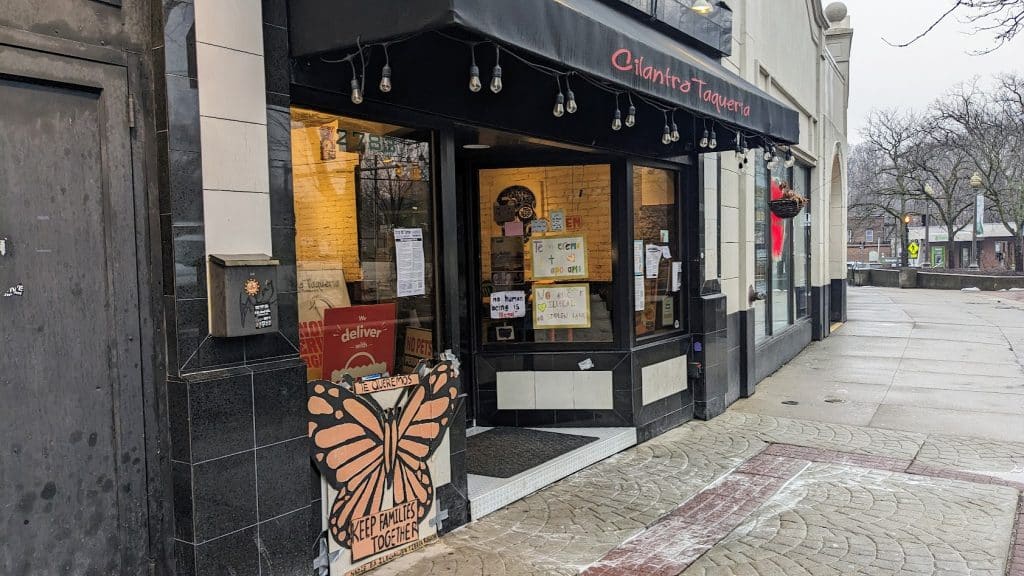
But Tramonte of the Ohio Immigrant Alliance said that such events were still drawing many immigrants and supporters. Locals also rallied outside the raided Cilantro Taqueria in Cleveland Heights and posted signs of support there. Said Tramonte, “I’ve never seen such interest in helping my immigrant neighbors.”
Of course, more Latinos voted for Trump last year than in 2020, and many supported enforcement of immigration laws.
Has Homeland Security really cracked down?
In his first term, despite some well-publicized raids in Ohio and elsewhere, Trump sent home far fewer people per year than President Obama had. According to Reuters News Agency, that trend continued during Trump’s first month back in the White House. He deported 37,660 people, much fewer than the nation’s monthly average in 2024 of 57,000. But ICE said it arrested 20,000 unauthorized aliens in January, compared to 33,000 in all of 2024.
In Greater Cleveland, only the Cilantro Taqueria raid had gotten much publicity, thanks to witnesses. Immigration lawyer Margaret Wong, representing six workers from Mexico arrested at the restaurant, said that five had posted bonds and been released pending further hearings, while a sixth had agreed to leave the country. None had criminal records, according to a federal lawyer at the workers’ first hearing.
Neither had more than half of the approximately 8,200 immigrants arrested nationwide during Trump’s first two weeks back in office, according to the Texas Tribune and the nonprofit investigative team ProPublica.
Wong said that immigration officers often claimed during raids to be looking for a specific immigrant, who never seemed to turn up. Then they arrested other immigrants on the scene.
The Department of Homeland Security had not confirmed any recent local raids, stops, audits or other enforcement work. Residents reported seeing Border Patrol vehicles in Painesville, which has many immigrants from Mexico. But Mackenzie Flores, whose parents own that city’s La Mexicana market, said that no immigration officers had contacted the market since Trump took office.
Then again, Tramonte said she knew of at least two raids at Northeast Ohio businesses that did not want to be identified. Herman said that Immigration and Customs Enforcement officers had asked two business clients for I-9 forms, which record workers’ immigration statuses. Wong’s firm reported that several clients had been stopped recently by ICE on the streets because of their perceived nationalities.
In Ohio, ICE was sending prisoners to Geauga and Seneca county jails and making plans with other jails. In late January, the Geauga County sheriff’s office reported holding 52 prisoners for that agency. In February, an official at the jail referred requests for an update to ICE, which did not respond.
Lake County has often transferred its own prisoners to immigration authorities on request. Chief Deputy Sheriff Robert Izzo said that such requests had not grown more frequent lately.

Is Trump the law?
Trump has long blasted immigrants for supposedly taking jobs from people born here, undercutting wages, “poisoning the blood of our nation,” and committing high rates of crime, from murder and rape to voting illegally and eating pets. Independent observers have called all those claims false.
From 2017 to 2021, among other actions, Trump started construction of a wall along the Mexican border, slashed refugee admissions, and separated immigrant children from their parents. He also tried to stop undocumented children (known as “dreamers”) from becoming citizens, an effort that President Joe Biden reversed and the courts have continued to weigh.
In his second term, Trump has resumed many of his previous actions and taken many new ones. He restarted the border wall, deployed the military against immigrants, jailed some at Cuba’s Guantanamo Bay, stranded others in Panama and Costa Rica, suspended all refugee arrivals, denied the use of an app for asylum appointments, disbanded a task force reuniting immigrant families, denied the Constitution’s guarantee of citizenship to children born here, and revoked humanitarian parole to immigrants here from Cuba, Haiti, Nicaragua and Venezuela.
Legal experts have said that many of Trump’s actions violated laws and the Constitution. Lawsuits have been filed, and courts have blocked some measures for now. But Republicans control Congress and the U.S. Supreme Court. And Trump has posted, “He who saves his Country does not violate any Law.”
Herman said, “That’s pretty much the definition of dictatorship.”
Trump planned to replace investor visas with $5 million “gold cards” for “Russian oligarchs” and other “global citizens.” But he’s making immigration harder for what the plaque at the Statue of Liberty calls “your tired, your poor, your huddled masses yearning to breathe free.” According to Herman, “We’re smashing it with a sledgehammer.”
Refusing refugees?
Roman and Diana Skalsky sponsored 17 families who fled the embattled Ukraine for Greater Cleveland. He said that most of these refugees were doing well now in jobs or studies.
The couple sponsored four more families who got approval to come this year. Then Trump blocked all refugees. “That was kind of heartbreaking,” Skalsky said.
Trump also suspended federal funds for agencies that give necessities to refugees for 90 days and other help longer. Officials from two of them, Catholic Charities and the May Dugan Center, did not respond to messages for comment.
At the third agency, a field office of the U.S. Committee for Refugees and Immigrants, Director Darren Hamm said those funds normally covered about 90 percent of the groups’ expenses. The groups were helping about 300 recent arrivals and had been denied about $300,000 so far. A recent joint appeal had raised about $200,000, and Hamm’s office had raised approximately another $40,000. The organization still underwent some layoffs and cutbacks.
Hamm said that America was breaking promises that refugees came here counting on. Now some felt so unwelcome, they wanted to go home.
Cooperate with enforcement?
In a Jan. 28 statement, Cleveland Mayor Justin Bibb said, “I fully condemn the concentrated effort to threaten and terrify our most vulnerable populations…. My administration will not engage in the deportation of individuals who have not committed violent crimes. No law requires that we do so…. Our police are not here to play politics or be used as a tool for fear….”
A bill introduced two days later in the Ohio House would require communities to cooperate fully with immigration officials.
On Jan. 20, Homeland Security revoked a Biden administration ban on entering schools, hospitals, houses of worship or other sensitive areas. A memo told agents to use “discretion” and “common sense” but not to draw a “bright line.”
On Jan. 28, rumors of a pending raid led to a lockdown at Akron’s Forest Hill Community Learning Center.
On Jan. 30, the Cleveland Metropolitan School District issued a statement saying “…We understand that families may have concerns about law enforcement inquiries or actions on school grounds. Please know that CMSD follows clear protocols, grounded in district policy and federal and state law, to ensure that any such interactions occur in a manner that minimizes disruption to our students’ education…”
The Shaker Heights schools put it more strongly: “Student records will not be shared with Immigration and Customs Enforcement (ICE) unless required by a court order. ICE agents are not permitted to enter our schools without a valid warrant signed by a federal judge.”
Lawyers said that what ICE called warrants were not usually signed by a federal district judge and therefore had no legal power. They’ve told clients to ignore such warrants, bar the bearers from private spaces, and withhold records. Herman has also said to give powers of attorney to trusted people to take care of property and children in case of arrests.
Do immigrants drain or sustain?
Advocates said that immigrants had long enriched Cleveland culturally and economically. They took jobs that people born here didn’t want. They supported our population and Congressional representation. They patronized local colleges, where total enrollment has tended to drop. They were much likelier than people born in the U.S. to start businesses.
The heads of the Cleveland Clinic, Cleveland Orchestra, Playhouse Square and many other local organizations are immigrants. So is U.S. Senator Bernie Moreno, who is from Colombia and Westlake.
Most advocates argued that the nation should bar and deport violent immigrants but make it easier for law-abiding ones to come and stay. Said Cimperman, “These are folks making all our lives better.”
Bibb’s January 28 statement said, “Immigrants are human beings. They have elevated our home by contributing their talents and cultures here. They support our economy. They attend our churches. They are our neighbors. Immigrants have been integral to our city’s story for generations.”
Holly Moonwind of the advocacy group Like Minded in Lake County said, “Our borders need to be more open. People are fleeing for their lives. They don’t have time to grab proper documentation.”
Advocates like to say, “No one is illegal on stolen land.” And even our land’s first occupants were immigrants.
Click here for more about Cleveland immigrants’ concerns and contributions. Click here for more about their rights
Keep our local journalism accessible to all
Reader support is crucial as we continue to shed light on underreported neighborhoods in Cleveland. Will you become a monthly member to help us continue to produce news by, for, and with the community?
P.S. Did you like this story? Take our reader survey!