A long-vacant historic property on Wade Park Ave. near University Circle will be completely renovated by Case Western Reserve University (CWRU), which plans to turn it into a community engagement center. According to Julian Rogers, assistant vice president for local government and community relations at the university, the renovated house will be used for neighborhood programs and events ranging from block club meetings to tutoring sessions for neighborhood kids to law school clinics to help people returning from prison.
“We’ve been working with the community in Wade Park over the last four years I’ve been there, and they indicated there need to be more community spaces in the neighborhood,” said Rogers, adding that the project, which is being called the Wade House Community Engagement Center, doesn’t yet have a firm timeline and that CWRU is actively fundraising for the $1-2 million renovation. “We’re still in the early stages of planning what this would look like.”

Council (NAC) in 2021. (Photo courtesy CWRU)
Barbara Wilcher-Norton, who has lived on Wade Park Ave. for more than 40 years, said the project is a welcome change from when the property was being considered for demolition. Wilcher-Norton is chair of the steering committee for Neighbor to Neighbor, a grassroots organization that works to maintain the historic character of the community and to give residents a voice in how the neighborhood is redeveloped. She said in the past, the residents have had to fight with CWRU to prevent its encroachment into the community.

“That property has been a battle for us, as well,” she said. “It was bought by a developer, and he wanted to put condos and apartments there, but we blocked him because we live in a historic, single-family district. The previous president (of the university) wanted to tear it down, and we said, ‘Absolutely not!’ So, the house sat there.”
They broke the logjam when new CWRU president Eric Kaler bought into the idea of turning it into a community engagement center, she said. “We are now in agreement with the house being rehabbed in terms of the use of the house,” said Wilcher-Norton. “We’re hoping it will be something that’s beneficial to the community.”
The house, which is located at 11310 Wade Park Ave., was occupied by a church from the 1970s until several years ago. The Cleveland Landmarks Commission recently signed off on the plans for the exterior of the house, which in total will cost about $1 million to renovate, Rogers said. The lot adjacent to the property will also be upgraded with landscaping, seating, and picnic tables, bringing the total renovation amount closer to $2 million.
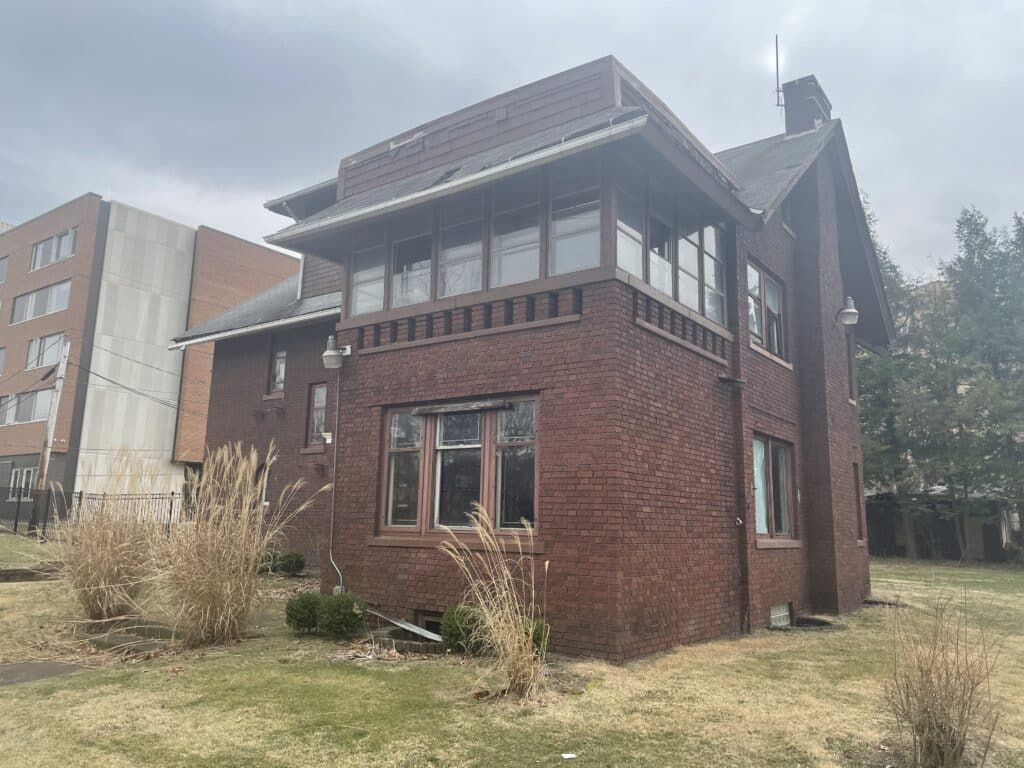
The historic home was designed by the Cleveland firm Dercum and Beer and was originally occupied by Irving Putnam, an entrepreneur who founded an industrial parts company, and Ruth Bradford Putnam, a descendant of the Cozad family of early Cleveland settlers. In 1917, the Putnams sold the home to Hungarian immigrant Moris Wuliger, owner of fledgling company Ohio Mattress. Later, the house was sold to Fellowship Christian Church, which held worship services here from 1970 until 2015.
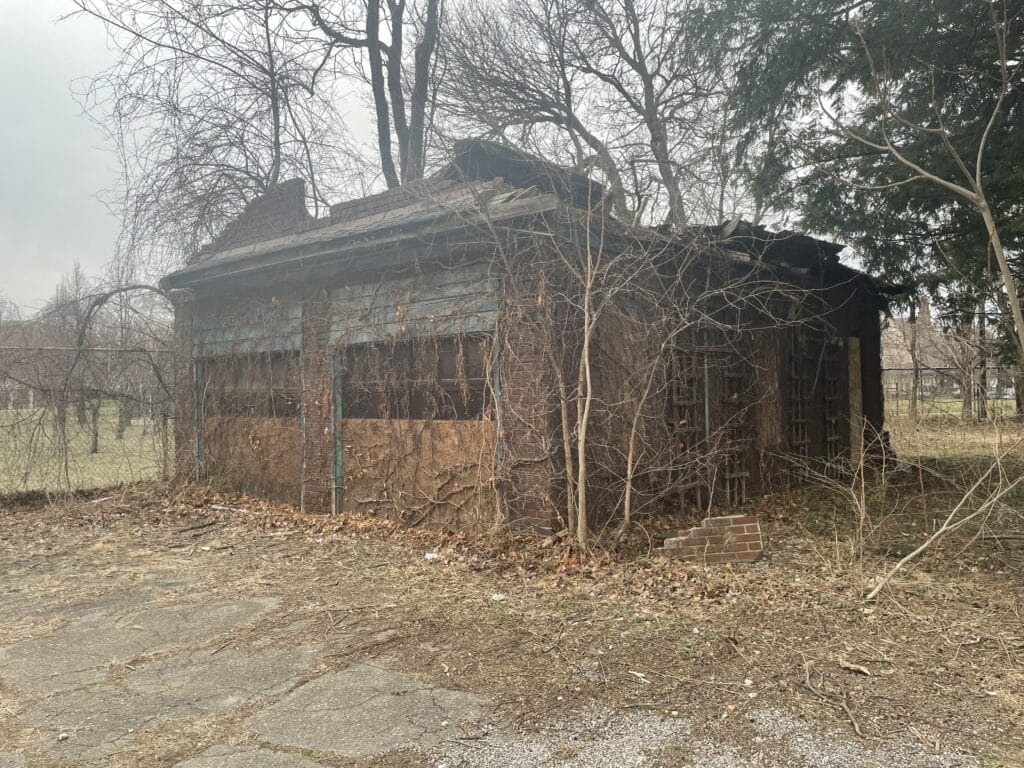
According to county property records, WXZ Development Group bought the house from Fellowship Christian Church for $450,000 in 2015 and then sold it to CWRU for $675,000 in 2017. Located on a large lot with 120 feet of frontage, the house was built in 1914 and contains nearly 4,500 square feet of living space, according to the county. The garage in the rear is in poor condition and will be torn down, and a small parking area will be built there, according to plans presented to the Cleveland Landmarks Commission.
The first floor of the house will be used for community meeting space and programs and will contain a large open space, a smaller meeting room, restrooms, and a small kitchen. The upstairs will contain offices for four to five CWRU staffers. Rogers said that the property sat vacant for several years while the university figured out what to do with it. “Typically as properties become available next to the campus, we try to secure them for future expansion and development,” he said.
University leaders have been working in recent years to strengthen connections between campus and community and help reduce negative health indicators and poverty in nearby neighborhoods, Rogers said. CWRU associate professor Mark Chupp offers a year-long Foundations of Community Building course to engage residents in creating institutional change in their neighborhoods. University students also initiated the Know Your Neighbor program to help foster connections between students and community members. In 2022, CWRU created the Neighborhood Advisory Council (the NAC), a 20-member body composed of community members, students, and representatives from CWRU, to form a more permanent communication between the campus and community. The council will meet at Wade House, Rogers said.
Chupp said that CWRU’s Foundations of Community Building course, which is open to residents of Cleveland and East Cleveland who live near the university, not only helps residents improve their communities but also hosts monthly dialogues and gives them the opportunity to become scholars-in-residence at CWRU. Chupp said that the Wade House Community Engagement Center is an important step towards permanently ending the university-community divide.
“One thing we know is that the community is very interested in engaging with the university, but access is difficult, it’s hard to know where offices are, how to get there, and where to park,” he said. “This is facing the community, it’s very visible, it’s very easily found, and all the programs are in one house. It says, ‘We’re paying attention, and we want to pay attention to you.’”
One of CWRU’s objectives is to use Wade House to help celebrate and educate people about neighborhood history, Rogers said. “We’ve heard time and time again that there is a lack of appreciation and understanding for the history of the surrounding neighborhood,” he said. The house will also be equipped with modern technology so that residents can use it for telehealth appointments or job interviews. Other activities that will take place at the house include tax preparation clinics, Siegal Lifelong Learning classes, and trauma and adversity training.
The exterior of the home will be completely renovated with a new roof, new wood windows, painted siding and trim, and new gutters, downspouts, and lighting. Additionally, CWRU will bring the property back to its historic look by removing several more recent additions. Although Wilcher-Norton is pleased with the plan, she said Neighbor to Neighbor still has to meet with university officials to discuss plans for the property.
Too often, the group has had to fight with developers, the university, and the nonprofit University Circle Inc. to preserve their historic neighborhood, she said. One example of these tensions in University Circle is the recent battle between Hessler Road residents and developer Russell Berusch, who plans to build apartments on a property at Ford Road and Hessler Road which he originally bought from UCI.
“It happens frequently,” she said. “Developers want it, and they want to turn it all into student housing. We also have our problems with absentee landlords. The university is landlocked, so these are things we’ve had disagreements on in the past.”
Rogers said he hopes the facility will help to mend fences and offer a friendly place for neighbors to meet and take advantage of programs being offered by CWRU. “It’s kind of like the touchpoint between the campus and the neighborhood,” he said. “It can be confusing to negotiate our campus and to figure out where to go for meetings. This is more inviting.”
Keep our local journalism accessible to all
Reader support is crucial as we continue to shed light on underreported neighborhoods in Cleveland. Will you become a monthly member to help us continue to produce news by, for, and with the community?
P.S. Did you like this story? Take our reader survey!