For years, members of my west side neighborhood have been dodging chunks of concrete and other debris falling from the crumbling Lake Avenue Bridge, which stands between the Cudell neighborhood and Edgewater Park. The bridge is the responsibility of Norfolk Southern Railway, the same rail company whose train derailed last month near East Palestine, Ohio. Yesterday, Cleveland City Council held a rail safety meeting to discuss not only derailments, hazardous material spills, and city plans for these events, but also rail maintenance problems around the city like those at the Lake Avenue Bridge.
In spring of 2018, neighbors attending a block club meeting at McNamara’s Pub, just south of the bridge, brought up its poor condition and a discussion began about how best to advocate for repairs. Out of this exchange the Friends of Lake Avenue Bridge group was formed and our work to gain the attention of Norfolk Southern began.

Initially, we held several cleanups at the bridge, picking up garbage, hauling away debris, and sweeping up the mud that flows down the walls and coats the sidewalk. A founding member of our group, Julia Van Wagenen, started an Ioby crowdfunding campaign and was awarded a grant from the Alliance for the Great Lakes, which raised a total of $8475 to beautify the bridge. Meanwhile, I researched its rich history.


The Lake Avenue Bridge was built in 1912. Designed by renowned Cleveland architect Frederick Striebinger, the bridge is encased in decorative cast iron and has served as the southern entrance to Edgewater Park for over a century. Dangerous traffic tunnels once occupied the site, until a neighborhood uproar convinced the city and the railroad to build something more suitable for the entrance to a city park.


(Left photo, Engineering News, V. 73 No. 6, 2/11/1915; right photo by Nikki Hudson)
With the help of AmeriCorps member Julia LaPlaca, I completed a Cleveland landmark nomination for the Lake Avenue Bridge and in November 2021 the Landmark Commission unanimously designated the bridge as a city landmark. The designation of the bridge as a historical landmark ensures the design and architectural integrity of the bridge are kept going forward, but does not compel its owner to make any repairs.
In June 2021, we hung banners on the bridge, imploring Norfolk Southern to “Fix the Bridge.” Done out of frustration over their lack of action, we were hoping to draw attention to the dangerous situation for anyone passing beneath the bridge. For years neighbors have been finding large pieces of concrete and even cast iron that have fallen from the bridge onto the sidewalk or the street below.


Norfolk Southern is legally responsible for keeping the bridge, including its drainage system, in good repair. According to ORC 4955.23, no railroad crossing over and above a street where people pass beneath, shall permit the bridge “to remain in such condition that iron, coal, other hard substance, fluid, or noisome matter can fall or drop through such crossing or bridge upon persons traveling or passing beneath it.” A railroad company in violation of ORC 4955.23 shall give the city $100/day for each day of the continuation of failure or violation (ORC 4955.24). Not only are the pieces of concrete and cast iron that fall in violation of this ordinance, so is the mud that continues to ooze down the walls, shorting out the LED lights recently installed by the city.


The city of Macedonia, Ohio, faced a similar situation with a dilapidated railroad underpass on Ledge Road that was dropping large pieces of concrete onto cars passing beneath. Macedonia sued Norfolk Southern, invoked Ohio Law 4955.24, and eventually settled for $500,000 in repairs and an agreement that they jointly seek money for replacement.
Norfolk Southern’s response to our efforts was to send an engineering team to inspect the bridge and then to remove any loose pieces that could fall. The problem with this is that the bridge has not had a functioning drainage system for decades, and especially with any freezing or thawing cycles, the loose pieces just keep coming. Eventually they installed a ‘plywood underdeck’ over the sidewalk portions of the bridge, but we’ve even found pieces of that on the sidewalk on windy days.
The railroad has repeatedly stated that the bridge is strong enough to carry trains, which is their main concern, and that there won’t be major repairs anytime soon. But it’s only a matter of time until something falls, injuring someone or damaging a vehicle passing beneath it.
Morgan Taggart, another founding member of the Friends of Lake Avenue Bridge, said that “Norfolk Southern has shown a careless disregard for the communities that they are traveling through; the bridge is safe for their trains but not for the community.” She added, “The bridge continues to deteriorate, and they’ve made no major attempts to address these issues. The local government’s hands are tied and now it’s up to Norfolk Southern to act.”
While Norfolk Southern sat idle, the funds Julia Van Wagenen raised were put to good use. They have been used to purchase supplies for the cleanups, paint and a cordless paint sprayer for covering up graffiti, annuals and perennials that were planted on the Desmond and Viking Court hillsides, and a public art project made with cyanotype prints from an Art in the Park event that Julia hosted.
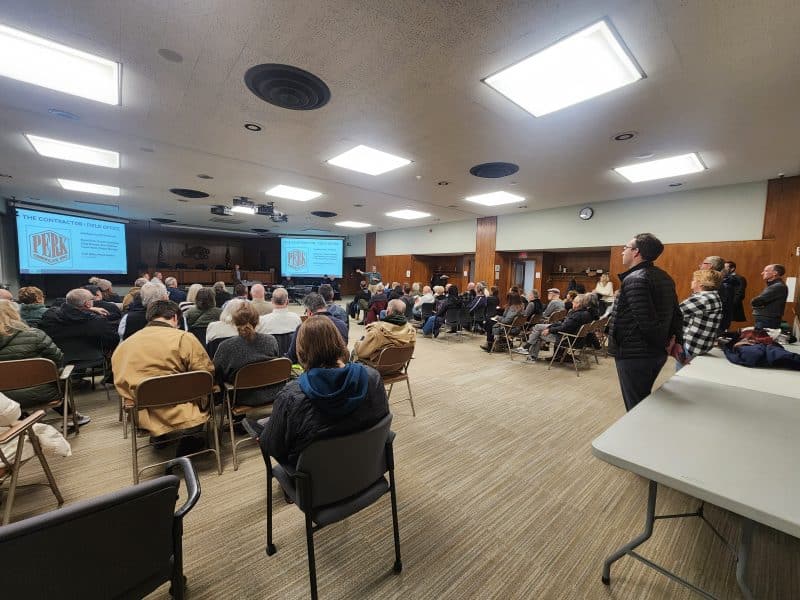
Ward 15 City Council member Jenny Spencer, who also sponsored the legislation to make the Lake Avenue Bridge a city landmark, chaired a rail safety hearing on Tuesday, March 21, 2023, the morning after City Council passed Resolution No. 340-2023 urging Congress and the Ohio General Assembly to enact legislation to further protect the citizens of the city of Cleveland from the inherent dangers of a train derailment on the tracks located in our city. At the hearing, they reviewed federal regulation and heard from Mayor Bibb’s team regarding the city’s Emergency Operations Plan should a derailment occur within the city of Cleveland.
Of particular concern to many of the Council members in attendance were maintenance issues related to railroad property in their wards, including many other dilapidated bridges. It seems the city of Cleveland is littered with them. At least two of the Council members in attendance, Mike Polensek and Joe Jones, believe the city needs to get more aggressive in dealing with the railroads and that past administrations have been far too passive. Given the state of the Lake Avenue Bridge, I would tend to agree.
Nikki Hudson was a participant in The Land’s community journalism program.
We're celebrating four years of amplifying resident voices from Cleveland's neighborhoods. Will you make a donation to keep our local journalism going?