When a neon sign breaks, there’s no dramatic explosion. No deadly chemicals seep into the lungs. The light dies, and the gas slips away, invisible and irretrievable.
Neon is strong, when made by the right hands, hands that meticulously craft each bend and loop, but neither the glass nor the trade are indestructible. When a neon craftsman has no one to pass their old-school expertise down to, the skill evaporates – quickly and quietly, like the gas that escapes a shattered sign and dissolves into the atmosphere.
Craig Alan Nichols, a chaotic yet charming 72-year-old practitioner of the trade, knows this better than anyone. He’s been keeping traditional signage glowing in Cleveland for over 40 years – until cancer stole the steadiness from his hands, rendering him unable to pass down the near-forgotten skill he spent decades perfecting.

“I’m waiting for the doctors to turn around and say, ‘We’re going to fix your hands,’ so I can start bending again,” Nichols said. “Before I get off this planet, I’ve got to teach.”
Becoming a Craftsman
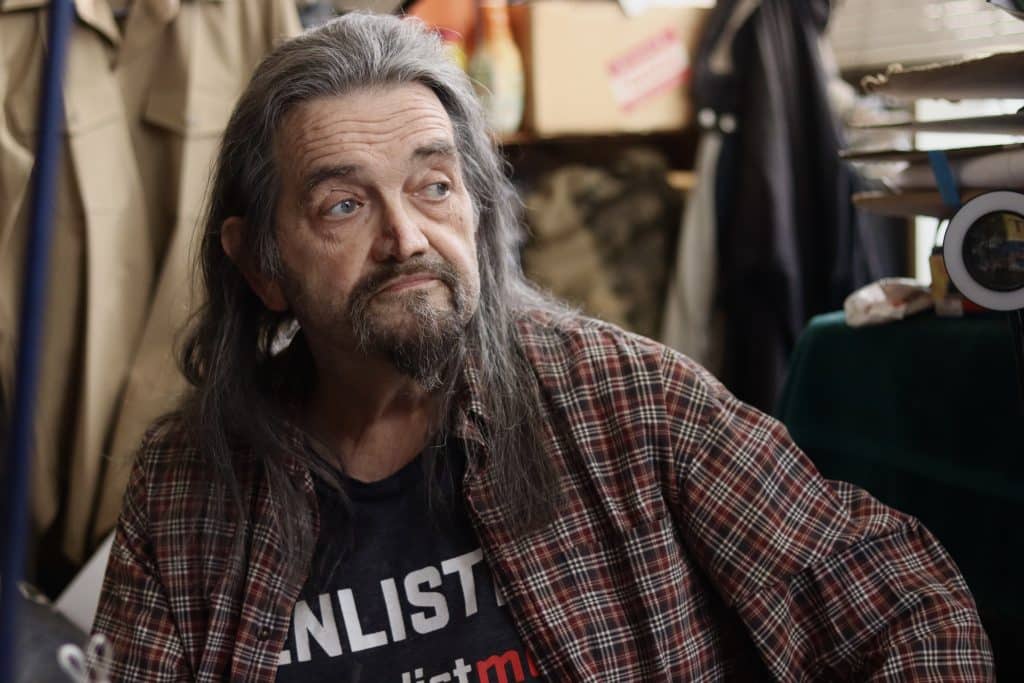
Nichols has made his home on West 105th for the last 14 years, inside of Can Do Neon. The name is a nod to his initials, ‘CAN,’ and his motto is simple: “If you can draw it on paper, I can do it on glass, and your wallet’s the limit.”
He recalls his neon dreams starting in the ‘70s, around 1:30 a.m. on a Tuesday night that, somewhere between one beer and the next, surrendered to Wednesday morning. Freshly home from his service in Vietnam, he tried to settle into life’s normalities, like office jobs and regular haircuts – until one sign illuminated a path that he hadn’t seen before.
As he paid his tab at a neighborhood bar, he noticed the glow of the word ‘Carryout’ flashing in fluorescent letters.
“I looked at it and said, ‘Some S-O-B made that,’” Nichols said. “I was tired of being in a cubicle, I was tired of having my hair short again. I said, ‘Okay, that’s enough.’”
He went to each neon shop in town, knocking door to door until First Neon cracked it open and he wedged his foot in. They suggested he attend the Neon School and Workshop in Antigo, Wisconsin – a program that was paid for by his time spent in the military through the GI bill.
For six weeks, he learned the basics of making neon, starting with as mundane a material as a glass tube.
The ins and outs of the tradecraft still burn bright in his mind. Though Nichols might not be able to show how the molten glass becomes recognizable letters, promises, warnings and invitations, he’s surely able to tell. The first step of making a simple piece of glass into a work of art is to sterilize it.
“You have to evacuate the tube,” Nichols said. “It’s the same as sterilizing a baby bottle.”
Next, he explained, the glass is put under a vacuum and hit with about 15,000 volts, which heats the inside of the tube to around 200 degrees. As the temperature rises, the remaining moisture and contaminants burn off, and the pressure inside shifts on a small gauge called a manometer.
The goal is to move everything out quickly enough that nothing reattaches to the electrodes on either end, which Nichols said acts like a “catalytic converter” for the sign. If too much residue sticks, the tube can fail.
“If you sterilize a baby bottle right and you do it right, the baby gets fat and happy,” Nichols said. “If you mess around with it, baby could get sick.” He said neon’s the same way. And if you’re really terrible at it, the baby can die.
And Nichols’s babies don’t die.
“There’s no two other ways to it,” he said. “I am one of the best cooks in the area, which is why I’m poverty stricken now, because my stuff won’t die.”
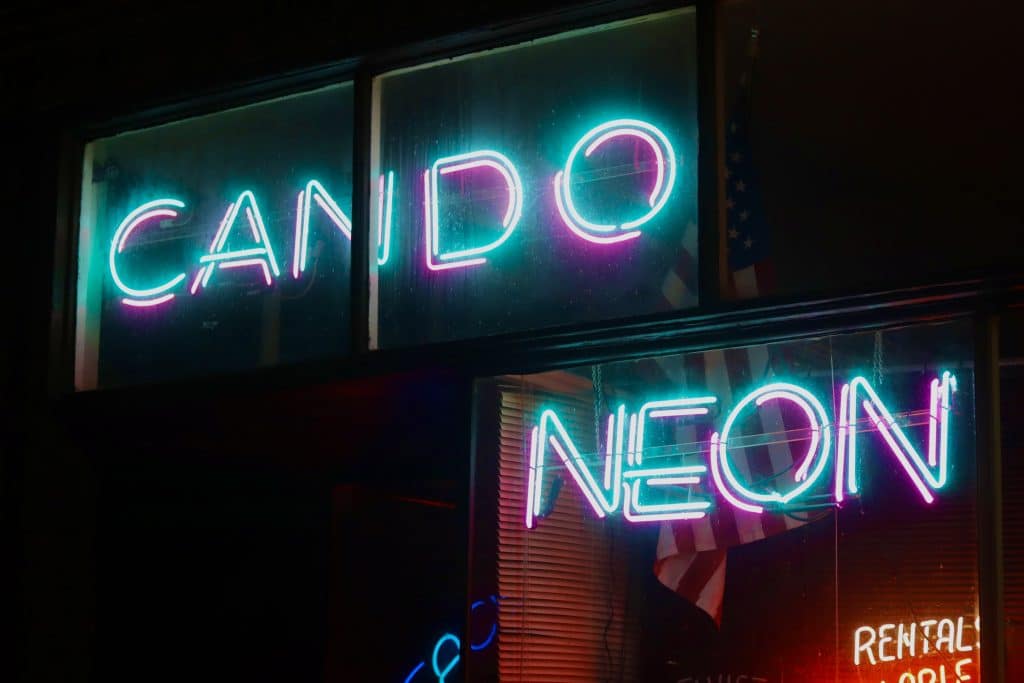
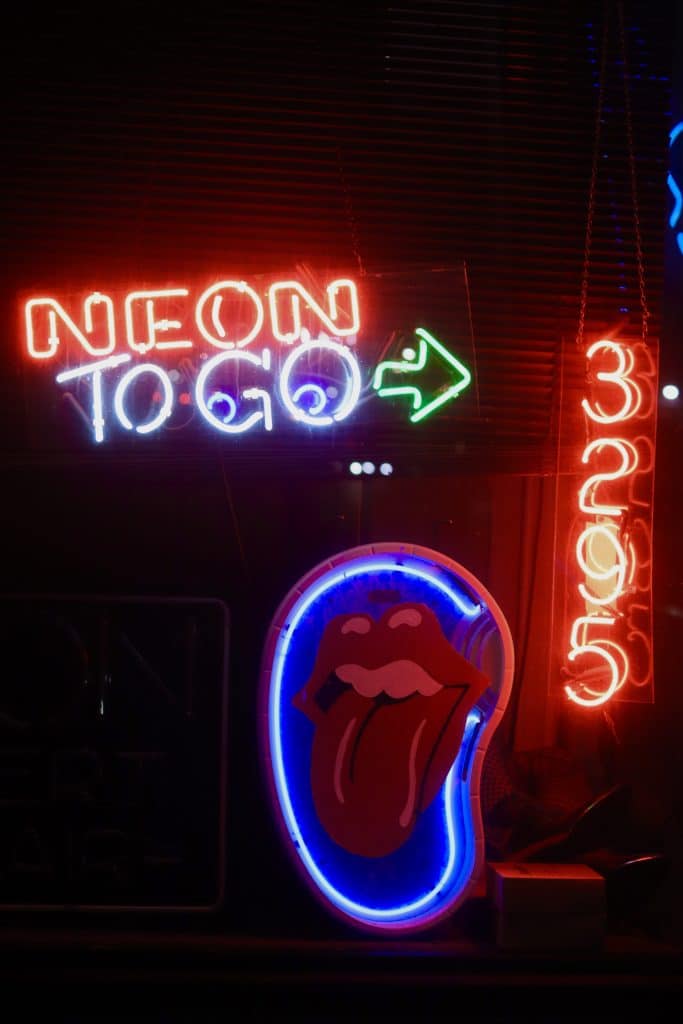
He points to the 27-year-old sign in the window, characters molded by his own hands to spell out “Can Do Neon.” It’s mounted on a one-inch piece of plexiglass and hooked on by zip ties. “Just because I wanted to be stupid,” Nichols said.
Despite the haphazard hanging, it’s not faced death yet. And despite his claims of being poverty stricken, neither has his business – because it’s not all about the money to him.
For Nichols, it’s about keeping something alive long after most people stopped noticing – a relentless resurrection made worthwhile when viewed by eyes that see his work as more than just light and glass.
“The look on people’s faces when I hold up their sign and plug it in for the first time is never, ever, ever anything but ‘Wow,’” he said. “That first wow is what gets me through. It’s kind of like handing someone their baby for the first time, you know?”
Neon in Cleveland
Nichols said that there were two neon schools teaching GIs in Cleveland, “turning out 300 to 500 neon benders a year for about six or seven years.” At the time, the demand for signage was exploding, and the post-Vietnam War workforce needed skills that translated into steady industrial jobs. In an era when colorful signs dotted along each street, neon bending became one of them.
“Cleveland, Ohio, pre-rock and roll, was teaching neon,” Nichols said. “Cleveland, Ohio, is where neon people got born.”
He calculated a portion of his neon career in the linear measurement of light – 1,100 miles of colorful glass tubing in the year of 1988 alone.
“At one time in Cleveland, Ohio, you couldn’t drive a quarter of a mile without running into a piece of me,” he said.
For decades, neon storefronts crowded the city’s streets. The windows of hair salons, bars, factories and theaters were illuminated with the hand-bent tubes. It was more than decoration – it was part of Cleveland’s identity.
But as technology shifted and small businesses closed, what was once an everyday sight became a memory. A nostalgic, warm glow replaced by smoke shop windows blinking with the rapid-rainbow cycle of modern LED strips manufactured thousands of miles away.
“In the 40 years I’ve been independent and whatnot, I’ve seen LED come up every 10 years. And every time they do, they say, “We’re going to put you out of business.” It’s a great tool, but it’s Barbie,” Nichols said. “It’s cheaper, right? You can buy little accessories for it. You can make it dance. But it doesn’t have the impact, the warmth or the history of neon.”
He challenges those that might dismiss neon’s abilities and aesthetics to think of a place where a vivid light buzzing in the window made them think, “Boy, is this going to suck.”
“It doesn’t happen, neon’s not capable of giving a bad time,” he said. “We can get (neon’s impact) back. Nothing says it like neon.”
Holding On
For Nichols, “getting it back” is about more than neon finding its place in the mainstream again. He wants back the autonomy of his hands and the simple, steady movements he built the better part of his life upon. He wants to impart the trade he’s spent a lifetime mastering.
He’s never passed his knowledge down in a traditional teacher-student setting. Bits and pieces were shared with curious minds the way the most sacred things are – across a cluttered table, over a cup of black coffee and a cigarette.
“Nobody knows about neon, so I had no objection to answering any question. It would go on for 45 minutes to an hour and a half,” Nichols said. “And then the abominable, ‘You got a cigarette?’”
After one conversation with Nichols, it becomes clear he has an abundance of stories and knowledge to share, more than an hour and a half could ever hold.
But he doesn’t smoke anymore, and he doesn’t teach either. After his Adenoid Cystic Carcinoma T1 diagnosis, his hands have simply been incapable of the meticulous movements necessary to make neon.
Years spent building muscle memory just for the body to forget, accumulated tradecraft dissipating like leaked neon gas.
The prognosis, which Nichols said is less than 1% of diagnosed cancers in America, has caused his hands to be affected by involuntary minor and fine motor movement. It happens when he’s concentrating and doing repetitive motion – two things that bending neon requires.
“Now who’s the one getting hit by lightning here?” Nichols asked. “If you really think about it, that means ain’t many cancer doctors out there that know how to wrangle that sucker.”
Can Do Neon is still full-service, but the actual fabrication is now handled by Navcour Glassware, a scientific, artistic and neon glass shop in Lorain.
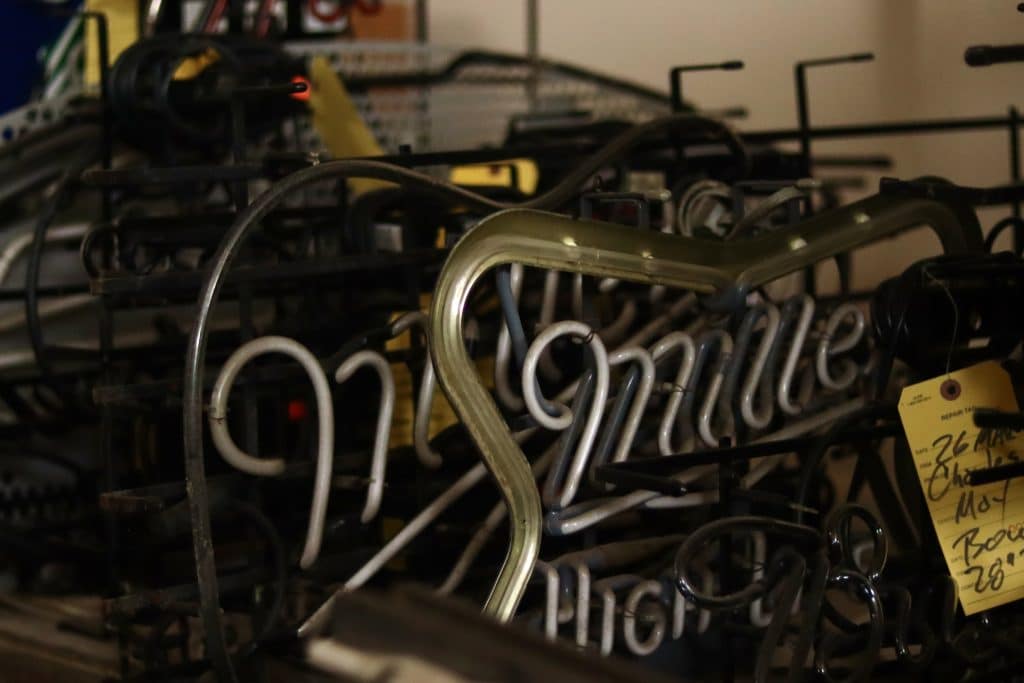
“It drives me crazy because sitting here in this shop, you see all the carcasses around here,” Nichols said.
It’s true. Inside the West Side workshop, each corner is tucked with a metal memory, a sign that might not light up anymore, a ghost of Cleveland’s past.
As a veteran whose life was directly made brighter by the trade he learned after coming back from Vietnam, he wants to get certified so he can teach veterans like him on the GI bill.
“We don’t have enough people doing it. I want to teach,” Nichols said. “Sitting in this room is like having a ‘67 GTO that needs work, having two boxes of Snap-On tools, and no thumbs.”
Without masters of the craft like Nichols being able to pass on what they know, the skill risks slipping further into obscurity, like some of the most artisanal trades do with time. That doesn’t mean they don’t matter, just that they stop being part of everyday life.
The old-world craft of blacksmithing used to shape entire towns, but now the fruits of such labor are viewed through the glass of a museum-grade case. A placard nearby would state how fundamental it once was, washed away with time and innovation. Now, only a resilient few still know how to forge metal by hand.
Neon once lit entire cities. Now, it lingers in scattered windows, clinging on with obstinance. It’s even housed in museums much like the displays of metal forged in the iron age, full of old signs that were once meeting points and landmarks. It’s likely that even if neon signmaking fades into obscurity, it’ll be left to marvel over as viewers imagine those that had the magic powers to make light and glass glow so vibrantly.
Despite it all, Nichols isn’t a tragic figure. He’s a character, a comic-book style keeper of the keys, holding a knowledge that burns bright.
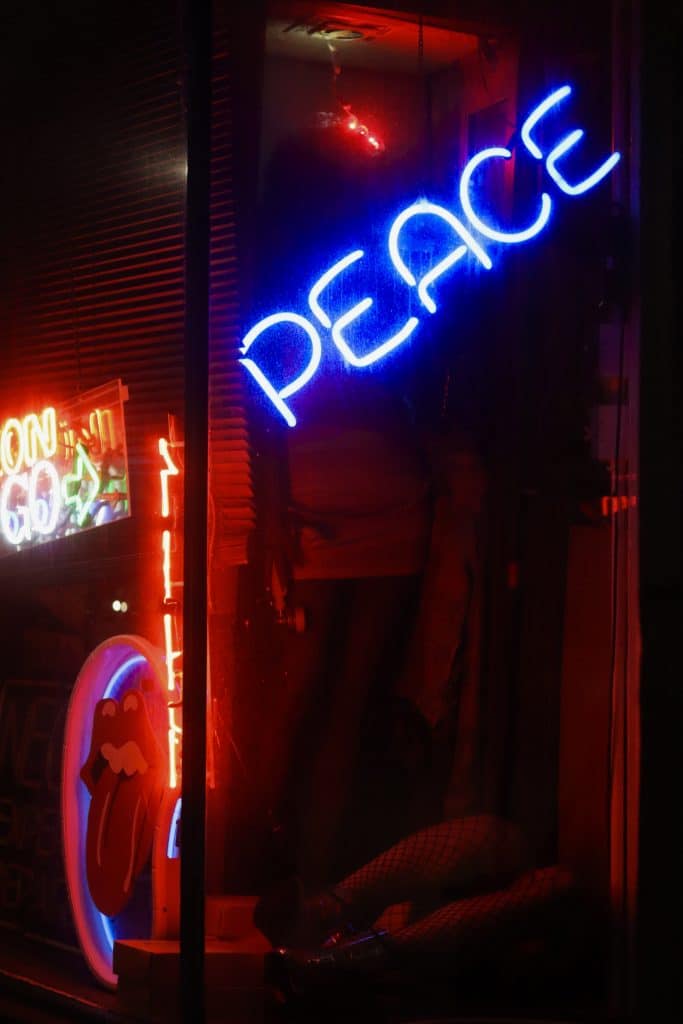
He’s the kind of man that interrupts his own story about cancer to tell you the original meaning of the peace sign, or to share how he once introduced an entire Wisconsin bar to mezcal, or how he and his bandmates staged a fake murder featuring the practical effects of chicken fat and plastic glad bags.
Nichols embodies the character that too often seems to be overshadowed by modern-day convenience.
The fluorescent blue and pink sign that hangs in the window of Can Do Neon still lights the sidewalk on West 105th. It hangs on the way the neon industry does – the way Nichols does – with a single zip tie and sheer stubbornness. Against all odds, it remains, built to be seen.
“I would rather be seen than viewed,” he said.
Whether a craftsman of a dying art form, stuck inside a body that doesn’t work as it used to, or finding a sense of stability in a world that’s constantly shifting, most of us just want our light to be seen – before it fades away.
Keep our local journalism accessible to all
Reader support is crucial as we continue to shed light on underreported neighborhoods in Cleveland. Will you become a monthly member to help us continue to produce news by, for, and with the community?
P.S. Did you like this story? Take our reader survey!