This story was produced in collaboration by The Marshall Project – Cleveland, The Columbus Dispatch, The Cincinnati Enquirer, Akron Beacon Journal and Canton Repository.
Jayson Murphy lit the speck of paper and held the smoke in his lungs as long as he could.
His cellmate, John Jenkins, got the drug-soaked scrap from another incarcerated man at Lebanon Correctional Institution. The paper — nicknamed K2 inside state prisons — was cut from a sheet soaked in unpredictably potent synthetic chemicals.

The drug was their escape from the cockroaches, the bad food, the brutality of their life in prison. The friends laughed themselves to sleep in their bunks that October evening in 2024.
The next morning, Jenkins nudged Murphy’s leg. He didn’t move.
“Oh man, my cellie is dead,” Jenkins recalled telling a corrections officer.
Investigators with the Ohio State Highway Patrol closed the case when the coroner ruled the death an overdose.
“They don’t care to even waste time investigating it,” said Murphy’s sister, Amber Hall.
Murphy was one of a growing number of people dying behind bars as drug-soaked paper floods Ohio prisons.
Smoking paper is a uniquely prison thing. The common chemicals and synthetic compounds are hard to detect. The paper is easy to smuggle and hide.
A single sheet can sell for $6,000 or more after being cut into as many as 1,400 tiny hits.
Incarcerated people, former staff and grieving families say the system comes down hard on people suffering from addiction behind bars while prison officials refuse to admit that the biggest smugglers are vendors and state employees.
Workers suspected of smuggling drugs into Ohio prisons are seldom charged. Many simply resign, a yearlong investigation by The Marshall Project – Cleveland, Columbus Dispatch, Cincinnati Enquirer, Akron Beacon Journal and Canton Repository found.
Alarming figures
Ohio prisons Director Annette Chambers-Smith, who is stepping down to take a job in the governor’s office, calls the fight against drugs a game of “Whac-A-Mole.” Shut down one route, another opens.
The state has invested millions of tax dollars to add technology and security measures. But Gov. Mike DeWine said officials are “certainly not satisfied” with the results.
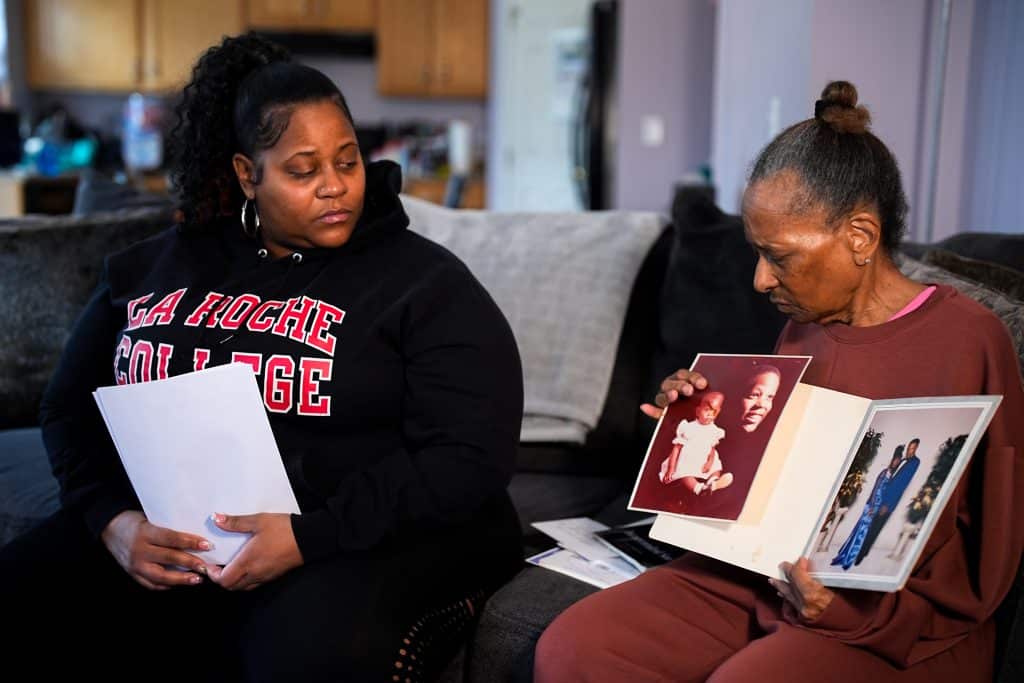
Drug-related prison rule violations doubled from over 10,000 in 2020 to nearly 21,000 in 2024. The proportion of incarcerated people who, when surveyed, said they could easily get drugs soared from 12% in 2023 to 88% in the following year.
Officers logged more than 56,000 drug confiscations since 2020. The source of the drugs was listed in fewer than 5% of the cases. The tracking system, however, is not updated if investigators later identify how the drugs entered the prisons.
It’s impractical to test or investigate everything that is found, officials said. And the eye-popping totals don’t include all the drugs and activity that go undetected. State inspectors have reported entire facilities filled with the smell of burning paper, even as staff in those facilities self-report some of the lowest confiscations.
Synthetic cannabinoids — lab-made chemicals sprayed onto paper — are now killing more people in Ohio prisons than fentanyl.
Based on completed death investigations from 2024, Ohio prison officials recorded 10 fatal overdoses. Autopsy and toxicology reports, however, show that drugs probably caused or contributed to at least 20 deaths, which is likely an undercount.
Standard testing isn’t designed to detect many chemicals in drug-soaked paper, and additional testing can be costly. Unable to confirm suspected overdoses, coroners often list an undetermined cause of death or point to a chronic disease in a person’s medical history.
State prison officials failed to count Aaron Dixon’s death as an overdose.
In August 2024, he called his oldest daughter, Katherine, from Chillicothe Correctional Institution. They talked about attending her little sister’s graduation together if he got out in time.
That night, a cellmate found Dixon slumped forward, blue and cold.
The autopsy said he suffered from heart disease and died of a synthetic cannabinoid overdose. Katherine learned that drugs were involved when a reporter called to share the medical report.
“Wait, did you say that he overdosed?” she asked.
She had believed prison would keep her father safe and give him a chance to kick the habit. Instead of her father walking her down the aisle for her wedding in October, Katherine will carry a portion of his cremated remains inside a heart-shaped necklace.
A scene from a horror show
Drugs are reshaping daily life behind bars.
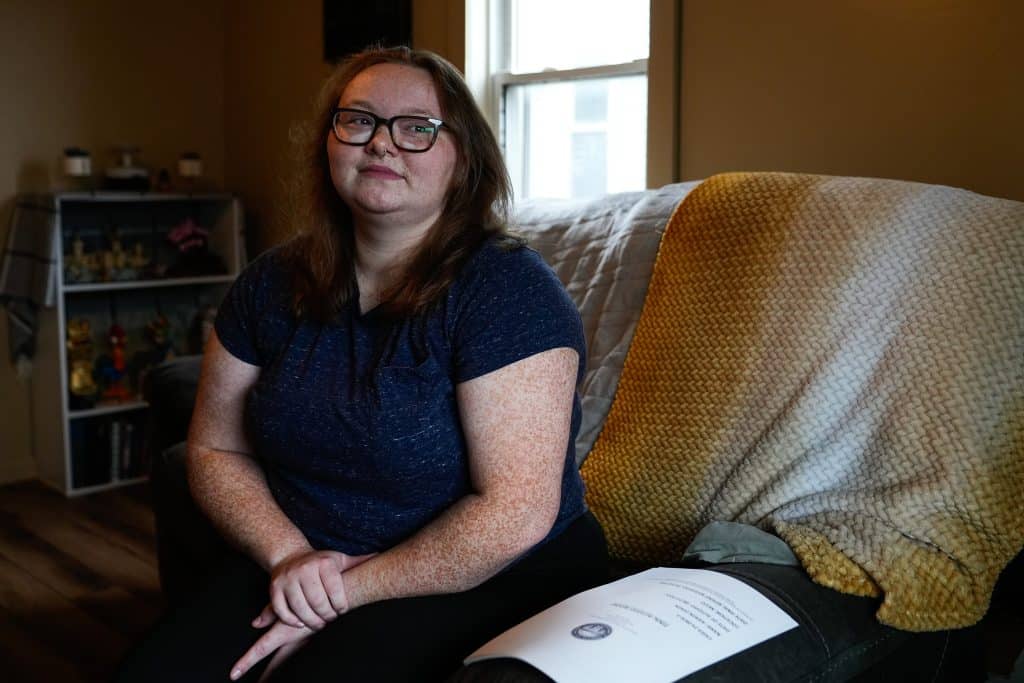
In some housing units, men pass out or shuffle like zombies with burn holes in their blue prison uniforms. Some vomit, convulse or lash out. Many can’t remember what happened. Jenkins, who found his cellmate dead one morning at the prison in Lebanon, called it a scene from “The Walking Dead.”
“It really has an impact on those of us who don’t use,” said one woman incarcerated at Dayton Correctional Institution, who didn’t want her name used out of fear for her safety. “We’re on lockdown more, and it has everyone on high alert and the COs on edge.”
Some incarcerated people say they now sleep with one eye open. They risk punishment if they fight back when someone who is high attacks them. At Mansfield Correctional Institution, three men staged a hunger strike last year to protest what they saw as a failure to stop the drugs.
State Rep. Mark Johnson, a Republican whose district includes two state prisons in Ross County, said the drug trade undermines rehabilitation.
“We got inmates that go to prison who were straight arrows and clean, and when they leave prison, they’re addicts,” he said.
The employee problem
Prison leaders say visitors, drone pilots and people throwing packages over fences account for most of the known smuggling. They’ve installed Top Golf-style fencing and systems to detect drones and illegal cell phones, deployed drug-sniffing dogs and added body scanners for incarcerated people. Every piece of mail addressed to an incarcerated person — about 158,000 pieces in 2024 — is now scanned and delivered to electronic tablets to prevent drug-soaked paper from entering.
Still, the drugs keep coming.
At the women’s prison in Dayton, state officials bungled a request for a hidden camera after at least three incarcerated women said a teacher was bringing in drugs and sexually assaulting prisoners in 2024. The teacher offered the women money and coerced them into selling by threatening physical violence, they told investigators.
One woman said she made the teacher $50,000 in a couple of months. When she reported him as part of a sexual assault complaint, prosecutors charged her — not the teacher — with aggravated drug possession.
“We’re the ones that are punished, and everything is blamed on us, and yet staff get no type of punishment, consequence, nothing. They just lose their job, and that’s it,” the woman said.
The teacher was fired, but never charged. He declined to comment for this story.
The state keeps lists of vendors banned from prison property or employees who are blackballed from future state jobs. Since 2020, 390 vendors and 335 former employees have been added to those lists, including the teacher.
The vendor list often gives a two- or three-word reason why they’re banned. The spreadsheet of barred employees doesn’t have a column for why they’re on the list, said JoEllen Smith, the spokesperson for the prison department.
“Although this information does not exist in list form, background on why an individual was flagged as ‘do not rehire’ can be located in their investigative reports,” she said.
Collecting those reports could be time-consuming. State prison officials sometimes take several months to respond to public records requests.
Many workers resigned without facing criminal charges. Some who were charged admitted to smuggling for weeks or months before getting caught, illustrating the incredible amount of drugs that are walked in through the front door.
In 2023 and 2024, prosecutors charged 20 state employees for collectively smuggling 5 pounds of tobacco, 2 pounds of marijuana, a half pound of meth, a half ounce of cocaine, 1,879 Suboxone strips and 619 pieces of drug-soaked paper, including at least 218 full pages — alone valued between $1 million to $4 million inside.
Dealers often pay smugglers through CashApp, Venmo or other apps. Incarcerated people also have friends and family send money to the cash apps. The dealers then confirm payment and release the drugs.
Workers have admitted to earning up to $5,000 per drop — sometimes more than a month’s salary.
One man incarcerated at Ross Correctional Institution bragged on a text-messaging system used to communicate with people on the outside that he could make $12,000 in two or three days, according to messages obtained by the highway patrol. His collaborators could make a half-million dollars in two or three years.
“It’s a gold mine here,” he texted.
Regrets and Prison Time
In late 2022, a man serving time for bringing drugs into another prison offered Barbara Devine $2,000. She had watched fellow corrections officers at Chillicothe Correctional Institution avoid major consequences for smuggling. Worn down by toxic prison work and desperately needing the cash, she said she agreed.
After passing through security to begin her shift, a drug-sniffing dog targeted Devine. She had vape pens, tattoo ink and super glue in her belongings, and a condom-wrapped package in her vagina with meth and cell phone SIM cards.
She confessed and pleaded guilty. Once incarcerated, Devine said she began to realize the magnitude of Ohio’s prison drug problem and how she contributed to it.
“That really bothers me,” she said.
Cory Sutphin, now incarcerated at Chillicothe Correctional Institution, worked as a driver, scout and drone pilot for a drug smuggling ring in 2021. He said he made about 100 drug drops and roughly $100,000 in seven months.
He’d disguise the drugs in empty chip bags to make it look like trash littering the yard or use a dead bird’s carcass. Sutphin could steer a drone directly to a cell window for someone to grab — like DoorDash for drugs.
But it all came crashing down in November 2021 when he and his collaborators were arrested and charged with more than 100 felony counts.
Sutphin got just under five years of prison time.
“I think about it now, it was the dumbest thing I could’ve possibly ever done in my life. Dumbest thing. Hands down,” he said.
Keep our local journalism accessible to all
Reader support is crucial as we continue to shed light on underreported neighborhoods in Cleveland. Will you become a monthly member to help us continue to produce news by, for, and with the community?
P.S. Did you like this story? Take our reader survey!


![No Kings protest brings thousands to downtown Cleveland [Photos]](https://d41ow8dj78e0j.cloudfront.net/wp-content/uploads/2026/03/28151521/1000004296-800x600.jpg)
![One of the largest salt mines in the world exists under Lake Erie [photos]](https://d41ow8dj78e0j.cloudfront.net/wp-content/uploads/2026/03/28072404/AP26083605060979-800x600.jpg)