As a longtime housing advocate, I know that housing insecurity is sometimes caused by injustices, including the lack of safe, affordable housing in many Cleveland neighborhoods. That’s why, for me, hearing about accomplishments in housing security, including developments that provide housing to people who need a safe, affordable place to live – is always a heartwarming experience.
I can recall when I first started life on my own at age 15 in New York and the many bouts I had with housing insecurity. Those experiences informed my passion for advocacy over the years on many life issues that people face, including affordable housing.
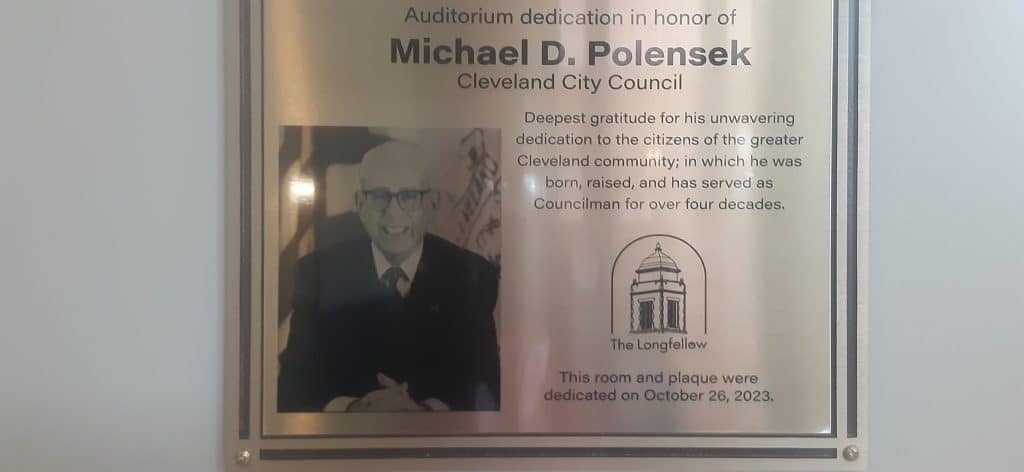
This is why my research and conversation with Ward 8 Cleveland City Council member Michael Polensek regarding the successful completion and opening of the 80-unit Longfellow Senior Housing community in Collinwood was such a rewarding experience.

I have personally encountered Cleveland area seniors struggling with affordable housing, so the addition of new affordable housing units for seniors to a Cleveland neighborhood is very much welcomed.

A history worth preservation
Before this successful development, the Longfellow complex, which is located just south of I-90 at 650 E. 140th St., was once the Henry Wadsworth Longfellow Elementary School, built in 1924.
In 2006, the Cleveland Metropolitan School District (CMSD) officially closed the school, according to the Cleveland Restoration Society. The school sat vacant for a while amidst plans to demolish it.
However, in 2013, change was on the horizon. This is the year that Cleveland City Council wards changed because of redistricting. When that happened, Council Member Polensek soon found that the empty Longfellow School was now located in Ward 8, which is his ward.
Polensek and other historic preservation advocates expressed their displeasure over the plans to demolish such a historic building that had served generations of children for over 85 years. The council member, who has lived in Collinwood his whole life, wanted to do something about it.
The school is well over 50 years old, qualifying it as a historic landmark. Furthermore, it was designed by a renowned and revered public housing advocate, the late Walter McCornack. The official architect for the Cleveland Metropolitan School District, McCornack also designed schools in East Cleveland, Cleveland Heights, and Shaker Heights. Having designed one of the first public housing projects in the country in 1937 – the Cedar-Central Apartments – he is credited for “changing the face of Cleveland,” according to the Encyclopedia of Cleveland History, for his design work with housing and schools.
Saving Longfellow School from demolition
Polensek began talking to everybody he could about rescuing Longfellow from the wrecking ball. One group he spoke with was the Cleveland Restoration Society (CRS), a nonprofit founded in 1972 over the same concerns Polensek had just a few years ago – that is, the decimation of Cleveland’s historic buildings. Being a perfect match, the two began to strategize.
Finally, in 2016, the Councilman, with the support of the Cleveland City Council and the cooperation of the school district, was able to get the former school designated a historic landmark. The plan continued with the search for and acquisition of financing and the right developer. The project partners were able to secure historic tax credits from the state of Ohio. Overall, the basket of financing included federal historic tax credits, loans and grants from the U.S. Department of Housing and Urban Development, and a loan from the city of Cleveland. The entire project budget ended up being around $23.5 million.
The developer search concluded with Vesta Corporation as the choice, which then brought in Marous Brothers Construction as the builder. The revelation that the mother of the two Marous brothers had once attended Longfellow School seemed to be confirmation that Vesta had made the right choice of a construction partner.
To turn the plan into reality, Vesta needed the Cleveland schools to transfer the property to the city, who would then transfer it to the developer to begin work. The project took two years to complete, and the newly named Longfellow Senior Housing community had its ribbon-cutting on Oct. 26. It includes a renovation of the historic building boasting 30 units, as well as a connected addition with another 50 units.
“Longfellow is a dream come true for me – saving a historic landmark building from demolition and providing 80 units of high-quality senior housing in a neighborhood where my grandparents lived for decades,” said Polensek. “A total victory for Ward 8!”

A new life for the historic building
As I strode along the walkway to tour this historic landmark, it was nothing less than majestic. If I hadn’t previously learned of its historic significance, its fine architecture and distinguished presence were striking enough to be deemed as such.
Inside the building, the huge vestibule hosted several restored photos in elegant frames of classes of children from the early 20th century. The age of the photos resembled the childhood photos I have of my mother from the 1940s, as well as those of my grandfather during that same decade.
As my tour began, I was taken in by the delicateness and attention to detail that was present in the restoration. As I am a history buff and an avid admirer of good architecture, it would be my usual to meticulously study the preservation aspects of the building. I noticed that the locker area had been beautifully converted into a mini-post office of sorts housing the residents’ mailboxes, complete with Amazon lockers. The 3,000-square-foot auditorium with a stage had been converted into a huge community room, where residents could host events. And the 2,200-square-foot gym had been turned into a fitness center with exercise equipment and a track.
The complex now also has a health room that will allow third-party healthcare providers to come and conduct private health examinations.
The care that was put into this restoration led me to a conversation with Kathleen Crowther, executive director of Cleveland Restoration Society (CRS), which played a significant role in this process. A regional organization, CRS works with communities through technical assistance, advocacy, and a loan program that aids historic preservation efforts.
Ms. Crowther educated me on the historic nature of the building and told me, the materials put into this building and other historic sites are unaffordable today. The high-quality skilled labor that went into making the bricks, baking them in the oven, and transporting them to the site should not be wasted, she argued. Terrazzo floors present in the Longfellow complex typically last the lifetime of a building. The glass block between the floors is designed to allow sunlight in, and the sturdiness and craftsmanship of the original oakwood are not to be taken lightly.
“We cannot afford to throw away into the landfill these higher quality materials,” she said. In doing so, she added, “We also throw away the embodied energy that is represented by them. That material represents the energy used to make, shape, and transport the materials to the site.”
So far, the complex, a mix of one and two-bedroom units, many with walk-in closets, has 23 residents and is accepting applications. The qualifications include being 62 or over and a maximum income of $37,980 for one person.
I was informed by the Longfellow Senior Housing office that when a person applies, once all of their paperwork is in, they could move in as early as in one week.
To learn more or apply for residence, visit longfellowseniorhousing.com, or call 440-431-3850.
We're celebrating four years of amplifying resident voices from Cleveland's neighborhoods. Will you make a donation to keep our local journalism going?