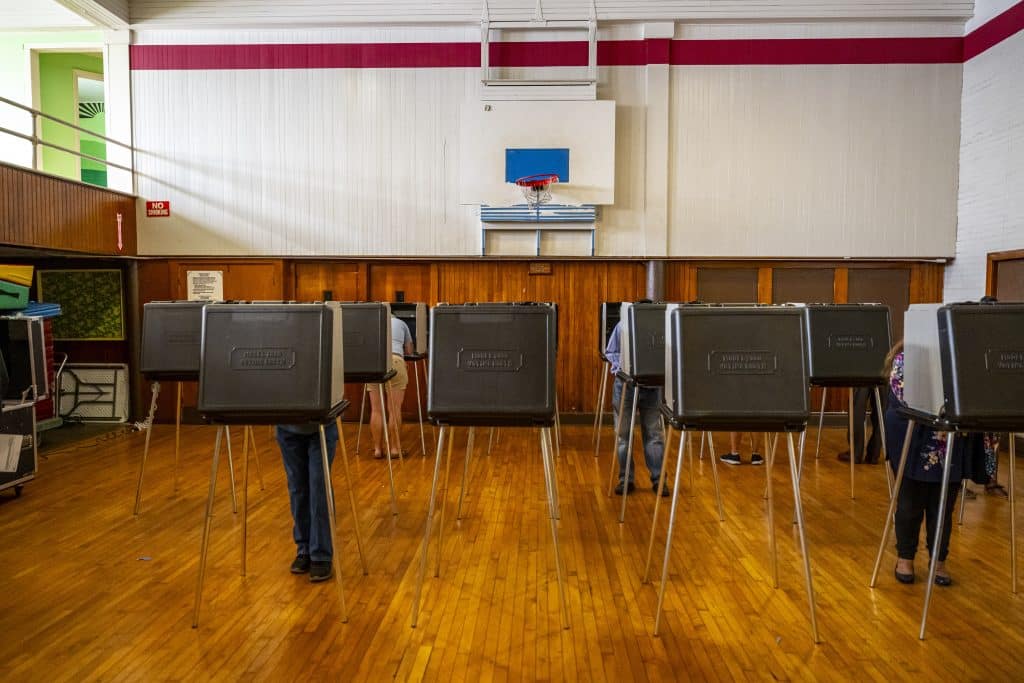
In April, Lakewood native Christopher Bendel launched the Rank the Vote Lakewood campaign to educate residents about ranked-choice voting (RCV) in preparation for a potential Charter Amendment to replace Lakewood’s current electoral system with RCV. He hopes to get RCV on the ballot in 2026.
Most Ohio cities currently use a plurality — or “winner-takes-all” — electoral system, where the candidate with the greatest number of votes wins (even if they didn’t receive a majority of votes).
In a ranked-choice voting system (also known as “proportional representation”), voters rank a group of candidates in order of preference instead of selecting only one person. Later, when all the votes are tallied, if one candidate receives half of the votes, then that candidate automatically wins the election, just like in our current system. But, if none of the candidates receive a majority, then the candidate who received the least amount of first preference votes is eliminated. If a voter’s first-choice candidate gets eliminated, then their second-choice candidate now gets counted as their first choice, and that person gets the vote. After this second round, the new totals are counted. If someone has won the majority of votes this time, then they win. If not, the process gets repeated until a winner can be declared.

RCV supporters say this system has more benefits and is fairer than how we currently choose candidates.
“The promise of ranked-choice voting for Ohio,” says Michelle Jackson, regional organizer for the Northeast Ohio Chapter of Rank the Vote Ohio, “is that you have better discourse, less rancorous elections and less partisan elections. And the winner is the voter and the constituency every single time.”
Ohio State Senator William Demora (D-Columbus, District 25) disagrees that RCV would benefit Ohio and its municipalities. Demora believes ranked-choice voting is “bad for Ohio.” He thinks it would be expensive, slower than our current system and confusing for voters.
Ohio Secretary of State Frank LaRose has also spoken out against bringing RCV to Ohio. Like Demora, he points to potential higher costs as one of the reasons he’s against it.
Bindel argues, however, that RCV would lead to a cost savings for the state.
“If we do RCV, we can eliminate our primaries,” he says. “Instead of doing a primary to get three people down to two for the general, we can just have three people in the general, and we save all that money for the primary.”
A study conducted by the National Conference of State Legislatures found that it costs districts about $154,759 to switch to an RCV voting system. The study also found, though, that switching RCV can be “a net money saver” because in some cases RCV leads to Boards of Elections holding fewer elections overall.
Bindel also says studies have shown RCV increases the diversity of candidates. “That includes more racial minorities and women, as well as more parties and viewpoints. So instead of just having a Republican and a Democrat run, like we always see, you could also get more third parties or independents running.”
Meet Christopher Bindel
Bindel believes he’s the right person to start an RCV campaign in Lakewood because he has lived in the city his entire life, and he has had a lifelong interest in politics and our electoral system.
“Even starting in high school, I was civically active,” he says. “I always followed what was happening with [Lakewood] City Council and other local politics.”
When Bindel left for college, he would still try to attend council meetings while he was home. When he graduated from college, he got involved with the “Lakewood Observer” and covered council meetings. He covered council from April 2009 until July 2016.
Bindel has also been a member of boards and commissions in Lakewood. He was on the Citizens Advisory Committee for four years, and then the Board of Zoning Appeals, which he was on for nine years. He then chaired the Board for four years, but termed off of it in December 2022.
“At that point I just didn’t have anything lined up and was enjoying spending time with my kids,” he says. “But I knew I would eventually get involved with something else.”
That “something else” ended up being RCV, which Bindel first learned about while listening to an episode of the “This American Life” podcast. He wondered if there were any groups or organizations working to bring RCV to Ohio. His research brought him to Rank the Vote Ohio (RTV Ohio), a nonprofit that aims to “educate fellow Buckeyes about RCV and its benefits.” Bindel reached out to them and met with Michelle Jackson, who helped onboard him as a volunteer.
“I’m really impressed with Chris that he’s made the time to kind of work with us on this,” Jackson says. “All of us [at RTV Ohio] are part-time. We are really scrappy … this is a very, very bare bones sort of operation, and so the volunteers have really been the ones who carried it since day one. This includes Chris, who is just really dedicated and has talents that he can lend to it.”
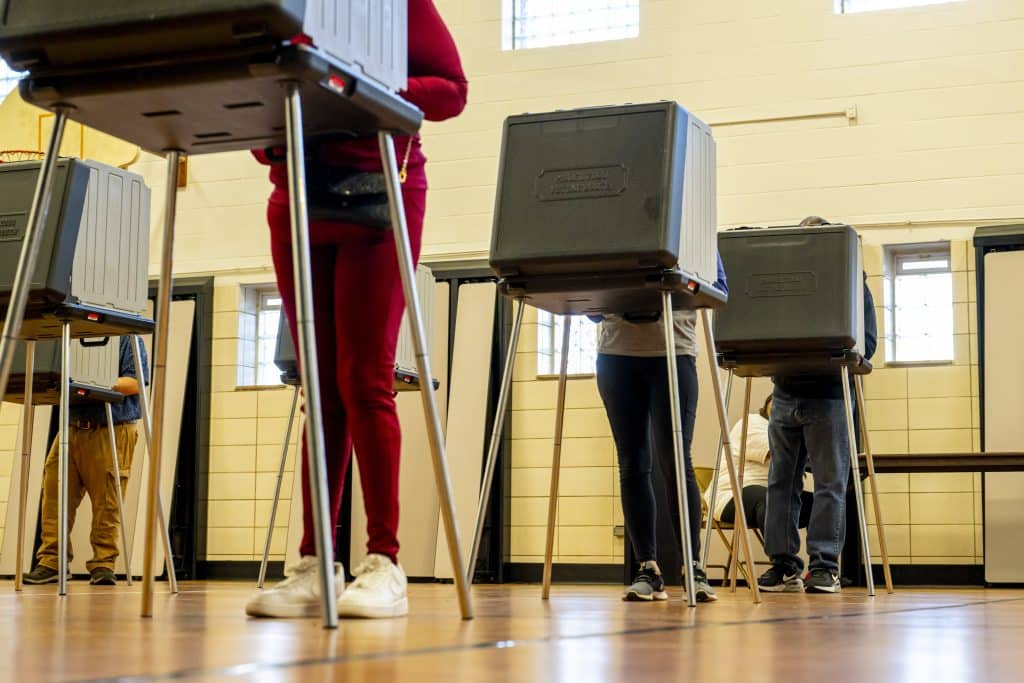
Bindel has the full support of RTV Ohio to try to bring RCV to Lakewood. Bindel got the idea to champion RCV when he learned that Lakewood’s 2024 Charter Review Commission had recommended the city switch to a ranked-choice voting system in their Final Report of Proposed Amendments.
“There are two main reasons I supported exploring RCV in Lakewood,” says Dean Jackson (no relation to Michelle Jackson), a member of the 2024 Charter Review Commission. “First, a system where voters rank candidates by preference has advantages over our current system: there is no separate primary, which reduces costs and ensures the winning candidate is supported by a majority of voters, not a plurality. It also reduces costs. The second reason is that Lakewood can be a role model for other communities by adopting a change that would be positive for the state and country as a whole. RCV encourages candidates to appeal to a broad set of voters.”
In the Final Report, Jackson and the rest of the Commission leave it up to Lakewood City Council to determine if they want to let Lakewood residents vote to switch from a plurality system to RCV.
“If Council decides to put RCV on the ballot then the people will decide whether or not to make the change to the charter,” Bindel says. “And that’s why it’s important to educate the public about RCV, because they’re the ones who are going to end up voting on it.”
When reached for comment about their current stance towards implementing RCV in Lakewood, the Council Members who did reply are not in agreement on whether they think it’s a good idea (City Council President Sarah Kepple and Mayor Meghan George could not be reached for comment).
“The greater issue remains gerrymandering,” says Councilwoman Cindy Strebig, Ward 3. “Until we correct that injustice, we’re putting the cart before the horse with any considerations of ranked-choice voting.”
Councilwoman Cindy Marx, Ward 4, also expressed skepticism about RCV, although her concerns were different from Strebig’s. She questions the need to switch to RCV when – in her opinion – the current system hasn’t had any issues. She also wondered about its potential impact on election results and costs. Finally, she expressed confusion about how RCV works and said if the city does decide to consider RCV, there will be a need for public education regarding the new system.
“I think it would be confusing to a lot of seniors in Lakewood,” she says. “You know, I was confused. I’m still confused when really trying to understand how it all works.”
Councilman Bryan J. Evans, Ward 1, and Councilwoman Angelina Hamiton-Steiner, At-Large, are in favor of switching to RCV.
“I’m all for ranked-choice voting for Lakewood,” says Evans. “It makes races between multiple candidates more equitable, has been shown to increase turnout, and can save the time and money of primaries or run-offs (among other things).”
Hamilton-Steiner similarly believes that RCV is a way to improve democracy and voter engagement in our community.
“It will help encourage people from and individuals with differing lived experiences, realities, and diversities to run for office, providing for a better representation of the community,” she says. “Individuals that have thought of running for office but were too nervous or afraid or a candidate that didn’t believe they would ever have a chance to win, but wants the experience. If you don’t run, you can’t ever win, so Ranked Choice Voting can lower the high risk for candidates newer to running for office.”
Multiple council members noted that neither Lakewood City Council nor the mayor have discussed RCV in a public meeting yet. If they decide to do so, that meeting will be open to the public so Lakewood residents can weigh in.
The history of RCV in Ohio
Ohio was actually the original testing grounds for RCV in the United States, according to the Ranked Choice Voting Resource Center. The first time RCV was used in the U.S. was in Ashtabula in 1915 to elect city council members. It then spread to other Ohio cities, like Cleveland and Cincinnati in the 1920s, and eventually to other states. By the 1940s, RCV was in two dozen cities across six states.
However, some politicians who lost their seats due to RCV organized against the system, and by the end of the 1950s, 23 of the 24 cities using RCV saw it repealed. Hamilton was the last city in Ohio to use RCV (they stopped in 1960). Rank the Vote Ohio claims that one of the reasons RCV was repealed relatively quickly is that it led to the election of women and Black candidates for the first time in some cities.
In Cleveland, for example, Marie Wing, a progressive activist who was one of the first two women to be elected to Cleveland City Council, was chosen by voters using RCV. After Wing, eight more women got elected to City Council through RCV. After RCV was repealed in 1931, though, it would be 18 years before another woman would be elected to council in Cleveland.
Cincinnati also saw more diverse elected officials after switching to RCV. The city elected its first Black at-large councilman – Ted Berry – in 1949. Berry, who eventually became the first Black mayor of Cincinnati in 1972, credited many of his political victories to RCV. He won four elections to council in a row, from 1949 to 1957. In response to Berry’s success, some of his critics launched smear campaigns against him and pushed for RCV to be repealed in Cincinnati, which happened in 1957. Around 55% of voters voted for the ban, with white voters voting “yes” by two-to-one margins and Black voters voting “no” by four-to-one margins.
But RCV is making a comeback. Currently, RCV is used by about 50 U.S. cities and two states, Maine and Alaska. Maine passed RCV for their federal elections through a citizen-initiated ballot measure in 2016. The results were 52.1% in favor and 47.9 % against, showing that initially, Maine voters were nearly evenly split in their views of RCV. However, RCV has since grown in popularity in the state. In 2024 ahead of the Presidential Election, 57% of polled Maine voters supported ranking candidates while 35% opposed the RCV system.
Like their Maine counterparts, Alaskan residents were also split nearly down the middle when RCV appeared on their ballots in 2021, with 51% of them voting in favor. But similarly to what has happened in Maine, it appears the more Alaskan residents use RCV, the more popular it becomes. In 2022, Alaskans for Better Elections surveyed voters after the November 8 Election, and 79% of Alaskans reported RCV to be “simple” to use and understand. And 60% said they think Alaska’s state and local elections were more competitive now. It should be noted, though, that Alaskans for Better Elections is an organization that advocates for RCV in the state.
As more people learn about RCV, the number of states and cities considering implementing it seems to be steadily increasing. In a 2022 survey conducted by YouGov, 56 percent of Americans had heard of RCV and 44 percent of respondents had not. The same survey was conducted in 2024 and found the percentage of respondents who had heard of RCV rose to 67 percent.
Ohio has also seen an increased interest in RCV. Michelle Jackson claims the advocacy and educational efforts of Rank the Vote Ohio play a big role in this increase. Besides Lakewood, there are currently campaigns to bring RCV to Cleveland Heights, Hudson, Kent, Riverside, University Heights, Cincinnati and Stow.
However, these campaigns might run into challenges because there are politicians who are trying to ban RCV in Ohio. In July 2023, state senators William Demora and Theresa Gavarone (R-Bowling Green, District 2) introduced OH Senate Bill 137, which would “withhold ‘Local Government Fund distributions from a municipality or chartered county that uses ranked choice voting.”
Regarding why he and Senator Gevorone added a provision to take away state funding from cities who use RCV, Demora thinks it is warranted because Ohio law requires that every municipality within a county have the same voting machine.
“If one municipality decided that they want to try ranked-choice voting, then it would require the entire county to change their machines everywhere, costing ten’s if not hundreds of thousands of dollars, far exceeding what these municipalities get in state funding. So, we included that provision to save municipalities money.”
Gavarone has claimed that voter confusion, possible delays with election results, and other concerns are reasons she sponsored a bill to ban RCV.
“Ranked choice voting distorts election outcomes, which inherently leads to uncertainty in our results,” said Gavarone in a press release. “If this idea came to Ohio, it could, as it has in other states, delay election results, decrease voter turnout, and create confusion among voters, diluting their voices at the ballot box. If implemented, it would undo more than two centuries of voters having the ability to cast their vote with one vote and one voice, and alter our elections to look similar to the way it’s done in New York City and San Francisco.”
After being introduced in the Ohio General Assembly, OH SB 137 was referred to the General Government Committee on September 13, 2023. The Committee held four hearings between September 2023-April 2024. During these hearings, witnesses shared written or oral testimonies either in favor of or against OH SB 137.
More witnesses testified against the bill (64) than for it (14). And, as Bindel noted, the majority of witnesses (12 out of 14) were “special interest groups from outside the state.” For example, one of the proponent testimonies was given by Gina Swoboda, who is the Chairwoman of the Arizona Republican Party since January 2024 and the Executive Director of the right-leaning and Trump-supporting Voter Reference Foundation (VoteRef). The rest of the testimonies can be seen here.
OH SB 137 did not end up passing (it remained stalled in the General Government Committee). But then on January 28, 2025, Senators Demora and Gevorone introduced another bill to ban RCV, OH Senate Bill 63. Once again, the bill would allow the state to withhold local government funds from a municipality or chartered county that uses RCV.
After being introduced in January, OH SB63 was then referred to the Senate General Government Committee. The proposed legislation went through four hearings (Feb. 26; March 4; March 25; April 29). One notable witness in the third hearing is Cuyahoga County Board of Elections (BOE) Director Anthony Perlatti, who testified as an interested party on behalf of the BOE.
In his testimony, Perlatti does not take an official stance on RCV, he says the BOE is neutral, but he does have serious concerns regarding administering an RCV election with the current certified voting systems, Ohio’s election laws, and the Secretary of State’s directives.
“To the best of my knowledge none of the five voting systems currently certified in Ohio are able to execute a rank-choice voting election,” he said. “This includes our ability to create the physical ballot for voters to mark and subsequently tabulate the voted ballots. Regarding ballot creation, the voting systems would need to be configured to create ballots that contain both rank choice and non-rank choice contests. Regarding voter tabulation, I do not know how election boards could report results for both rank choice and non-rank choice contests with current equipment or the time constraints of the Secretary of State’s Office.”
In response to Perlatti’s concerns that the current voting software used by the BOE to tabulate votes might not be able to handle ranked-choice voting (which he also told Cleveland.com in 2023), Bindel argues that the machines would just need a software update and that neither the speed nor accuracy of vote tabulation would be impacted.
According to a representative from the Cuyahoga County BOE, the ballot creation and tabulation software that they use is Clear Ballot Group. On their website, Clear Ballot Group says “all of our products include the latest operating system updates and the most modern hardware developed.” They also claim their machines “can tabulate ballots created by all major voting systems,” although they don’t name RCV specifically.
Like Perlatti, Bindel also submitted a written testimony for the March 25 hearing. But he took an opposition stance.
“I am a voter and constituent who finds it very troubling that the Statehouse is expressing the wish to pass a bill with such overreach,” he wrote. “This bill is an attack on home rule. Its punishment of withholding Local Government Funds to any municipality that adopts RCV goes beyond the intent of the cited precedent, and it seems unlikely it would be upheld. Federal courts have upheld the constitutionality of RCV in several cases and the Ohio Supreme Court has regularly affirmed ‘the state may not restrict the exercise of the powers of self-government within a city.’”
Bindel is referring to Ohio’s Home Rule Amendment. Home Rule gives municipalities the power to pass their own laws and regulations without interference from the state (although historically the state of Ohio hasn’t always honored this amendment).
On April 29, OH SB63 passed the General Government Committee 6-1. Then on May 14, it was passed by the Senate 27-5. One of the “yes” votes was Nickie Antonio, the senator who represents District 23, which includes Lakewood. The bill was introduced to the State House of Representatives on May 20. You can track the status of the bill here.
If Ohio bans RCV, it would not be the first state to do so – Kentucky, Missouri and West Virginia for example have passed laws that prohibit RCV. When asked if he is nervous about how far OH SB63 has progressed, Bindel acknowledged that, if passed, it would significantly impact his plans to bring RCV to Lakewood. But he remains optimistic and tries to stay focused on the present.
“I have to keep doing what I want to do,” he says. “And if they move forward with their plan, then we focus on that when it happens.”
The future of the Rank the Vote Lakewood campaign
Bindel doesn’t foresee ranked-choice voting appearing on Lakewood ballots in time for the next election, so he is currently focusing on awareness efforts and letting voters know how RCV could benefit the city.
“I think the main point that we need to focus on right now is education,” he says. “Then hopefully in the next one, two, three years RCV is something we can actually consider. I think trying to put it on the 2025 ballot is way too premature.”
Some outreach activities that he has planned in the meantime include having a table at upcoming Lakewood events like Summer Meltdown and Spooky Pooch Parade. He’ll have RCV-themed activities for the kids and free resources for adults. There will also be petitions both for Rank to Vote Ohio and Rank to Vote Lakewood that eligible attendees can sign.
Besides educating residents, Bindel hopes to recruit more volunteers for the campaign.
People can learn more about Rank the Vote Lakewood here.
We're celebrating four years of amplifying resident voices from Cleveland's neighborhoods. Will you make a donation to keep our local journalism going?