Cole Ware is a program manager for Results for America, where he helps local governments promote economic mobility. When the young community organizer moved to the Coventry neighborhood of Cleveland Heights from out of state, he saw opportunities to fill gaps in the area’s potential, and he saw ways that his public policy background made him qualified to help mobilize his neighbors. The Wisconsin native also picked up on Coventry’s place in the Greater Cleveland imagination, perceptively putting his finger on how many locals’ senses of attachment to the district were formed during formative times of their lives. Mike McGraw sat down with Ware to learn more about efforts around the Coventry Living Room Project, and about how we worked with the City of Cleveland Heights to focus the neighborhood’s input on decisions to allocate the area’s share funding from of the American Rescue Plan Act.
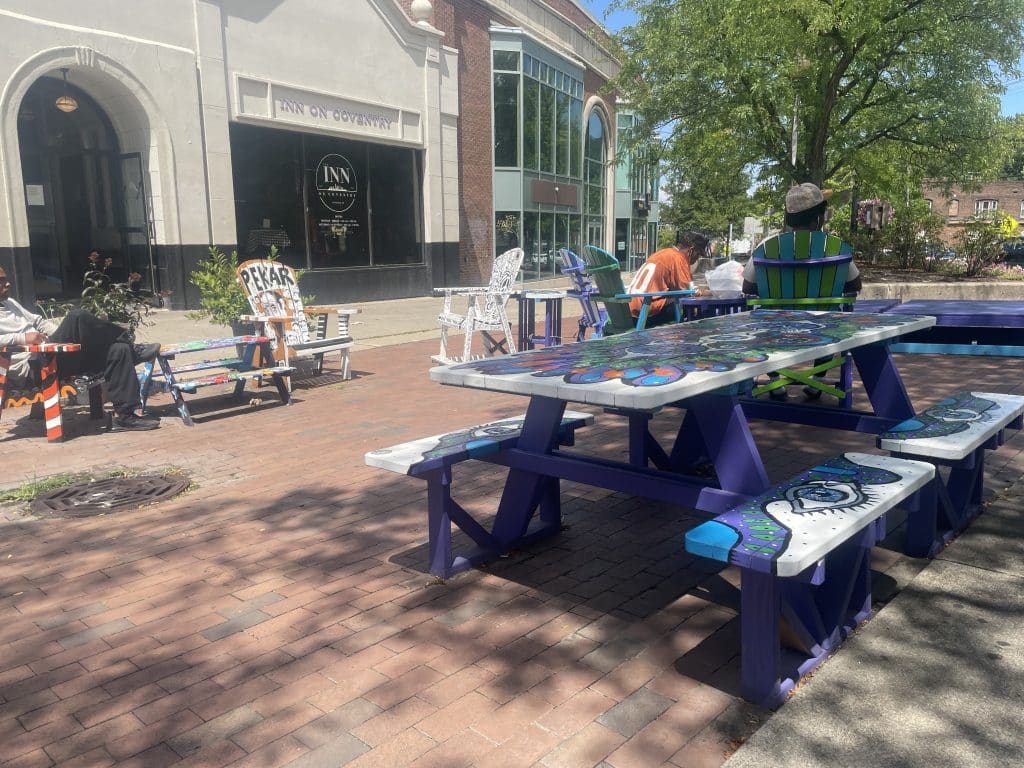
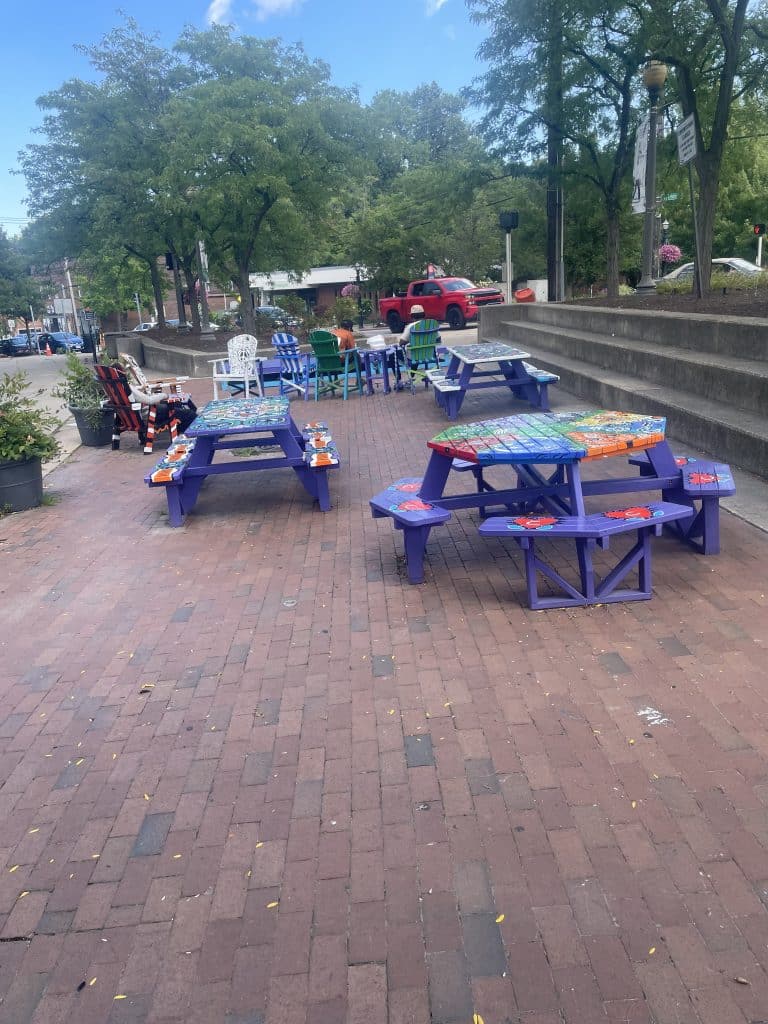
MM: I think your most visually notable accomplishment is the Coventry Living Room project, the outdoor furniture at the corner of Coventry and Euclid Heights, by the Grog Shop and the Inn on Coventry. How did you get the idea for that project, and how did you bring it about – who did you work with, how did you fund it?
CW: I’ll try to give you the overview, and then I can dive into some of the details. In short, I saw a need in the neighborhood where I live, I went out and talked to folks who felt the same way, and we worked together to make it happen. Back in 2022, I approached Mallory Kent, who you might know was executive director of the Special Improvement District [in Coventry]. And I said, “Hey Mallory, it seems like we don’t have a lot of outdoor gathering space on Coventry.” And one of the reasons I felt that’s important is that those types of third spaces are part of the social fabric of the neighborhood, a way to build community. And so, identifying that as something we could use, we initially tried to put together a really quick demonstration project over that summer, in one of the little municipal parking lots. And it all kind of fell apart and it didn’t work. That was OK, though, we kind of learned a lot about the process. We need to follow-up with the city to do this. So, the next year, we took our time, and we started by engaging the neighborhood, and asking the question, what would you like to see in an outdoor gathering space?
MM: How did you do that? Like did you put up flyers?
CW: The meatiest part of that process were two design sessions that were held at the Heights Library where folks came in and we had some interactive displays for folks to walk by, interact with, give feedback on for their priorities for what they wanted to see in a space, and later on, in the second session, what they wanted those to really look like. So we did some other things as well. We had flyers, we had an email list, we had a sort of a survey. Low-lift ways for people to connect. Basically we did that through the sessions.

And that yielded the initial priorities we had for the first year, 2023, which were: places to sit, shade and public art. Those were the top three things people had said. And that informed what we focused on that year. So as you know, we worked with a lot of folks, a lot of business owners, and artists who were from the neighborhood, to execute that the first year. And the two artists who did the furniture and the canopy are both from the PEACE Campus, and a lot of the paint and materials came from Ace, so we were really trying to spend that money on Coventry, and within Northeast Ohio, and the furniture came from the Amish furniture makers from Ohio as well. So that was really cool. We’re kind of going out of order, but we fundraised that money through an Ioby campaign, which is basically a fundraising platform for community groups. And, we leveraged some of the Cuyahoga Arts & Culture matching funds, that was great that helped us sort of fundraise more quickly than we could have otherwise. I think we fundraised from about 80 individuals donors, some of the bigger donors were folks who own businesses on the street. So you can see the buy-in from that perspective as well.
MM: And you raised more than $5000?
CW: All told in was I think $12,000, so $7,000 plus the Arts & Culture match.
MM: And that was enough to cover your vision? Was it everything you ideally envisioned?
CW: Well, I think it was a good start. I think it was a really good foundation in terms of solid space for the neighborhood. There were obviously things that people wanted that we couldn’t pay for. But I think the quality of the artwork, of the furniture is really high, I think what is out there made the best of what people wanted.
MM: And it was out there for Summer 2023, and then it went into storage for the winter, and now it’s back out there for Summer 2024. When does it go back into storage?
CW: It’s out from May through October.
MM: And it’ll be back out for Summer 2025?
CW: That’s the plan! We did raise a few thousand dollars which helped us fund some repairs, some cleaning, things like that, as well as some programming this year. That was something that people requested. So there’ll be a busking program that we were able to fund through the Special Improvement District, so that will be something new this year.
MM: How were able to secure American Rescue Plan Act funding for the project?
CW: If you spent time on Coventry last year, you know that a topic that comes up a lot is commercial vacancies. I don’t remember the exact date, but I think we had between 15 and 18 commercial vacancies last year, which is almost a third of spaces on the street. This was historically high, as far as the folks I spoke to could remember. So this was another example of a problem that I saw in the place that I live, and I think a lot of other people saw, and I helped bring together a group of other residents, some merchants on the street, the Special Improvement District, to really discuss what we could do about the commercial vacancies.
We had some small early wins, such as we worked on some storefront displays in a couple of vacant storefronts. Then when the city announced the opportunity to apply for some of the ARPA funds, we took that as the opportunity to get the funds to really address the problem more holistically. And so we worked on a pretty condensed timeline, myself with a couple of merchants on the street, particularly Ash O’Conner from Made Cleveland and Kathy Blackman from the Grog Shop, and we developed a proposal for those ARPA funds which was submitted to the city. That was informed by things that I know about local policy from my professional work, as well as things that Ash and Kathy and others in the group know from running businesses. What was really cool was how that happened. From what they initially shared publicly, the city wasn’t planning to dedicate any specific money to Coventry. What we were able to do was to draw attention to the opportunity to address some of the commercial vacancies here, by activating the community to get behind it. As you know, this was a big topic for a lot of folks who live here and some who don’t. I think Coventry holds a special place in a lot of peoples’ hearts, because they live here, or they used to, or they spend time here at another stage in life. And I think that they way people feel about the neighborhood was reflected in how quickly people came out to support the proposal for the ARPA funds.
MM: OK, so Cleveland Heights, like a lot of cities around the country, got the opportunity to get their share of the ARPA funds, and then you helped them to apply. Then this public comment, how did that work?
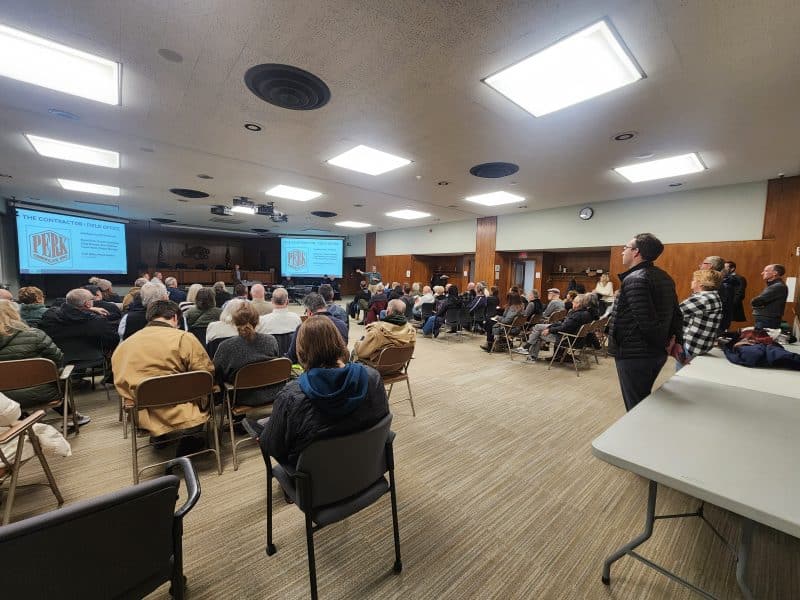
CW: We did two things to show support for the funding. One was sort of the classic email and phone campaign, where we encouraged people to reach out to Cleveland Heights City Council, [and ask] that they support this proposal. As far as we could tell we had about 100 people who emailed City Council. Then, perhaps more meaningful in some ways, we had a large group of people who showed up to a City Council meeting to speak in favor of it as well. I think what was so effective that the room was overflowing; we had people sitting in the hall. But also the speakers that were able to talk about what the neighborhood meant to them, and about the opportunity they saw to leverage the assets that we have to revitalize the street. So you had folks like Tommy (Fello, of Tommy’s) and what was called the Mount Rushmore of Cleveland Heights business, but also newer folks like Ash, and community members like myself, a dozen or so folks, about why it was important to them, and many others cheering them on from the crowd. And that made an impression on City Council and that’s a big reason we have the money we’re about to have.
MM: And what’s the money going to do?
CW:The money will go to the Special Improvement District to manage. Matt Moore, who’s now the executive director of Coventry SID, will lead that on a strategic level. An example of what it will do is leveraging ARPA funds to incentivize investment from landlords in sort of “white-boxing,” building out, cleaning up their spaces, in exchange for lower rents for new tenants. I guess the way to put this is we would help to support the build-out of space in exchange for sort of more favorable terms for tenants. So that is one possibility.
MM: Anything else readers should know about what’s happening in Coventry?
CW: I think in terms of framing, there’s a lot of momentum on Coventry. Last year we brought a lot of attention to the commercial vacancies issue. That was really important, but you also don’t want to paint too dark of a picture. There are a lot of cool assets here. There’s been a lot of positive momentum, not just with the ARPA dollars, but with the PEACE Park renovation, a lot of things moving in a positive direction.
Keep our local journalism accessible to all
Reader support is crucial as we continue to shed light on underreported neighborhoods in Cleveland. Will you become a monthly member to help us continue to produce news by, for, and with the community?
P.S. Did you like this story? Take our reader survey!