David Goldberg says of the latest threat to the Shaker Lakes, “This is Porter all over again!”
Of course, Goldberg, a leader of the Friends of Horseshoe Lake, knows that there’s a big difference between Cuyahoga County Engineer Albert Porter’s rebuffed call in the 1960s to run a freeway through the lakes and the Northeast Ohio Regional Sewer District’s sudden call last month to turn Lower Lake into a marsh.
But nearly all residents interviewed at Lower Lake oppose either asphalt or sedges. They prefer open water.

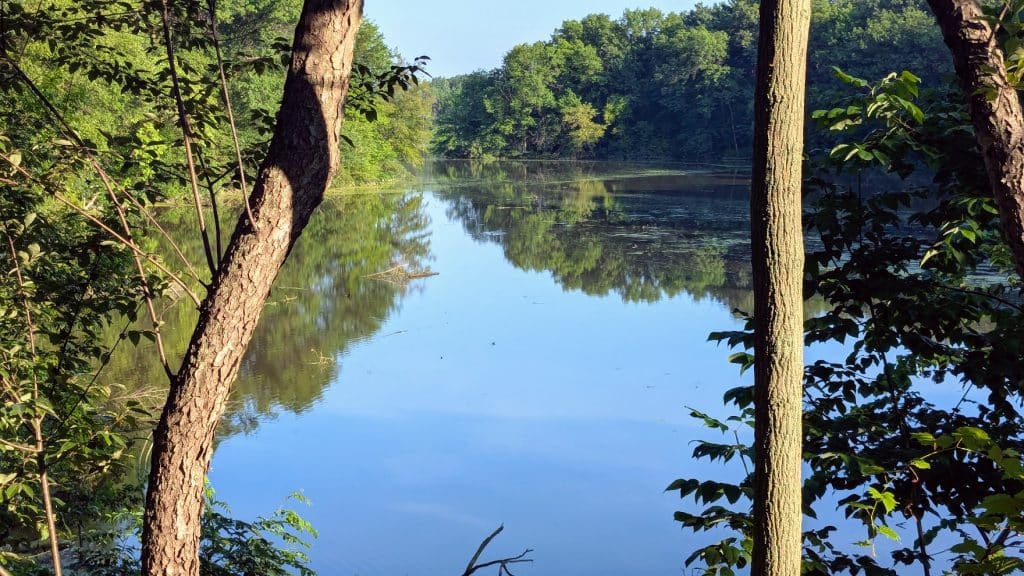
“Water makes you feel more in touch,” Jim Dixon says while walking along the lake. “It adds a sense of serenity.”
The lake hosts herons, migratory birds, turtles and other creatures. It also draws many joggers, walkers, bicyclists, picnickers and nature lovers. “I don’t think that would happen if it’s a marsh,” says Brian Scully, stretching on Lower Lake’s dam.
Paul Christopher Abood is the rare visitor who supports NEORSD’s recommendation to raze the dam. “Allowing Doan Brook to return to a more natural flow would help native fish, amphibians, and plants that haven’t thrived in the artificial lakes.”
Three cities will decide the dam’s fate: Cleveland, which owns the two lakes and the surrounding parkland between North Park Boulevard, South Park Boulevard, Park Drive and Coventry Road; Shaker Heights, which governs, leases and maintains more than half the area; and Cleveland Heights, which does likewise with the rest.
If the dam’s removed, NEORSD would pay an estimated $37 million for the task, plus $7 million for related work. If it’s rebuilt, Shaker Heights and Cleveland Heights would cover that cost, estimated at $43 million plus $12 million to dredge the lake’s vast sediment. Shaker controls about 57 percent of the dam but pays two-thirds of its state fee.
The estimate to rebuild has more than tripled in the last couple years. NEORSD blames the change on more detailed analysis.
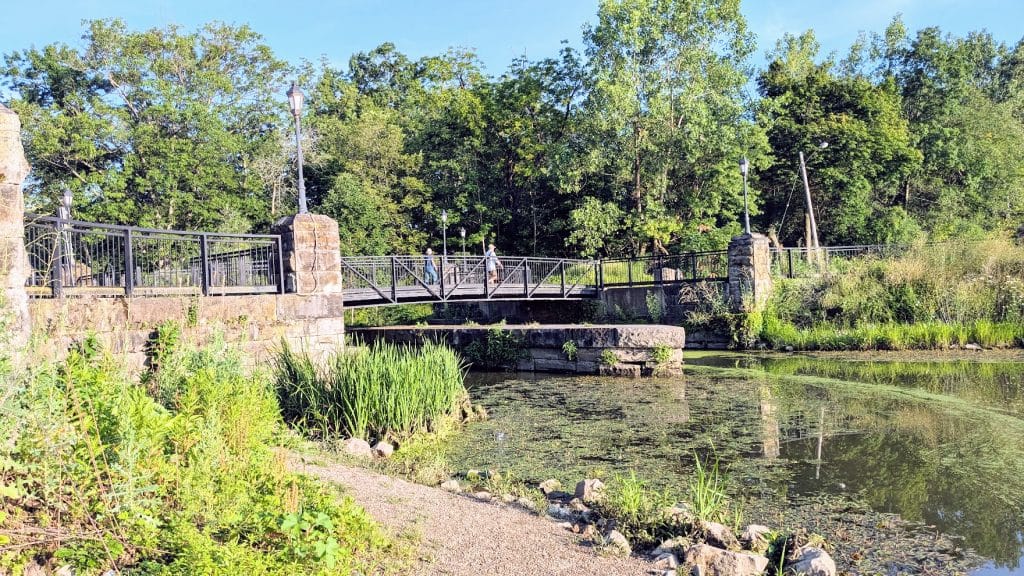
Dammed for eternity?
According to the Encyclopedia of Cleveland History and other sources, the Shaker sect built earthen dams across the Doan in the early and mid-1800s to power mills, creating Lower Lake and Horseshoe (also called Upper) Lake. Late that century, Shaker Heights’ developers gave 279 acres to Cleveland, including the two lakes, the Doan Gorge downstream and the adjoining land.
The term “Shaker Lakes” can also include nearby Marshall Lake and Green Lake, which feed Lower Lake and are much less visible and visited.
In the late 2010s, despite past repairs, the Horseshoe Lake and Lower Lake dams were declared by the state to be failing. Crews breached Horseshoe’s dam, about 30 feet tall and more than 600 feet wide, making the lake a marsh. Angry residents formed Friends of Horseshoe Lake and sued for a new dam. But they lost at trial in 2023 and on appeal last year, with judges saying they lacked power over the dam.
Horseshoe Lake Park was recently renamed plain Horseshoe Park. Next year, NEORSD plans to start a two-year, $31 million project (the figure has been slightly lowered since the linked post went up) at the park’s 60 acres to remove that dam, add native plants, and create trails, a nature playground, an outdoor classroom, a pedestrian bridge and other amenities. Shaker Heights expects to contribute $4.6 million and Cleveland Heights $2.5 million.
For a few years, officials said that locals who missed Horseshoe Lake could still enjoy Lower Lake, which is far more seen and used. In July, though, NEORSD confirmed reports that it would recommend razing Lower Lake’s dam, 600 feet long and 17 feet tall, because of soaring costs, new technology showing the structure’s not needed for flood control, and a new opportunity for flood control downstream.
It has renamed the Lower Shaker Lake Dam Reconstruction project as the plain Lower Shaker Lake Project. Construction might begin in 2030.
Bad faith?
Some critics accuse NEORSD of bad faith around previous discussions of Lower Lake’s fate.
“They’ve been deceiving the public for a long time,” says Jeff Rusnak of the Friends of Horseshoe Lake.
Chris Quinn, who edits cleveland.com and The Plain Dealer, called for dumping NEORSD’s director and trustees, the latter composed mostly of local mayors and their appointees. “You make a promise, you stand by it.”
Matt Scharver, NEORSD’s watershed programs director, denies deception. He says the district really meant to rebuild Lower Lake’s dam. Studies had shown it necessary to prevent floods downstream in University Circle, the Cleveland Cultural Gardens and elsewhere along the Doan’s path to Lake Erie. NEORSD would have funded the project as part of its mission to protect water quantity and quality.
So the district spent $1.7 million for a preliminary design. But the proposed structures looked obtrusive, with a second spillway 400 feet long and concrete flood walls up to eight feet tall.
Then, according to Scharver, new technology showed the dam not blocking a crucial amount of water. Yet the aging structure’s failure could release too much water all at once.
Now the Cleveland Museum of Art is making plans to redo its campus, which lies above the culverted Doan. That should give the district an opportunity to run a second culvert there, carrying more water.
Scharver and many other experts consider natural marshes much better for the environment than manmade lakes. They slow down floodwater and filter pollutants. They don’t host every species that lakes do, but they host many native ones.
Whether the dam’s rebuilt or removed, Scharver says the work will reduce floods on Coventry and North Park. If the dam goes, NEORSD will probably add a pedestrian bridge and other amenities to the 17-acre marsh. Either way, current amenities should survive, including trails and the “Liberty Oaks,” which honor victims of World War I.
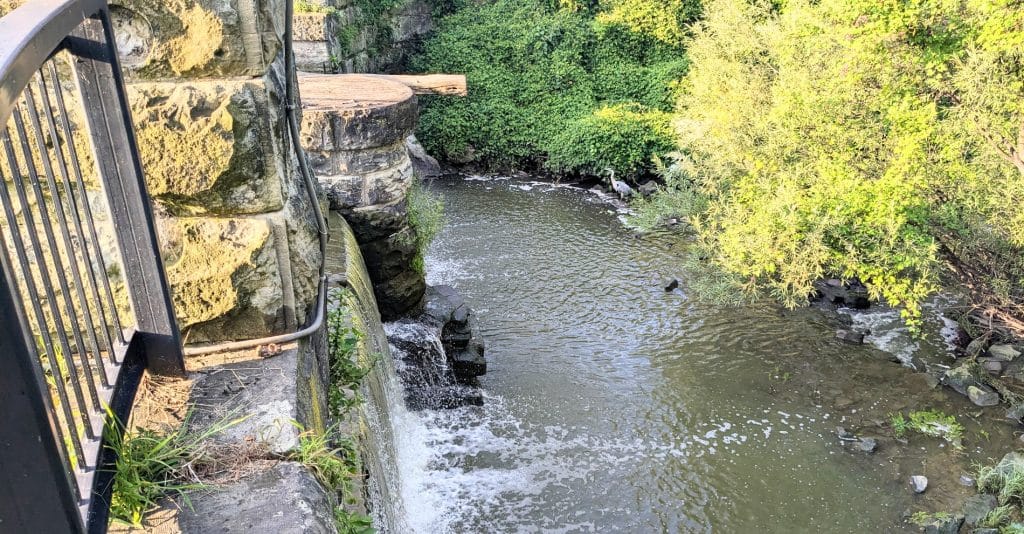
Officials take sides or not
A statement from Cleveland Heights Mayor Kahlil Seren says, “I am not personally aligned with the decision to drain the lake.”
Cleveland Heights Council President Tony Cuda says he approved razing Horseshoe’s dam partly because Lower Lake’s was supposed to be rebuilt. “I want to know why so much has changed since not that long ago.”
Shaker Heights’ and Cleveland’s administrations have not yet taken public stands. “We understand and respect the significance of Lower Lake as a recreational, ecological, and historical asset,” Cleveland spokesperson Marie Zickefoose writes. “We are awaiting NEORSD’s full technical presentation and will review all relevant information carefully before making any determinations.”
Mo Drinkard, who leads the Doan Brook Watershed Partnership, says, “Dam removal typically restores natural stream function, reconnects habitats, and improves water quality and aquatic biodiversity,” she writes. But Lower Lake “holds generations of memories, serves as a quiet place to reflect or interact with nature, and carries important cultural and historical meaning.”
Local historical societies have disagreed about the Horseshoe dam. Cleveland Heights’ supported it, and Shaker’s opposed it. As for Lower Lake’s dam, Shaker’s society has taken no stance yet, but Cleveland Heights’ wants to save it.
Five residents spoke about Lower Lake’s dam Monday at a Cleveland Heights council meeting, all in support. They urged their city to get a second opinion and seek grants for rebuilding it.
But Peggy Spaeth, who leads the Watershed Partnership’s Friends of Lower Lake, welcomes the dam’s demise. “Everybody will grieve the loss of that scenic lake, but it’s very unhealthy. It’s full of silt. If it’s restored to a free-running brook, it will be just as scenic.”
In 1966, people opposing the freeway created what’s now the Nature Center at Shaker Lakes. President Peter Bode says the center’s name will need changing if Lower Lakes goes the way of Horseshoe.
But he’s thought of a compromise: Raze Lower Lake’s dam but embank a lake of at least 10 acres alongside the freed Doan. He compares that lake to the recently restored Garfield Park Pond by Wolf Creek and Mill Creek.
Scharver says the district is open to exploring Bode’s idea and possibly funding it.
Meetings
Shaker Heights City Council will hear Scharver discuss the dam at 7 p.m. on Aug. 11 at City Hall, 3400 Lee Rd. Despite earlier reports, the meeting is scheduled to be open to the public. Cleveland Heights officials will participate remotely. The meeting will be streamed at shakerheightsoh.gov/811/Public-Meeting-Livestream-Recordings.
At 6 p.m. on Aug. 19, NEORSD will hold a public webinar on Lower Lake. On Aug. 20, it will host open houses from 11 a.m. to 1 p.m. and 5 p.m. to 7 p.m. at the Lee Road Branch of Heights Libraries, 2345 Lee. Rd., Cleveland Heights.
NEORSD leaders are also meeting privately with several Cleveland officials. They plan more public sessions about the dam soon.
Keep our local journalism accessible to all
Reader support is crucial as we continue to shed light on underreported neighborhoods in Cleveland. Will you become a monthly member to help us continue to produce news by, for, and with the community?
P.S. Did you like this story? Take our reader survey!