


Wearing a baseball cap, sweats, and a pair of cool sneakers, Cleveland Mayor Justin Bibb strolled into Urban Kutz barbershop in Cleveland’s Ohio City community. He was there on a recent Saturday morning for a town hall with residents discussing proposed closures and mergers of some Cleveland Metropolitan School District buildings.
This was his first stop for the day. He and his staff planned to visit a couple of eastside barbershops, including Diamond Cuts on Superior Avenue, and Polished Professionals on Larchmere Avenue.
According to Waverly Willis, owner of Urban Kutz, the mayor understands that historically, barbershops are where topics such as politics, policing and sports are discussed honestly and without fear.
“A few weeks ago, Mayor Bibb’s staff asked if I could come to City Hall for a meeting with Bibb,” he said. “I wondered what he wanted; however, when the mayor calls, you go. It wasn’t long after I arrived that I learned he wanted to discuss his administration’s plan to close and merge some Cleveland schools. Understanding how unfiltered barbershop talk can be, he wanted to know what I was hearing, which wasn’t good at the time, and if he could plan a visit to Urban Kutz for a town hall meeting. After making sure he grasped what he was stepping into, we set a date.”
The proposed CMSD consolidation plan would impact 39 schools, according to Signal Cleveland reporting. The district argues that declining enrollment — dropping from 70,000 students in 2004 to 34,000 students in 2025 — contributed to the need for consolidation. The district currently operate 90 buildings, and is facing a $150 million deficit. The Board of Education will discuss these changes during a Dec. 2 work session and at a Dec. 9 business meeting.
Approximately 25 people were in attendance at the barbership on Saturday, including members of the media. Bibb initially received a warm welcome, but you could feel the anticipation climbing as people waited to ask their questions. Some critics have blasted CMSD for not including the community early on in the consolidation process. Others have voiced concerns about empty buildings being vandalized and the safety of their children, like at an event covered by WKYC.
Willis had hoped for a better turnout but joked that the 10 a.m. start time was too early for some of his clients on a Saturday.
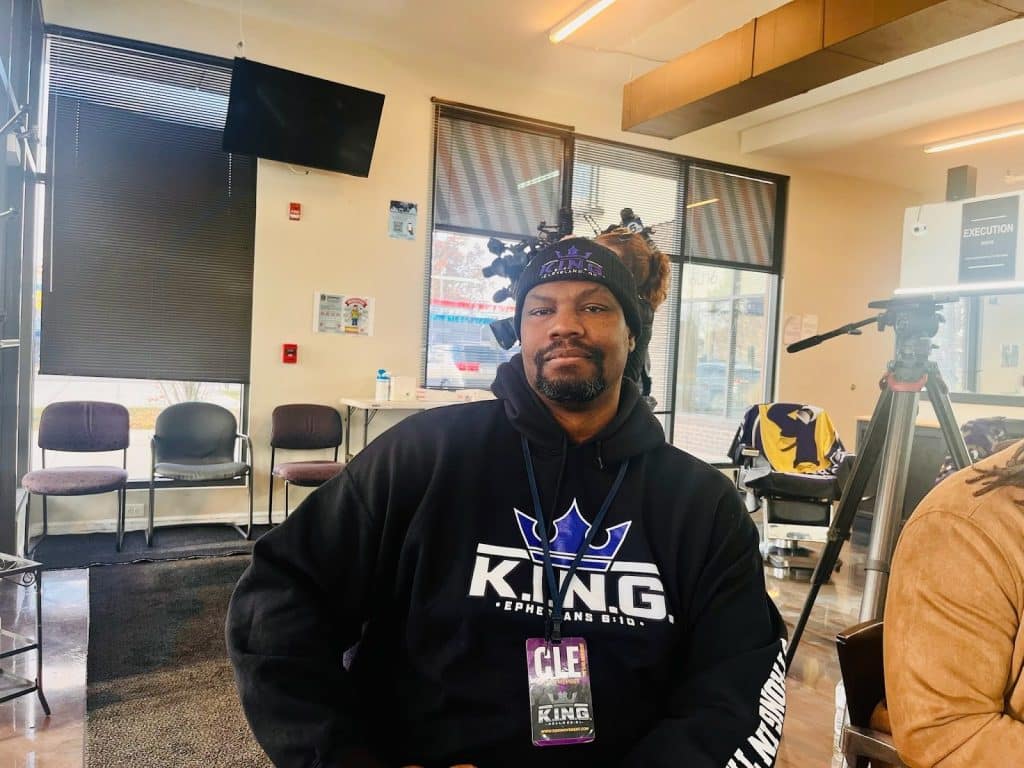
Despite the time, Charles Boone recognized the importance of traveling from his east side home to hear directly from the mayor about his plans. Boone is a Collinwood graduate and has strong feelings about the closure of his beloved high school.
“I think the proposal to close Collinwood is a bad idea,” he said. “The school has a long history that can be described as both good and bad. My older cousin went there in the 1960s when it was predominantly white. I believe she helped pave the way for my generation to attend. My biggest fear is for my nephew, who is currently a student there. He’s a good kid, and I would hate for him to transfer to another school where he ends up in the wrong crowd.”
According to Bibb, the decision to put this mandate on the table was a hard decision, knowing how attached many Cleveland schools’ alumni groups are to their respective buildings. He assured the group in attendance that he and the CMSD Board of Education plan to pay homage to those memories and respect the legacy.
“When I was running for mayor four years ago, residents gave me a clear mandate,” Bibb said. “Number one, make sure that regardless of where our kids live, whether it be the southeast side or West Park, Collinwood, Mount Pleasant or Union-Miles, our young people have access to a high-quality education. The problem, though, is that we’ve lost 50% of our student population over the last 20 years. In the early 2000s, we had roughly 70,000 young people going to CMSD. Now, we have roughly 35,000 students. For example, Collinwood was built for 1,100 young people to go to school there every single day. Now, the average daily attendance rate, not the enrollment, is 96 students.”
The district expects to save around $30 million a year with the proposed consolidation plan, Bibb noted.
According to Bibb, building quality played a role in some schools targeted for closure. CMSD will then aim to open a new high school in 2031 that will focus more on apprenticeships and trade programs. Bibb said he wants a school that mirrors Max S. Hayes High School on W. 65th St. and its trade program. Also, he said that if a school’s building is deteriorating it will interfere with a student’s learning experience; that’s why a new school is being proposed.
Many students have also voiced concerns over not having cosmetology and barber programs at any of the high schools, Bibb added. John Adams High School will soon have both programs in its curriculum.
State and national decisions impact local schools
The federal government is talking about dismantling the Department of Education. The state of Ohio is contemplating eliminating property taxes. Both could affect CMSD dramatically.
“Cuts to the education department mean less funding for the schools,” Bibb said. “Meaning special education programs, after-school programs for young people, free and reduced lunch and breakfasts would receive less funds. The end of income tax in the state of Ohio will limit basic city services in the city. Sixty percent of the general revenue fund is funded by the tax. If property tax goes away, the city will face challenges.”
The CMSD Board of Education will vote on the consolidation plan in December. If it passes, the plan goes into effect next fall. Bibb said he doesn’t anticipate any staff layoffs, despite the consolidation efforts.
Some left the meeting with cautious optimism about the mandate, such as Laura Cowan, a Cleveland community activist.
“Sometimes we don’t like change, right? But we must go forward,” she said. “The school system is like a business. If it’s not doing well, it’s either merge or cut off. So, I understand that part of it. I’m concerned about the kids and their safety. The concern for safety comes from all the bullying and fighting that continues to plague our schools. Understandably, every parent is on pins and needles.”
Keep our local journalism accessible to all
Reader support is crucial as we continue to shed light on underreported neighborhoods in Cleveland. Will you become a monthly member to help us continue to produce news by, for, and with the community?
P.S. Did you like this story? Take our reader survey!


![Cleveland activist organizations call for general strike at anti-ICE protest [photos]](https://d41ow8dj78e0j.cloudfront.net/wp-content/uploads/2026/01/28094754/IMG_8580-800x600.jpg)


