Jennifer Lumpkin, principal and founder of My Grow Connect (MGC), wants Clevelanders to connect with the earth. Literally.
A Cleveland-based, BIPOC-owned civic and social organization focused on community engagement and urban agriculture, MGC’s mission is to support the development of sustainable communities through creative relationship building and mindful resource connections.
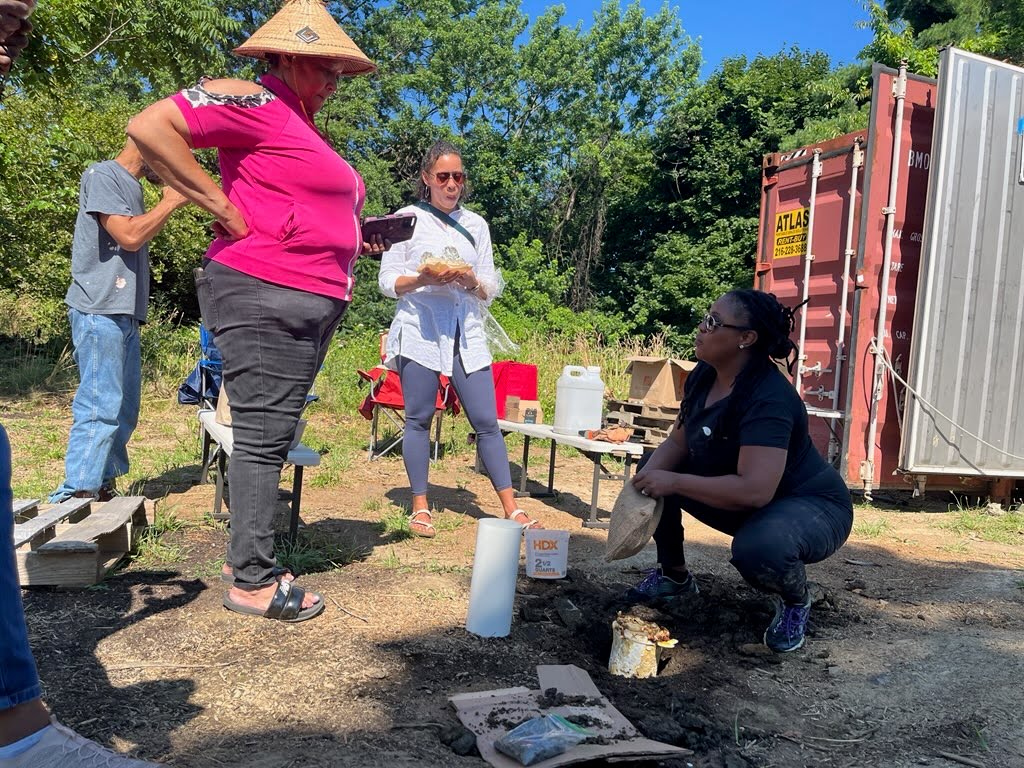
Lumpkin teaches people how to grow fruits and vegetables. She also conducts research and analysis for farmers’ markets and helps them identify new customers and resources.

“As a partner holding a leadership role in a statewide organization like BIPOC Food and Farming Network, I hold a broader purpose centered around the business of environmental justice and food sovereignty, hence the navigational toolkit authored by MGC in 2025,” Lumpkin said. “The importance of reducing the distance between where food is grown and consumed, eliminating competitive bias and racial harm embedded in agriculture, working together to advance policy and advocacy both at the local, state and federal level is primordial to my purpose and mission.”
Through a decade of relationship building with other like-minded environmentalists, Lumpkin is now one of the creators of the “Roots and Remains: Legacies in the Land” exhibit at Cleveland Public Library’s Rice Branch serving the Buckeye-Larchmere neighborhoods.
Almost eight years ago, Lumpkin partnered with two colleagues to form their environmental justice collaborative: Robin Brown of Collective Citizens Organized Against Lead and Christopher Maurer of redhouse studio architecture. Early on, they dreamt of creating a project to educate the public about sustainable environmental practices. Running through May 9, 2026, the special exhibit was funded by the St. Luke’s Foundation.
The exhibit is shaped around a small structure built of mycelium, a sustainable construction material extracted from mushroom roots. Visitors can walk into a recording studio to share their stories of environmental injustice, including those affected by the devastating impacts of lead poisoning as Brown’s family was. The three creators and the Rice library branch partnered with ideastream to feature some of the stories for broadcast.
The bioremediation component includes using mycelium fungi to create building materials that, after demolition, will recycle as waste into safe, healthy materials through a process called biocycler developed by Maurer.
The exhibit also contains panels with biographies of each of the three partners and their contributions to environmental justice, as well as other information pertinent to the theme. Lumpkin said the goal was to inform viewers about what regenerative agriculture and remediative healing and communities look like.
“The concept we came up with was an exhibit at the library that has panels that tell the story of environmental justice and injustice while fabricating the very material that is a bioremediator so that people can touch it, actually see what it is.” Lumpkin explained. “The initial concept was let’s build a house but then let’s build something with multiple panels, and this is what we made that fit the environment we could house it in.”
Growing up grounded in the soil
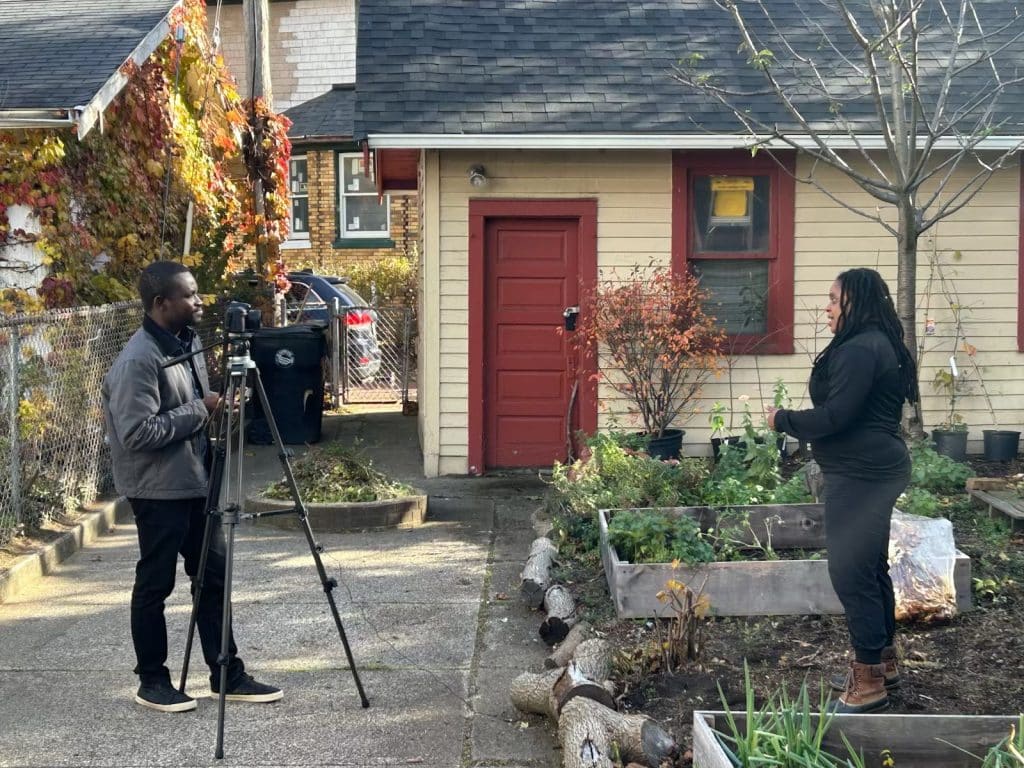
Lumpkin acquired her knowledge and love for farming through her grandparents whose parents were sharecroppers in Georgia. Her grandparents moved to Cleveland and then to Warrensville Heights in the early ‘60s.
They relocated for the employment opportunities then available in Northeast Ohio. Her grandfather drove a truck, and her grandmother, who had worked as a sharecropper in Georgia picking cotton, studied at Tri-C to become a typist and then got a job at LTV Steel.
Lumpkin was born in 1983, and she first dug her hands into the soil to help her grandparents, who continued to do micro growing in their backyard gardens. The family would also regularly return to Georgia and visit relatives and the land where her great grandparents farmed.
“My family went back to Georgia regularly, and that was my initial exposure to growing in a rural setting, but here, mostly in Warrensville where other folks from Georgia related to my family moved, they all lived in this small enclave and they always grew and shared,” Lumpkin recalled. “For me, it was just intrinsic. There were just things that we didn’t buy because we knew folks who grew it or had it.”
She fondly recalls formative experiences of food swapping with family members, receiving mango shipments from her aunt in Florida and their family’s front yard serving as a pop-up supermarket for their neighborhood. Her family created their own food system, one that aimed to reflect her great-grandfather’s legacy as a sharecropper.
After she graduated from Regina High School, Lumpkin attended Loyola University in Baltimore, Maryland, where she majored in public relations and marketing, knowing that she wanted to own her own business after she graduated in 2001. She taught English in Thailand for a summer, then returned to Baltimore and worked in advertising and radio.
In 2008, Lumpkin decided to move to New York. Her neighborhood in Brooklyn had a community garden, and fittingly the people tending it were from Georgia. The garden provided her first reintroduction to urban agriculture since her childhood.
“New York did not feel warm and fuzzy, so that was my first experience in my neighborhood, where community gardening was a central point for people to interact and engage, and that’s where I was introduced to personal sustainability,” she said. “I wanted to have a business based on building sustainability within community like I had experienced there, because it was a part of reconnecting me to something that was familiar and felt like home.”
The growth of My Grow Connect
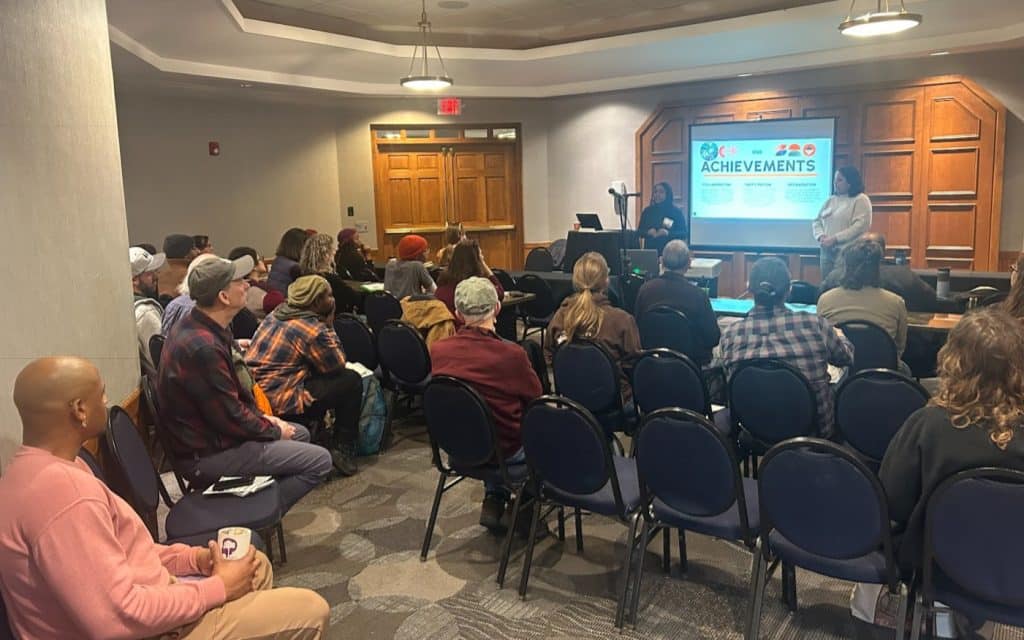
In 2015, while living in Washington, D.C. and working professionally in community development around agricultural initiatives, such as managing greenhouses and related after-school programs, Lumpkin decided to launch a dating site with a community connections mission called Grow DC.
“I was trying to create a platform for people that lived in low-income housing or were newly refuged, people who didn’t have built-in networks, social systems,” she explained.
In 2018, Lumpkin returned to Cleveland to help care for her mother and grandmother who were dealing with health issues that had not previously been a concern in her family.
“It was all my family that moved up north that was getting diabetes, hypertension,” she said. “I was seeing the direct result of the disconnect between healthy growing and eating that we were doing before and how not doing that as much was affecting my family.”
While researching natural home building and alternative growing methods she learned about Maurer’s work with biocycling materials and connected with him. They met and engaged in a partnership after she returned to Cleveland. He later connected her with Brown and her work with mitigating or preventing lead poisoning, and the three formed their collaborative.
“I was working for Cleveland Neighborhood Progress and holding farmers markets selling my stuff, trying to commodify so that I could sustain it and not have another job,” she said. “I’ve always had to have a full-time, professional job, and it’s always been in advocacy. When I met Chris, it was a chance to say, ‘How can we work together so that this can be a main focus of what I do?’”
In 2020, an engineer friend of Lumpkin’s helped her reformat MGC with more of an urban agricultural focus.
“He reengineered the dating site so that the attributes that you were matched with were water, land, composting, soil, etc.,” she said. “I was trying to rewire something to make it more applicable to resource sharing and community development, which is what I was doing.”
In 2020, Lumpkin was able to phase out of working full time for other organizations and commit all of her time to MGC as a for-profit business.
The importance of mentorship
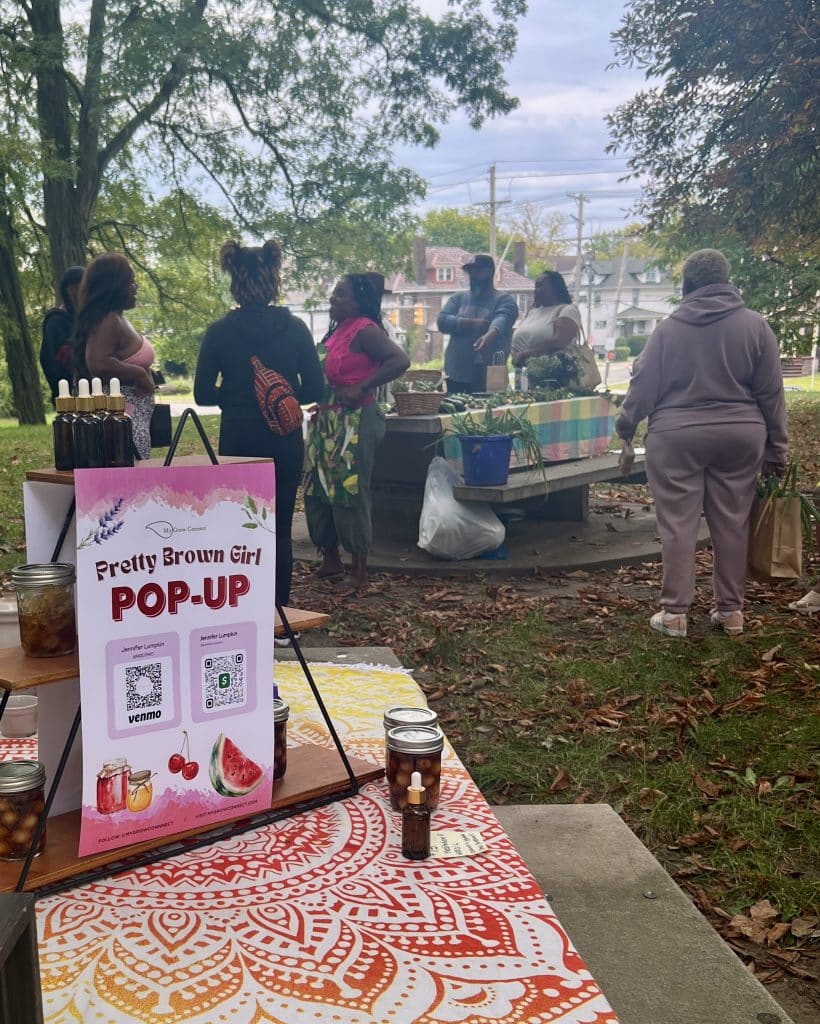
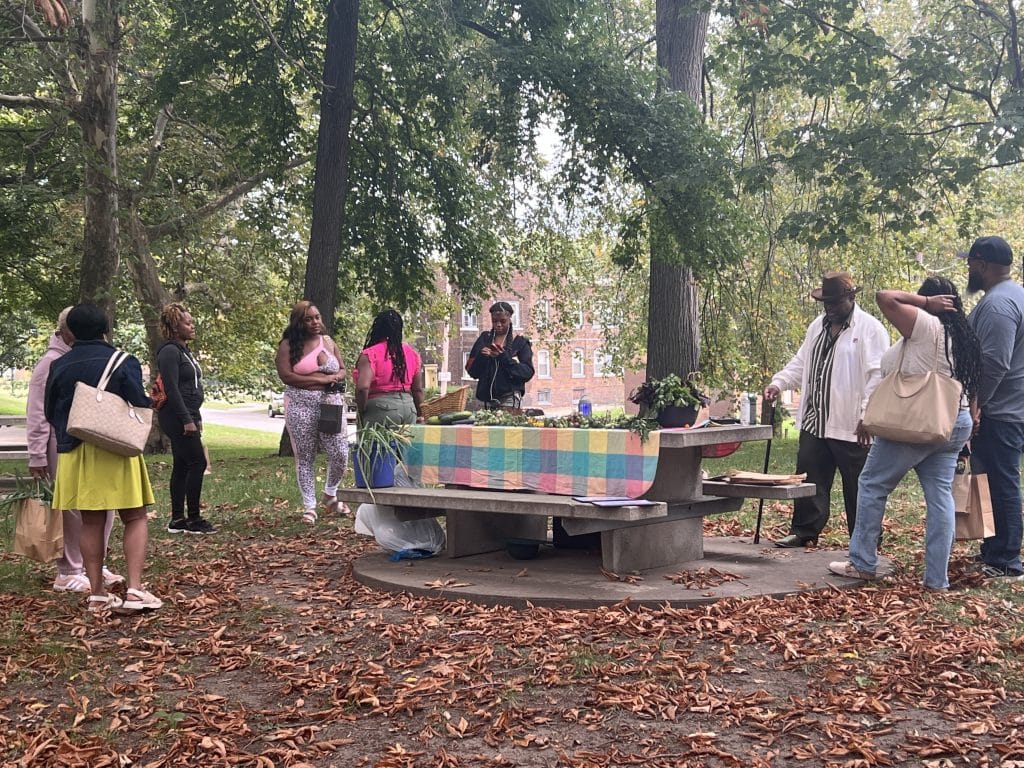
After returning to Cleveland, Lumpkin initially endured varied and, as a woman, occasionally unpleasant experiences trying to become part of the agricultural community. To help circumvent those experiences for others, she realized mentorship was important, as was having alternative ways to access land to learn how to grow and conduct the business side of agriculture.
“Mentorship in agriculture is having someone teaching you how to use certain tools and grow on land that’s conducive to how much you want to grow,” she said. “I learned that there needed to be alternatives for people that were vulnerable, and there also needed to be some sort of valid and verified way to do that.”
Lumpkin reached out to the Women, Food and Agriculture Network (WFAN), a woman-managed organization in Ames, Iowa, that is dedicated to gender justice in agriculture and focused on mentorship through its Harvesting Our Potential (HOP) program. In 2024, they provided a stipend and connected her with a mentor in Chicago, and she spent time with her on her farm learning how to cultivate small-scale home parcels in a metropolitan area.
Lumpkin then became a mentor for WFAN in 2025, using her recently purchased home property in Glenville to host the HOP mentorship for a woman in Cleveland, Alisa Huffman. The two purchased six fruit trees and started a small orchard in Huffman’s mother’s back yard. They also got a Neighborhood Connections grant together to launch a new program this year.
“Jennifer’s knowledge and her connections with people in the community helped me be more rounded and confident in the work I’m doing,” said Huffman, who now has her own business. “She gave me a better support system for this type of work, a community that I can depend on and feel comfortable with, where I don’t have to worry about people taking advantage of me.”
Lauren Marolis, program manager for WFAN, said: “I’m impressed with Jennifer as a mentor overall, and it was cool to see her transition from mentee to mentor, which we don’t see often. She’s very knowledgeable, happy to share the knowledge she has, and she’s great at connecting people in the community and getting them excited about the local food system.”
According to Nicole Wolcott, grassroots policy organizer (federal), Ohio Ecological Food and Farm Association in Columbus, Lumpkin understands how general policy affects farmers in their daily lives and has been an effective partner in that work.
“Jennifer has been critical in helping us think as a policy program how we can better reach farmers of different demographics across the state and ensure that how we work with farmers in advocacy is accessible and helpful to them,” Wolcott said. “She’s helped us assemble a lot of tools and case studies to show why this work is important and how people can get engaged with it.”
Attend a ‘mushroom mixer’
If you would like to learn more about what Lumpkin and her colleagues are up to and dig your hands into the soil to grow your own healthy foods and practice sustainable local agriculture, she recommends that you first dig into one of the quarterly Mushroom Mixer events at Rice Library.
“I like to meet people in person and make sure that they meet the people that I’m working with,” Lumpkin said. “Come to a Mushroom Mixer at Harvey Rice and check out the work in the built environment, and then go to MyGrowConnect.org and use the contact page to reach out and talk directly to me.”
You can also learn more about MGC, sustainable agriculture and home farming by listening to Lumpkin’s Apple Podcast “In Our Element.”
Keep our local journalism accessible to all
Reader support is crucial as we continue to shed light on underreported neighborhoods in Cleveland. Will you become a monthly member to help us continue to produce news by, for, and with the community?
P.S. Did you like this story? Take our reader survey!