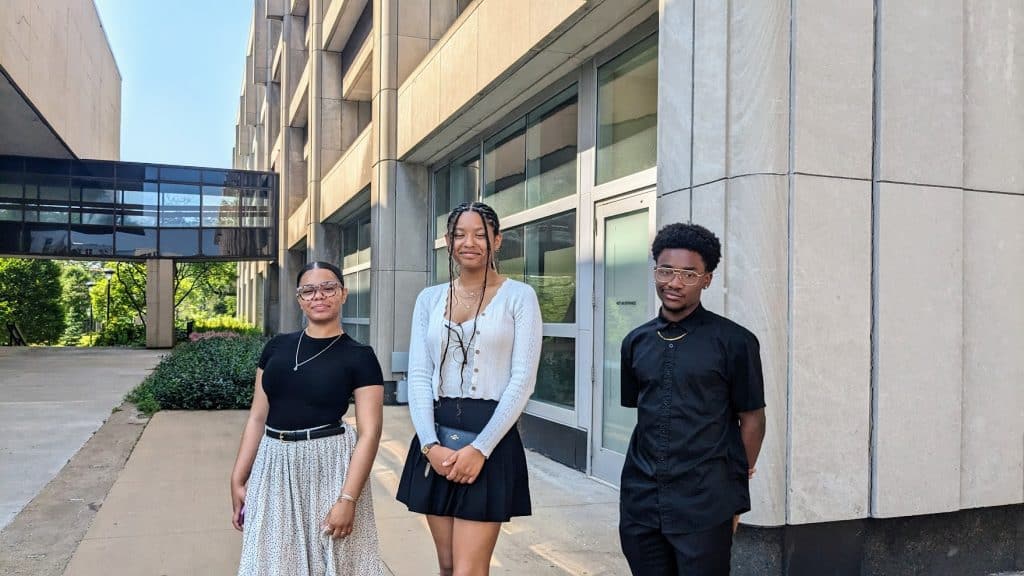
Most college students live off campus these days, and many go home in the summer. But some students who’ve been in foster care think of college as home.
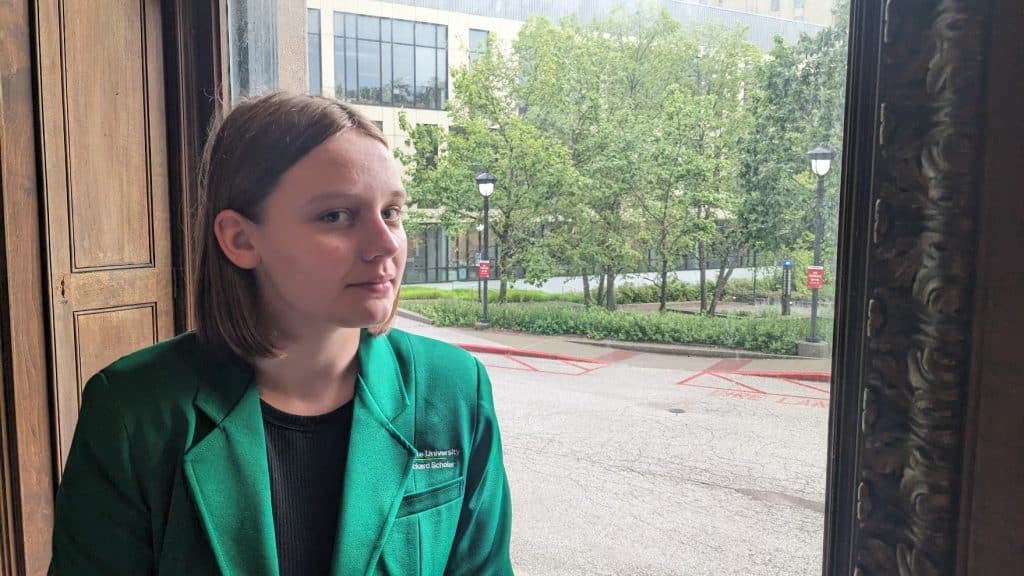
“Because we’re here all the time, we know we have each other here,” sophomore Amara Jackson says about members of Cleveland State University’s Sullivan-Deckard Scholarship Opportunity Program, which houses and helps current and former foster youths on campus year-round. “We can always walk to each other’s rooms. We can talk to each other.”
The Sullivan-Deckard Program includes extra aid, guidance and requirements, such as year-round campus residency, to help overcome the daunting odds against success for people from foster care.

One of the current foster youths (Ohio does not release their names) says that moving to Cleveland State this summer felt at first like getting just another placement. But “this time, I’m moving for education.”
Former foster youth Hope Gibbs, a junior, says she sometimes feels sad seeing other students go home for the summer. Still, “I’m grateful and blessed to stay here.” She often visits her biological mother and brother but not for long. “It’s just not the best place for me. I don’t focus well there.”
Gibbs focuses well on campus, though, earning nearly a 4.0 grade-point average. Sullivan-Deckard scholars must earn at least a 2.5 GPA. Seventy-five percent of them get at least a certificate and 59 percent a bachelor’s degree. Those rates are much higher than or former foster youths nationwide. No more than 6 percent of the latter get two-year degrees and no more than 4 percent get four-year degrees.
Instead, according to the Casey Foundation, about 30 percent of former foster youths become homeless between ages 19 and 21, and about 20 percent become incarcerated. The hardships start in childhood. An estimated 90 percent of foster youths are exposed to trauma in their biological homes, foster homes or both.
“If we knew the stories of some of your origins, all of us would be in tears,” Jarrett Pratt, who runs the Sullivan-Deckard Program, told freshman scholars during this summer’s two weeks of orientation. “But I’m not concerned about where you’ve come from. I’m invested in where you’re going.
As one of the foster youths put it, “This is a good opportunity to become a brand-new person and leave behind my trauma and issues.”
The program and its people
Cleveland State’s foster program is named for donors Frank and Barbara Sullivan and Jenniffer and Daryl Deckard. It’s part of a statewide network called Ohio Reach for collegians from foster care. It’s fully funded by the state and donors, so Pratt says it’s not subject to the sorts of budget cuts happening elsewhere at Cleveland State.
The program is based at Cleveland State’s Pratt Center, named for founder Charleyse Pratt, Jarrett’s late mother. The center also gives current and former foster youths from the area a holiday party, a high school graduation party, and a six-week course in independent living.
The Sullivan-Deckard Program has anywhere from 3 to 20 scholars per class. It helps them get other scholarships and fills any gaps to cover their tuition, room and board.
During their first summer, the scholars take seven credit hours, including two hours of a health course on stress management, time management and other challenges. Throughout their time at Cleveland State, they must spend 10 hours a week studying at the Pratt Center and do occasional community service.
The program gives scholars extra career counseling and other services. A social worker comes to the center twice a week. The National Council of Jewish Women brings the scholars care packages, takes them to local events and more.
Pratt calls the scholars’ helps “the aunts, sister, mothers they’ve never had in their personal life.”
Scholars also get peer assistants: Cleveland State students from outside the program. For the first 12 months, three Sulivan-Deckard scholars share a quad with a peer. Afterwards, scholars have the same choices of rooms and roommates as other resident students do.
“It’s a community,” Callie Brewer says about the program. “Everyone is pretty close.” At the same time, she feels like part of the whole school community. “No one really knows I’m a foster kid, so they don’t look at me differently.”
Scholars can leave the program at any time and continue as regular Cleveland State students, without the extra help or rules.
Today and tomorrow
During orientation, Sullivan-Deckard scholars learn their way around campus, take field trips, share other activities, and talk about their worries and hopes. They’re taught to recite a speech and a few slogans meant to boost their self-esteem, discipline and ambition. Much of the material was written by famed teacher Marva Collins, such as: “I was born to win if I do not spend too much time trying to fail.”
The scholars also learn to help each other. As one of the current foster youths said, “We have a lot of smart people, strong mentally and emotionally. We have to work together and push each other further than what we can do by ourselves.”
Pratt pushes them to overcome stereotypes. “The world will draw circles and put labels on us because of where we’re from. You have to say, ‘This curse stops now. It stops with me.’ You all are reshaping and redefining what’s possible.”
Not every scholar succeeds. One with good grades fled campus in the middle of the night because his biological family learned his whereabouts, and he no longer felt safe there.
But Pratt says that most of the scholars thrive at Cleveland State and beyond. “We have scholars who have gone on to start businesses. We have scholars going on to grad school. We’ve had three get doctorates in occupational therapy. One has become a foster parent.”
Striving for such goals, the scholars often quote another Marva Collins line: “This is my time and my place. I will accept the challenge.”
Keep our local journalism accessible to all
Reader support is crucial as we continue to shed light on underreported neighborhoods in Cleveland. Will you become a monthly member to help us continue to produce news by, for, and with the community?
P.S. Did you like this story? Take our reader survey!