The mixed-income housing development, due to begin construction in 2025, draws lively discussion over population density, funding, street appeal and more.

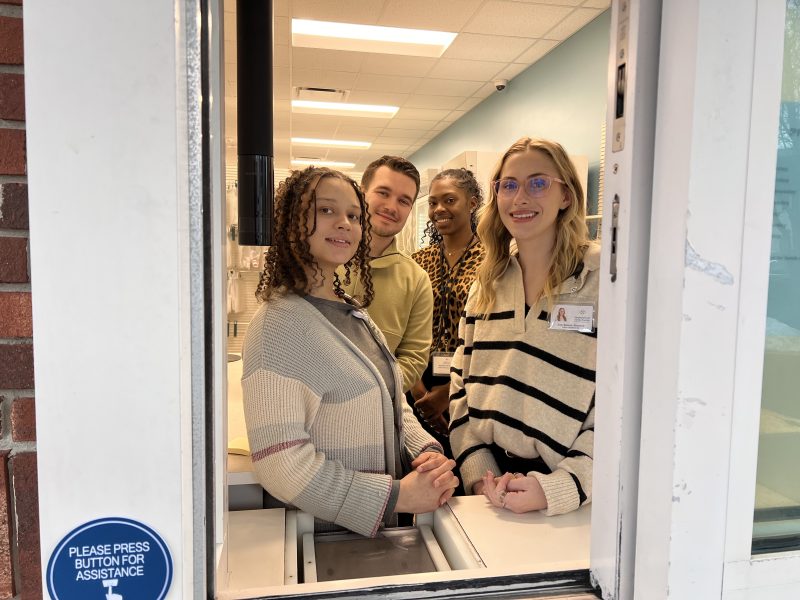
The second community engagement meeting for the Watterson Lake Mixed Income Housing Development project was held on May 7 at Our Lady of Mt. Carmel Church to update community members on the current state of the project on the site of the former Watterson-Lake school site (W 74th & Detroit).
The agenda included a slide presentation that introduced the team involved, gave an overview of the project and displayed design updates made since the last community meeting which took place on November 8, 2023. However, the bulk of the two-and-a-half hour meeting was taken up by Q&A and even some heated discussion.

Leading the meeting was Derrick Tillman, president and CEO of Bridging the Gap Development, the real estate development firm selected by the City of Cleveland through a request for proposals (RFP) process which began back in August 2022. Also in attendance were Matt Schmidt of the Cuyahoga Metropolitan Housing Authority (CMHA); the project’s development partner, Stantec Architecture; councilperson Jenny Spencer, and roughly 40 community members – many of whom are involved in city and neighborhood organizations.
Additional project partners are general contracting firm Next Generation and the financial partners, Bellwether Enterprises and Enterprise Community Partners.
A vision of mixed income housing
The Watterson Lake project is a mixed income housing development. There are 136 units total, which include studios, 1 bedroom units, 2 bedroom units and townhomes. Thirty of those units are subsidized Project Based Vouchers (PBV) awarded by CMHA. The other 106 units are below market-rate middle income units.
Tillman pointed out, “In this development, we are serving those at the affordable level, but we’re also serving kind of the missing middle, so really middle-income America.”
He went on to explain that the area median income (AMI) in the area is $97,200. Residents at Watterson-Lake will be 30% (the PBV units), 50% and 80% of AMI.
In contrast to this are all of the market-rate developments built in Gordon Square between 2015 and 2023, plus an addition 500 units in the planning phase.
“And then there’s at least four other projects, which those details about the unit mix haven’t been released,” said Tillman.
Tillman also noted that greater Cleveland has been ranked third nationally for the highest percentage of rent increase.
“Rents rose here 6.5% between March 2023 and March 2024,” he said. “The Cleveland metro area came in first for the increase in single-family home rents, which jumped 9.4% during the same period.”
“Right now, within this area, the median market rate rent for the area for a one-bedroom, one-bed is between $1,600 and $2,500. The median market rate for a two-bedroom, two-bed is between $2,100 and $3,000 plus,” added Spencer, quoting rents listed for the recently completed Welleon at 5454 Detroit Avenue as $2713 a month for a one-bedroom apartment, $1843 for a studio, and as high as $8708 per month for a two-bedroom penthouse apartment on the 7th floor.
Similarly, Station 73’s website quotes two beds, two baths for between $2,500 and $3000 a month.
“This is what gets built in our community when it is not subsidized.” said Spencer. “This is why, when we did the community engagement process for this site, affordability came through loud and clear as the core value.”
Getting to specifics, Tillman shared the rental tiers at Watterson-Lake development.
“For a one-bedroom, one-bath, the tenant portion would be $450 for those at 30% AMI and below,” Tillman said. “For a one-bedroom, one-bath for someone at 50% AMI, they would be paying about $750. For a one-bedroom, one-bath for someone at 80% AMI, they would be paying $1,257. For a two-bedroom, one-bath at 30% AMI, they would be paying about $500. For a two-bedroom, one-bath at 60% AMI, they would be paying just under $1,100. And for a two-bedroom, one-bath at 80% AMI, their rent would be at about $1,500.”
“This whole project is affordable housing,” Tillman emphasized. “It meets many different levels of affordability. So, every single unit in here is going to be rented to somebody that has to apply and qualify their income at less than the area of median income.”
CMHA’s role in Watterson Lake
Because Bridging the Gap is based in Pittsburgh, CMHA is the local liaison for the development partnership, working “as the local participant in the development team to help assist and move this project forward, looking at how this builds out its financing,” said Schmidt.
“We are providing pre-development loan funding for the project, as well as kind of serving, as we continue to move forward, as a guide to help look at how we set up as a team, a successful property management and social services model for residents of the property,” he added.
CMHA was a crucial partner in the application for State of Ohio Housing Finance Agency tax credits, which the project received through a competitive process in March 2024.
Parking versus green space
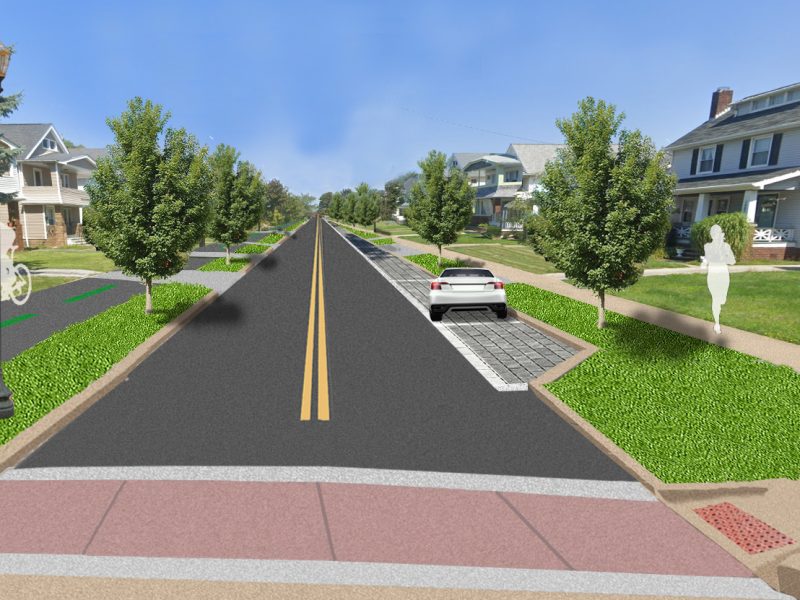
The current site plan includes a total of 88 parking spots. At a previous community meeting, it was questioned if that was enough.
For this meeting, Bridging the Gap created an alternative plan, which adds 24 more parking spots, but at the expense of green space. Inclusion of green space was a central community request in initial feedback sessions. Discussion at this meeting was divided in terms of how many residents in an urban development project, such as this one, would own a car.
“We believe that everyone’s not going to have a car,” Tillman said. “I think the instant thought is that everyone, all 136 Residents will have a car, and if they don’t today, they’re going next year. It’s just not true. It’s not true anywhere across the nation. Maybe in some market rates, but typically in an urban environment, that’s not the case.”
In support of car-free, urban living, Watterson-Lake will have a secure, indoor bike room for 45 bikes and public transportation information kiosks in the main lobby.
Questions of density
The most contentious topic of the evening was the density of the project for Detroit Shoreway, a historic, residential neighborhood. 136 units could add close to 200 residents to the area.
“The density – why is it that the number of units has to stay that amount? That’s extremely dense for our neighborhood and I don’t even understand why the city required that level of density when they know it’s a historic area,” said local resident Catondra Noye. “Please reduce the number of units. Please. It’s too many units for our neighborhood.”
Because of the Ohio State tax credits, the number of units is fixed and cannot be changed.
“We had to have a market study performed,” Tillman said. “We couldn’t even adjust from a two-bedroom, two-bath to a two-bedroom, one-bath. So, it’s that specific.”
Many community members welcomed the density and an influx of new people the neighborhood.
“I’ve been in the neighborhood for 35 years,” said Chuck Ackerman, who lives four houses from the site. “I liked when the school was there. I liked when we could sit on the porch and watch the kids come and go twice a day and teachers come and go. And I’m going to look forward to welcoming new people in the neighborhood. It will add some diversity to the neighborhood, for sure. And it will add much needed affordable housing. The density doesn’t bother me.”
“I walk past the site twice a day, every day,” commented Josh Jones Forbes, also a local resident. “And I would be very grateful to welcome 200 some new neighbors to the neighborhood. Historically, this neighborhood had twice as many residents as it does now, so we’re not full. And also, the affordable housing is so, so important, truly needed.”
Spencer made sure to point out that, even though the project does extend to West Clinton, the city has always considered this a Detroit Avenue project and consequently required density as part of the original RFP.
“The RFP was set up, the point system and all of that, for it to be very dense. For you to win it, they set it up for it to be that way. I feel like our community was set up to make us accept this because they go and get their tax credits,” Noye replied. “You have to accept this density now because we’ve got this tax credit. It’s shoved down our throats.
“The adjustment process that our neighborhood, that community is going to go through with all those units, it is going to be hard,” she added. “And we are not wrong to feel scared and threatened by this.”
Adding to the back and forth, long-time West Clinton resident Phil Buck said, “Cleveland needs population desperately. And I like people, that’s why I moved to a city. If I wanted to get away from people, I would have moved out to the exurbs somewhere. People are great. We have a really wonderful community on our block. We can welcome these neighbors. They can be our friends.”
Design changes based on comments at the last community meeting shifted the visual bulk as well as ground level storefronts onto Detroit Avenue, aligning with the rest of the street. The pedestrian walk through the site continues the sightline of West Clinton.
To scale back from Detroit Avenue, Jeremiah Brooks, the Senior Architect at Stantec, explained, “We located the public way and the green space at the termination of Clinton Avenue to not only extend Clinton as the pedestrian cut through to the site, but also then to locate our green amenity space.”
Who will be the property manager?
Many commenters during the evening had questions about plans for the long-term property management of the project. Currently, CMHA is listed on the Ohio Financing Authority application as the property manager – something many community members raised as a concern.
“We (CMHA) don’t manage any of our mixed income developments across the community. We don’t have that capability. We don’t have that funding,” Schmidt explained. “Our goal is to work with the Bridging the Gap team to create a property management structure that will best serve this particular building in this particular setting.”
Spencer asked Tillman to clarify plans for property management.
“We’re still exploring who the final property manager will be. And as Matt (Schmidt) said, their experience really is around affordable housing. This is a more of a mixed income development,” Tillman replied. “We’re talking to firms, we’re interviewing firms, so if we had to open today, it would, be some group of us kind of working together to self-manage. But that’s not our goal. And because we have time between now and when construction is intended to start, we’re looking at who will be the best, who’s managing property well in this region. And then we’re looking to approach them to bring them to this project.”
In a related question about who owns the land, Tony Bango, City of Cleveland Housing Development Division Bureau chief, offered an explanation.
“I don’t think the city of Cleveland has ever done something like this for an affordable housing project, but the primary goal that we want to achieve is we want to make sure that number one, this site remains affordable, has an affordable housing development on it for the entire span of that lease That’s the first priority,” Bango said. “And the second priority is to make sure that the building is well maintained and managed for that entire period. So those are really the two governing tenants.”
To work out the agreement will “be a long process through law departments and figuring out what the structure is that will govern a lot of different elements of that agreement,” Bango added, explaining that there will be a 99-year land lease that will “have certain obligations under that lease to maintain the property.”
Addressing the financing gap
Still in question is the $5 million gap in financing. In response to this, Tillman emphasized the commitments they have already received.
“There’s about $45 million in commitments. When we were in front of you before, we were talking about our plan for financing.” he said. “So, that’s a much different place today than where we were before. We can’t overstate the importance of the Ohio state tax credits, and we also did receive a million dollars from one of the city’s departments in the form of a soft loan commitment. We do plan to apply for additional funds from the city. There’s an RFP out now. We plan to pursue that. We also have a whole team dedicated to filling this gap. And we do have some time.”
The project’s major financial partners are Enterprise and Bellwether Enterprises. However, Some neighbors, like Bobbi Reichtell, remain concerned because often, “the last money in is the hardest to get” and will end up coming from multiple sources. According to Bango, the city does not have enough to fund the remaining $5 million.
Upcoming opportunities for more community feedback
Other issues brought up by community members included whether the storefronts will be leased when there are vacant properties across the street, the addition of 12 extra units with no community input before the tax credit application, visibility issues at the corner of Detroit & 74th streets, extra car traffic, the location of the vehicle entrance to the building, construction quality and what the buildings look like.
Spencer has requested that Bridging the Gap return to the Landmarks Commission for a second conceptual review (normally only one is required), which will give community members another chance to address concerns about aesthetics and to give specific feedback on design.
Construction is set to start in early 2025. Sign up for updates and learn more about the process since the beginning on the project’s website.
We're celebrating four years of amplifying resident voices from Cleveland's neighborhoods. Will you make a donation to keep our local journalism going?