New development is stirring on a grassy lot in Cleveland’s Clifton-Baltic neighborhood. After more than 20 years of the land sitting vacant, six new for-sale townhomes are slated to rise at the southwest corner of Clifton and West Boulevard. Ryan Arth, principal of Smartbuilt Development, said he saw an opportunity to add new life and vibrancy to the neighborhood.
“We want to build something that’s attainable for people who want to be 1,000 feet from the entrance to Edgewater Park,” said Arth, who said he was originally drawn to real estate because it “lights up my brain a little bit.” He has a background in manufacturing but pivoted to building homes in 2017 and has ramped up his business since then. He and his partner, Chad Zumkehr, have done projects in Wadsworth, Medina and Lorain among other places, according to their website.
The townhomes will be 1,420 square feet and will feature two bedrooms and two and a half baths. Arth said the goal is to price them under $500,000, but exact pricing hasn’t been determined yet. He is optimistically still hoping to break ground on the project this fall, and it’s expected to take about six months for completion.

Arth said the revitalization of the neighborhood, especially Edgewater Park, drew him to take on the project. “Somebody can head down there with their coffee or take their dog for a walk down there,” he said. “It’s a bridge to the west side and could be a marquee entrance to the near west side along the lake.”
For a relatively small vacant lot, the property has a somewhat controversial history. Andrew Brickman with Brickhaus Partners LLC tried to build six new townhomes here in 2020. However, that development, which was dubbed “Bighaus,” attracted the ire of neighbors who thought that it was too large for the site, wasn’t in keeping with West Boulevard’s historic character, and didn’t have enough guest parking.
Although the project was eventually approved by the Cleveland Landmarks Commission over resident objections, the developer ultimately abandoned the plan over cost concerns. “It didn’t pencil at that time with material costs and labor costs, so it was sidelined,” said Arth, who purchased the LLC along with the property from Brickman. “We went back with the same density but a more affordable product, and that’s what we’re working through right now.”
The neighborhood’s opinion of the current project is unclear. Councilmember Danny Kelly said there’s an upcoming community meeting to vet the project with neighbors, and it may need to go to the Board of Zoning Appeals for additional approvals. “As a councilmember who believes in the importance of development in the city and of course the job creation that comes with it, I am excited by this build,” he wrote in an email. “That being said, I just don’t know enough about how the immediately impacted neighbors feel. Many of the residents have voiced frustration as to whether six townhomes will fit in that strip of a historic district. As you may know, this has been a contentious proposed site for years, and we want to make sure everyone feels comfortable with it. I can’t honestly say I have been convinced one way or the other.”
The Land received notification after this article was published that neighbors have yet to weigh in on the project. We subsequently spoke with one neighbor, Jeon Francis, who lives nearby at West Boulevard and Baltic. “When I heard that landmarks had given this developer basically a pass, allowing him to use vinyl windows and portions of vinyl siding and shake, I was livid,” Francis told The Land. “In the 20 years I’ve lived on the boulevard, I’ve witnessed numerous neighbors come across difficulties trying to upgrade their properties, yet this developer, who doesn’t even live here, could come into the neighborhood and present to this very commission that enforces these rules and they in turn give him a pass to allow him to use the vinyl.”
Additionally, Francis is concerned about development on this high-traffic corner. “We see a lot of accidents over here,” he said. “When it gets windy, we see a lot of trash cans blowing around. Some of this can be fixed. It’s just a question of why we, as residents, need to police the very departments that are supposed to protect us?”
Virgil Tent, a homeowner who lives next door to the property, is opposed to the project because he feels it would be out of place in the neighborhood. “The area is single families, and it basically doesn’t fit with that,” he said. “A townhouse would be so out of whack.”
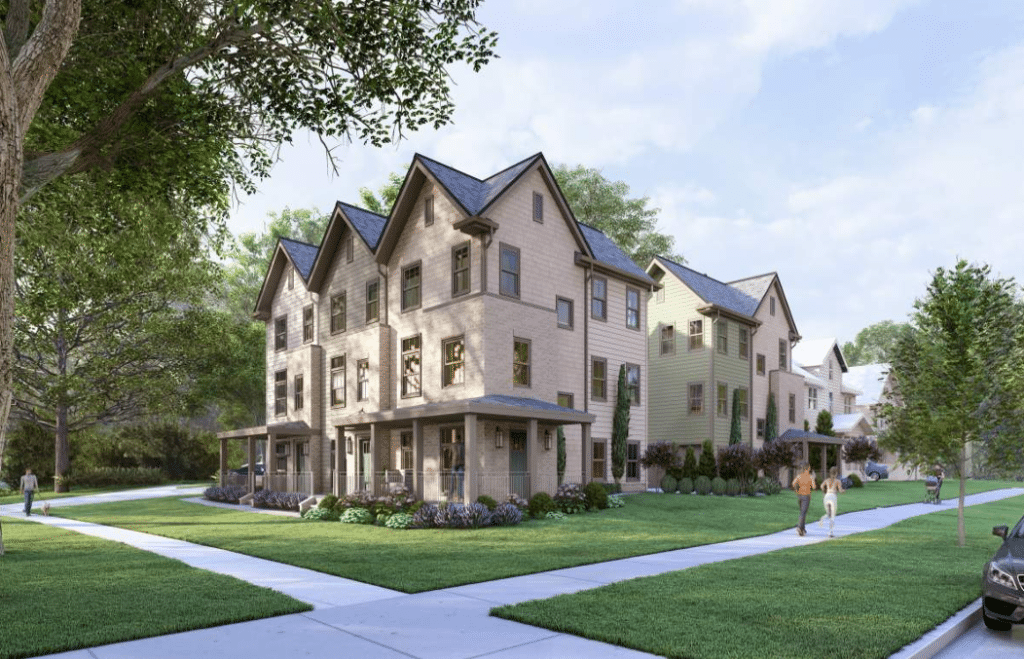
Despite potential controversy, Arth and his partner are forging ahead. They’ve dubbed their new project the Westcliff Townhomes. It will be built in two groups of three units. The challenge then and now was always how to build them in a way that fits in with the neighborhood, which is lined with century homes. One key aspect of the project is that the developers wanted to present a facade that faced both West Boulevard and Clifton so that it didn’t appear as if the townhomes were “turning their backs on the neighborhood.”
“The whole process here has been how to dress up the facade in order to make the Clifton sides of the units actually look like the fronts of houses,” said Arth.
To achieve this, the developers took the front doors of the northernmost units and oriented them towards Clifton. Then, they made that side look like the front of a house, adding gables and porches so that it fit in with the surrounding neighborhood.
They’re currently tweaking the final designs of the townhomes with guidance from Cleveland Landmarks Commission staff. “Now, we’re extending the front porch and the porch roof along Clifton to accentuate that, as well,” he said. “But we’re only going to do that on one of the buildings, because we also thought that not making the buildings look like identical twins makes them stand out more. We wanted, in the words of the landmarks commission, ‘to ‘make them look like sisters but not twins.’”
The buildings could be constructed out of highly energy-efficient modular panels. SIP panels, or structural insulated panels, are high-performance building panels that include an insulating foam core sandwiched between OSB boards (a type of engineered wood product).
“It’s definitely something we’re open to, and we’d love to achieve it as a goal,” said Arth. “We want to have this corner be a showpiece for us. Full (SIP) modules are something that’s easy to do with townhomes because you basically stack them neatly and save a lot of time in the actual framing process.”
The difference between panelized construction and modular construction is that SIP panels are shipped and assembled on site, whereas modular homes are entirely constructed off-site. Arth said there are many advantages to panelized construction. “The house is much tighter, quieter and more insulated, and it can be framed out faster,” he said.
The developer said it was necessary to do townhomes here (as opposed to single-family homes) in order to make the numbers work. “By amortizing the costs of the lot and getting it over six units and also getting the efficiency of building townhomes with attached walls, we can lower the costs,” he said.
He added, “We are not shooting for the luxury market at all. As I told (councilman) Danny Kelly, ‘We’re trying to get a base hit here, not a home run.’”
Despite the project’s controversial history, there were no protesters at the recent Cleveland Landmarks Commission meeting. In addition to the design changes, the developers also added three parking spaces for guests. Commenting on the project, Jessica Beam, a staff member of the landmarks commission, said, “We’re happy to see all of the changes. We appreciate the applicant taking into consideration all the comments from the local design review committee and staff and incorporating those comments into the design.”
Mark Duluk, a member of the landmarks commission, agreed. “It would be wonderful to see something on this corner,” he said. “It’s been a long time.”
Editor’s note: This article’s headline and text have been updated to reflect the fact that neighbors’ concerns about the project have not been resolved at this time.
Keep our local journalism accessible to all
Reader support is crucial as we continue to shed light on underreported neighborhoods in Cleveland. Will you become a monthly member to help us continue to produce news by, for, and with the community?
P.S. Did you like this story? Take our reader survey!