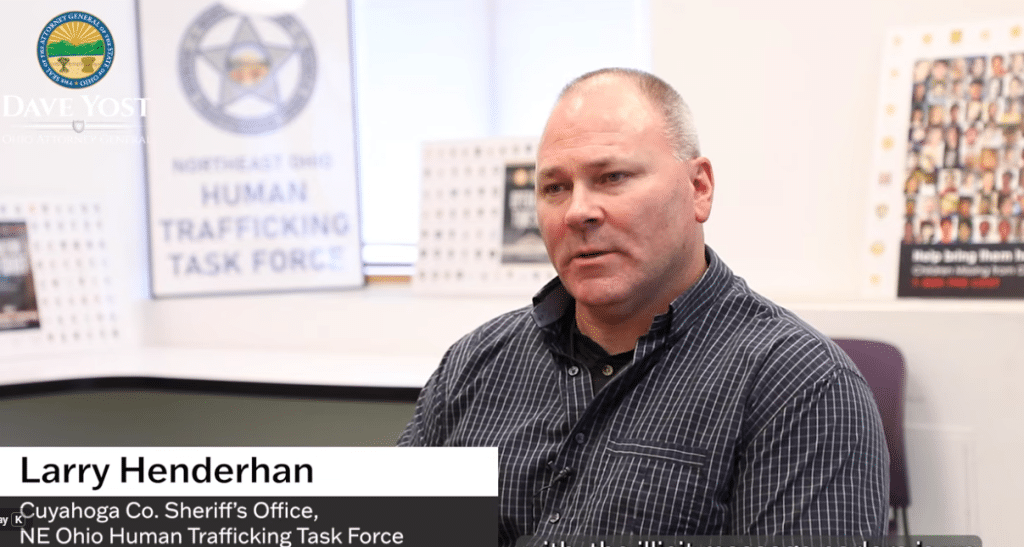
As chief investigator for the Northeast Ohio Human Trafficking Task Force (NEOHTTF), Larry Henderhan likes arresting the offenders, but rescuing the victims is of equal importance.
“With human trafficking, you are inherently involved with these victims’ lives, and you might be one of the people that they rely on or feel comfort in because so many people have discarded them in the past or lied to them,” he said. “You can feel a sense of accomplishment when you are able to help somebody or you are able to get someone bad off the street.“
Each day, Henderhan and his team conduct ongoing investigations into human trafficking activities throughout the region. Typically, they identify potential suspicious individuals or activities through their own investigations or tips they receive from police departments or community partners such as the Collaborative to End Human Trafficking, Cleveland Rape Crisis Center, Canopy Child Advocacy Center, Harriet Tubman Movement and the Greater Cleveland Salvation Army.

Additionally, the task force works closely with police departments throughout the region and other state and federal agencies.
For anyone who does not understand what human trafficking is, Henderhan recommends using your cell phone or preferred means of accessing the internet to search for the Ohio Revised Code, Chapter 2905.32/Trafficking in Persons.
“The requirements to be a violation of trafficking in persons is you have to compel somebody through force, fraud or coercion or intimidation to engage in commercial sex, and that includes any substance manipulation,” he explained. “The compelling is not a requirement if the victim is a minor or has any developmental disabilities, because the person is not able to make those decisions, and the trafficker is outright exploiting them.”
The NEOHTTF is organized under Ohio Attorney General Dave Yost’s Ohio Organized Crime Investigations Commission. There are seven task forces throughout the state, so not every county is covered by one of the task forces. While Henderhan and his team fall under the auspices of the state attorney general, the task force is led by the Cuyahoga County Sheriff’s Office.
Because human trafficking cases can be difficult to prosecute and prove, Henderhan said they often employ the “Al Capone strategy” to build a case. Notably, Capone, one of America’s most famous mobsters, was convicted on tax fraud, not any of the other crimes he was accused of committing including murder, bootlegging, gambling and bribery.
Traffickers are usually committing numerous crimes simultaneously, and since drugs are frequently used to manipulate victims, they are often selling illegal substances, which NEOHTTF agents can confiscate during busts and use to get indictments.
Major sting operations in the fall
In September, Henderhan’s NEO Task Force participated in Yost’s statewide “Operation Next Door” that was conducted by more than 100 federal, state and local law enforcement agencies.
Yost named the operation to acknowledge “the proximity and prevalence of human trafficking,” namely the fact that the girl or boy next door may be victims of sex trafficking and the guy next door may be a buyer or seller of commercial sex. The fall 2025 operation led to the arrests of 32 people on felony charges including promoting prostitution, compelling prostitution, seeking sex with a minor, and drug possession and/or trafficking.
Additionally, 103 “johns” seeking to buy sex were arrested and charged with engaging in prostitution or solicitation, 67 human trafficking survivors were referred by law enforcement to health care and social services organizations, and nine search warrants were executed by law enforcement, Yost’s office said. The operation included raids on massage parlors in Cleveland, Akron and Toledo. More than $62,000 was seized along with other evidence for long-term investigations.
In a recent interview, however, Henderhan said the highlights of the investigations were: locating and recovering a 14-year-old girl known to be at risk for trafficking; opening an investigation to identify a possible trafficker; and recovering a missing 17-year-old female from the Cleveland residence of a registered sex offender.
“One of the biggest things about law enforcement is you can see the results of your efforts,” said Henderhan. “You get to see the impacts on someone’s life, and you’re not just talking about making a difference, you’re actually doing it.”
Commenting on the impact Henderhan and the NEOHTTF have had in their region, Yost said: “I am incredibly proud of the task force’s many successes this year, including cracking down on illicit massage parlors, advancing several long-term trafficking investigations and playing a crucial role in Operation Next Door, our latest statewide human trafficking sting. By targeting would-be buyers of sex, the task force reduces demand and reinforces our message – ‘Don’t buy sex in Ohio.’”
Henderhan’s distinguished law enforcement career
As a young man, Henderhan knew he wanted to work behind the badge. He started as a police officer in Warrensville Heights before becoming a Secret Service agent, completing assignments in Cleveland, Chicago and Washington, D.C. for 15 years.
He then took an agent position with the Food and Drug Administration (FDA), where he investigated misbranded, adulterated drugs and medical devices and clinical trial fraud.
“I’ve always been in law enforcement,” he said. “Luckily, I’m one of those people who was fortunate to know what I wanted to do at a young age.”
After he retired he saw that there was a position open with the NEOHTTF, with whom he had worked on a few money laundering investigations and other cases. Believing he still had more to give because of his years of investigative experience, he applied.
One fact he knows about human trafficking is that victims often do not want to be trapped in that life. He knows they need help getting out, so investigations into traffickers are secondary to rescuing victims and providing them the resources they need to recover a safe, healthy life.
“Victim care is number one for us, whereas in law enforcement, of course, we always want to go after the bad people and make arrests, because we want to hold people accountable,” Henderhan said. “However, it doesn’t work like that for us. If we can get that, great, but getting a victim out of this life is paramount.”
Two victim advocates embedded in the NEOHTTF
To ensure that the task force can offer human trafficking victims the best advocacy and care, they have two victim advocates embedded on their multidisciplinary team, one from Cleveland Rape Crisis Center (CRCC) and one from Canopy Child Advocacy Center.
Tracy Springford, advocate – anti-human trafficking for CRCC, estimates that between 90 and 95% of her clients come directly from a local partner agency in the county, or a NEOHTTF initiative, whether that be a sting operation, a street operation, serving search warrants, or tips that come through the tip line for a victim who has been recovered from a hospital. She accompanies the task force on those operations.
“They bring me in to speak with victims, whether that be in a hotel room, the back of a cruiser or on the street, and my main objective as an advocate is ensuring they are safe,” Springford explained. “If they’re being released back into the community, then where can I help them go that’s safe for them.”
Victims of human trafficking require a much higher level of care that is largely different than what CRCC addresses with other sexual assault victims. There are three touch points for CRCC: victim advocacy, which Springford handles, case management and housing stability, and trauma therapy with a CRCC therapist.
“Those three pieces working together are important and may require bringing in outside agencies to help, so it can be a lot for a victim,” Springford said. “We often also work through drug charges, theft charges or other crimes related to their victimization, so we help clients through the judicial process, go to court with them, try to make sure that they have better communication with their attorneys, work with The Bail Project, if they need help being bonded out and then ultimately getting them into drug treatment, if that is necessary.”
Currently, Springford has more than 25 active cases on her agenda.
Effective relationship with the Cuyahoga County Prosecutor’s Office
“If you don’t have a prosecutor’s office that supports you or they don’t believe in what you’re doing, you’re not going to be successful at fighting human trafficking, but our prosecutors are unique,” Henderhan said. “Anybody that works these cases is well aware of the obstacles that this environment brings, but we have a great relationship with them and with all of our victim advocates.”
According to Debora Brewer, assistant prosecuting attorney supervisor for the Cuyahoga County Prosecutor’s office, human trafficking cases can be “voluminous with a lot of different, moving parts,” including forensic evidence, victim statements, digital records from cell phones or computers and records of financial transactions.
Her office’s strong relationship with Henderhan and his task force enables them to discuss their investigations in detail and review if there is any additional information that they require. She estimates that the county tries about 10 human trafficking cases annually.
“I love the fact that we have a task force that specializes in these cases and has the expertise and knowledge,” Brewer said. “They understand the dynamics of trafficking and what the victims, these girls and women, go through.”
She added that prosecutors assigned to human trafficking cases also partner with the advocates from CRCC and Canopy to ensure that the victims receive counseling and support during the lengthy investigation and trial process.
“Often, these cases don’t go to trial for almost a year, so helping keep the girls or the women in the right perspective and supporting them throughout that time is huge,” Brewer said. “These girls have been through a lot, so trying to get them to present the trauma that they’ve endured to a jury can be difficult sometimes.”
Brewer added that they also have to educate juries on how human trafficking actually manifests, the violence and abuses involved, because they may have an unrealistic expectation of what happens to victims from what they’ve seen on television or in movies.
Additionally, she believes victims in Cuyahoga County benefit from Judge Marilyn Cassidy’s specialized dockets for human trafficking and domestic violence and Judge Joan Synenberg’s Recovery Court.
“I’m always a fan of having these victims supported and getting all of the services that they need,” Brewer concluded. “Having a specialized docket and a specialized task force is absolutely needed just because of the nature of these cases, so it’s a huge benefit to the county.”
If you see suspicious activity that you think might be related to human trafficking, Henderhan advises that you first contact your local police department. Additionally, to report suspected human trafficking in Cuyahoga, Lake, Ashtabula or Geauga county, call the NEOHTTF tip line 216-443-6085 or contact Crime Stoppers at 216-252-7463 or email crimestoppers@cuyahogacounty.gov.
Keep our local journalism accessible to all
Reader support is crucial as we continue to shed light on underreported neighborhoods in Cleveland. Will you become a monthly member to help us continue to produce news by, for, and with the community?
P.S. Did you like this story? Take our reader survey!

![No Kings protest brings thousands to downtown Cleveland [Photos]](https://d41ow8dj78e0j.cloudfront.net/wp-content/uploads/2026/03/28151521/1000004296-800x600.jpg)
![One of the largest salt mines in the world exists under Lake Erie [photos]](https://d41ow8dj78e0j.cloudfront.net/wp-content/uploads/2026/03/28072404/AP26083605060979-800x600.jpg)