In a fast-changing legal world with much uncertainty, local organizations are doing all they can to combat disinformation and fear around immigration.
Potential immigration policy changes from the federal government under the new administration has caused fear among immigrant communities in Cleveland. Local organizations say one of the biggest challenges right now is the uncertainty in what is a legal and constitutional order from the federal government, such as the attempt to freeze federal aid to non-profit organizations. Other leaders say that the uncertainty stems from disinformation, which causes those seeking resources to hide or go it alone instead of addressing their situation with legal assistance.
Chris Schmitt, CEO of Cleveland Metropolitan Bar Association (CMBA), says that their organization is focused on being the connector of resources. “It’s connecting individuals who need help to resources that already exist, even if they may not be within our organization, and working with our great partners at Re:Source Cleveland, Legal Aid Society, and Global Cleveland.”

How Organizations Are Bridging the Gap
The Legal Aid Society’s mission is “is to secure justice, equity, and access to opportunity for and with people who have low incomes through passionate legal representation and advocacy for systemic change” says Melanie Shakarian, director of Development and Communications. Asked if demand for legal services is rising, Shakarian said, “We always see really high demand, and given the current climate, there’s a lot of questions, not just about immigration but also about things like public benefits. So much of this is on a case-by-case basis, and our approach is very personalized.”
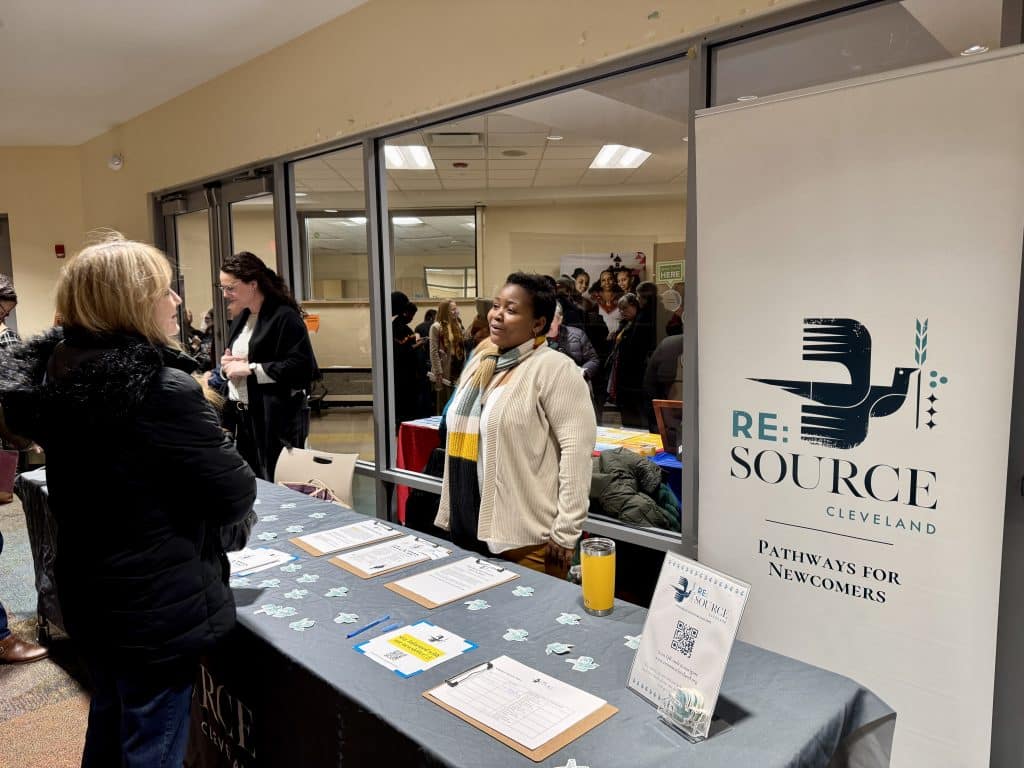
Patrick Kearns, executive director of Re:Source Cleveland (formerly Refugee Response), says public benefits are a major component of helping newly-arrived immigrants acclimate and get on their feet. Kearns and partner organizations run a program called Newcomer Navigators, which helps families enroll and stay up to date on federal and state resources.
“We provide support to [immigrant] families to help them enroll in programs like the Supplemental Nutrition Assistance Program (SNAP), Supplemental Security Income (SSI), Medicaid and Medicare, or with Ohio’s Jobs and Families Services,” he said. According to Kearns, food insecurity and housing are two of the biggest challenges that organizations like Re:Source Cleveland see every day.
Read more: Immigrants, newcomers face fear of restrictions, expulsions and hate in Northeast Ohio
Global Cleveland, a nonprofit that works to create a welcoming atmosphere for immigrants and refugees in Greater Cleveland, says that their organization remains focused on attracting and retaining newcomers to the region.
“International newcomers provide a good solution to growing our economy and increasing our population in Northeast Ohio” says Zachary Nelson, program director for Global Cleveland. Recent population studies show Ohio’s population growth can be mainly attributed to immigrants and refugees. Nelson also credits partners like the Cuyahoga County government, which opened a Welcome Center in 2024, for making the region an attractive place for newcomers to locate. Still, the challenge remains retaining these newcomers within the region. “Ohio is top three in attracting international students, but bottom three in retaining them,” says Nelson. With federal policy on immigration expected to change, including a proposed travel ban, the opportunities for immigrants and refugees to help grow the region could be substantially reduced.
Free Legal Services
Because immigration is a civil issue, officials say Legal Aid can assist with handling immigration matters for those who are low-income, typically at or below 200% of the federal poverty level (around $64,000 for a family of four). Legal Aid’s services are completely free to those who qualify.
Those not looking for representation, but who have questions, can stop at one of Legal Aid’s many Advice Clinics hosted throughout their five county service area, which includes Ashtabula, Cuyahoga, Geauga, Lake and Lorain. Shakarian describes these events as an opportunity “to get free legal advice, one-on-one.” The clinics are first come, first serve, and are typically hosted on weekday evenings and Saturdays at local libraries, churches, or community centers. In response to recent ICE raids in the region, Legal Aid has also set up a hotline for immigrants who are currently detained and face deportation. In order to be accessible, translation services are available in over 200 languages.
The Justice Gap
CMBA’s work is also helping connect people who fall in the “justice gap” to legal representation. According to The Legal Services Corporation (LSC), a publicly funded nonprofit established by Congress, “The justice gap is the difference between the civil legal needs of low-income Americans and the resources available to meet those needs.” In civil law, there is not a constitutional right to an attorney, meaning people are left to secure their own counsel, unlike criminal cases where an attorney is provided to those who can’t afford one. In other words, those that fall in the justice gap can’t afford a commercial-rate attorney, but also do not qualify for free services through organizations like Legal Aid. LSC’s 2022 Justice Gap Report found those within the justice gap did not seek legal representation to resolve three out of four civil matters they had. According to 2023 American Community Survey data, about 32% of Cuyahoga County residents would fall within the justice gap.
CMBA recently established The Cleveland Legal Collaborative, an 18-month program which pays a stipend to newer lawyers who have passed the Bar Exam. This cohort of lawyers are paired with a “seasoned lawyer” who mentors them, while they take on low-bono and pro-bono (typically low cost or free) civil cases for those who fall within the justice gap. According to Schmitt, because the costs of legal services are dramatically reduced or completely eliminated, those that fall within the justice gap are able to see improved outcomes for their situation.The 2025 Cohort applications are now closed, but those who are interested in receiving services are encouraged to apply.
The Final Word
Leaders say there is a need for retired immigration attorneys or active attorneys to take up cases as the number of immigration cases increase. CMBA is hosting educational seminars for lawyers to keep apprised of the changes to US immigration policy and how it will impact the region. Still, Schmitt says the most important thing for regular citizens to do “is to pay attention and know your own rights, regardless of your immigration status… to help your neighbors is the most effective thing you can do.”
———————————————————————————————————————
Legal Aid Contact Info
Website: lasclev.org
Hours of Operation: 9am-5pm M-F Applicants seeking help can visit the Cleveland office weekdays from 9:00 a.m. – 5:00 p.m. Walk-in applicants are offered several options to complete an intake to ensure access to services.
Phone number for immigrants currently detained (24 hour hotline): 216-861-5700
Intake number for seeking legal assistance: 888-817-3777
General number: 216-861-5500
1223 West Sixth Street Cleveland, OH 44113
Cleveland Metropolitan Bar Association Contact Info
Cleveland Metropolitan Bar Association Contact Info
Website: https://www.clemetrobar.org/
Hours of Operation: 9am-5pm M-F
General number: 216-696-3525
Email: communications@clemetrobar.org
1375 East 9th Street, Floor 2
Cleveland, OH 44114-1785
Global Cleveland Contact Info:
Website: globalcleveland.org
Hours of Operation: 9am-5pm M-F
General number: 216-472-3282
Email: info@globalcleveland.org
1422 Euclid Ave #1652 Cleveland, OH 44115
Re:Source Cleveland Contact Info
Website: https://www.resourcecleveland.org/
General number: (216) 236-3877
Email: info@resourcecleveland.org
2054 W. 47th St. Cleveland, OH 44102
We're celebrating four years of amplifying resident voices from Cleveland's neighborhoods. Will you make a donation to keep our local journalism going?