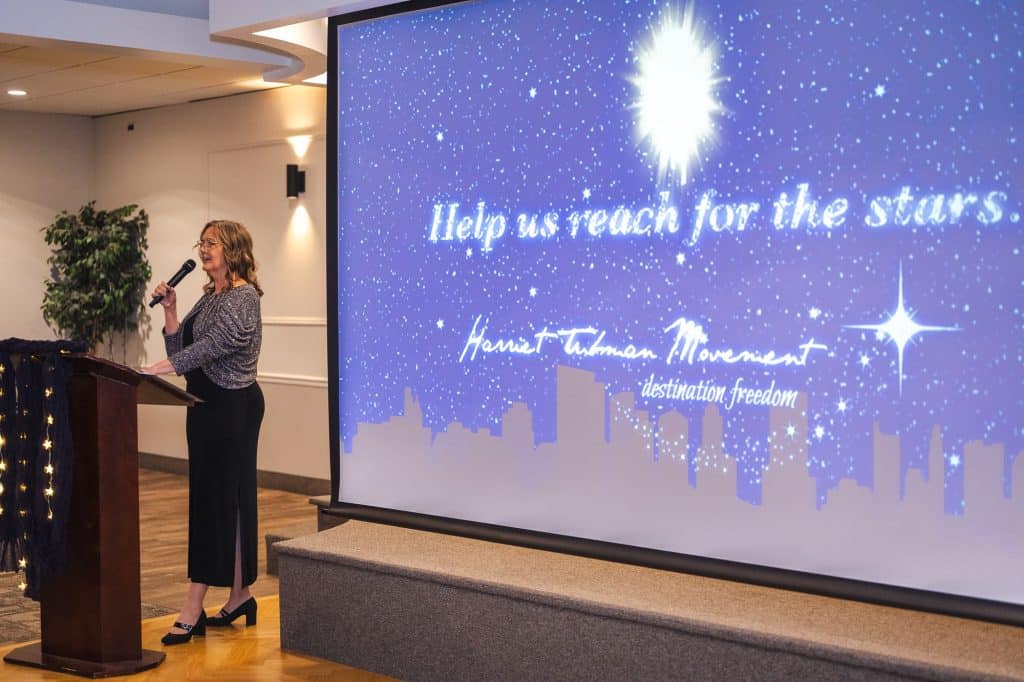
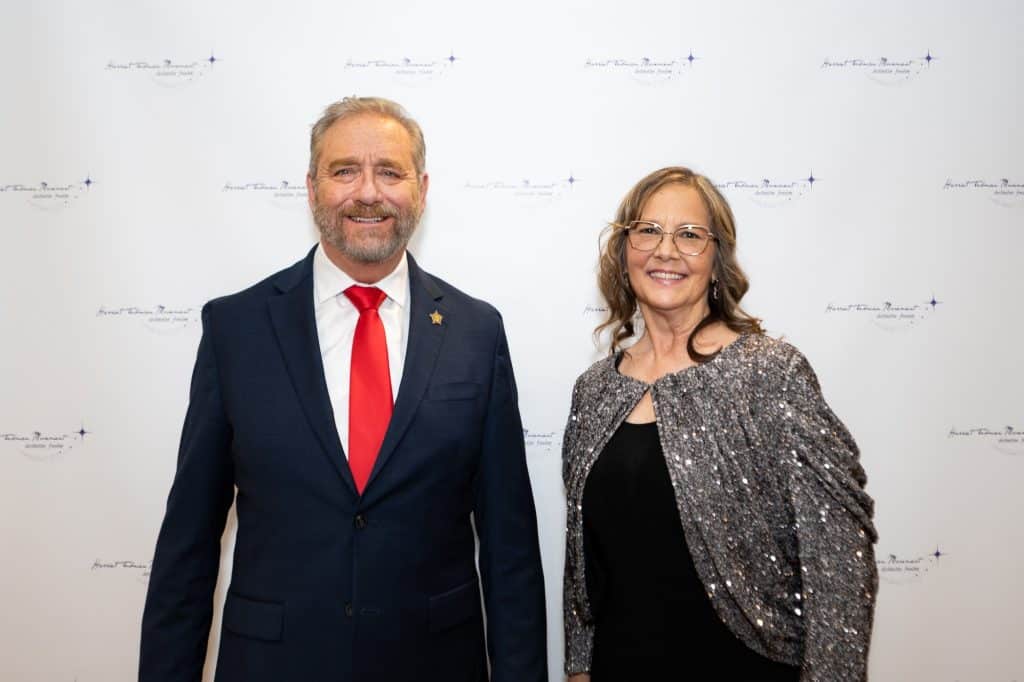
This spring, the Harriet Tubman Movement (HTM) celebrated its 10th anniversary of advocacy focused on assisting victims of human trafficking throughout Northeast Ohio.
Named for the legendary 19th century abolitionist and Underground Railroad “conductor,” the nonprofit organization based in Burton provides support and guidance to individuals navigating their journey towards freedom from modern slavery and exploitation.
“At the time we founded the organization, the tagline ‘modern day slavery’ was becoming popular,” said Laura Bartchak, cofounder and executive director of HTM. “This injustice is not the same as slavery was in the past when it was legalized, but it’s similar in that human beings are being bought and sold, and it’s a similar solution that we need people to come together from all different areas to combat it.”

Before forming a 501(c)(3) in 2016, the founders seriously pondered whether they should name their organization for the famed freedom fighter. Then some of the survivors of human trafficking they were helping convinced them it was an effective name.
“When we talked to our clients about it, they would say, ‘Oh no. We get it. We remember it,’” Bartchak recalled. “One girl was like, “I remember being high as a kite, and all I could think was, ‘I need Harriett Tubman to get free.’”
Bartchak and her team of volunteers swing into action when they learn of an individual who has been identified as a possible victim of human trafficking. They collaborate with a variety of referral sources such as law enforcement, hospital emergency departments, domestic violence or homeless shelters or addiction recovery providers.
She characterizes their role as “mobile advocates,” because they will go wherever the victim is located. They meet with the person, assess what’s happening with them, then offer them a range of services to help them recover their health and their lives.
“Because we get referrals from so many sources, we are able to meet people early when they are first identified, maybe even before they are aware that they are being trafficked,” said Pam Tomm, HTM’s lead advocate and board president. “Then we are able to offer them a different path because they aren’t aware that there are long-term programs to help them by getting them to a safe place to get them stabilized.”
For Jennifer Moreland, a forensic nurse and lead Sexual Assault Nurse Examiner for the Southeast Region of University Hospitals Medical Centers, it’s powerful to be able to tell human trafficking victims who are feeling hopeless that there is someone who can come to their bedside and help them take the next steps.
“Nurses like to help people, and when they come to the ED we treat them medically first and foremost, but then they have to leave,” she said. “Where are they going to go? What are they going to do? If they want help, then we let them know we can call HTM.”
Jacqueline Hughley, victim service manager for the Rape Crisis & Counseling Center, Compass Family and Community Services, Youngstown, said. “To know that an advocate will come get you in the middle of the night or anytime and place you somewhere safe so that you don’t have to keep taking that abuse from a trafficker is powerful. They have saved many lives.”
After they are safe, survivors’ needs vary from having to obtain a birth certificate or legal identification or needing a sexually transmitted infection treated or legal services to help them address a pending court case. However, they all need a safe place to live, according to Bartchak.
“Up to this point, we’ve partnered with domestic violence shelters to house our victims, and we coordinate case management with them,” she said, adding that domestic violence and homeless shelters are not considered to be the ideal places to house survivors of human trafficking.
The pathway to restoration and services needed for a DV victim or a homeless woman, she says, are different from the pathways needed for a trafficking victim. The level of trauma experienced is different. Relocation is sometimes necessary because their trafficker might be in that area. Appropriate safety procedures and therapeutic services most beneficial to survivors might not be available at the shelter.
“Laura and HTM offer the most valuable service of identifying safe shelter, which is the first step in a victim’s or survivor’s recovery,” said Carolyn M. Kinkoph, cofounder of Alliance Against Human Trafficking and budget & operations coordinator, Cleveland State University, Provost’s Office.
How the Harriet Tubman Movement started
In 2011, Bartchak attended a human trafficking awareness event near where she lived. A Geauga County public defender spoke about how four Chinese women that were being sex trafficked had been found in a home in Chesterland. The word “trafficking” had become a buzzword because, in the U.S., the first federal comprehensive anti-trafficking law, Trafficking Victims Protection Act, was not passed until 2000. In Ohio, a similar anti-trafficking law took another decade to pass in December 2010.
“Most people’s first impression is always, ‘That happens overseas, not here,’” Bartchak said. “So, learning that these women were found in Chesterland was a complete shock.”
She volunteered to help the organization that sponsored the event and began to familiarize herself with other organizations in the human trafficking sphere. She connected with the Collaborative to End Human Trafficking in Cleveland and the Mahoning Valley Human Trafficking Task Force in Youngstown.
She took public speaker training programs and became a member of Toastmasters. Until 2015, she was happy to raise awareness about human trafficking in the community at churches, Rotary Clubs and for “lunch and learn” sessions at businesses.
Then things got personal. The date of the Harriet Tubman Movement’s anniversary coincides exactly to the day a young woman walked up to Bartchak at a public speaking event at an inner city church. The 19-year-old said her family was selling her to people they knew to engage in sex with her. Her family was deeply involved with illicit drug activities, so they would use their daughter as currency to purchase drugs. She also told Bartchak that she had been abused since she was 3.
When Bartchack and several friends jumped in to help the young woman, they encountered a number of barriers from long-term residential trafficking and substance abuse treatment programs throughout the U.S.
Bartchak rattles off a list of example requirements for people seeking admission: The person could not be on certain medications or have a certain type of diagnosis, had to possess certain types of clothing, had to be 30-days clean and needed $1,000 to enroll in a treatment program after filling out a lengthy application and faxing it to the facility.
“These programs are allowed to have their own rules, so if they say they can’t take anybody who is on suboxone or a certain type of medication, that’s their rule, or if they say they can’t take anybody who has a schizophrenic diagnosis, that’s their rule,” Bartchak explains. “That was throughout the country, and we will scour the country for programs, and it is not an easy process.”
During the process, they started to receive requests to talk with other women in similar situations. After working to help five women in that one year, Bartchak and her friends realized there was a definite gap in services to get women survivors into long-term restoration programs.
Unfortunately, the first woman to contact Bartchak has not had a successful long-term recovery. Bartchak and her team did get her into a treatment program initially. She has been in and out of treatment programs ever since but has not completed one. The good news is she did separate herself from her family.
“She periodically reaches out to us and most often is not doing well, despite being in and out of programs throughout the years,” Bartchak says. “Her mental health challenges are significant, and it’s so sad, but she knows she always has someone to call.”
Filling the gap
Since founding Harriet Tubman Movement in 2016, Bartchak and her volunteers have helped 350 women through the complex process of regaining their health and a safe, normal life after enduring the hardships of recovery from being trafficked. Harriett Tubman Movement serves as a victim service provider for the Northeast Ohio and Mahoning Valley task forces.
If they accompany the task force officers on a sting operation at a motel where women are being trafficked, they come equipped with comfort kits containing fuzzy blankets, hygiene products, snacks and water bottles.
“We’ve helped women that haven’t eaten in three or four days and they have only the clothes on their back,” Bartchak said. “If they need serious medical care, they go by ambulance or we can drive them for minor cuts and abrasions. If they need detox, we get them to detox. Sometimes, unfortunately, they are arrested, but then we will meet with them in jail and make those follow-up plans.”
Kelly Phillips, who started as HTM’s program manager in January 2024, said: “We’re serving in a gap where individuals are falling through cracks, and we’re going to continue finding those gaps and stepping into those areas of need.”
Mission 2026-27: open an emergency housing facility
Currently, Bartchak, her three employees and an army of volunteer advocates are on a mission, in the next two years, to open the first short-term emergency home in Northeast Ohio. They are applying to tap into some funds available for such facilities.
In October 2023, Ohio Governor Mike DeWine announced a new initiative to reduce emergency housing barriers for survivors of human trafficking. Supported by a $1.8 million grant from the Ohio Department of Public Safety, the program enables the Ohio Domestic Violence Network to expand the number of domestic violence programs in Ohio that can provide comprehensive services to human trafficking survivors.
“We have our own funds to purchase a home, but it’s also about ensuring the financial sustainability for the home,” Bartchak said.
To date, the organization’s operations have been funded through donations from private individuals and foundations, but Bartchak knows she needs to identify state funds to run the home. She is currently searching for those opportunities as well as a safe location for the facility.
She’s encountered some zoning challenges in Geauga and Lake counties and knows she’s also up against a “Not In My Backyard” fear in the community because of fears over housing human trafficking victims.
“Ultimately, we don’t want to be a shelter but a home where we can greet someone with a fuzzy blanket and a cup of tea,” she said. “I’m also not naive in what it’s probably going to look like, but for our first year, we’ll have no more than five women at a time, and we realize there will be a huge revolving door with our clients.”
You can also connect to the Harriet Tubman Movement on Facebook and Instagram. On October 4, 2025, they will hold their 2nd annual fundraising event.
To report suspected human trafficking activity or to seek help for victims in Northeast Ohio, you can contact the Northeast Ohio Human Trafficking Task Force Hotline at 216-433-6085. This is a dedicated line for non-emergency assistance from law enforcement and for providing information about potential trafficking.
To report a tip in Ohio, the non-emergency hotline number is 844-END-OHHT (844-363-6448), which funnels incoming tips about suspected sex and labor trafficking directly to law enforcement. All tips are reviewed by the Ohio Bureau of Criminal Investigation’s Criminal Intelligence Unit and forwarded to the appropriate human trafficking task force and local law enforcement agency in Ohio – all of whom are experienced in investigating allegations of human trafficking. https://www.ohioattorneygeneral.gov/ENDOHHT
To learn more about human trafficking, visit Polaris Project or the Department of Homeland Security’s Blue Campaign.
Keep our local journalism accessible to all
Reader support is crucial as we continue to shed light on underreported neighborhoods in Cleveland. Will you become a monthly member to help us continue to produce news by, for, and with the community?
P.S. Did you like this story? Take our reader survey!