
‘Not just a safe space’: Ohio Means Jobs center helps people find jobs before leaving prison
Last month, an Ohio Means Jobs Center opened at Cleveland’s Northeast Reintegration Center. Prison staff and people incarcerated there hope the space will be a distraction-free “sanctuary” where people can connect to resources needed to improve their futures.
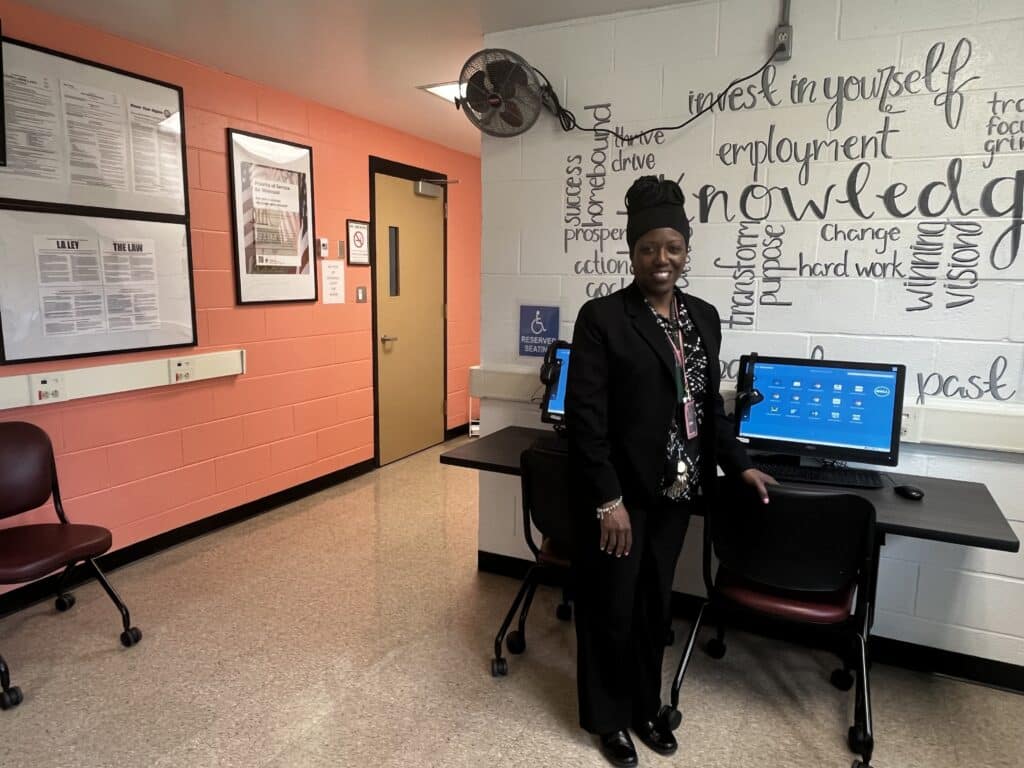
Karenda Hutsenpiller, who is incarcerated at Northeast Reintegration Center, looks forward to Mondays. NERC, a minimum security prison on Cleveland’s east side that houses about 400 women, has several workforce and community service programs, including a program where incarcerated people groom prison employees’ pets. After working with dogs all day in that program, Hutsenpiller kicks off the week at the prison’s newly opened Ohio Means Jobs center, a small room lined with computers where she helps others prepare resumes and plan for their futures after leaving prison.
“If I start my week off by helping people, that’s good energy throughout the rest of the week,” Hutsenpiller said. “I know a lot of people are like, ‘Aw, it’s Monday, I gotta go to work.’ Not me. I’m like, ‘It’s Monday, let’s get it started. Who do I gotta go talk to?’”
But before she was a program aide at NERC, Hutsenpiller didn’t know where to find employment resources and how to go about creating a resume. She remembers her first experience putting together a resume at the prison with NERC staff member Theresa Antal.
“I had no idea about the questions that they were asking. And I’m like, ‘I’ve never done any of this stuff in my life, so what do I put?’ And she was like, ‘Well, this is where we come into place to actually show you how to answer these tough questions on a resume,’” Hutsenpiller said.
Now, she’s helping other incarcerated people who are going through similar experiences prepare resumes and find jobs. “It’s really important to me to be able to help people reach a different goal, rather than coming back here,” she said.
The prison recently expanded its capacity to make this possible. Before the jobs center opened last month, the prison had two computers in the housing units where people could access Ohio Means Jobs resources. But now it has a designated, peaceful space where people can receive guidance from people like Hutsenpiller and Dawn Ballard-Little, a case manager and the prison’s Ohio Means Jobs coordinator, also known as Ms. Little.
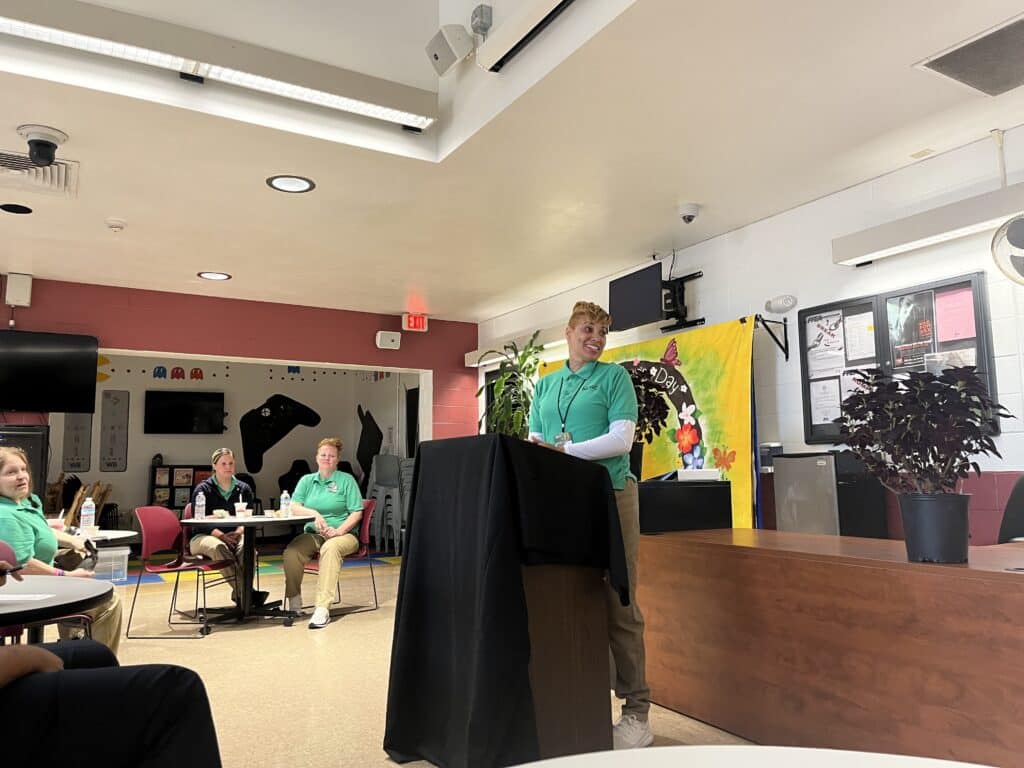
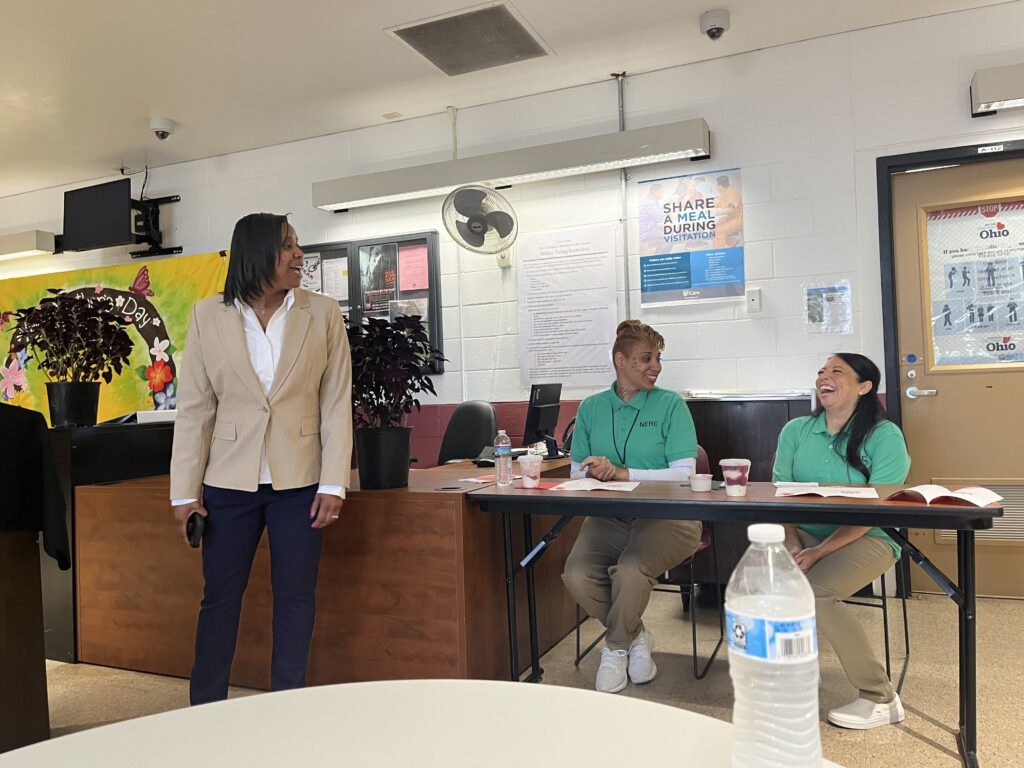
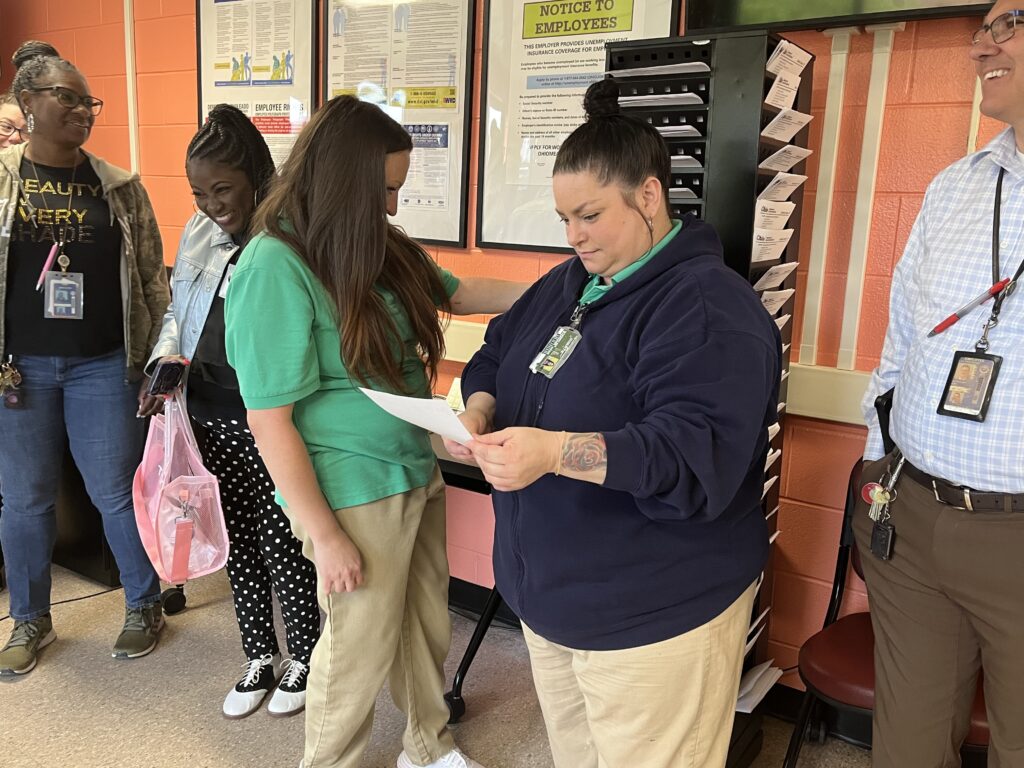
At a ribbon-cutting ceremony on Friday, Hutsenpiller described the space as a “beautiful, amazing sanctuary.” Before welcoming prison staff, incarcerated individuals, and community members to the space, Ohio Department of Jobs and Family Services project manager Ronald Weber presented NERC with a plaque and announced the certification of the Ohio Means Jobs Center.
“I consider the Ohio Means Jobs center to be one of the heartbeats of our facility because it breathes life into the incarcerated persons as they prepare to exit our facility and reintegrate back into society,” Ms. Little said at the event. “We have been intentional in supplying a welcoming space where our residents can be comfortable and focus on developing their employment skills to secure a better future for themselves and their families.”
Gina Miller, who has been incarcerated for six years and has since earned her GED at the prison and associate’s degree through Lutheran Metropolitan Ministries, said at the ceremony that she plans to continue to work with Ohio Means Jobs until the day she leaves. Miller, who currently lives at NERC while working a job out in the community, is getting ready to move to a halfway house (a residence for people transitioning from prison to the community) and has trained Hutsenpiller to take on her role.
The Ohio Means Job Center is open on Monday evenings, Wednesday mornings, and Friday afternoons, and upwards of a dozen people come to the center on a typical day. Hutsenpiller said that sometimes Ms. Little will sign passes for six to eight people to attend, but then 15 end up showing up.
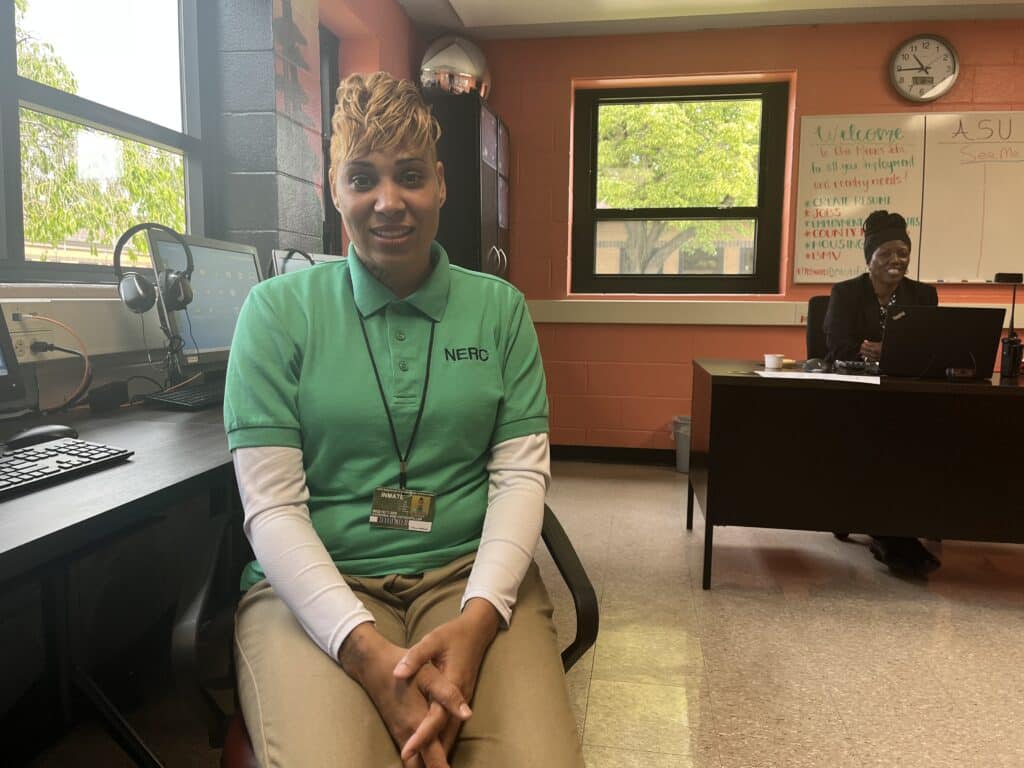
Helping people find jobs before release from prison
Job-seekers at the prison can create up to five resumes on the Ohio Means Jobs computers, and 90 days before their release date, they can add one resume to a database available to employers.
Beyond resume and interview prep, Ohio Means Jobs also has resources for housing, clothing, and peer support, she said. A rack of papers at the new center holds information and resources available for individual counties in Ohio.
Outside of the three days the jobs center is open, Hutsenpiller meets up with people at the prison to talk to them about what job they would like to do post-release. Hutsenpiller and Ms. Little promote the jobs center by putting up flyers and through word of mouth. Hutsenpiller said that sometimes people will see her with Ms. Little and then ask her where they’re going, giving her a chance to explain what the jobs center is and how it works.
When people say they don’t want help from the Ohio Means Jobs center, Ms. Little’s next question is always “Why?” She said that people sometimes say that they already have jobs lined up for after their release, but she encourages them to make multiple backup plans.
Hutsenpiller has multiple potential career paths in place. She has a pet grooming license and a plumbing license, and she’s working toward her commercial driver’s license (CDL).
“The job world is like a war. When you leave here after doing all that time and not having the resources, it’s a struggle,” Hutsenpiller said. “I know people who still currently use Ohio Means Jobs, and it’s the best thing they’ve ever done, versus people who have left that are struggling.”
Getting the center ready
NERC struggled to find a space for the jobs center at first but eventually landed on sharing a room with Ashland University, which teaches courses at the prison on select days. With $50,000 in funding through the Department of Jobs and Family Services program, NERC updated the electrical system at the jobs center and added furniture, Ms. Little said.
The jobs center is the size of a small classroom, and it resembles a school setting, Hutsenpiller said. Residents work at two big tables pushed together in the middle of the room, and at the computers bordering the walls. Now, with computers and a space designed for a specific purpose, they can focus without distractions, she said.
“For me, it’s a sense of calmness and that people aren’t judging you because everybody that’s in the space is all working at the same goal, versus being in the (housing) unit, you have people that are working out, you have people that are cooking in the microwave, and you have people that are not on the same level of wanting to go down that path and start getting things in order,” Hutsenpiller said.
Residents at the prison helped move furniture, waxed and buffed the floors, and painted the walls with images and messages of hope. On one of the walls, images of fences and looming trees painted in tones of dark brown, gray, and olive green fade into sunlight and a shade of bright coral that adorns two of the other walls. The mural symbolizes moving from dark times to freedom and following a pathway to opportunity, staff and NERC residents said at the ribbon-cutting ceremony.
On another wall, called the “affirmation wall,” a resident painted words such as “knowledge,” “invest in yourself,” “purpose,” “homebound,” and “education.” At the bottom of the mural, in a space partly covered up by computers, she painted the phrase, “Moving past your past.”
“The bottom part, I like that the best. I laid up at night and thought about that. It’s just moving past your past, because this is definitely going to be a part of our past; this is definitely going to always be a part of us,” she told event attendees during a tour of the space.
Ms. Little said she’s most excited about the center helping people land a job even before they leave prison. “We know that once they leave here, they have many barriers that they’re going to face initially. But we want this to be one less thing,” she said.
“It’s not just a safe space. It’s a pathway to a better future if you really want to utilize it,” Hutsenpiller said.
Learn more about the programs available at Northeast Reintegration Center here, and find information about reentry support resources at the Cuyahoga County Office of Reentry website. NERC is located at 2675 E. 30th St., near the border of the Industrial Valley and the Central neighborhood.
Keep our local journalism accessible to all
Reader support is crucial as we continue to shed light on underreported neighborhoods in Cleveland. Will you become a monthly member to help us continue to produce news by, for, and with the community?
P.S. Did you like this story? Take our reader survey!
Author

Related Articles

Federal Reserve votes 9-3 to leave key rate unchanged despite persistently high inflation
Dissenting in favor of a quarter-point interest rate hike were Beth Hammack, president of the Federal Reserve Bank of Cleveland; Neel Kashkari, president of the Minneapolis Fed; and Lorie Logan, president of the Dallas Fed.

Will tough talk be enough? Fed Chair Warsh faces pressure to combat inflation
Beth Hammack, president of the Cleveland Fed, said in a post on LinkedIn earlier this month that for the first time she is hearing business leaders call for higher rates.

Coffee industry struggles pour into Northeast Ohio
Effects of climate change, civil and international unrest and inflation are driving up production costs, making it especially hard for specialty producers.


