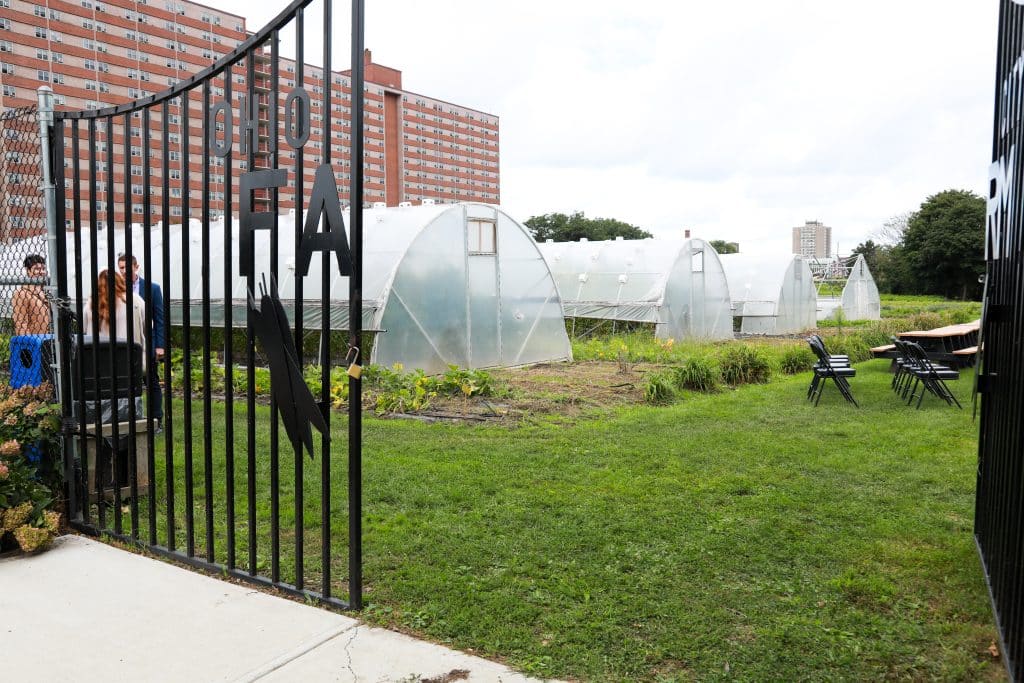
Ohio City Farm, a six-acre farm run by the nonprofit Refugee Response, which provides jobs for immigrants and fresh produce to the community, plans to break ground on a “global farmers market” next year. The new building, which will be built on the farm on W. 25th St. and Bridge Ave. next to the West Side Market, will serve as an indoor market where people can come and buy the food produced at Ohio City Farm.
“This area where we’re standing used to be housing, and next year, it’s going to be a global farmers market that is introducing access to newcomer growers and newcomer food producers, putting this [farm] on the map,” announced Patrick Kearns, executive director of Refugee Response, at Global Cleveland’s Welcoming Week press event held Wednesday, Sept. 13 at Ohio City Farm.
Kearns explained that the expansion will allow for year-round operations despite Cleveland’s harsh winters. Food that’s currently grown year-round in the farm’s greenhouse spaces will now have indoor space for processing and sales. The building will include a commercial kitchen where farmers and food entrepreneurs can cook and prepare food. Along with this, the global market will offer space for educational programs so visitors can learn about Ohio City Farm, which is considered to be the largest urban farm in Cleveland.
All in all, the new building is expected to create five more jobs for refugees and, just outside, create space for 12 additional community garden plots for Cleveland families. The jobs will include retail, marketing and communications management, business management, and sanitation positions.
Refugee Response also hopes to collaborate with the West Side Market in the future, but they need a separate space for growing and preparing food year-round, said Kearns. “The shared vision is of a Cleveland food corridor bringing more retail and engagement opportunities for residents and visitors,” he told The Land. “The proposed new farm stand at the Ohio City Farm is designed to meet the unique needs of the farm to improve our operations, maximize our impact, and create new opportunities for growth and partnership. Our hope is that such an investment will only increase the opportunities for potential collaboration with the West Side Market.”
Plans for the market building
The entrance of the 4,000-square-foot building will be accessible to the public from Bridge Ave. and W. 24th St. It will have glass windows visitors can look through to see inside, where there will be an area for the market, which will sell produce grown onsite, plus space for select outside vendors to sell their products.
Refugee Response plans to break ground on the building by next spring, and their goal is to have it running by 2025. According to Kearns, they are currently raising funds for the building through donors and fundraisers, and they have raised about three-fourths of their goal.
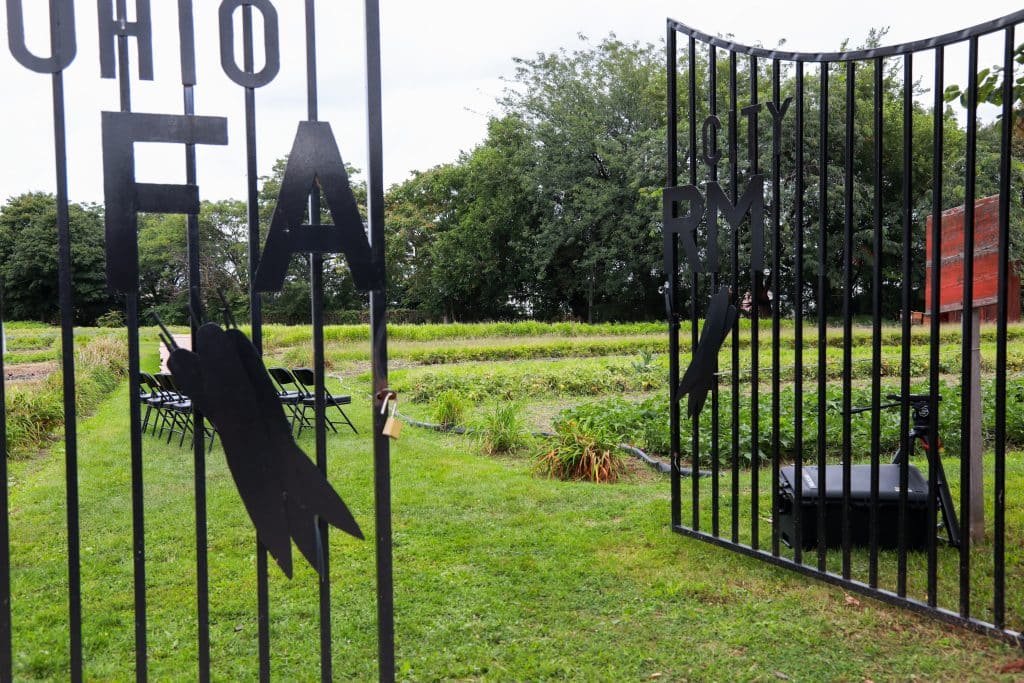
Ohio City Farm was founded in 2010 to provide training and jobs to resettled refugees, many of whom come to Cleveland with a background in agriculture. The crops are currently sold through a seasonal farm stand and through a community supported agriculture (CSA) program in which people pay for weekly shares of fresh produce. Ohio City Farm is jointly administered by Refugee Response and Cuyahoga Metropolitan Housing Authority (CMHA). While visitors are in the area or are shopping at the farm stand (typically June-November), they can also stroll down a grassy pathway to a stunning view of downtown Cleveland from the edge of the farm. Guided tours are also available.
“This is going to allow us to go four seasons, which is going to allow our team to have full employment throughout the year,” Kearns said of the new building. “It’s also going to give them a heated workspace, a locker room, indoor plumbing for the first time in 13 years, retail and vending for the public, and a commercial kitchen.”
“Our goal is all together to have 12 vendors, 5 restaurant partners, 5 food partners, as well as five different jobs created to support the environment itself,” Kearns continued. The vendors and restaurants have not been decided yet, and the food partners will be new entrepreneurs in the Cleveland area that will have access to the commercial kitchen.
While it will help the refugee community, the market will also create more food access for the Cleveland area, says Kearns. He said they will be working closely with the county to accept public assistance programs in the market.
Refugee Response is a nonprofit organization aiming to support and resettle refugee families in Cleveland. In addition to running Ohio City Farm, they offer youth mentoring, youth and adult tutoring, teen wellness programs, and more. In 2022, they distributed 6,000 boxes of fresh produce through Ohio City Farm, according to their website.
When the farm was started in 2010, it was originally plowed by an Amish farmer using horse-drawn tillers. Over the past 13 years, it has grown into a vibrant urban farm. Now, it is set to expand with the global farmers market.
Growing opportunities for refugees
Along with Kearns, three refugees working with Refugee Response spoke at the press event, sharing their stories.
The first, Khoon Thomas Kate, said he came to the U.S. from Thailand in 2010 and lived in the Bronx, New York, for three months before moving to Cleveland. With help from Refugee Response, he said his family owns a house in Lakewood, while his daughter attends college at Cleveland State University.
Along with Kate, Nelson Baguma, originally from Uganda, and Liliia Mamrokha, from Ukraine, also spoke. Baguma is a tutor with Refugee Response and completed his bachelor’s degree in computer science, while Mamrokha is a teacher with Refugee Response who moved to Cuyahoga County to live with her mother.
The Cleveland metro area has a relatively low foreign-born population compared with other cities, but it’s growing. In 2019, 156,800 immigrants were living in Northeast Ohio, making up 5.7% of the population in Northeast Ohio. While the population declined 0.4% overall, the immigrant population increased by 7.3% in Northeast Ohio. So, while the overall population has gone down, the immigrant population has increased.
The trend in the city of Cleveland is similar. In 2021, 374,861 people lived in Cleveland and there were about 22,347 people who were foreign born, about 6% of the population. Compare that to 2017, when 383,827 people lived in Cleveland, and 20,113 were foreign born, about 5.2%. Compared with New York (29%) or Los Angeles (32%) that’s peanuts, but it’s a step up for Cleveland.
Today, about 117 nationalities and ethnic groups live in the Cleveland area, according to Global Cleveland. Foreign-born residents contributed $11.8 billion to the region’s GDP, and 6,861 international students were enrolled in Northeast Ohio in the fall of 2019. Northeast Ohio has 8,300 immigrant entrepreneurs, and they generated $204.8 million in business income.
Joe Cimperman, president of Global Cleveland, and county executive Chris Ronayne also gave statements at the press event, touting the work Global Cleveland and Cuyahoga County have done together to boost the immigrant population in Cleveland and help support refugees.
“One of the programs that was referred to was the county’s incredible support, over a million dollars in the budget last year for refugees, and this is the first time in the history of Cuyahoga County that that money was ever allocated,” said Cimperman. (See The Land’s previous coverage of that county support here.)
“We believe in immigrants, we believe that Cuyahoga County is one Cuyahoga, we believe that this place matters in the world because it is the world,” Ronayne said. “This farm that we’re on today continues that legacy of immigration, because it’s run by people from all over the world.”
CORRECTION: A previous version of this post incorrectly stated that the farmers market building will be 14,000 square feet. The building will be 4,000 square feet. Additionally, this story has been updated to reflect Refugee Response’s proposed future collaboration with the West Side Market.
Learn more about Refugee Response here and Ohio City Farm on its website and Instagram page. The farm is located at Bridge Ave. and W. 24th St., Cleveland.
Keep our local journalism accessible to all
Reader support is crucial as we continue to shed light on underreported neighborhoods in Cleveland. Will you become a monthly member to help us continue to produce news by, for, and with the community?
P.S. Did you like this story? Take our reader survey!