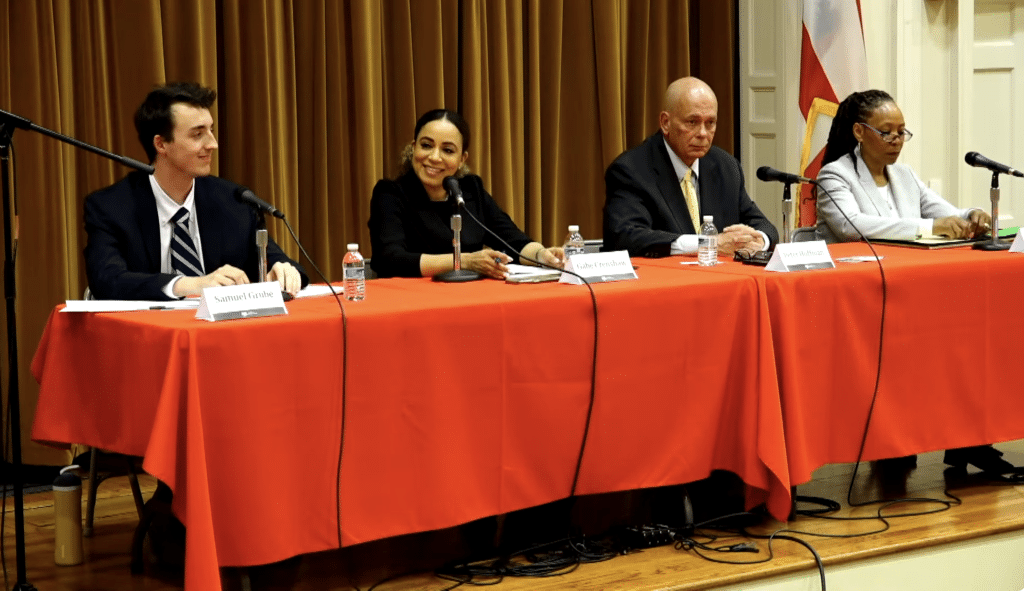
Strong storms rolled through Cleveland on March 31, bringing hurricane-force winds and heavy rains. The weather didn’t stop Democratic Party hopefuls from sharing their views at a candidate forum for the Ohio House District 18 primary.
Hosted by the League of Women Voters of Greater Cleveland, the event at Shaker Heights High School featured four candidates competing for term-limited Democratic state Rep. Juanita Brent’s seat. District 18 includes Cleveland Heights. along with parts or all of Cleveland, East Cleveland, Shaker Heights, Orange and Warrensville Heights. (Republican candidate Maureen Lynn is running unopposed.)
Contenders Gabe Crenshaw, Sam Grube, Peter Hoffman and Davida Russell opened with introductions before covering audience-led questions on immigration, education, the environment and housing affordability. Cleveland Heights City Council Vice President Russell said her roots in local politics provide the necessary foundation for building bipartisan cooperation in Columbus.

“We must collaborate with Republicans and find some common ground,” said Russell, who unsuccessfully vied for the Cleveland Heights’ mayor’s seat last November. “We know there are serious issues going on at the statehouse. Going in, you’ll have to talk to people you already know, and make friends with people you don’t. I’ve done this for six years on city council.”
Russell and her opponents face a May 5 primary to secure the party’s nomination for the general election in November. Political newcomer Grube said Ohio needs leaders that will step up against harmful Trump Administration policies.
“Cities and states throughout the country have stood up to the Trump agenda,” said Grube, a Shaker Heights High School graduate currently majoring in political science at the University of Chicago. “Why haven’t we seen our elected leaders across the state work as hard to stop the rising threat of fascism?”
Candidates, including Grube, questioned installation of Flock traffic cameras in Cleveland Heights, raising concerns about the city potentially sharing recorded information with immigration and Customs Enforcement (ICE) officials. Cleveland Heights-University Heights school board president Crenshaw championed the community’s diversity while stating opposition to sharing any camera data with ICE .
“Immigrants are individuals who are needed in our community, and we should pride ourselves on having a diverse community,” Crenshaw said. “We should encourage people to come into our communities, and that we’ll be a voice for them.”
Cost of living and the economy was another pain point brought up by audience members. Hoffman, a Shaker Heights resident and Cuyahoga County Democratic Party executive, named Ohio one of the most regressive tax systems in the country. A recent study from Policy Matters Ohio revealed that low- and middle-income families pay a higher percentage of their income in state and local taxes than the wealthiest 1%.
Mentioning his finance background, Hoffman said he is uniquely equipped to unravel inequitable state-level policies. Among his proposed reforms is a zero-percent income tax for any household or individual making less than a living wage.
“Columbus is putting the burden on working families,” said Hoffman. “If I get to Columbus, I’ll be sticking it in their eye all the time, because we can’t keep living like this, and putting the burden on working people in Ohio. I’m a numbers guy. I can figure out the processes and make sure the money that the taxpayers pay is used effectively.”
On the environment, the candidates raised concerns about local construction of high-tech data centers, which require significant water volumes to manage server temperatures. Proximity to Lake Erie makes protecting these resources vital, from limiting agricultural runoff to improving local recycling.
Although Ohio is positioned to be a leader in clean innovation, the state’s current policy framework has not capitalized on this potential, said Crenshaw.
“We all know that climate change is not a distant issue,” Crenshaw said. “Clean water isn’t negotiable, so our families should not be concerned about the water that’s coming out of their tap.”
In her closing statement, Russell said the upcoming election is about hard-working families, seniors who deserve dignity, and children fighting for an uncertain future.
“My fight began in the halls of Collinwood High School, standing up against racism, sexism and classism,” said Russell. “We are still fighting those same things today. We don’t need to talk anymore, we need action.”
Voting in the May 5 primary takes place between 6:30 a.m.-7:30 p.m. on election day. Visit www.ohiosos.gov/electionsor call 877-SOS-Ohio for more information on voting times and locations.
Keep our local journalism accessible to all
Reader support is crucial as we continue to shed light on underreported neighborhoods in Cleveland. Will you become a monthly member to help us continue to produce news by, for, and with the community?
P.S. Did you like this story? Take our reader survey!