Note: The author’s opinion does not reflect the opinions of their employer. The author is an alumni of Cleveland State University for both undergraduate and graduate programs.
Years ago, as a student at Cleveland State, I wrote an article about the perceived parking problem on campus. My argument was simple: with seven parking garages and roughly 18 surface lots on campus, there was no parking problem. There was a Transportation Management problem. CSU was not doing enough to encourage students (or subsidize, which is an even better incentive) to live on or near campus and utilize RTA’s U-Pass program.
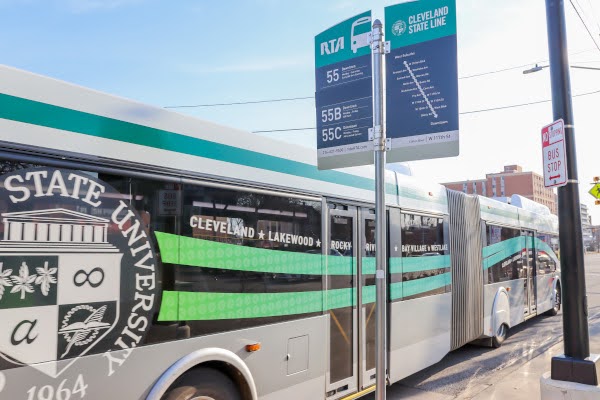
The RTA U-Pass is a semester charge of $57 to every student’s tuition, with unlimited trips using RTA’s service. Every student is charged this fee as part of their tuition, regardless of whether they utilize it or not, helping bring down the cost of the semester pass. With great nearby transit service, including RTA’s Healthline BRT on Euclid Avenue, this program was widely successful with students living on and near campus who didn’t have access to a vehicle. Given CSU’s historic identity as a commuter school, the U-Pass program also provided a low-cost option for transportation around the city.
Abruptly, this week, Cleveland State emailed students to announce the discontinuance of the U-Pass program. Students are now only able to purchase the monthly $95 RTA pass. In a matter of hours, a campaign was launched to demand that CSU reinstate the program. Additionally, an Instagram account was created to spur student testimony about how important the program is to them. One submission, posted by the account, said:
“As an urban major and a proud student of Levin College of Affairs and Education this is a slap in the face. Levin is ranked #1 in programs for Urban Policy and Local Government Management. For CSU to decide to take away one of their best programs for it’s [sic] students is diabolical. As a student who does not have a car and relies on public transportation for everything I can, 100 percent this is affecting my quality of life at CSU… do better.”
Presumably due to backlash, President Laura Bloomberg released a second statement later in the day apologizing and explaining that state regulations now prohibit CSU from billing every student for the U-Pass:
“I am truly sorry for the stress this is causing including the unexpected financial hardship caused by the abrupt nature of this change. While we cannot control the state regulations that impact the student fee structure, we are working internally on options to lessen the immediate financial impact of this for our students.”
Later in the evening, City Councilwoman Rebecca Maurer, who is running to represent Cleveland State in Ward 5 under the new ward boundaries, released her own statement calling on CSU to reactivate the program, “Public transit is not just a student issue. It benefits our entire city by reducing traffic, easing parking demand, and supporting economic mobility. I urge the university to work with GCRTA and student leaders to find a solution that keeps students on track, not left at the curb.”
Then, early this morning, current Ward 5 Councilmember Richard A. Starr (whose ward includes Cleveland State’s campus today) issued a statement sharing similar concerns and outlining potential solutions, including establishing an opt-in program for students that would still be subsidized by the university without the mandatory fee, and investigating alternate funding methods through grants, sponsorships or partnerships with local businesses to support the program.
What is unclear, however, is why Cleveland State is the first state school to publicly announce this new regulation. Other state schools, such as Ohio State University, provide transit to students at no cost through COTA (Central Ohio Transit Authority). Additionally, local community college Tri-C also provides free transit passes to students enrolled during the semester. Time will tell if these programs will remain or be discontinued as part of this vague new regulation.
In a written statement, a Greater Cleveland Regional Transit Authority (GCRTA) spokesperson said that the program generated $1.4 million in annual revenue for the transit authority. He also stated that GCRTA is working with CSU to sell passes to students at a regular weekly and monthly price.
Why It Matters
We know CSU is facing budget shortfalls as student enrollment is flatlining, student visas are being threatened, and public education is under attack from The White House. While it currently is unclear if this was truly a state regulatory issue or a CSU budgeting issue, Cleveland State’s enrollment shrunk from nearly 16,000 students in 2019 to about 13,500 in 2024. In similar fashion, the nearby Reserve Square Apartments (a major hub of international exchange students near campus) has lost nearly 400 tenants and is moving towards foreclosure, one can see why the outlook for enrollment is not optimal.
However, this is no excuse to end this important program. In fact, decisions like these create barriers for non-traditional students whom CSU has long served and could negatively impact enrollment further.
The U-Pass program provides access to the campus population to Cleveland’s entire transportation network without a personal vehicle. Few college students can afford the cost of choosing between taking transit or buying a vehicle. The subsidy for students was a great benefit of attending the university. Compared to RTA’s cheapest monthly pass of $95, the $57 U-Pass (applied every semester) saved students nearly $345 per semester if utilized instead of driving to campus. The cheapest parking pass, by comparison, is $141 per semester, but can cost as much as $272.
Reinforcing the Status Quo
Ending this policy re-incentivizes driving to campus. Cleveland State’s own recently adopted Master Planning effort identified the need to create more housing opportunities on and near campus. Without affordable access to transit, this plan will be for naught. Furthermore, the Campus Plan effort grounded itself in four key pillars: “Equity, Diversity, Inclusion, and Sustainability.” Ending the U-Pass program accomplishes the exact opposite of these pillars. Ending the subsidy of public transit for students only creates the need for parking on campus, and discourages walkability on the campus itself.
Cleveland State is perfectly located in Cleveland’s downtown core, between a world class theater district to the west and a major health care and education hub to the east. The opportunity for a student to live near campus, take public transit to their job and classes, and not need a car is incredibly important in supporting upwards mobility. For a student utilizing the U-Pass year round, it would cost about $165. In the United States, the average cost of owning a car ranges from $12,000 to $14,000 per year, or roughly over $1,000 per month. This is not financially sustainable for students trying to afford rent and a college education. Instead of shedding programs for transit passes and shrugging their shoulders because of state regulations, Cleveland State must embrace GCRTA and find a way to provide a subsidy to students seeking to utilize public transit.
We respectfully call on Cleveland State’s leadership to reinstate this program. It is clear that both alumni and current students feel strongly about this program’s significance, as shown by the public outcry over its cancellation. Removing the U-Pass option disincentives students from living near campus and enjoying our public transit system, limiting upward mobility and making students poorer in the process. It also is a sign that Cleveland State is not embracing its own philosophy of being an urban campus in the city’s core. Embracing the city means incentivizing public transit, affordable housing for students and increasing access to opportunity for students. Ending this program is only going to hurt students in the long-term and further decrease campus enrollment.
We're celebrating four years of amplifying resident voices from Cleveland's neighborhoods. Will you make a donation to keep our local journalism going?