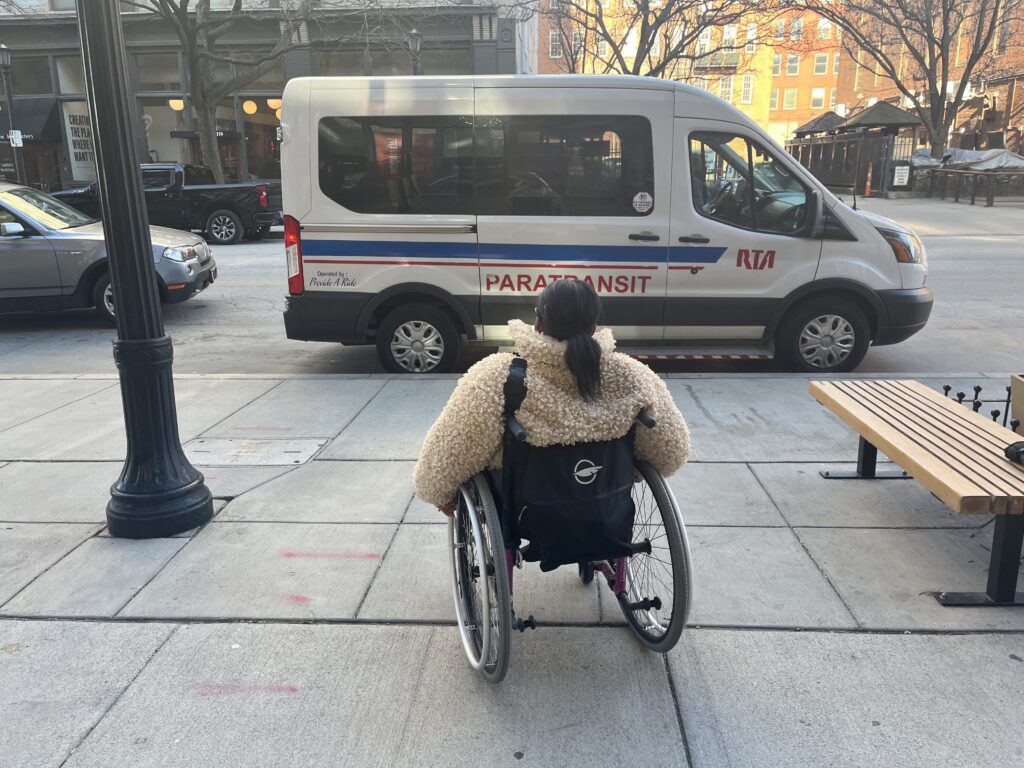
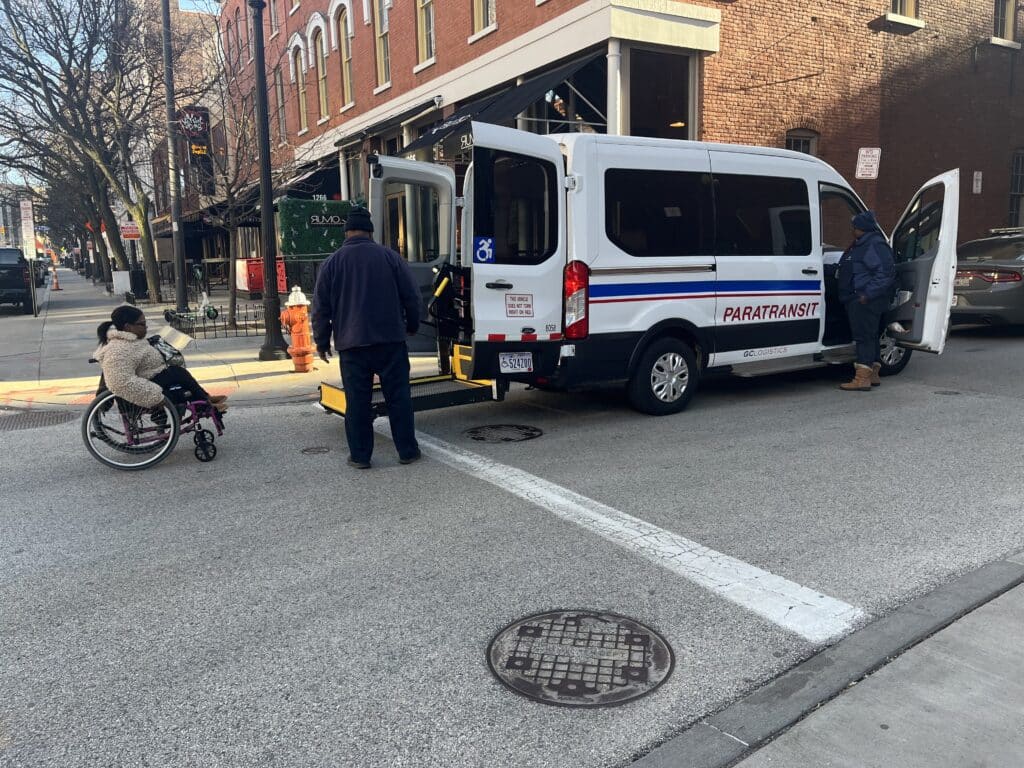
On Jan. 31, Bedford resident Shalida Dobbins had a meeting at Cleveland City Hall about ways to make the city more accessible. After the meeting, Dobbins, who uses a wheelchair, waited outside for the ride she scheduled to get home through paratransit, a service of the Greater Cleveland Regional Transit Authority (RTA) that provides door-to-door rides for seniors and people with disabilities who can’t use the typical fixed-route service.
When the bus didn’t arrive during its scheduled time frame, Dobbins checked her account on her phone and saw that she had been marked as a no-show even though she was waiting outside for the bus. She ended up taking an Uber to get home.
RTA told The Land on March 20 that its GPS shows that Dobbins’ paratransit vehicle was at City Hall from 2:04 to 2:18 p.m. Dobbins said she was waiting in the front of City Hall at that time. Her pickup window was 2:05-2:35 p.m.

The next day, RTA called to follow up on the complaint that she filed about the incident. Dobbins hadn’t received a call when the paratransit ride didn’t show up, she said. But when she told this to RTA, they responded by saying that dispatchers aren’t obligated to call because they’re often swamped with work. Dobbins said that response sent the message that the dispatchers’ time was more important than hers.
“As a Black disabled woman, I’m used to being ignored, but I’m not OK with it,” Dobbins said in a video she shared on TikTok.
She had a friend with her and was able to take a rideshare to get home, but a lot of people don’t have that option, she said.
“I just feel like when you’re working with the disabled and elderly community, you have to be understanding, you have to be helpful, and you have to make sure they’re always in a safe position,” Dobbins said in an interview with The Land. “And leaving someone stranded so far from home who’s disabled is unforgivable.”
A few days later, Dobbins, who is vice chair of transit advocacy group Clevelanders for Public Transit (CPT), had another meeting scheduled to talk about accessibility with Mayor Justin Bibb, but she missed the meeting and took an Uber home because her paratransit ride got her there late.
Dobbins and other paratransit riders have experienced service issues, including late arrival and pickups, that prevent them from getting to and from places like work, the grocery store, and the doctor on time, they told The Land. RTA’s paratransit district director Nick Davidson said that worker shortages and increased ridership coming out of the pandemic have created challenges and that on-time performance has dipped in recent months compared to earlier in 2022. But he’s hopeful that revamped agreements with three returning paratransit service contractors and the addition of 20 larger paratransit vehicles will improve the service. The new contracts begin in June, and the new vehicles will replace 20 old ones in September.
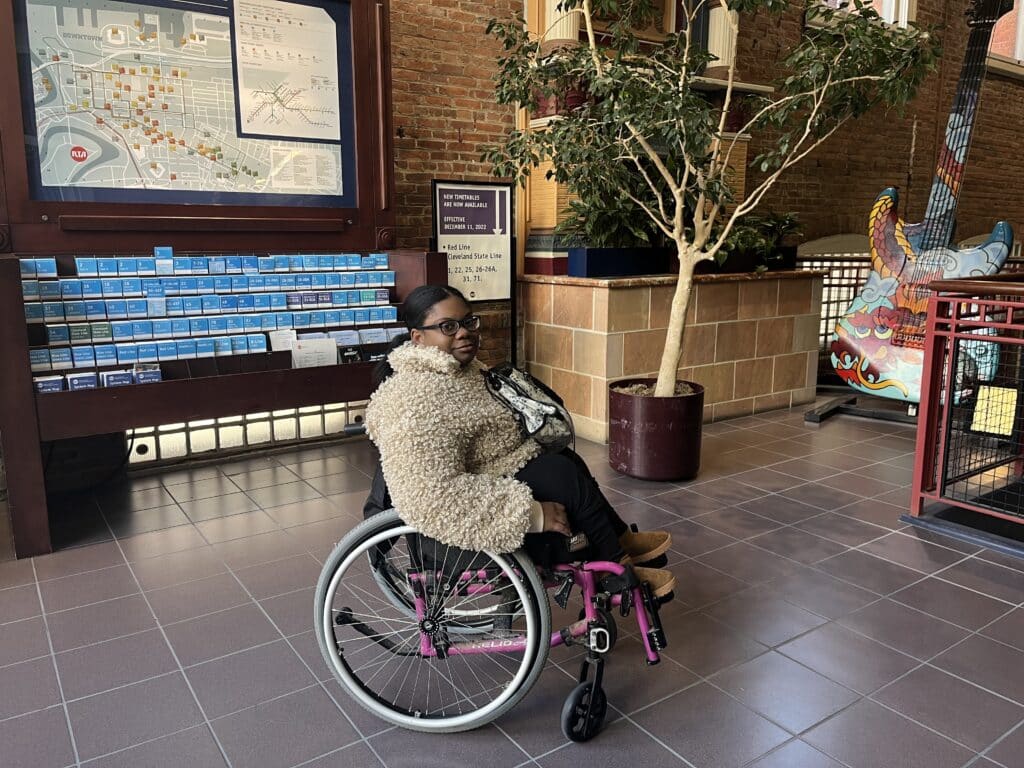
How does paratransit work, and why is it important to riders?
Under the Department of Transportation Americans with Disabilities Act (ADA) regulations, all transit agencies operating a fixed-route system are required to offer a corresponding paratransit service for people who cannot use the fixed-route system – and the paratransit service must be within ¾ mile of the fixed route service and during the same days and hours. RTA paratransit service goes beyond ADA minimums and also provides rides within a five-mile radius for people who live outside the fixed-route service area, such as in Olmsted Falls and Columbia Station.
To take RTA’s paratransit service, riders have to complete an application process to determine eligibility. Once their application is approved, paratransit riders can schedule rides by phone from 7:30 a.m. to 4:30 p.m. To schedule rides 24/7, riders can call RTA’s interactive voice response (an automated phone system also known as IVR) or use a paratransit scheduling website on a computer or mobile device.
Riders make reservations for rides one to three days in advance. When scheduling, they can request either the time they want the bus to pick them up at their door or the time they want to arrive at their destination. They receive a 30-minute pickup window, with the bus arriving anytime during that period. Paratransit fare costs $2.75 each way, $7 for a daily pass, $30 for a seven-day pass, or $110 for a monthly pass. (Non-paratransit RTA service rates are $2.50 each way, $5 for a daily pass, $25 for a seven-day pass, or $95 for a monthly pass, with additional discounts for seniors and people with disabilities.)
Paratransit is a lifeline for many people with disabilities and for seniors, riders who use the service said. For Donna Prease, a paratransit rider and co-chair of the ADA subcommittee of RTA’s Community Advisory Committee (CAC), paratransit means independence.
“It keeps us involved in the community versus just living in it,” said Greg Stuart, a paratransit rider who attends the monthly CAC meetings.
RTA board president Rev. Charles P. Lucas has been taking paratransit for 17 years and uses the service every day, he said in an interview with The Land.
“I will never forget after being in the hospital for three years, when I was picked up by paratransit, the joy of seeing the city again,” Lucas said at the Jan. 31 board meeting. “I’m on paratransit every day, and I have been trying my best to make paratransit No. 1, but I understand that they have a way to go.”
RTA paratransit performance and survey results
RTA’s paratransit service makes about 40,000 trips a month, said Davidson, RTA’s paratransit district director. At a Nov. 1 presentation on paratransit operations and rider survey results, Davidson said that increased ridership and a shortage of drivers contributed to a fall 2022 dip in on-time performance.
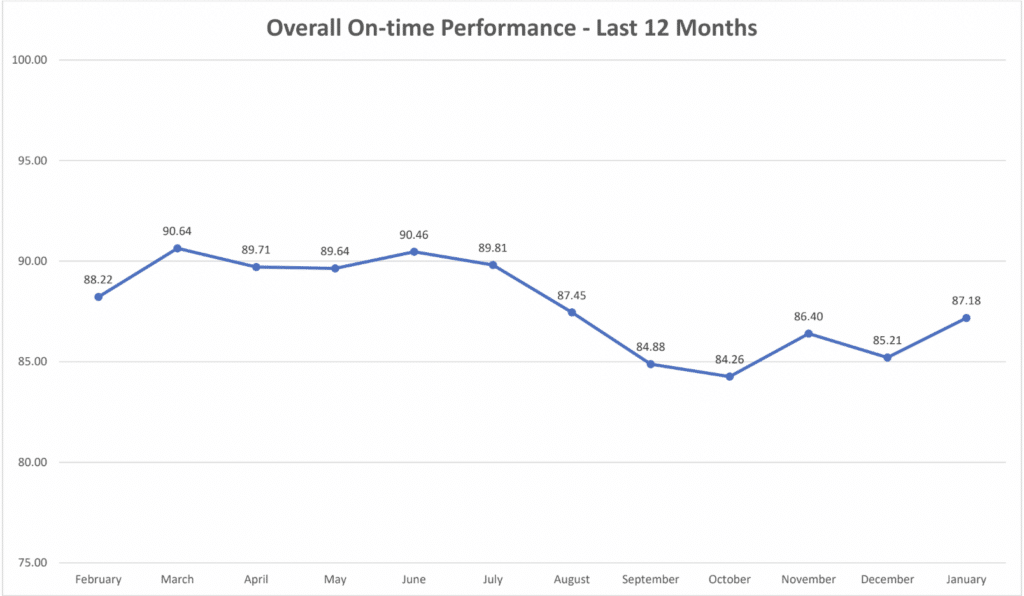
On-time performance was at 84.24% in October, down from about 90% in the spring and midsummer of 2022. It was 87.18% in January 2023, according to the most recent data provided by RTA. Looking only at trips where riders requested to be dropped off by a specific time, such as for work or a medical appointment, the service got people to their destinations 90.9% of the time in January in 2023, an increase from 88.7% in October 2022, according to data from RTA.
The overall on-time performance metric is a combination of a few factors: whether a rider was picked up within their 30-minute pickup window and whether they were dropped off at their destination by their scheduled arrival time.

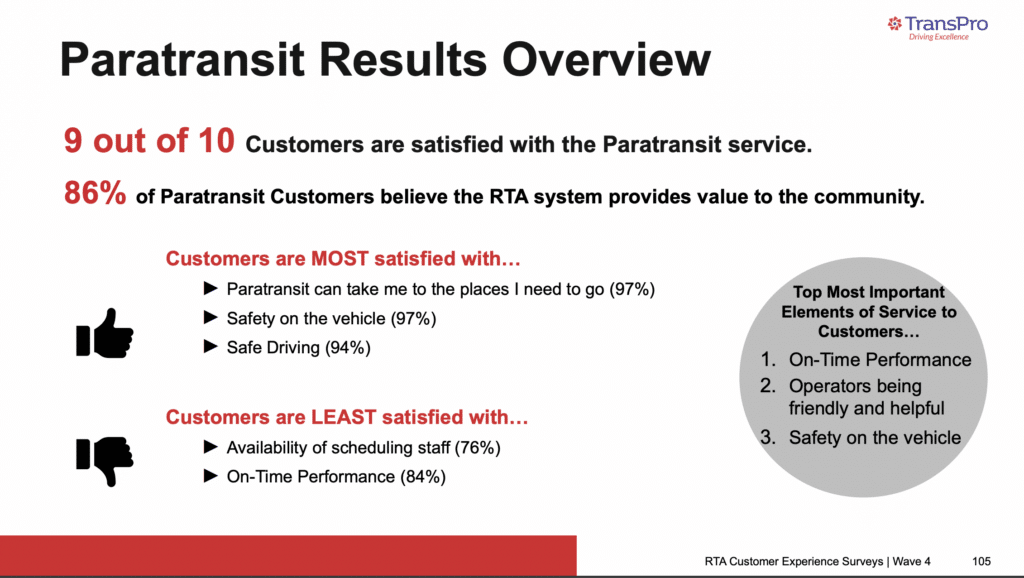
An RTA paratransit survey conducted by TransPro Consulting between November 30, 2022 and December 14, 2022 received 371 responses from calls to a random sample of people who had taken a paratransit ride at least once in the previous six months. The two factors that respondents were least satisfied with were availability of scheduling staff and on-time performance, with 76% of respondents satisfied with scheduling staff availability and 84% satisfied with on-time performance. The factor that was most important to survey respondents was vehicles arriving within their scheduled pickup window.
The TransPro survey also included a net promoter score (NPS), which is a customer service metric that measures how likely a customer is to recommend a product or service to their friends and family. The lowest possible rating is -100, and the highest is 100. RTA received an NPS of 50, which Davidson described as a “very good score.” The survey also reported a 94% overall satisfaction rate with its paratransit service.
Despite these rosy survey results, several paratransit riders told The Land that they have experienced late pickups and dropoffs and long wait times on the phone to schedule rides.
Riders report long phone waits and pick-up delays that make them late
Paratransit rider Dontez Taylor said in a public comment at the Jan. 31 board meeting that the paratransit bus service needs more dispatchers and operators, noting that there have been excessive wait times to schedule rides. Taylor said that there have sometimes been 35 people in the queue when he called to schedule a ride. Stuart, who attends the CAC meetings and has been taking paratransit for 24 years, also pointed to call wait times as an area for improvement in an interview with The Land.
Larry Rodriguez uses paratransit to get to medical appointments and to his job at Susy’s Soup & Deli at Tower City Center. He has had to wait about 40 minutes to an hour on the phone to schedule a ride, he said.
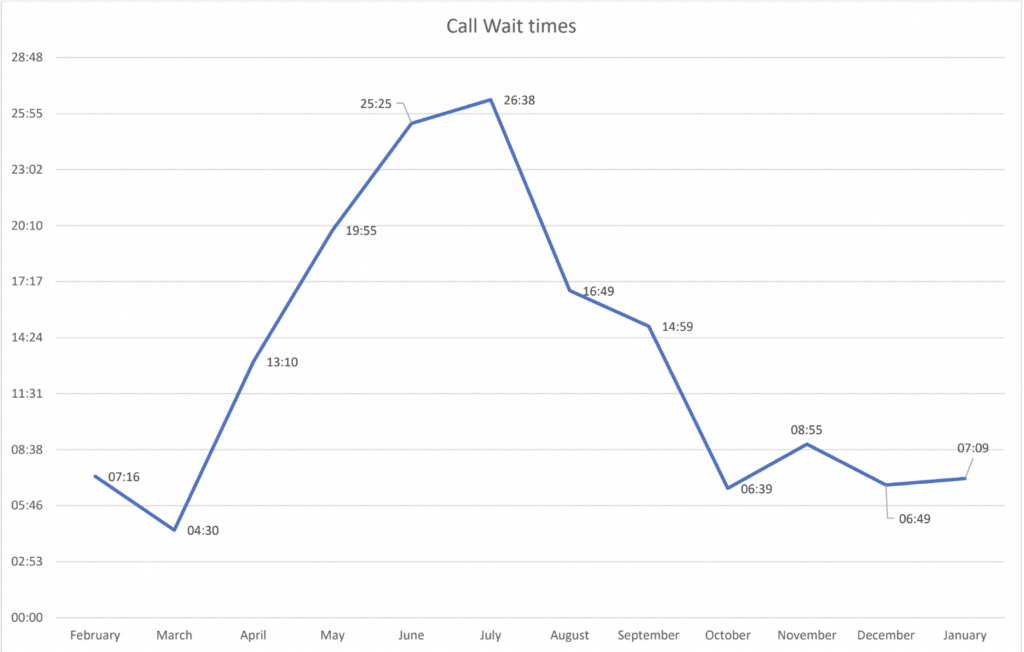
Reservation call wait times increased in summer 2022 as a result of staff shortages, with average weekday wait times around 15 minutes in May and July, Davidson said in the Nov. 1 presentation. Data from RTA shows a peak call wait time of 26:38 in July 2022, which decreased over the subsequent months. The average call wait time was at 6:39 in October 2022 and 7:09 in January 2023, the data show.
For the most part, CPT member Niral Sheth hasn’t encountered problems taking paratransit and getting to work on time. But coming home from work was a different story, he said, recalling a time when his dropoff window changed from 6-6:30 p.m. to 8:30 p.m. and he took an Uber home instead.
Prease, the co-chair of the CAC’s ADA subcommittee, doesn’t take paratransit as often as she used to when she was working. She had no issues when she took the service to get to her doctor’s appointment last month. But one time in December, Prease missed a doctor’s appointment and had to reschedule because her paratransit ride never picked her up, she said.
Another community member who has taken paratransit for approximately six years used the service to get to her job at a youth shelter for about a year. She requested to go by her initials, CG, in this story because she didn’t want publishing her full name to hinder the work she does as an advocate in the community. Paratransit delays affected her commute to and from work. Like Dobbins and Sheth, she had to resort to Uber at times to get home.
The condition of the paratransit buses have also created issues for CG, who has fibromyalgia and experiences chronic pain. “Cleveland roads are not the best, and those buses are raggedy,” she told The Land.
The 20 new vehicles slated to be on the roads in September will have an enhanced suspension system for more comfortable rides, Davidson said.
CG said she frequently contacted RTA about the timing issues she experienced with paratransit. In the fall, paratransit had been consistently getting her to work late, causing her to fear losing her job. “Every day I’m on pins and needles going to work,” CG told The Land in December.
She decided to leave the job and is now working from home because she couldn’t rely on paratransit to get to work on time, she said.

RTA efforts to improve paratransit service
Providing paratransit service that is both efficient and timely requires finding a balance between several factors that can be hard to predict, including traffic conditions, number of ride requests, and onboarding time, said David Koffman, a principal at transportation consulting firm Nelson\Nygaard who has been consulting on paratransit issues since the late 1970s.
“Some amount of untimely service is always going to happen,” Koffman said, acknowledging that too much lateness can make the service unusable for riders. “How much is too much is difficult to say. There’s no one standard that is used by everybody.”
A common standard among transit agencies, though, is picking up riders within a 30-minute window 90% of the time, he said.
As for RTA’s paratransit on-time performance goals: “I would love to be at 92%,” Davidson said. “I think if I’m above 88, I’m happy. Above 90, I’m very happy. And at 92, I’m thrilled.”
After ridership dips during the pandemic, post-Covid recovery of paratransit has surpassed that of fixed-route service, he told The Land on Feb. 28, with fixed-route service at 60% of pre-Covid levels and paratransit between 85-90% of pre-Covid levels. The demand for service has outpaced RTA’s ability to hire, Davidson said, but he expects the 20 larger paratransit vehicles coming in September to help RTA keep up.
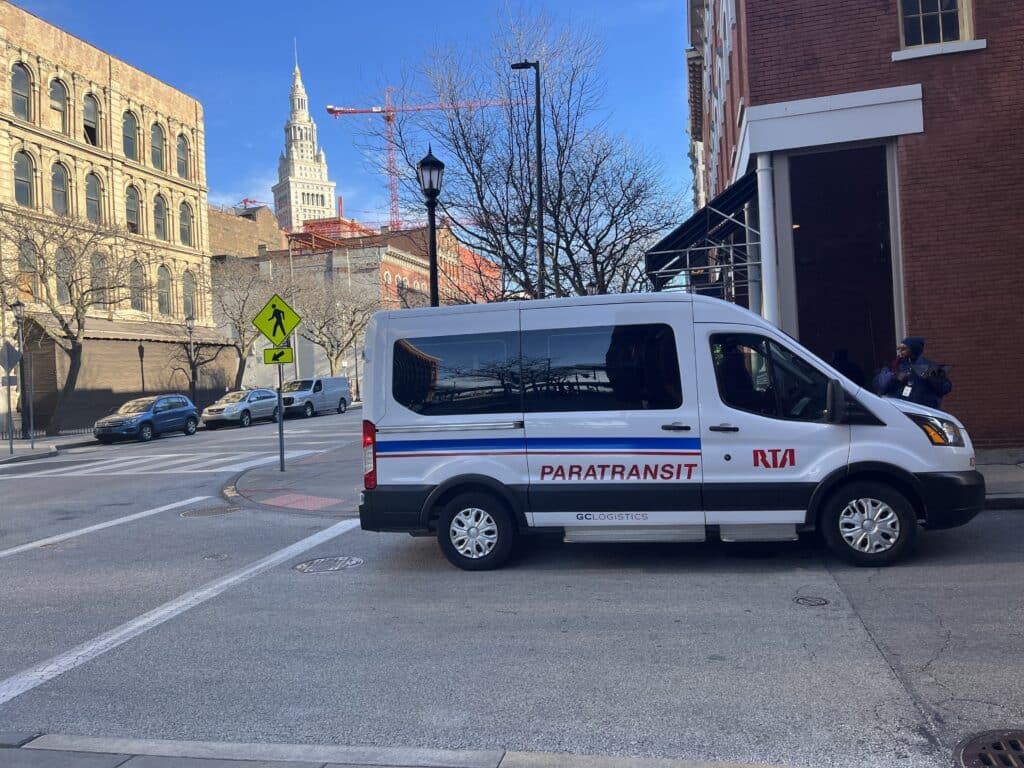
RTA vehicles and employees handle about 50% of the transit authority’s paratransit service, with third-party contractors providing the remainder of the services, Davidson said. At its Feb. 28 meeting, the board of trustees passed resolutions to approve three paratransit service contracts. RTA required the contractors to “demonstrate ability to attract and retain talent” and offer annual wage increases and a competitive benefits package to employees, according to an RTA presentation on contracted paratransit services.
The contracts also include a mandate for constant audio and video recording to increase transparency, a change from the current system, which has recording triggered by driver behavior such as speeding and harsh braking but doesn’t always capture interactions with riders, Davidson said. The contractors will be training and bringing on more employees in June.
Davidson expects the increased capacity in the 20 vehicles and higher number of contracted workers to improve on-time performance as well as decrease the number of calls dispatchers will receive asking about the status of their rides.
Editor’s note: This story has been updated with the following information: RTA told The Land on March 20 that its GPS shows that Dobbins’ paratransit vehicle was at City Hall from 2:04 to 2:18 p.m. Dobbins said she was waiting in the front of City Hall at that time. Her pickup window was 2:05-2:35 p.m.
Readers, what else should we know? Tell us about your experience riding and scheduling RTA paratransit here.
You can watch the recordings and access the minutes and presentations from RTA’s Nov. 1 committee meeting, Jan. 31 board meeting, and Feb. 28 board meeting by clicking the corresponding date on this page. For meetings from 2022 or other years, click on the archives page. The transit authority holds board meetings at 9 a.m. on the third Tuesday of every month at 1240 W. 6th St. You can make a two-minute public comment at the board meetings in person or by calling 440-276-4600 during the public comment portion of the meeting. You can provide feedback to RTA by filling out this form or calling the RTA Community Connection Line. The Community Advisory Committee is currently seeking applications for new members. You can learn about the eligibility requirements and apply here.
Keep our local journalism accessible to all
Reader support is crucial as we continue to shed light on underreported neighborhoods in Cleveland. Will you become a monthly member to help us continue to produce news by, for, and with the community?
P.S. Did you like this story? Take our reader survey!