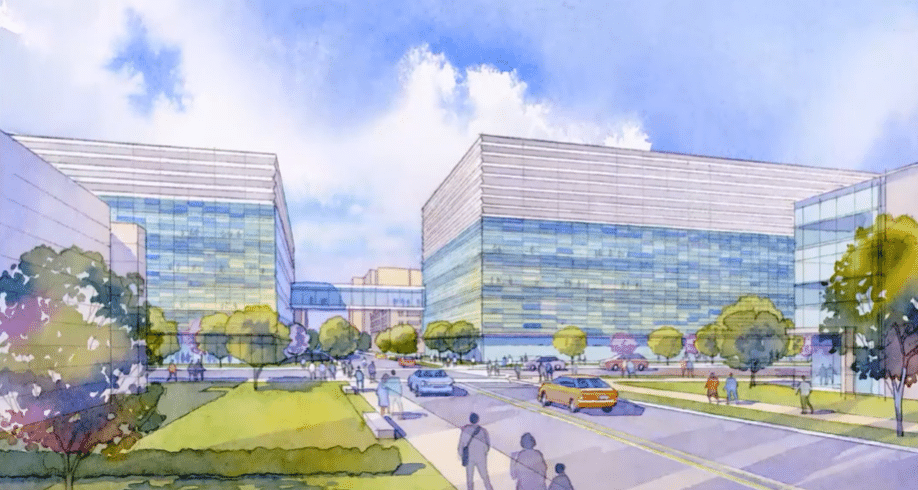
At the Cleveland City Planning Commission’s Feb. 17 meeting, the Cleveland Clinic presented plans to build two glassy new research buildings on the northwest and northeast corners of E. 100th St. and Cedar Ave. Commission members challenged the nonprofit hospital to consider how community members will be able to engage with the buildings.
Called the “Global Center for Pathogen and Human Health Research,” the project is part of the “Innovation District,” a joint effort by JobsOhio and the city’s universities and medical institutions to create jobs in research, education, and the health care supply chain.
The project will bring an estimated 1,000 jobs at Cleveland Clinic by 2029 and an additional 7,500 jobs in Ohio by 2034, the Clinic said in an email statement. Project representatives told the commission they want the building to interact with the community and envision people who work there walking to the nearby Meijer grocery store that is now under construction.

But commission members are concerned that the plans, which show two glassy multi-story buildings with a ribbon of green space running on Cedar Ave., don’t show enough potential for community members to access and engage with the research center. Currently, the site is home to a parking lot and loading dock and service area.
“I’m not convinced by your words concerning community engagement and how this building engages with the community,” said commission member August Fluker, an architect who lives in the Fairfax neighborhood. “You’ve done nothing, in my opinion, to demonstrate how the north side of the street interacts with the south side, which is already under development.”
Added city planning director Joyce Pan Huang pointedly: “I think if we’re inviting 1,000 more jobs through JobsOhio and this is such a critically important building, I think we can do better for the Fairfax neighborhood.”
The plan for the research center received schematic design approval from the planning commission with conditions, including being more intentional about creating spaces that engage with the community.

Plans for the research center
The Clinic’s pitch during their presentation was that the building’s landscaping, green space, and transparent windows would feel open and welcoming to the predominantly Black Fairfax community.
Dallas Felder, a design principal with architecture firm HOK, described different types of glass on the buildings’ facades creating a pixelated look that resembles an impressionist painting. The landscape would include a mix of evergreens, shade trees, and flowering plants that would “bring a little bit more friendliness and warmth,” said Jayme Schwartzberg, a landscape architect with DERU Landscape Architecture, which is working with HOK on the project.
A skywalk would connect a building with a loading deck for equipment to a building with a quantum computer, classroom space, cafe, offices, and research labs. The wet labs, or labs where researchers use chemicals rather than just computer-generated models, would have glass walls so people can see the research happening there from the outside, Felder said.
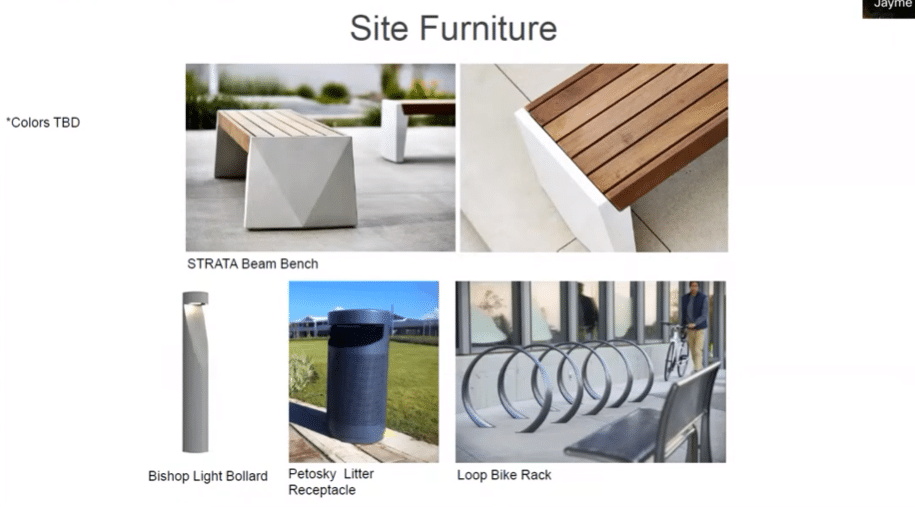
Outside the center, there would also be bike racks, low lighting, and outdoor seating, including benches next to the nearby bus stop on the corner, Schwartzberg said.
“HOK’s designed a really thoughtful building that, despite the level of security that’s required for research, is really attempting to bring some of this activity, make it very visible to the neighborhood and really engage people with the incredible work that’s going to be going on here,” she said.
Commission members’ concerns
Despite this, commission members voiced a number of concerns about the Clinic’s proposal, including how the building interacts with other Clinic buildings, its relationship to the surrounding community, and how first floor space would be programmed and used by community members.
Commission chair Lillian Kuri suggested having a retail space on the ground floor extend out from the main mass of the building to the street, and commission member Marika Shioiri-Clark expressed support for that idea.
A retail space that extends into the street to draw people into the research center makes particular sense for this project, considering innovation is the focus of the building, Kuri said.
“This is about innovation, and it’s also about making innovation more apparent and accessible to the community – that it goes on here too,” Kuri said.
While the plans for the center include bike racks, Fluker pointed out that people also use other forms of transportation, including electric bikes, scooters, and the bus. There needs to be more consideration of how community members could access the building beyond “only coming through the massive parking garages (and) taking all of the above-ground walkways so that you can avoid ever being on the street,” Shioiri-Clark said.
The Clinic said in an email statement to The Land that it is “in the earliest design phase of this project and (has) developed initial concepts” for the research center. “As we further develop the final design for these new research buildings, we will incorporate feedback from our community and city partners,” the Clinic wrote.
Travis Tyson, the Clinic’s director of planning, said during the meeting that the Clinic has worked closely with Fairfax Renaissance Development Corporation on the project.
“As it relates to the space you said the community’s gonna use, that’s great. But unless you’re intentional, unless it’s programmed, unless you communicate it, it’s just another space,” Fluker said, “because there’s a lot of healing that has to happen between the Fairfax community and the Clinic.”
Relationship between the Clinic and the community, and what’s next
The Fairfax neighborhood has a rich history. Restaurants, barber shops, and entertainment spots, many of which were Black-owned, once lined Cedar Ave., where the Clinic wants to build the research center. As just one example, Pla-Mor Roller Rink’s original location was on Cedar Avenue at E. 107th Street. The rink was once the only Black-owned skating rink in Cleveland, according to Cleveland Historical, and until 1964, it was the only rink that allowed Black skaters.
The street was also home to United Recreation, the first Black-owned bowling alley in the U.S., according to Green Book Cleveland, a project of the Center for Public History + Digital Humanities at Cleveland State University. E.F. Boyd & Son Funeral Home still stands today, near Cedar Avenue at 2165 E. 89th St. It’s the oldest Black-owned funeral home in Greater Cleveland and the oldest Black-owned business in Cuyahoga County, its website reads. (You can learn more about some of the Cedar Avenue businesses of the past by navigating the map on the Green Book Cleveland website or typing “Cedar Avenue” into the search bar.)
“There’s just a rich history of businesspeople, entrepreneurs who created this fabulous and fantastic street – we had restaurants and cafes and hair salons,” Fluker said in an interview with The Land. “You need to appreciate the history to understand where you’re taking the street or where it’s not going.”
During the planning commission meeting, city planning director Huang described Cedar Avenue as “a critically important street to the history of our city and our neighborhood.” The plans for the research center buildings don’t show enough connection to the neighborhood-scale buildings on the south side of the street, she said, reiterating the idea of having the building “step down towards the street more.”
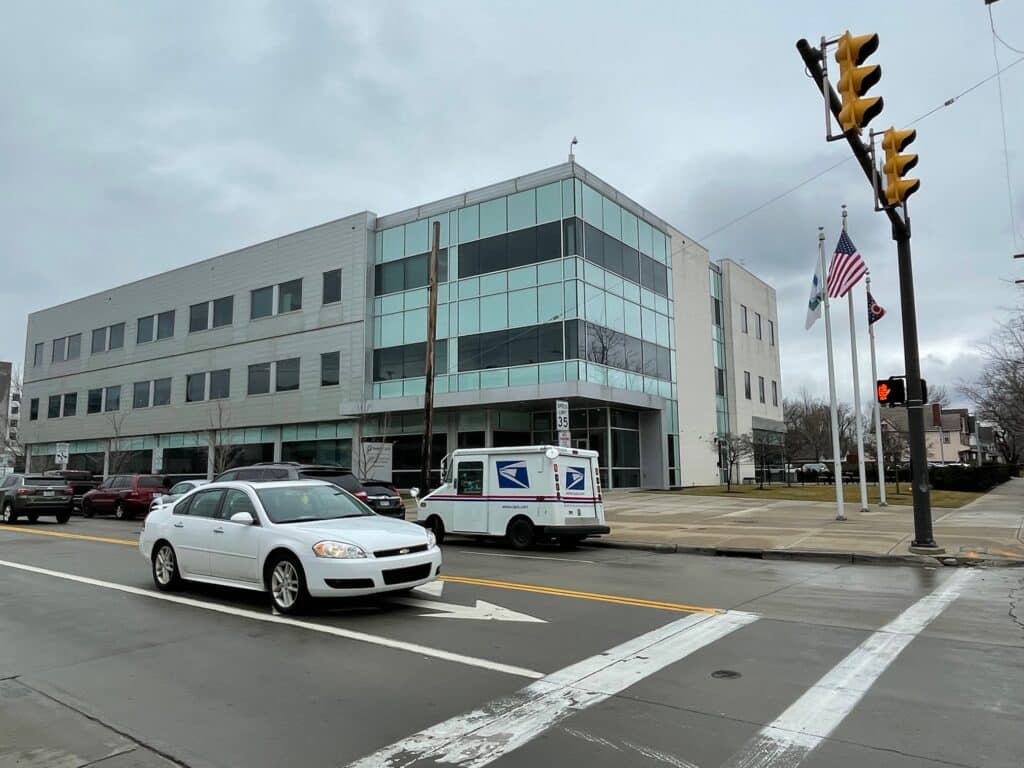
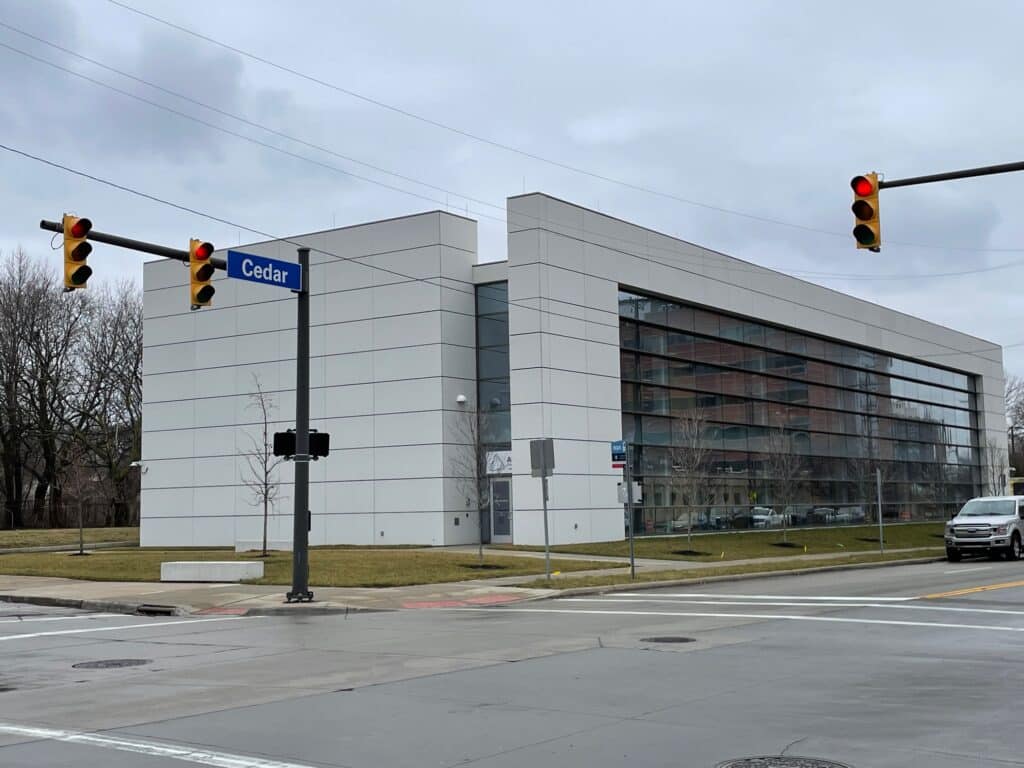
In an interview with The Land, Fluker said he would like to see a study on how all the Clinic’s buildings “relate to one another.” The Clinic has another research building, the Global Cardiovascular Innovations Center, across the street from the proposed new research center.
“I think you have to ask yourself, ‘Are you designing a building that’s good for the inhabitants (of the neighborhood), right?’” he said. “Because if in fact, your desire is to just continue the connection to your facilities through pedestrian walkways above, it’s going to continue to be insular, which this project suggests.”
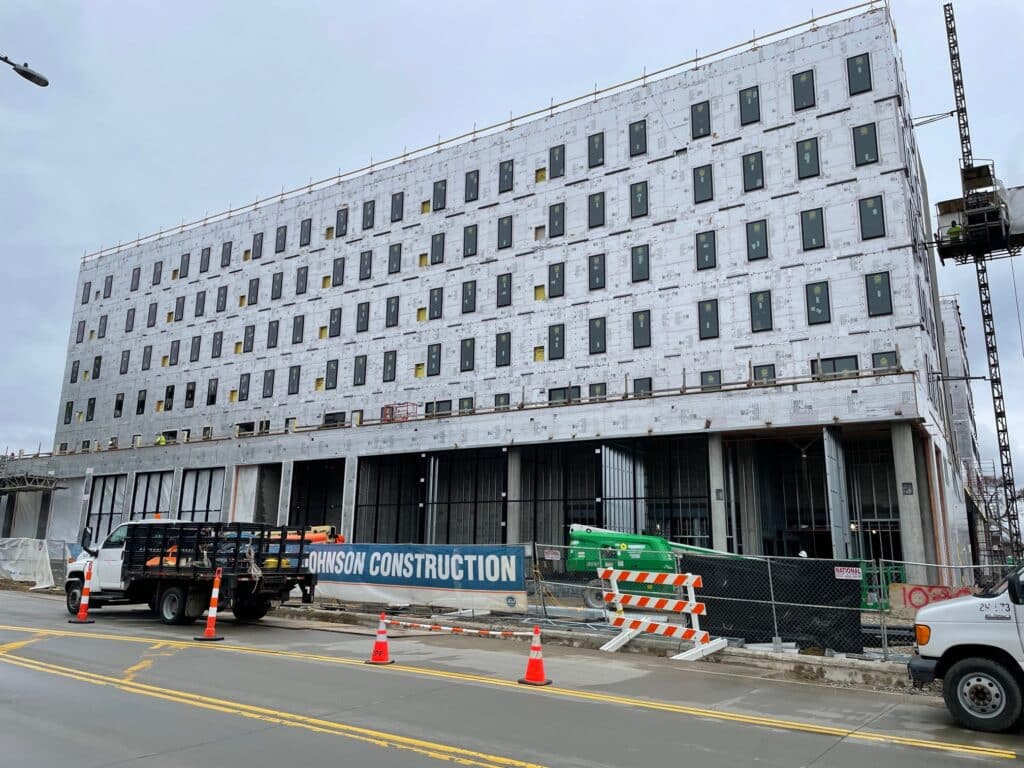
The Clinic is also helping build a Meijer grocery store and apartment complex on the corner of E. 105th St. and Cedar as part of the “Innovation District.” That project broke ground in December 2021 and is expected to open later this year.
Beyond the physical connections between the Clinic’s buildings and the Fairfax neighborhood, the conversation points to a broader issue: the relationship between the hospital system and the community.
As a nonprofit hospital, the Clinic doesn’t pay taxes on much of its property. Meanwhile, the predominantly Black neighborhoods near the Clinic face health disparities, including shorter life expectancies and higher likelihood of medical conditions like asthma, diabetes, and high blood pressure. Structural racism, including redlining, a racist 1930s lending policy, has led to disparities that continue to impact Clevelanders today.
Some have argued that the Clinic and other hospitals that receive the property tax breaks have not done enough to benefit the people who live near the hospitals’ campuses.
One aspect of the health disparities comes from the stress that people go through when their neighborhoods are not designed for them, including new buildings being constructed, Fluker said.
At the planning commission meeting, Kuri told the Clinic’s team that there’s still time for the Clinic to take the feedback from the commission and planning director to make the research center more welcoming and engaging for the Fairfax community.
It’s up to the Clinic’s team to decide when to return for the next phase of review after incorporating the commission’s feedback — it could be two weeks or several months, Fluker said. The project will have to go through the design review committee again before it gets to the planning commission.
You can watch the recording of the Feb. 17 planning commission meeting here. The research center presentation starts around 1:23:30. To send questions, comments, and feedback to the Cleveland City Planning Commission, email cityplanning@clevelandohio.gov or call 216-664-2210. Read more about the Cleveland nonprofit hospitals’ property tax breaks, health disparities in the nearby communities, and community benefit in this June 2022 three-part series with Ideastream Public Media.
Keep our local journalism accessible to all
Reader support is crucial as we continue to shed light on underreported neighborhoods in Cleveland. Will you become a monthly member to help us continue to produce news by, for, and with the community?
P.S. Did you like this story? Take our reader survey!