“Step right up, take a look inside,” 31-year-old Kevin Ballou shouts to a crowd of passersby. “I promise you’ll be free to go.”
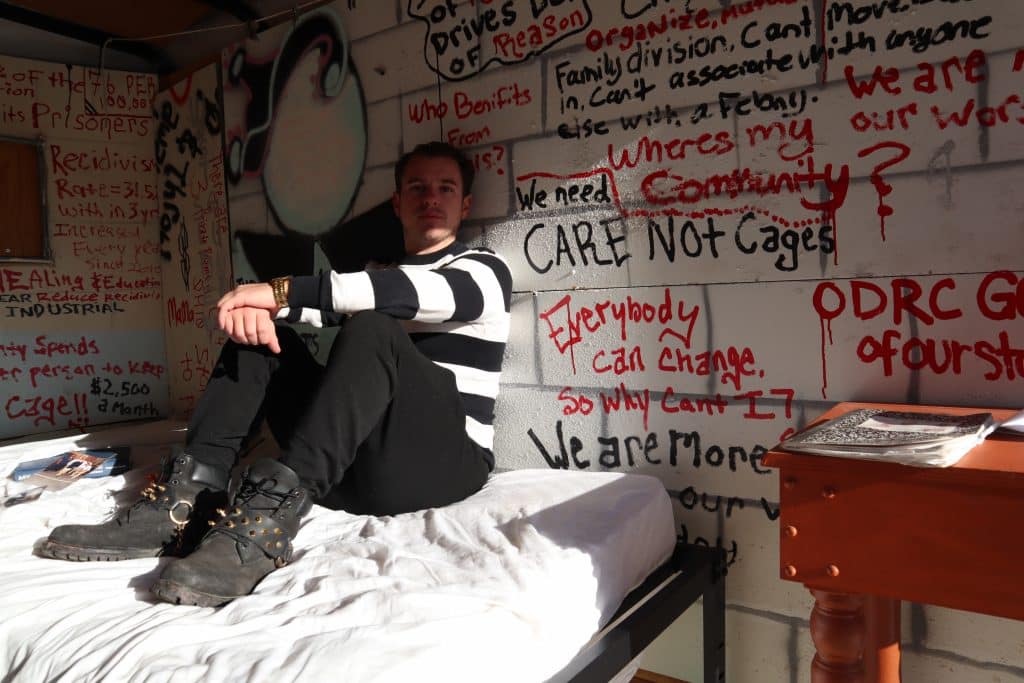
Ballou isn’t the ringleader of a circus, tempting curious minds to peer through the curtains of a funhouse. In fact, it’s quite the opposite. He’s challenging them to enter the “Celly Port,” a mobile art installation that gives an honest look into the facts and living conditions of Ohio’s prison system.
The walls inside are lined with glossy snapshots of Ballou throughout his time in the system – over six years before he reached the age of 23. The photos show him standing in prison-issued sweats and a white shirt, the same as the men next to him. He holds his chin high, his face painted with the forced expression of a boy contorting himself into manhood. He has no other choice.

Red paint drips down the walls of the installation, outlining statistics like Ohio taxpayers’ $1.5 billion-per-year funding for the prison industrial complex, as reported by Healthline Policy Institute of Ohio. Next to the facts are inquiries that reveal the inner monologue of a mind behind bars: “What am I supposed to do? Where am I supposed to go?”
The installation boasts one bed, a toilet and just enough space for another inmate to sleep on the floor – a phenomena that Ballou said was commonplace especially in the cells of overcrowded county jails.
The goal, he said, is that a viewer leaves with a different perspective.
He thinks of his friends and fellow artists in incarceration, still caged inside of this reality. They aren’t free to go – but he is. So he fights against the deficiencies of the prison system alongside the Returning Artist Guild (RAG) through his art, through organizing and through helping to foster the community of artists both free and actively imprisoned.
What is RAG?
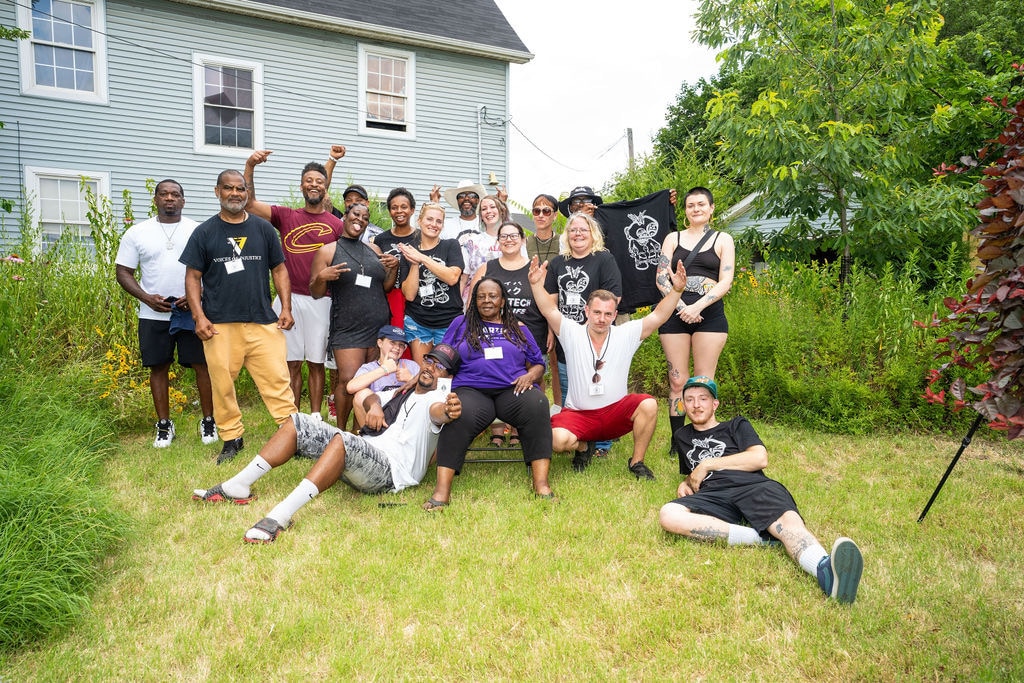
The Returning Artist Guild, or RAG, is a nonprofit abolitionist guild of creatives both currently and formerly affected by the prison system. Their mission is to play a fundamental role in the battle to end mass incarceration through artwork, mutual aid and community. It was founded in Columbus and is growing a presence here in Cleveland.
Ballou is just one of the Returning Artist Guild’s approximately 40 total members, all impacted by the prison system, who have found a means of support within the RAG.
The Returning Artist Guild was co-founded in 2018 by formerly-incarcerated creatives Kamisha Thomas and Aimee Wissman. The collaboration began within the walls of Dayton Correctional, a women’s maximum-security prison, where they led an art-therapy group and participated in a short-film project.
After their respective releases, Wissman said they worked individually as artists before realizing they missed being part of a creative community.
“Reentry is incredibly challenging,” Wissman said. “Having the community support of people that we were inside with was important to us and important to them as well.”
The decision to establish the group also came from a necessity to make a place in the art world for systematically-impacted individuals.
“There’s not a lot of calls for art or spaces that are particularly interested in the work of currently or formerly incarcerated people,” she said. “So it kind of just seemed obvious that we should be doing our own thing.”
Thomas and Wissman said they could have benefitted from having a role-model like themselves to help navigate life through incarceration and reentry. Now, they try to do that for a large group of individuals impacted by the carceral system, with the previously, formerly and even wrongfully-imprisoned population.
“It’s a diverse group, and mass incarceration affects so many people. There’s hardly anybody that’s not affected,” Thomas said. “And there’s strength in numbers, right?”
Thomas and Wissman agree that the RAG has blossomed far beyond what they could have imagined; an idea that began in a facility that obscures the vision of what the fruits of their labor could one day bear.
“Aimee and I spent a lot of time sitting on a bench in prison, imagining what life would be like after incarceration,” Thomas said. “None of this matches.”
Since its conception, RAG has tripled the number of artists it started with and now has 40 members across Ohio. The original vision was one seen through a smudged window that grew clearer as Thomas and Wisemann put their feet to the pavement beyond the confines of a cell.
“To have a community of artists matches [our vision], but it’s above and beyond what we ever expected,” Thomas said. “We couldn’t really fully see the vision that we wanted to have until we got out there and started doing the work.”
Representation and visibility are two of the main focuses of The Returning Artist Guild. Wissman and Thomas said incarceration is the kind of thing that isn’t talked about, or that people are ashamed of – but it’s not just something that goes away. Now, Wissman said, people are really starting to pay attention.
“You’ve got to see better, to know better, to be able to dream better,” Wissman said. “You can’t ignore social problems into non-existence.”
The RAG could be considered necessary for a city with a disproportionate rate of incarcerated people compared to state population statistics. While Clevelanders make up 10% of Ohio’s population, Cleveland.com reported that 14% of all the state’s inmates are from Greater Cleveland. Last year, Cuyahoga County Jail had more full beds than any other county, housing 15% of all inmates in Ohio.
According to The Marshall Project, nearly 2,000 released incarcerated people return to Cleveland every year, and countless more residents feel the ripple effects of the prison system, both directly and through the experiences of someone close to them.
Rehabilitation through art
Cleveland native Ballou had his first run-in with the law at just 12 years old, when he spraypainted a wall and landed on probation.
“The juvenile system is terrible. Children are going through this emotional trauma of being taken away from their family, and they don’t have the proper emotional intelligence to deal with this, they’re still growing,” Ballou said. “So all you do is fight.”
It’s a system, he said, that deepens instability instead of facing it, leaving kids without constructive activities or opportunities to develop healthy coping skills.
In 2024, the Division of Youth Services in Ohio reported that 40% of children who make their way out of the system will either return to DYS custody or be introduced to the adult system after release. Ballou was one of them: a child caught up in an institution that is consistently proven to fail to set children up for a fruitful life outside of its confines.
“Part of me had that ‘fuck it’ mentality, like this is the life I guess I have to live,” Ballou said. “Like okay, they’re labeling me now. They’re labeling me as a delinquent or a degenerate, at least that’s how it felt.”
This is when art first became a lifeline for Ballou. While imprisoned in Marion Correctional Institution he became involved in the improvisational theater program. It gave him a rare sense of freedom, connection and a sense of self.
“That was my escape from prison, every week I’d look forward to improv,” Ballou said. “I didn’t have any problems because, well, I was funny and people liked that. And I was helping cultivate this new culture of giving people creative outlets.
It’s been eight years since Ballou came home, and seven since he first heard about The Returning Artist Guild. He immediately knew it was an organization that aligned with his goals as an artist and an activist, and his desire to be part of a collective, working together to create something greater than he could construct alone.
“When I first meant Aimee (Wissman), it was obvious this was something that I was supposed to be a part of,” Ballou said. “Everything I’ve done artistically since then has been a representation of RAG, including the Celly Port.”
The choice to join RAG is one that has become more than a foundational part of his artistic endeavors; it’s a place where he’s found emotional and mental grounding in his life outside of a cell.
“The Returning Artist’s Guild for me is a family, and it’s also an opportunity,” he said. “There’s core members gathered throughout the state, and these are people that I love and that love me. People that I can depend on.
How RAG helps
The Returning Artist Guild confronts these social problems by offering support to its members in different ways. They provide art supplies and funding to incarcerated individuals, and write letters of support for those facing trial. The RAG also helps members find housing and provide emergency financial support, from dental care to a flat tire.
“It’s important to us because we view these people as whole human beings who cannot function properly if their needs are not being met,” Wissman said. “If they have no needs, and it’s met, then they can show up as their full selves and contribute to a beautiful future that we want to see.”
Individuals within the criminal justice system primarily form connections with the RAG through word of mouth, but it is also listed as a resource on reLink, an Ohio-based platform that connects people leaving incarceration with essential community resources.
“We’ve welcomed a few people home,” Thomas said. “Like, literally out the gate into the guild and that feels pretty good. I want more of that.”
Besides supporting projects like Ballou’s “Celly Port,” RAG has helped produce plays about wrongfully-incarcerated people and hosted galleries of work by both formerly and actively-incarcerated artists.
Todd Sodders, 58, is one of The Returning Artist Guild’s actively-incarcerated creatives. His day begins with a trek down to the gym, where his airbrush painting supplies are locked away overnight. Airbrushing is his newest artistic pursuit. Each morning, he signs out the tools he needs and makes his way to his small sanctuary.
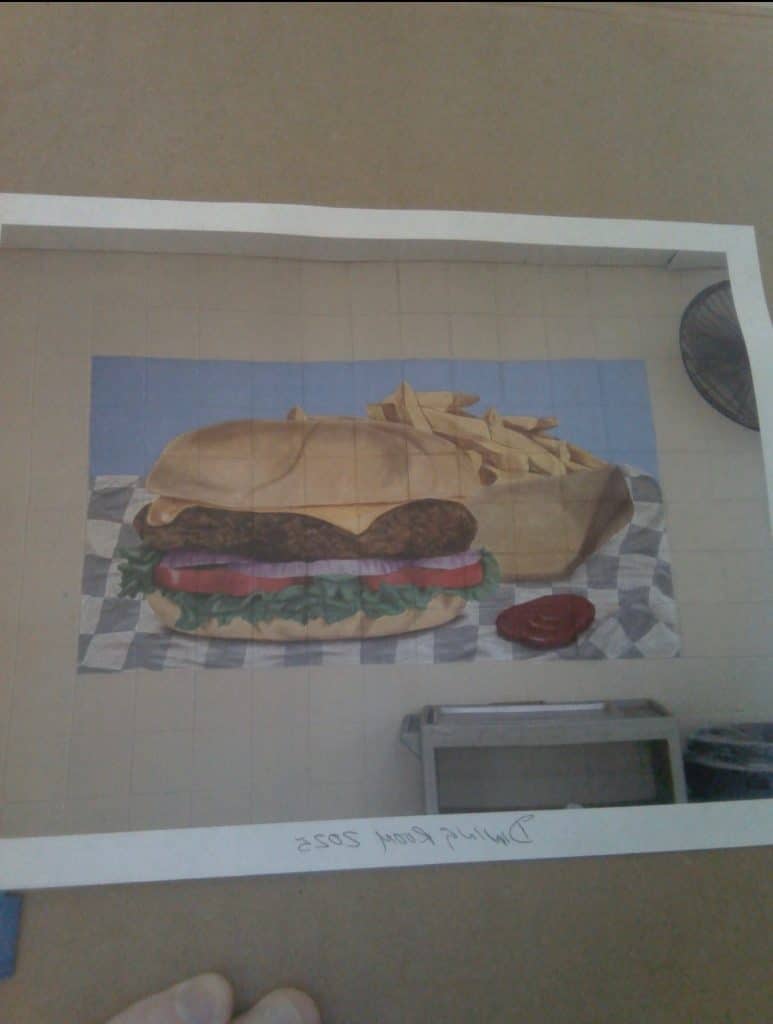
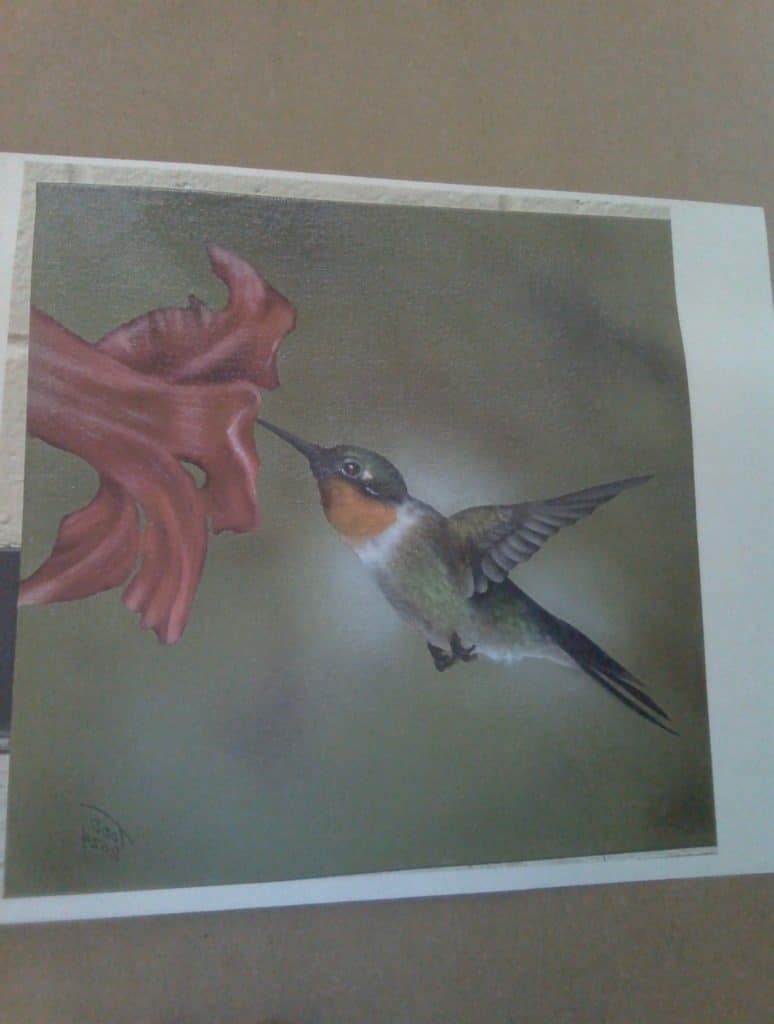
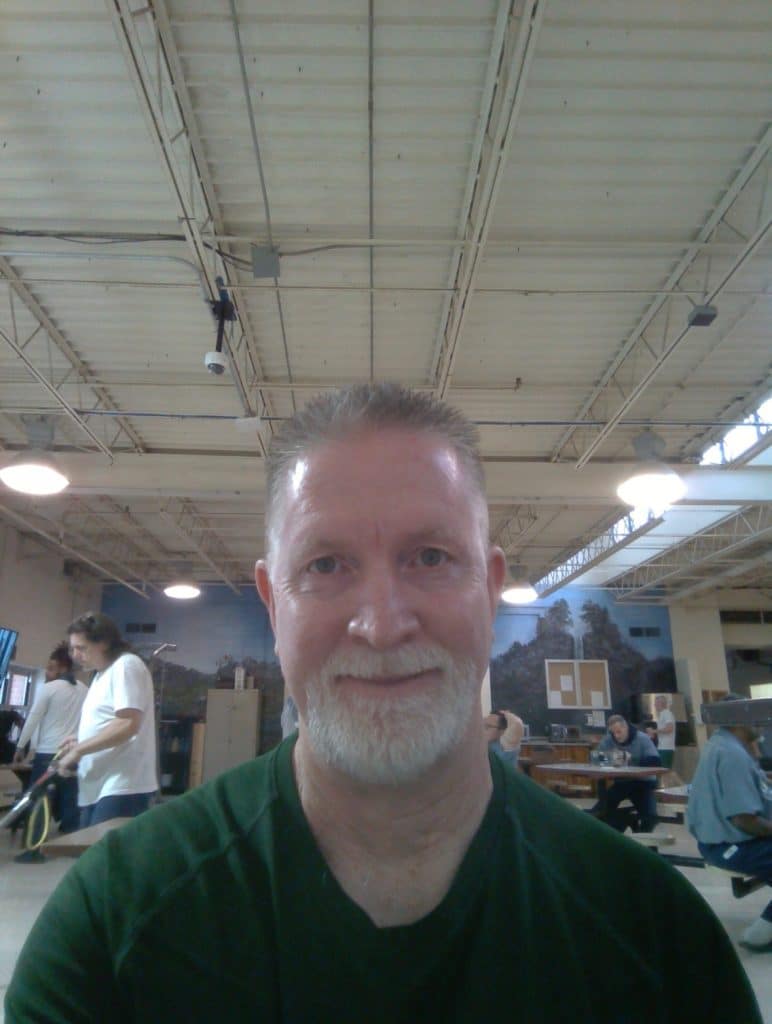
[Above photos courtesy of Todd Sodders.]
From morning to night, Sodders paints in a corner of the day room at Madison Correctional Institution in London, Ohio. His workspace is modest – a desk and a table, a few canvases and easels, and a handful of supplies RAG helped fund tucked neatly in a small cabinet.
As his day winds down, the light shifts. Outside a small window, the sun slips out of view. Sodders said the skies over Madison can be beautiful. A last wash of gold fades from the concrete walls, giving way to the stark white glow of overhead lights. It’s time for Sodders and his supplies to return to their confines for the night.
He is 39 years into a life sentence that began at 19 years old, after being convicted of aggravated murder, aggravated robbery, attempted rape and kidnapping.
“I committed this horrible act for which I wish I could take back,” Sodders said. “You know, obviously I can’t.”
The weight of that night still sits heavy on his chest.
“It was a terrible night. I still struggle that I would be capable of doing something like that,” Sodders said. “I still don’t have all the answers, I suffered from severe blackouts.”
His conviction came within a year of being discharged from the military at 18 for drug and alcohol use, an addiction that followed him from high school. He dropped out of school at 17 and enlisted in an attempt to run from the chaos he felt was closing in around him. After coming home, he fell back into the same patterns he tried to outrun.
“I came home after being discharged and I didn’t really fit in. I struggled to find a job,” Sodders said. “I fell right back in with the same group of friends that were using and abusing and it just went downhill from there.”
With time, he’s been able to see his past more clearly, and to recognize the future that lies in front of him.
“Looking back, I can recognize now that I had a lot of potential for greatness,” Sodders said. “I still do. I’m realizing it now, just because I’m incarcerated doesn’t mean I can’t live up to my full potential.”
For Sodders, art has been more than a form of self-expression. It’s a reprieve from the noise of prison life, with each piece proving that he can choose differently, create differently, and become more than the person he once was. Today, his murals can be seen covering the walls of the facility, brightening up spaces that once felt “depressing and demoralizing.”
“Starting in the county jail, all I had was some paper and a number two pencil, and my drawings were horrible,” Sodders said. “But I kept putting in the effort. If I don’t give up and quit, I won’t be a failure, no matter what the result.”
This persistence became the foundation for everything that has followed, both in Sodders’ growth as an artist and as the person he has spent these 39 years trying to become.
As his skills developed, so did his understanding of himself.
“As I saw a drawing coming together I began to see the positive aspect of my art instead of the negative,” he said. “From that moment on, literally, my life got exponentially better. In that moment, it was like a freeing of myself. I could be me. I could focus on the positive things that I could do and not rue or regret the things I can’t do.”
This shift in perspective reshaped not only how he saw himself, but how he saw the possibility of change for others all across the justice system.
In 1999, he founded the LOCI Fine Arts Association at London Correctional Institution. It grew to more than 325 members, over 10% of the 2,500-person population at the facility. The program offered drawing, painting, woodworking and model building and jewelry making among other art forms. They even became “wish-granters” for Make-A-Wish foundation, consistently making donations of over $5,000. The program ended after a change in administration.
“We made a mistake, we’re not defined by that mistake,” Sodders said. “We can learn and evolve and change and become productive members of society, upstanding people who found themselves in a different way.”
Since first connecting with the Returning Artist Guild, they’ve helped him purchase supplies and display his art publicly. If Sodders were ever granted release, RAG would help reduce some barriers to reentry. He would also have access to the communal space of artists with similar lived experience – a familiarity that Sodders said is crucial.
“Everyboy there has that commonality of incarceration, of being impacted by the justice system,” Sodders said. “Everybody knows who you are, where you come from and what you’ve been through. You have that familiarity, and can be truly accepted.”
His paintings now hang on the walls of the Columbus Metropolitan Library, displayed alongside works by other members of the Returning Artist Guild. The gallery, “Imagining Abolition: Blood, Sweat and Tears,” ran through Jan. 30 and is the second time RAG has helped Sodders share his art with the public.
When his work meets a viewer’s eye, Sodders is recognized, if only for a moment, as the artist he is, rather than the worst choice of his life.
“I know that I’ll forever be viewed for what I did. I know that’s something I’ll have to live with forever,” he said. “But it’s nice when, just for a few seconds, you can breathe, noticing that you’re making a real, personal connection with someone. That you’re seen as someone with value and worth, contributing in a positive way.”
Becoming a 501(c)(3)
This past summer, the RAG received 501(c)(3) status in Cleveland, marking their official presence as a nonprofit within the city. It’s a journey that’s focused on the long game, taking one step at a time to start a sustainable influence. The most recent step in this process has been finding a local space for artists to create and gather.
“A permanent home is critical,” Wissman said. “Just for our own gallery, for our own ongoing programs and as a way to consistently offer access to us, to the RAG and our resources.”
She noted that Cleveland is one of the most prominent artistic areas in Cleveland and beyond. Cuyahoga Arts & Culture (a supporter of The Land) reported that in 2023, Cleveland-Elyria was ranked 12th of communities across the country most brimming with support for the arts.
“Cleveland is more of the robustly-funded arts cities in Ohio, it’s a way better situation than Columbus,” Wissman said. “The plan was to prove that this (the RAG) is a good thing, the best thing, and to replicate that (in Cleveland).”
The decision to expand into Cleveland isn’t just about the access to funding, but also based on the large population of directly-impacted artists that exist throughout the city.
“Cleveland has a huge community full of incarcerated people,” she said. “There’s an overlap between formerly incarcerated people and really dope arts funding and spaces.”
These elements allow The Returning Artist Guild to connect Cleveland members with resources across the city, while providing members with the freedom to pursue their own creative mission.
“I think we want Cleveland to do what Cleveland wants to do,” Wissman said. “We can be there as an ally to help them secure funding or space, or push them as a group to accomplish what they want to accomplish.”
Back at the lot on Hamilton Avenue in Cleveland’s warehouse district, Ballou sits on the thin mattress of the Celly Port, wiry springs digging into his legs, as an alert from his phone cuts through the air. He puts it on speaker and a robotic voice says, “This call is from a correctional facility and is subject to monitoring and recording.” It’s from an incarcerated artist and friend, and a call he said he always answers.
Core members like Ballou have been given a stewardship role in the organization’s expansion, helping to guide fellow artists and activists into the next chapter. He said this role is all part of a bigger goal, one that started to unfold back in the prison improv program.
“When I was locked up, I tapped into my love of performance art,” Ballou said. “If there can be more of that, more artistic outlets for people in prison or kids who are going down the wrong path, then maybe we wouldn’t have such a huge system of mass incarceration.”
To find more information about the Returning Artist Guild, visit their website. It includes a membership application portal and provides up-to-date information about the network taking shape across Ohio.
Keep our local journalism accessible to all
Reader support is crucial as we continue to shed light on underreported neighborhoods in Cleveland. Will you become a monthly member to help us continue to produce news by, for, and with the community?
P.S. Did you like this story? Take our reader survey!