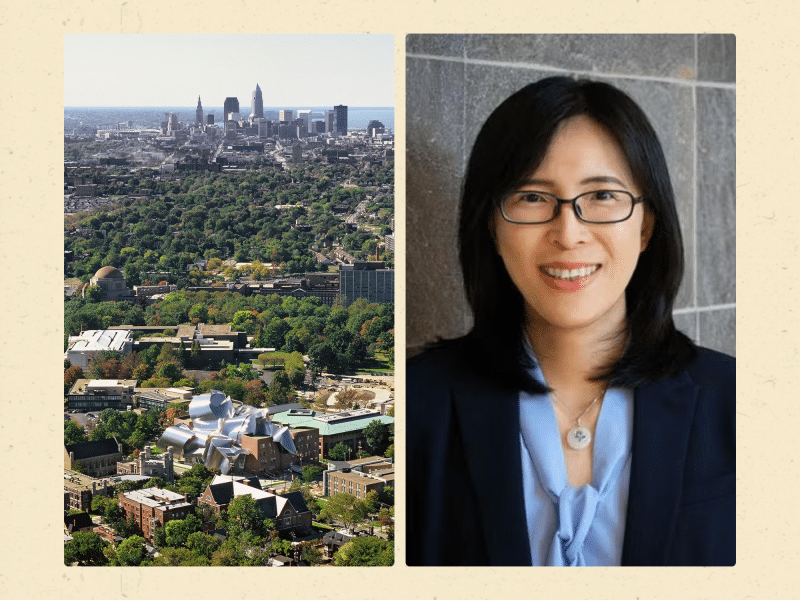
Robin Brown’s mission to put an end to lead poisoning in children is a never-ending journey.
In 1999, Brown became an advocate for raising lead poisoning awareness within Greater Cleveland after her 4-year-old daughter got lead poisoning from their home. It started when Brown received an alarming call from her family physician after he performed a routine test of her daughter.
“I was informed that my daughter had a high lead level of 70mg per deciliter,” Brown recalled. “The doctor told me to get her to the hospital, don’t stop, forget about life, just get her to the hospital immediately, and she is going to be admitted.”

For context, The Centers for Disease Control has found there is no safe level of lead in a child’s blood, and just 5 micrograms per deciliter have been associated with lower IQ levels and challenges in school. The lifelong effects of lead poisoning can affect a person’s development, and there is no cure.
Although Brown’s child suffered with the impacts for a long time, she was treated to alleviate some of the symptoms and discomfort and recovered as well as possible. They later moved from the home that caused lead poisoning for Brown’s daughter, but, she said, that home still stands. She also knows her daughter represents the fourth generation of her family that has experienced lead poisoning.
Brown became deeply impassioned about the lead poisoning and founded an organization to do everything possible to bring awareness to the devastating impacts lead in the environment can have on children and adults.
In 2005, to enhance and enlarge her efforts to increase awareness and teach people about possible management solutions, Brown and her daughter founded Collective Citizens Organized Against Lead (CCOAL). They wanted to serve as an educational and empowerment resource to instruct citizens how to advocate for addressing lead poisoning and other health hazards in homes and neighborhoods and help families of lead poisoned children.
“Robin truly loves the community and cares about the people’s health,” said Diana King, long-time CCOAL member and board chair. “She wants to ensure that everybody knows the dangers of lead poisoning and what it can do to their bodies, their families and the community as a whole, so she wants to eradicate childhood lead poisoning and any lead poisoning.”
Cleveland’s lead problem
Regarding the lead poisoning epidemic Brown was fighting, the Frances Payne Bolton School of Nursing at Case Western Reserve University reports that Cleveland has one of the highest percentages of children with elevated lead levels in the United States.
In fact, Cleveland has higher lead levels than Flint, Mich., whose own lead problem sparked national coverage and outrage. Flint reported that seven to 10 percent of their children had elevated lead levels, while Cleveland has an average of 12 to 13 percent of children with elevated lead levels, with some neighborhoods seeing rates as high as 25 percent.
Additionally, Ohio ranks as one of the top states in the country for lead service lines with an estimated 745,000 lead water service pipes, according to EPA estimates. Drinking water can represent up to 20% or more of a person’s exposure to lead. Chronic exposure to lead contributes to chronic health issues in both children and adults.
Brown advises having children ages 0 to 6 tested for lead in their blood and preferably up to age 18 and beyond to be safe. She recommends that individuals do their own research, too, citing the Ohio EPA, Ohio Department of Health and Consumer Reports as credible resources about lead poisoning.
Gaining expertise in lead poisoning issues
At the time of the incident with her daughter, Brown was completely unaware of how bad the situation was in her city. But she learned quickly. When the hospital required her to have her home professionally inspected for lead before they would allow her daughter to return, she received a crash course about the problem of lead poisoning in houses from the inspector.
Brown knew she needed more extensive knowledge to serve as a community advocate and educator. She completed the training required of contractors and earned her certificates for lead safety and risk assessment through The Dell Group in Cleveland, which provides consulting and training in occupational health, safety and environmental compliance. She also became a certified Community Health Worker (CHW) through A Vision of Change, a nonprofit founded in Cleveland 23 years ago to provide academic empowerment.
Brown later partnered with A Vision of Change so that CCOAL could provide individuals seeking CHW certification for employment volunteer hours by working with her and other community members in helping teach people about lead poisoning. The volunteer hours are a certification requirement.
Establishing a national platform
In August, Brown spoke at the National Healthy Homes Lead Conference in Kansas City, Missouri. She discussed how the changes in federal government funding affected CCOAL as an organization.
“That was our fourth presentation at that national NHHL conference, which has given us an opportunity to be classified as a national presenter organization,” Brown said. “We’ve done so well that people have been asking whether we were going to be there, so every time we wanted to present, they gave us an opportunity.”
Christopher Maurer, principal architect, redhouse studio architecture, Cleveland, has worked closely with Brown for several years, and is inspired by her tireless commitment to environmental justice. This past year, Brown participated in the 9413 Sophia Avenue effort with Maurer – that was a Transformative Arts Fund project to convert a condemned house in the Buckeye-Woodhill neighborhood into environmentally safe construction materials.
Under the guidance of Maurer and lead artist Malena Grigoli, the project implemented the “choreographed deconstruction” of a condemned property owned by the Cleveland Land Bank to study the lifecycling of a built structure. The project employed a “biocycling” process developed by Maurer that incorporates mycelium, a fungi from mushrooms, to recycle demolition waste and create environmentally sustainable construction blocks.
The component of interest to Brown was the removal from old building materials or the soil that may contain lead and the creation of a new, lead-free building material.
“Robin’s looking at cutting-edge, futuristic technologies now that are only being funded by NASA and MIT, as well as the tried and true technologies available to us today,” said Maurer, who presented with her at last August’s NHHL conference in Savannah, Georgia, and the two have done virtual presentations all over the country together. “She’s thinking more long-term in this research category than a lot of other folks are, so that’s why we’re enjoying teaming up with her.”
After 23 years of working to raise awareness about lead poisoning and promote abatement, Brown is deeply frustrated that it still exists as a significant problem. While Cleveland Mayor Justin Bibb announced his plan for accelerating abatement and preventing lead poisoning in children in February 2024, Brown believes there’s more to be done. All of which has made her more open to considering futuristic approaches to gradually replace current attempts to combat lead poisoning.
“We’re in a whole new time right now and we need to start thinking about value for our youth, future generations; they don’t want this old, hazardous material anywhere in their sight because everything in the home is pretty much hazardous,” Brown said. “The new work such as what’s happening at 9413 Sophia Ave. could put Cleveland on the map globally, but we also can start investing in these homes because you’re never going to get rid of lead unless you abate.”
An important new initiative for CCOAL
Brown and CCOAL have received a grant from AGU Thriving Earth Exchange that will enable them to get churches engaged in the environmental justice platform in Cleveland to leverage their reach and influence on their communities. The organization represents a global community supporting more than half a million advocates and professionals in the earth and space sciences.
The objective of the project is to educate 10 churches about lead and enlist volunteers to do soil sampling around Cleveland, obtain the results, and look to remediate the soil. In a sample testing effort in which CCOAL partnered with Laurel School and worked with students, they tested soil on various properties throughout the city and then applied soil remediation techniques. The project reduced lead in the sample soil by 90.3%, according to Brown.
To incentivize property owners to allow the soil testing, CCOAL’s team will be giving $25 gift certificates to 30 people who allow soil testing.
“Once we get the soil, we will give them the $25, and that is a contribution from our partner at Case Western Reserve University,” Brown explained, adding that their team includes Brian Biroscak, Ph.D., an assistant professor from CWRU’s School of Medicine’s Center for Community Health Integration. “Then we’re going to take the top five out of 30 samples and utilize those five to start remediating the lead out of the soil.”
Thriving Earth Exchange has already published an article about the model research and remediation project: “Co-Creating an Approach for Community Organizations to Test and Remediate Neighbor’s Soil for Lead Contamination.”
“I’ve been working in public health research for about 25 years, and what stands out for me is not just how genuine Robin is and her story of having four generations of her family poisoned by lead,” Biroscak said. “I’m impressed by how much she loves learning so she can advocate about this subject.”
Biroscak was so impressed with Brown’s unflagging commitment to learning about lead poisoning and how to mitigate it that he named her a principal investigator on a lead research proposal that they did not receive. Currently, they are pursuing a grant for a National Institutes of Health research study that would combine system science research that his center does with community-engaged research that Brown and Maurer do.
“We need to use these materials that are recyclable that could be used in the future, so let’s do something that’s futuristic and will stand and be good for the environment, the climate and will be what the next generations want to have,” Brown said. “Why not start it now and stop wasting money?”
Exhibit at Cleveland Public Library – Rice branch
On October 3rd, the Harvey Rice branch of the library opened an exhibit featuring the work of Brown, Maurer and Jennifer Lumpkin, principal and founder of My Grow Connect and partner with CCOAL. The exhibit highlights the importance of advocacy, environmental and agricultural justice from their standpoint. It will be on view through May 9, 2026.
Partially funded by a grant from the St. Luke’s Foundation, which is also funding the soil testing and remediation project, the “ROOTS & REMAINS: Legacy in the Land” exhibit features a mycelium-built recording booth created by Maurer so visitors can share their environmental justice stories. It was hosted in collaboration with Ideastream Public Media.
The exhibit will also host “mushROOM Mixers,” a creative workshop series celebrating the partnerships between people, plants, and fungi in restoring our communities and environment. Each session includes Reishi mocktails and teas and guided art or cultivation activities.
“Robin’s approach has been integrative with solutions, so she’s able to bring different research avenues and innovative approaches to her membership,” Lumpkin said. “It’s not just how to advocate in the public health setting, but it’s also advocating with a global perspective, and it expands their lens of advocacy and the importance of the work they’re doing.”
Keep our local journalism accessible to all
Reader support is crucial as we continue to shed light on underreported neighborhoods in Cleveland. Will you become a monthly member to help us continue to produce news by, for, and with the community?
P.S. Did you like this story? Take our reader survey!