New grant funding, along with the combined efforts of partnering agencies, may allow harm-prevention solutions to make change in the neighborhood.
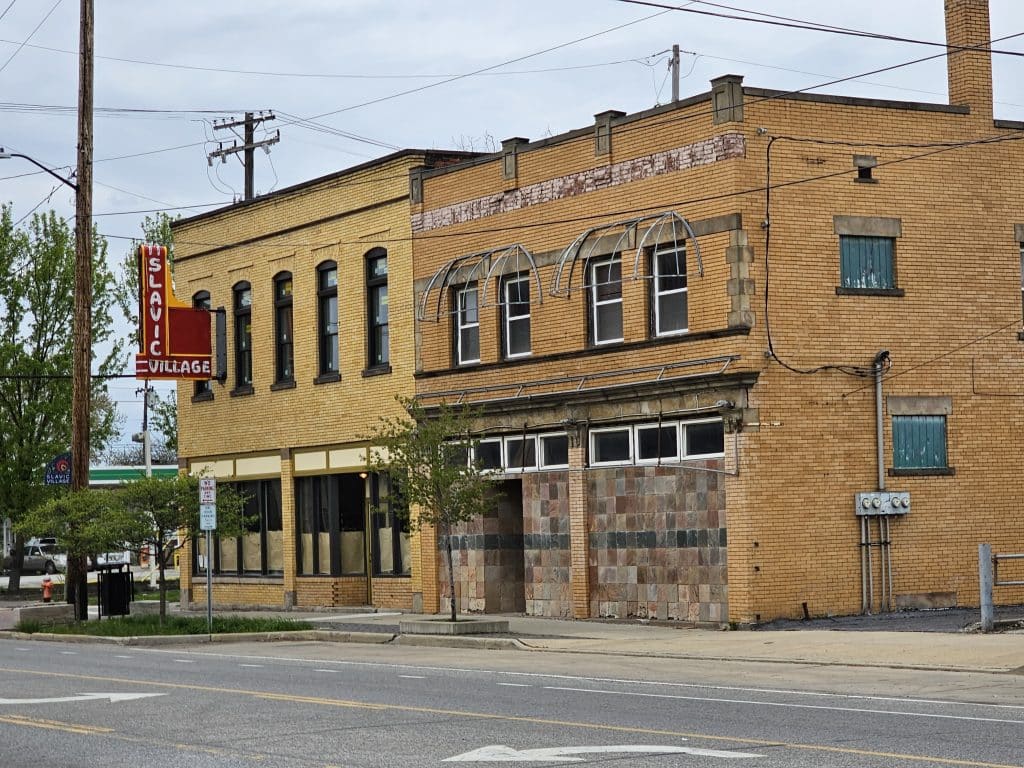
Mental health professionals and community organizers in Slavic Village are making it their mission to fight an epidemic of addiction with a Community Needs Assessment and Community Prevention Plan released in December 2023. With funds from a grant they hope to receive in September 2024, they plan to bring opportunities for outreach and recovery to Slavic Village.
The plan, written by Dr. Madelaine Matej McQueen and the Slavic Community Planning Coalition (SCPC), outlines the state of the addiction crisis in Slavic Village and offers community-based solutions to alleviate the problem, which organizers say are crucial to fighting addiction in communities.
Based on the report, and thanks to the cooperation of regional agencies, the SCPC plans to increase access to resources geared toward the treatment of mental illness and prevention of injury through harm reduction.
McQueen, who headed the research presented in the report, said curiosity about what solutions are available to those who struggle with addiction is part of what drove her to head the project.
“There are safety nets in place, but there are also lots of holes,” she said. “And different agencies in Cleveland, they’re getting better at working together, but there are a lot of siloed agencies.”
McQueen said that although there are several helpful agencies serving Cleveland, many people in need don’t know about them, and some of those aware of the resources do not qualify to receive aid from them. The knowledge of these barriers is part of what inspired McQueen to take on the research presented by the report.
Understanding the environment
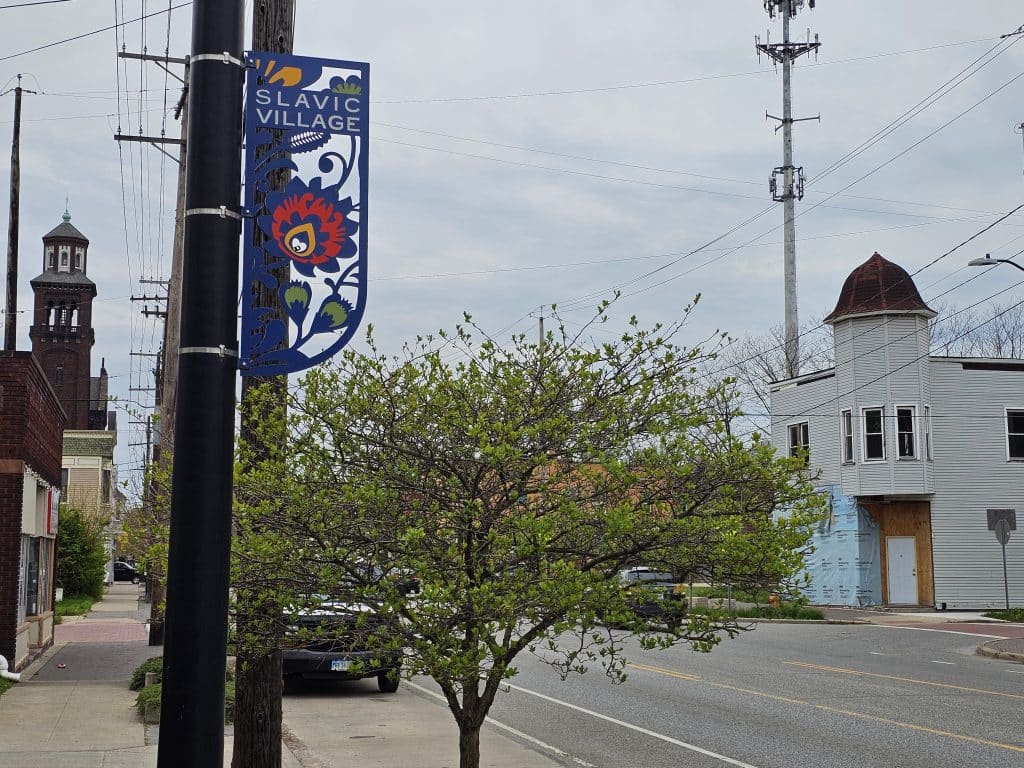
The report describes Slavic Village, a historic neighborhood on Cleveland’s Southeast side, as a “microcosm” of Cleveland as a whole, as its demographics nearly mirror those of the entire city. Where many neighborhoods have residents of primarily one race, Slavic Village is as diverse as Cleveland itself.
The report built an overview of drug use and overdoses in Slavic Village by compiling research done by the Cuyahoga County Medical Examiner’s Office, the U.S. Attorney’s Heroin and Opioid Task Force Data Subcommittee (HOTF Data Subcommittee) and Case Western Reserve University’s Begun Center for Violence Prevention and Research. By combining the data provided by researchers – as well as information collected during Slavic Village Drug Data Day, an event co-sponsored by community organizations – the SCPC was able to provide concrete statistics that highlight the reality of the drug epidemic in Slavic Village.
Their findings demonstrate that Slavic Village shows a “disproportionately high” rate of both fatal and nonfatal drug overdoses fueled by both poverty and fentanyl contamination.
Between 2014 and 2022, 300 people died of overdoses in Slavic Village. Compared to the overall population, this means 1 in 68 residents of the neighborhood have died as a result of a drug overdose. This is highly disproportionate compared to drug-related incidents in the state of Ohio as a whole.
Additionally, data showed that in Slavic Village, Black individuals make up 48.3 percent of overdose fatalities, compared with white individuals, who make up 50 percent. This is disproportionate to the statistics of overdose deaths in Cuyahoga County as a whole, of which Black residents make up 31.2 percent and white individuals make up 68 percent of overdose deaths.
Tatianna Burks, a contributor to the report and HIV prevention coordinator at University Settlement, said the Slavic Village community is “subdivided.”
She said that although there are large efforts to build connections in the neighborhood, lack of access to the internet makes it difficult for community leaders to organize. Burks said news of most community meetings are spread by word of mouth.
“When you have these individual group meetings, people are discussing issues that affect the entire community,” Burks said. “And so, until we can come together as an entire community and strategize how we’re going to ratify these issues, we’re still going to be coming with the same issues as small subgroups.”
A plan of action
In addition to research findings on the substance abuse crisis in Slavic Village, the coalition put together a prevention plan tentatively called STOP, which stands for safe spaces, treatment, outreach and prevention.
The safe space the coalition hopes to implement, modeled after Safe Bay of Duluth, Minnesota, would have meals, bathrooms, showers, wireless internet access, Community Health Workers to link people with resources on recovery and treatment, and transportation to higher levels of care.
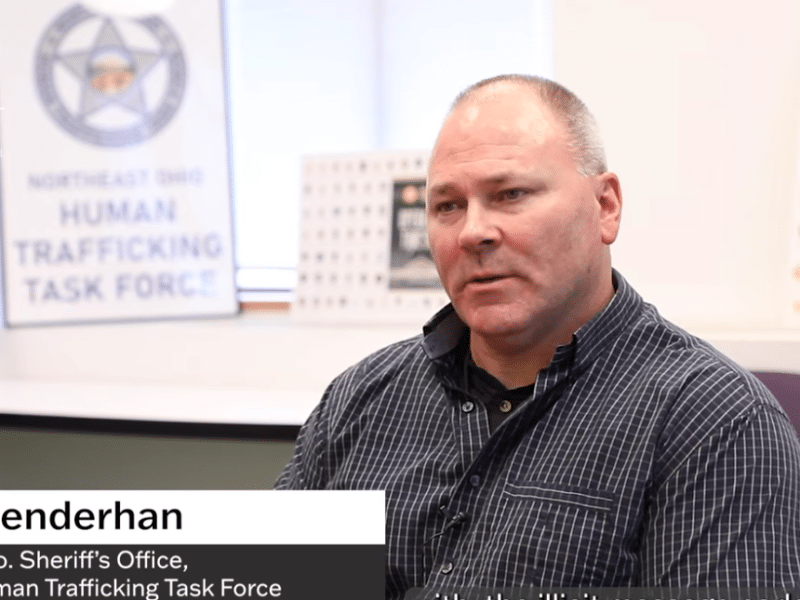
Scott Osiecki, CEO of the Alcohol, Drug Addiction and Mental Health Services (ADAMHS) Board of Cuyahoga County, said that University Settlement applied for a Substance Abuse and Mental Health Services Administration (SAMHSA) grant to implement portions of the STOP program put forward in the report.
“It will be focused on creating a safe space, outreach and recovery efforts related to the STOP plan,” Osiecki said.
The ADAMHS Board has pledged a commitment to work in conjunction with University Settlement should the grant be accepted. Osiecki said University Settlement will hear if they have received the grant in September of this year.
“We’re going to open a safe space,” McQueen said. “I really want to model it on the Cleveland Rape Crisis Drop-in Center. It has access to anything people might need, like a kitchen and a shower, and a napping place, a harm-reduction station and drug-deactivation kits.”
McQueen said they plan to place the safe space off of Fleet Avenue, which she noted is the epicenter of overdose deaths and sex-work in Slavic Village.
“Our argument to SAMHSA for why we need this space is we already have these clients, we’re already serving two-thirds of the Slavic Village community,” she said. “Every single person knows someone who uses. So, we want a space where we’re a little bit free from funding restrictions where we can deliver the mental health and drug use specific services and have those conversations for our client base and others.”
In addition to working with University Settlement, Osiecki said the ADAMHS board is partnering with the city of Cleveland to create a program called the Care Response Teams. This would offer those suffering from mental health or substance abuse disorders an alternative to calling law enforcement in times of crisis.
Osiecki said the program is currently in development and would allow those in crisis to call 988 instead of 911. From there, a behavioral health specialist and peer recovery coach would be dispatched to aid the individual, instead of a police response. This, he said, will help the individuals get the help and treatment they need.
The fentanyl crisis affects Cleveland greatly, Osiecki added – and the SCPC’s report findings support this statement.
The research done by The SCPC found that in 2022, 100 percent of cocaine and methamphetamine-related overdose deaths included fentanyl. The report suggests that this is a partial reason for the racial disparities in overdose deaths, reading; “the racial disparity continues to increase, as (crack) cocaine becomes increasingly contaminated with fentanyl.”
Osiecki, who has worked with the ADAMHS Board for thirty years, said this is just a further evolution of the opioid epidemic.
“When the opiate crisis started, it was based on prescription medication, and then it went on to people seeking out heroin to continue,” Osiecki said. “Now, it has morphed again: the opiate crisis, into fentanyl.”
He said many who perish from fentanyl-related deaths aren’t even seeking out fentanyl in the first place.
“The sellers of illicit drugs are putting fentanyl … they’re cutting cocaine with it, they’re cutting methamphetamine with it. They’re making pressed pills that will say percocet, but it’s not, it’s fentanyl,” Osiecki said. “The drug-sellers and the drug cartels are doing that. So, what it has done is create another epidemic of people who are not seeking opioids. They’re not seeking heroin, they’re not seeking fentanyl.”
ADAMHS has begun providing resources throughout Cleveland’s communities as a response to this “new epidemic,” Osiecki said.
These efforts include the distribution of fentanyl test strips, in addition to NARCAN kits, to encourage users to take preventative measures and to lower the fatality rate among those who struggle with addiction.
Ongoing conversations
The report detailed how often social stigma surrounding substance abuse disorder and mental illnesses prevents those suffering from seeking help. According to Burks, addiction is often accompanied by other barriers people face.
“Addiction is usually dual-diagnosis,” she said. “Why that is important is, if someone is experiencing, it doesn’t have to be a mental health disorder, they can be experiencing a mental health crisis, and you stack on some social barriers, it creates a perfect environment for addiction.”
She added that in many cases, drug use can provide an inexpensive escape from seemingly inescapable barriers.
“If all you have is three bucks, and you can use that three bucks to escape the $300 worth of issues that you have surrounding you, people are going to pick that solution,” Burks said. “So it’s not just an issue of ‘why are people spending all of their money on drugs?’ They don’t have enough money, or just support, to get them out of their circumstances.”
To fully address the opioid crisis, she said, one needs to address mental health and social barriers that affect those who suffer.
McQueen said that in order to address the crisis, compassion is key.
“No one who is addicted or has a substance abuse disorder is choosing to use drugs,” she said. “It’s not bringing them pleasure. They just use to stave off withdrawal, because they get deeper and deeper into the physical dependence, as well as the physical and emotional dependence.”
Withdrawal from fentanyl, which McQueen said users are often receiving against their knowledge or will, affects every body system. Symptoms of withdrawal include nausea, hypertension, increased heart-rate and other symptoms that make it hard to function.
“You can’t do anything. You can’t even get yourself to treatment,” McQueen said. “People using drugs are not having a good time. It’s not a pleasurable thing, they’re not getting high from it. They’re just, at this point, barely surviving.”
Osiecki said that substance abuse disorder is a mental illness like any other.
“What we want people to realize about mental health or addictions is that they are a biologically-based brain disorder,” he said. “Nobody goes out to take an illicit drug and says ‘I’m going to get addicted to this.’”
He compared drug abuse disorder to alcohol use disorder, saying that the body or brain’s reaction to substances does not equal a fault of character.
“There’s nothing to be ashamed of,” Osiecki said. “Whether you love someone, whether it’s you, it’s a friend or a family member as well. We want people to know that treatment is available and that treatment works and that recovery is possible.”
Keep our local journalism accessible to all
Reader support is crucial as we continue to shed light on underreported neighborhoods in Cleveland. Will you become a monthly member to help us continue to produce news by, for, and with the community?
P.S. Did you like this story? Take our reader survey!